Showing posts with label dinosaur. Show all posts

Saturday, May 6, 2023

REPLY TO A COMMENT ON 25 APRIL 2015 COLUMN "DINOSAURS IN ROCK ART - PERU'S ICA STONES":


Photograph of Ica Stone illustrating a Triceratops with back fins - a fabrication. Internet photograph, public domain.

On May 1, 2023, I receibed a new comment from Anonymous to my posting of 25 April 2015 about the Ica Stones hoax in Peru. I am sorry I cannot credit you with this query, but comments come to me Anonymously with no return address.  


Photograph of an Ica Stone showing Stegosaurus in the upper right. Internet photograph, public domain.

Anonymous has left a new comment on your post DINOSAURS IN ROCK ART - PERU'S ICA STONES: "My problem with this finding that we never existed at the same time is this, how did they know in the 1930s that this animal had fins on its back when we just found out in 2019 when we found a fossil of one? If it was a fake they would have never put fins on it, they would have gone with the excepted (accepted?) narrative of the time which said there was none." 

Well Anonymous, I thank you for your comment and the opportunity to address it. There were two so-called dinosaurs with plates or fins on their backs in the illustrations that accompanied my column, one appeared to be a Stegosaurus and the other an obvious Triceratops. Now the Triceratops never had fins on their backs so that one is an obvious fabrication (lie).

Skeleton of stegosaurus. Photograph by Susannah Maidment
 et al., Natural History Museum, London. 

As to Stegosaurus, I actually live just a few miles from where the first one was discovered by Arthur Lakes in the Morrison formation west of Denver in 1850.             


1891 drawing of stegosaurus skeleton by Othniel Charles Marsh. U.S. Geological Survey, 16th Annual Report. 

Although researchers originally thought the plates (fins) on the back lay flat like the scutes on a turtle, by 1891 Othniel Charles Marsh had published his drawing of a stegosaurus with the plates vertical. So, by 1891 we already knew the proper conformation of the stegosaurus' plates. 

I do not know where you got your date of 2019 for when the first fossil of a stegosaurus was discovered, but I submit that you have been misled. I refer you to Wikipedia for a detailed history of the knowledge of Stegosaurus skeletons, and thank you for your comment.  


Friday, April 1, 2022

FIDDLER CRABS IN THE GRAND CANYON?

For a very long time Creationist fringies have been desperately trying to prove that humans coexisted with dinosaurs. In 1980 Beierle’s book “Man, Dinosaur, and History” identified this petroglyph from a canyon wall on the Havasupai Reservation in Arizona as a dinosaur proving that people must have coexisted with dinosaurs in order to have seen one to make the picture of.


Original Fig.99, p.84, from Beierle, Man, Dinosaur and History, 1980, 
 photograph Ed Natziger.


Retouched for clarity, Fig.99, p.84, from Beierle, Man, Dinosaur and History, 1980, 
 photograph Ed Natziger.
Retouched by Peter Faris, 4/1/2022.

Beierle’s caption for his figure 99 states “Photo by Ed Nafziger, science teacher from Kent, Washington. Believed to be a dinosaur carved on the canyon walls of Havasupai Indian Reservation in Arizona.” (Beierle 1980:84) And on the next page Beierle further explained “Carvings on the canyon walls of the Havasupai Indian Reservation located in northwest Arizona picture not only modern-day animals but animals that appear to be dinosaurs. The Havasupai Indians have said that these canyon wall carvings were not made by them, but were already on the walls when their ancestors arrived.” (Beierle 1980:85)


Ink drawing of so-called dinosaur petroglyph. Image from Phil Senter.

Then in 2012 Phil Senter totally debunked that nonsense. “Bighorn sheep in most southwestern rock art are drawn with a distinct neck and with the horns obviously arising from the head (Figure 6), whereas in HD2 the horns seem to arise directly from a neck that is barely there. However, bighorn sheep drawn with horns directly arising from a neck that is just barely there are characteristic of southwestern rock art of the late Pueblo III period (Turner, 1971). Alternately, it is possible that the long ‘horns’ are ears, and that the animal is a rabbit. Either way, these two possibilities show that there is no need to invoke a dinosaur to explain this petroglyph. Also, the petroglyph does not resemble any specific, known kind of dinosaur.” (Senter 2012:8)


Male fiddler crab. Internet file, public domain.

Now I have a great deal of respect, even admiration, for Phil Senter, and I would hate to be seen as attacking him in any way, but Phil, you are just wrong. Not as wrong as Beierle to be sure, his identification is 65 million years off base, while yours at least is in the correct time frame. No, your error is just in your designation of the creature that Beierle so embarrassingly misidentified as a rabbit or desert bighorn sheep. This petroglyph from the Havasupai Reservation in Havasu Canyon at the Grand Canyon is very obviously a picture of a Fiddler Crab.

Male fiddler crabs display with their one enlarged claw, called a cheliped, for territorial retention, mating display, and, rarely, for fighting. Now you ask “how could a fiddler crab be there on the Havasupai Reservation in Havasu Canyon at the Grand Canyon?”  There are a couple of possibilities here: 1. There might well be an undiscovered species of large freshwater Fiddler Crab living there in the Colorado River and its tributaries, or 2. It is known the Native Americans of the southwest highly prized seashells and a Fiddler Crab shell might have been traded here from the Baja and was so highly prized that it was portrayed as the petroglyph in question.


Map of Grand Canyon and Supai. Internet file, public domain.

Either of these possibilities is actually very easy to picture as a possibility. I can see a happy group of residents in Supai sitting around a fire with a small dish of melted butter chowing down on cracked crab to celebrate this April Fool’s Day.

NOTE: Some images in this posting were retrieved from the internet with a search for public domain photographs. If any of these images are not intended to be public domain, I apologize, and will happily provide the picture credits if the owner will contact me with them. For further information on these reports you should read the original reports at the sites listed below.

REFERENCES:

Beierle, F.P., 1980. Man, Dinosaur, and History, Perfect Printing, Prosser, Washington.

Senter, Phil, 2012, More ‘dinosaur’ and ‘pterosaur’ rock art that isn’t, Palaeontologia Electronica, Vol. 15, Issue 2:22A, 14p:palaeo-electronica.org/content/2021-issue-2-articles/275-rock-art-dinosaurs

Tuesday, October 11, 2016

DINOSAURS IN ROCK ART? THE BLACK DRAGON CANYON PTEROSAUR - REVISITED:


Drawing of the traditional image
of the supposed "pterosaur" in
Black Dragon Canyon, UT. From
Geggel, 2015, Photos:'Winged Monster'
Rock Art in Black Dragon Canyon',
August 18, 2015,
http://www.livescience.com/51892-
photos-utah-rock-art.html.

On May 24, 2014, I posted a column titled DINOSAURS IN ROCK ART? - THE BLACK DRAGON CANYON PTEROSAUR, about the supposed pictograph of a pterosaur seen on a cliff wall in Utah. In that column I stated: "To me one of the strangest sub-studies of the field of rock art consists of attempts of creationists and evolution deniers to find dinosaurs in rock art. Apparently this is to prove that humans and dinosaurs lived concurrently because that is the only way primitive people would have their examples to portray. As best I can tell this is the work of a group of creationists who ascribe to the theory that the bible says the earth is only 6,000 years old based upon 17th century Bishop Usher’s calculation that “the first day of creation began at nightfall preceding Sunday, October 23, 4004 BC” (Wikipedia), so dinosaurs and humans have to have coexisted." (Faris 2014)


Chalked pictograph in Black Dragon
Canyon, UT. Public Domain.

I then continued, citing Phil Senter whose July 2012 exploration of the subject (Rock Art “Dinosaurs”, More “Dinosaur” and “Pterosaur” Rock Art That Isn’t, Palaeontolical Association) took on the crazy ideas of creationists and evolution-deniers directly. I wrote "Whatever their motivation, there are a few tired examples that get trotted out over and over to supposedly prove that there are indeed portrayals of dinosaurs in rock art. Of these, perhaps the most ubiquitous example is the supposed pterosaur pictograph in Utah’s Black Dragon Canyon. In 2012 Phil Senter stated “An alleged pterosaur painting in Black Dragon Canyon, Utah, is actually not a single painting. Its "head" and "neck" are a painting of a person with outstretched arms. Its torso and limbs are those of a painting of a second person with outstretched arms, whose body continues into the "pterosaur's" "wing." The other "wing" is a painting of a horned serpent. The three paintings only appear connected because someone outlined the group with chalk.” (Senter 2012)" (Faris 2014)


Phil Senter's analysis of the image.

Senter presented a detailed analysis showing that the supposed pterosaur was a combination of smaller painted (and quite faded) Fremont images. An August 18, 2015 article in LiveScience written by Laura Geggel, and titled "Photos: 'Winged Monster' Rock Art in Black Dragon Canyon'" presents a project that resulted in even better analysis of the image and shows the original imagery in greater detail using DStretch analysis of high quality photographs of the panel.


The new DStretch analysis of the
pictograph, Black Dragon Canyon, UT.
From LiveScience.com.

Now a more recent (2015) analysis of the image of the supposed "pterosaur" in Black Dragon Canyon has utilized DStretch to provide even more detail of the real image. This study was conducted by Jean-Loïc Le Quellec, Paul Bahn and Marvin Rowe, ("The Death of a Pterodactyl," Antiquity, Volume 89, p 872-884, 2015, Copyright Antiquity Publications Ltd., published by Cambridge University Press.), and reported on in LiveScience by Laura Geggel in her article Photos: 'Winged Monster' Rock Art in Black Dragon Canyon, August 18, 2015. Where Senter had conclusively proven that the image was not a pterosaur, but was instead a combination of Fremont pictographs including a pair of anthropomorphs, a pair of animals, and a long sinuous image which might represent a therianthropomorphic figure, Le Quellec, Bahn, and Rowe, have now given us even more detailed images of the original Fremont figures, and even more proof of the fallacy of the Creationist position. And, thank you to Laura Geggel and LiveScience for making this accessible. Go to
http://www.livescience.com/51892-photos-utah-rock-art.html to read the whole article and see a number of detailed photographs.

REFERENCES:
Faris, Peter
2014 Dinosaurs in Rock Art? The Black Dragon Canyon Pterosaur, May 24, 2014, httpp://rockartblog.blogspot.com/search/label/Black%20Dragon%20Canyon

Geggel, Laura,
2015 Photos:'Winged Monster' Rock Art in Black Dragon Canyon', August 18, 2015, http://www.livescience.com/51892-photos-utah-rock-art.html

Jean-Loïc Le Quellec, Paul Bahn and Marvin Rowe,
2015 The Death of a Pterodactyl, Antiquity, Volume 89, p 872-884, 2015, Copyright Antiquity Publications Ltd., published by Cambridge University Press.

Senter, Phil
2012 Rock Art “Dinosaurs”, More “Dinosaur” and “Pterosaur” Rock Art That Isn’t, Palaeontolical Association, July 2012. (http://palaeo-electronica.org/content/2012-issue-2-articles/275-rock-art-dinosaurs).

Wikipedia

Saturday, November 21, 2015

A PAINTED DINOSAUR TRACK IN UTAH:


Pictograph showing painted dinosaur
footprint at Flag Point east of Kanab, Utah. Photograph By John Foster and Alden
Hamblin, Survey Notes, January, 2001,
Utah Geological Survey.

A pictograph (painted rather than pecked) on a rock art panel at the Flag Point track site near Kanab, Utah, appears to represent a tridactyl dinosaur footprint (Eubrontes); these are the most obvious prints at the site, though there are also Grallator tracks. The footprints are in the Kayenta Formation of the Lower Jurassic in the Grand Staircase – Escalante National Monument. The pictograph dates to the Formation Period of the Ancestral Puebloan (Anasazi) culture, between AD 1000 and 1200 (Mayor and Serjeant. 2001:151).


Dinosaur track at Flag Point, East of Kanab
Utah. Photograph By John Foster and
Alden Hamblin, Survey Notes, January,
2001, Utah Geological Survey.

These pictographs are found at a location known as Flag Point in the Grand Staircase – Escalante National Monument in southern Utah. There are a number of dinosaur footprints in the rock there and nearby in a rock shelter is a red-painted pictograph panel. It clearly includes a tridactyl form that very closely imitates one of the dinosaur footprints found nearby. A number of other images in the pictograph panel represent bird-man figures with outspread arms. Most viewers assume that the bird-man figures were suggested by the presumed resemblance of a dinosaur footprint to the footprint of a very large bird. This may in fact be the case but it must be remembered that there are also fundamental differences between the track of a bird’s foot and that of a theropod dinosaur other than size.

Most tracks left by a bird’s foot, whether new or fossilized, show the fourth or posterior toe that the bird uses to grasp with extending backwards from the foot. The tridactyl track of a theropod dinosaur does not show that fourth toe extending backwards. The painting of the large track at Flag Point in Grand Staircase – Escalante National Monument lacks that projecting fourth toe of a bird’s footprint which suggests that it does in fact represent the nearby dinosaur footprints instead of a bird track. Also, the angle of spread on the toes is quite different for bird and dinosaur tracks. The angle of spread between the outer toes of a bird is about ninety degrees, and the same angle on a therapod dinosaur's track will be nearer forty-five degrees. Although the Flag Point pictograph does not exhibit the fourth toe on the back like many bird tracks, the angle of spread between the outer toes definitely indicates that it is a bird track. But perhaps we are over-thinking this.


A bird track above, a theropod
dinosaur track below.

Having drawn that distinction, I then have to ask myself if the Native Americans who painted the Flag Point panel knew of the difference between bird and dinosaur tracks. Since I am assuming that they had no knowledge of dinosaurs as our modern science has revealed them, the question must be rephrased to "did they know the difference between bird tracks and the tracks of something else?" These people certainly knew their tracks so they would have recognized them as such, but tracks of what? These large tracks in solid stone would undoubtedly have been attributed to mythological monsters, indeed these tracks may well have prompted the origins of such beliefs.

NOTE: This is really only the beginning. We have yet to look at the question of lizard tracks.

REFERENCE:

Mayor, Adrienne and William A. S. Serjeant
2001    The Folklore of Footprints in Stone: From Classical Antiquity to the Present, Ichnos, Vol. 8, No. 2, 143-163.

Saturday, September 19, 2015

HUMAN AND DINOSAUR COEXISTENCE:


Supposed Cambodian stegosaur
carving, artalien.net

Episode ten of season four on Ancient Aliens, on H2 channel, was named Aliens and Dinosaurs. This program proved the coexistence of humans and dinosaurs by various lines of evidence. One was the stone carving at Angkor that seems to portray a stegosaur. One was a dinosaur track site in Texas that includes what they identified as a human footprint along with the petrified dinosaur imprints. And finally, they dragged out the Ica Stones as proof.

First - the Cambodian temple stegosaur is a decorative carving of an animal in a rondelle on a temple at Angkor

"Young earth creationists Don Patton, Carl Baugh, and some of their associates and followers have argued that a stone carving on the wall of the Ta Prohm temple in Cambodia was based on a live Stegosaurus dinosaur seen by the artist. There are problems with this interpretation, even aside from extensive evidence that humans did not appear on earth until at least 60 million years after non-avian dinosaurs* went extinct. First, the image in question differs in several significant ways from actual stegosaurs. Second, the main evidence for the Stegosaurus interpretation consists of a row of lobes along the back of the carving animal. Although superficially resembling the bony back plates of stegosaurs, there are a number of alternate explanations, including the possibility that they merely represent background vegetation or decorative flourishes, similar to many others on and around other carvings on the temple. The lobes may also represent exaggerated dorsal spines of a chameleon or other lizard. When all features and factors are considered, the carving is at least as compatible with a rhinoceros or chameleon as a stegosaur. Moreover, even if it represents a stegosaur, the carving could have been based on fossil remains rather than the artist seeing a live stegosaur." (Kuban 2014)

"Ta Prohm is the modern name for a temple at Angkor, Cambodia. It was built in the late 1100's and early 1400's as a Buddhist monastery. Originally called Rajavihara, it was among many other Buddhist and Hindu temples produced by the Khmer civilization from the eighth through the fourteenth century A.D. The temple was commissioned by self-proclaimed "god-king" Jayavarman VII, one of the most renowned monarchs and builders of the empire. Statues depicting him in Buddha-like poses are found throughout the region. Ta Prohm was built in honor of his mother and dedicated in 1186. The temple's stele records that it was home to more than 12,500 people, including 18 high priests and 615 dancers, with 80,000 thousands more people in surrounding villages providing various services and supplies. Some question whether these figures may involve some exaggeration, but clearly the temple was an active and impressive complex." (Kuban 204)

The protagonists of the young earth Creation theory argue that most of the carvings in these panels are detailed enough to allow the viewer to identify exactly which animal is being portrayed, and yes, many of them are that exact. But many others are not. Indeed, it is the details that are argued on both sides because that is what there is to analyze. What we see in the rondelle is an apparently four-legged animal, with fairly thick legs, relatively large horns on top of the head, a pointed tail, and a high-curved-back above which are a row of decorative petals to fill the background of the rondelle. There are no spikes on the tail - stegosaurus had large spikes on his tail. Stegosaurus did not have horns on his head, and his head was relatively much smaller than in the carving. As to the identification of the plates across his back upon which the whole identification rests, many of the other decorative rondelles there (and dozens can be found online) fill the background space with a range of petals as if the creature is in front of a flower. I do not believe that these are meant to be connected with the animal at all.

Unidentified figure second down from the so-called stegosaur. Credit: Colin Burns, from Kuban, Fig. 11, http://www.bible.ca/tracks/tracks-cambodia.htm

If we have to take seriously the Creationist's arguments about anatomical correctness, then I need to hear them give a logical explanation for the creature portrayed in the second rondelle down from the so-called stegosaur. It portrays an ugly little naked humanoid with a tail and legs like a goat.  If the one carving proves that humans and dinosaurs co-existed on 12th century Cambodia, then this other carving seemingly proves that the ancient Greek god Pan was there with both the humans and dinosaurs too. And do the Creationists really want to get into explaining the pros and cons of that?

Second - As to the dinosaur track site in Texas including a human footprint, that was bogus. It was easy to see that what they were identifying as a human footprint was just a portion of a larger dinosaur track, apparently a three-toed therapod track. I will refer you to Glenn Kuban's excellent online analysis debunking this one (see reference listing below).

And third - the Ica stones. One of the so-called experts that they had testifying to the importance of the Ica stones was so ignorant that he kept calling them Inca stones. On April 25, 2915 I posted a column titled DINOSAURS IN ROCK ART - PERU'S ICA STONES, in which I expressed my reasoning why I believe them to be modern forgeries instead of ancient artifacts. However, I should add that if they are not forgeries - if they actually prove that humans and dinosaurs coexisted, the fact that they are modern not ancient supposedly proves that humans and dinosaurs are still coexisting somewhere, but that gets us way too far into cryptozoology, and is not my field.

All in all, episode ten of season four of Ancient Aliens was laughable, but unfortunately some people actually seem to believe this stuff. Maybe we need the aliens after all, there still isn't enough intelligent life on this planet.

REFERENCES: 

Kuban, Glenn
2014    Man Tracks? A Topical Summary of the Paluxy "Man Track" Controversy, http://paleo.cc/paluxy/mantrack.htm
2014    Stegosaur Carving on a Cambodian Temple?, http://paleo.cc/paluxy/stegosaur-claim.htm


Dinosaurs in Ancient Cambodian Temple, http://www.bible.ca/tracks/tracks-cambodia.htm

Saturday, April 25, 2015

DINOSAURS IN ROCK ART - PERU’S ICA STONES:


Ica stone of a man riding a triceratops. Wikipedia.

Whenever the conversation on dinosaurs in rock art is brought up one will invariably hear about the Ica Stones from Peru.

“The Ica stones are a collection of andesite stones found in Ica Province, Peru that bear a variety of diagrams. Some of them have depictions of dinosaurs and what is alleged to be advanced technology, and these are easily recognized as modern curiosities or hoaxes.

From the 1960s Javier Cabrera Darquea collected and popularized the stones, obtaining many of them from a farmer named Basilio Uschuya. Uschuya, after claiming them to be real ancient artifacts, admitted to creating the carvings he had sold and said he produced a patina by baking the stones in cow dung.

This is, by the way, also the method used to produce the black finish on the pots made by the famous potter Maria from San Ildefonso. It is not part of a natural weathering process at all.


Ica stone of a man fighting dinosaurs
(allosaurs or tyrannosaurs). Internet.

Some of the images are of flowers, fish, or living animals of various sorts. Others appear to depict scenes which would be anachronistic in pre-Columbian art, namely extinct animals, such as dinosaurs, advanced medical works and maps.


Ica stone illustrating brain surgery. Internet.

Meanwhile, in 1966, Peruvian physician Javier Cabrera Darquea was presented with a stone that had a carved picture of a fish, which Cabrera believed to be of an extinct species. Cabrera's father had begun a collection of similar stones in the 1930s, and based on his interest in Peruvian prehistory, Cabrera began collecting more. He initially purchased more than 300 from two brothers, Carlos and Pablo Soldi, who also collected pre-Incan artifacts, who claimed they had unsuccessfully attempted to interest archaeologists in them. Cabrera later found another source of the stones, a farmer named Basilio Uschuya, who sold him thousands more. Cabrera's collection burgeoned, reaching more than 11,000 stones in the 1970s. Cabrera published a book, The Message of the Engraved Stones of Ica on the subject, discussing his theories of the origins and meaning of the stones. In this he argued that the stones show "that man is at least 405 million years old" and that what he calls gliptolithic man, humans from another planet, and that "Through the transplantation of cognitive codes to highly intelligent primates, the men from outer space created new men on earth." The Ica stones achieved greater popular interest when Cabrera abandoned his medical career and opened a museum to feature several thousand of the stones in 1996. In 1973 during an interview with Erich von Däniken, Uschuya stated he had faked the stones that he had sold“. (Wikipedia) 

 
Ica stone with dinosaurs. Wikipedia.

What is so surprising to me is that some people take these things seriously. We know the old inhabitants of this area as well or better than we know the ancient inhabitants of anywhere on earth except possibly Egypt. Not only are there Spanish colonial records of what they found when they conquered their South American territories, we have a long running record of archaeological investigations. Ica is found on the coastal desert of Peru along the Pacific ocean. This is one of the driest regions in the world and preservation of organic remains is better here than almost anywhere else known to archaeologists. And in all of this there is a total lack of artifactual evidence to back up the Ica stones. What concrete evidence could we expect to find if humans and dinosaurs had coexisted in Peru? You might examine burials for injuries caused by dinosaur teeth, or for artifacts made of dinosaur teeth or bones, you might even look for the remains of small pet dinosaurs in human burials, or human remains in the stomach area of excavated dinosaurs. You would find dinosaur bones and human burials in the same soil horizons during excavations that could be dated and demonstrated to have been laid down concurrently, and the truth is we find none of that. Indeed, I have been unable to find any reference to dinosaur remains found in that area at all.


Ica stone, man attacked by dinosaur.
http://www.paleo.cccedino/art.htm

In his book Encyclopedia of Dubious Archaeology: From Atlantis to the Walam Olum, Kenneth Feder (2010) stated: “There is, I hope needless to say, not a shred of evidence for any of this positively crazy stuff. Although he has been very difficult to pin down and while he has recanted just about every version of the story he has told, Cabrera’s major source for the Ica Stones, Basilio Uschuya, has admitted to being not the discoverer of the stones but their fabricator. Basing the images on photographs, drawings, and illustrations in magazines and books, he engraves the images onto and through the dark surface of the stones using metal knives, chisels, and a dental drill. Then, to add a patina of age to the stones, he bakes them in donkey and cow dung, which seems poetically appropriate. The Ica Stones clearly are not the most sophisticated of the archaeological hoaxes discussed in this book, but they certainly rank up there as the most preposterous.” (Feder 2010:143)

Indeed, these are so obviously fakes I have to wonder why anyone with any education or common sense at all would espouse their case. The only conclusion I can reach is that their motivation is venality, material gain from selling books, and speaker’s honorariums from giving travel speeches and creationist symposia. To me, far from supporting the bible by their position, they are dishonoring it by associating it with these prevarications and falsehoods by the most vocal proponents. 

And remember, far from reinforcing the Creationist’s belief that humans have only existed for 6,000 years, the Ica stones convinced their first investigator, Cabrera, that we have existed for 405 million years. Let’s see you fit that into Bishop Usher’s dating scheme.

Now, if you take violent exception to my statements above and wish to discuss this in a rational manner, I will be happy to correspond about it. Those of you named Anonymous who wish to only insult and threaten me, please keep your frustration to yourselves, but to all others, conversation is an art. Let us practice it together.

REFERENCES:

Feder, Kenneth L.
2010    Encyclopedia of Dubious Archaeology: From Atlantis to the Walam Olum, Greenwood, Santa Barbara, Denver, and Oxford.

 
Wikipedia

Saturday, December 13, 2014

THE DOHENY SCIENTIFIC EXPEDITION TO THE HAVA SUPAI CANYON, NORTHERN ARIZONA, OCTOBER AND NOVEMBER, 1924:


The Grand Canyon petroglyph in question.

On June 21, 2014, I posted a column titled DINOSAURS IN ROCK ART – THE HAVASUPAI CANYON HADROSAUR. In this I expressed my disbelief in the claims of creationists that there are rock art examples of dinosaurs that prove that humans and dinosaurs coexisted and interacted. The example I discussed in that posting, the Havasupai Canyon so-called “hadrosaur” was first recorded by the Doheny expedition in October and November of 1924 and here is an abbreviated version of that account from Samuel Hubbard's account of that expedition.

“The Doheny Scientific Expedition to the Hava Supai Canyon in Northern Arizona, was organized for the express purpose of bringing before the scientific world, certain discoveries relating to prehistoric man made by the writer in three previous visits to this isolated region.” (Hubbard 1925:3)

“This canyon was first visited by the writer in November, 1894, and in February and March, 1895. Most of the matters of prehistoric interest described in this pamphlet, were observed at that time but their true significance was not fully recognized. Endeavors were made at various times to interest scientists in this discovery, but without avail. - - - -


Havasupai Canyon hadrosaur,
Doheny expedition, p. 10.


Hubbard's conception of what the petroglyph
represents. Doheny expedition, p. 11.

The fact that some prehistoric man made a pictograph of a dinosaur on the walls of this canyon upsets completely all of our theories regarding the antiquity of man. Facts are stubborn and immutable thins. If theories do not square with the facts than the theories must change, the facts remain.
Samuel Hubbard, Director of the expedition.
Oakland, California,
January 26th, 1925.” (Hubbard 1925:5)
                   
Hubbard's map. Doheny Expedition, p. 4.

“THE DINOSAUR PICTOGRAPH
The “Tobocobe Trail” after leaving the “Warehouse” at the Hill Top, makes its way for about six miles down Lee Canyon, a tributary canyon to the main canyon of the Supai. Just at the junction of these two canyons are the most important wall pictures so far discovered. –
The accompanying halftone, taken from a photograph made by Robert L. Carson of San Gabriel, California, gives a better idea of the figure than any description can possibly attempt to do. The fact that the animal is upright and balanced on its tail would seem to indicate that the prehistoric artist must have seen it alive.” (Hubbard 1925:7)

“That dinosaurs were in the vicinity, is proved by the tracks we discovered, which were identified by Mr. Gilmore as belonging to one of the carnivorous dinosaurs. These tracks were in the “Painted Desert” not over 100 miles from the picture.
The dimensions of the figure are as follows: Total height, 11.2 inches; greatest width, 7 inches; length of leg, 3.8 inches; length of body, 3.9 inches; width of body, 3 inches; length of neck to top of curve, 3.5 inches; length of tail (approximately) 9.1 inches, length of neck (approximately) 5.1 inches.
About a year ago a photograph of the “dinosaur” was shown to a scientist of national repute, who was then specializing in dinosaurs. He said, “It is not a dinosaur, it is impossible, because we know that dinosaurs were extinct 12 million years before man appeared on earth.” (Hubbard 1925: 9)


 Edmontosaurus (an early hadrosaur), by 
Mineo Shiraishi. museumvictoria.com


Diplodocus, wikipedia.org

In my previous posting of June 21, 2014, titled DINOSAURS IN ROCK ART – THE HAVASUPAI CANYON HADROSAUR, I pointed out that, while this petroglyph fit what was thought about dinosaurs at the time we now know that the figure is completely inaccurate according to today’s scientific knowledge. Far from being the limp nebbish shown, standing on his hind legs with his tail dragging on the ground behind it, modern paleontologists see the hadrosaur as running bipedaly with his tail straight out behind, and relatively rigid. So, while the image might have made sense as a dinosaur in 1925, it no longer does. The same goes for the tail of the diplodocus that Hubbard equates the petroglyph with. It stuck out straight and relatively rigid, and while it would have been able to swing from side to side it probably rarely dragged on the ground at all. The designation of this petroglyph as a picture of a dinosaur must be rejected on the basis of our current scientific knowledge. So sorry creationists, it just isn’t true.

SOURCE:

Hubbard, Samuel
1925    The Doheny Scientific Expedition to the Hava Supai Canyon, Northern Arizona, October and November, 1924, Oakland Museum, Oakland, CA.

Wikipedia

Saturday, August 2, 2014

DINOSAURS IN ROCK ART: NOT EVEN CLOSE! – A TRICERATOPS PETROGLYPH NEAR MONTROSE, COLORADO?


Dr. Don Patton pointing to the claimed petroglyph
of a triceratops near Montrose, CO, in this
photograph from www.bible.ca

Absolutely amazing, isn’t it? This is another example of the extremities that the Evolution-deniers and Young-Earthers will go to in order to prove that humans and dinosaurs lived together a few thousand years ago. Remember, that the goal is to prove the position that the bible says the earth is only 6,000 years old based upon 17th century Bishop Usher’s calculation that “the first day of creation began at nightfall preceding Sunday, October 23, 4004 BC” (Wikipedia). In order for that to be true humans and dinosaurs have to have coexisted for some period. Therefore, they study the rock art record for pictures that they can brand as dinosaurs. This picture (from www.bible.ca) shows a supposed triceratops petroglyph near Montrose, Colorado. In this picture the hand of Dr. Don Patton points to the image in question.

The anthropomorphs in this panel are Fremont in style which would date the panel to between over 2,000 years to approximately 1,250 years BPE. There is, of course, absolutely no way to prove that all the images were done back then, or that some were not added more recently. In fact, of the horns on this supposed triceratops one is obviously newer than the others; it is more heavily abraded, and brighter (less patinated) suggesting that it is considerably newer, and the longest one looks modified as well. So I have to assume that this so-called triceratops image has been modified, and it really wasn’t all that close to the original model anyway. It would seem that if people had indeed been living among dinosaurs when this image was created it should look a lot more like the real thing. In fact, to me, it looks much more like a Fremont portrayal of a dog which someone modified by adding another “horn” to two existing ears. In fact dog portrayals are relatively common in Fremont culture rock art.

By the way, this Dr. Don Patton has a background in geology, and his PhD is in Education. (http://www.bible.ca/tracks/ask-creationist.htm) Perhaps someone ought to have educated him about never touching the rock art. It messes up any attempts at scientific dating. But then, if the dating cannot be reliably established, it cannot be proven that this is not at all genuine. Perhaps there is a motive for his handling the surface of the rock like this after all.


Scientific illustration of a Triceratops, 
http://landbeforetime.wikia.com/wiki/Triceratops.

Now, according to conventional science the triceratops lived in the late Cretaceous period, 65 to 70 million years ago. Its range was Wyoming, Colorado, Montana, South Dakota, North Dakota, Alberta, and Saskatchewan, so this could have been within the area that they frequented, but they frequented it 65,000,000 years ago, not 6,000. (http://www.uwyo.edu/geomuseum/exhibits/triceratops.html)

This has obviously devolved into another situation where we have diametrically opposite belief systems and I doubt if the twain shall meet. Young earth believers will probably continue to see dinosaurs in rock art, and I, just as adamantly, will not see dinosaurs in rock art. How about you?

REFERENCES:
http://www.bible.ca/tracks/ask-creationist.htm

Wikipedia.

Saturday, July 5, 2014

DINOSAURS IN ROCK ART? – THE NATURAL BRIDGES SAUROPOD:


Supposed sauropod dinosaur petroglyph in Natural Bridges National Monument, Utah. http://www.stupiddinosaurlies.org/utah-s-false-testimony-to-catastrophe. 

To return to the subject of whether or not there are depictions of dinosaurs in rock art as claimed by Young-Earthers we now take a look at the supposed petroglyph of a sauropod found in Natural Bridges National Monument, outside of Blanding, Utah. Remember, they are so eager to find pictures of dinosaurs in human created imagery because that should prove the claims of creationists who ascribe to the theory that the bible says the earth is only 6,000 years old based upon 17th century Bishop Usher’s calculation that “the  creation began at nightfall preceding Sunday, October 23, 4004 BC” (Wikipedia).


Supposed sauropod petroglyph outlined. 
http://www.genesispark.com/exhibits/evidence/historical/ancient/dinosaur.

“The picture above was drawn by North American Anasazi (maybe Anasazi, perhaps Fremont, Ute, or Paiute) Indians that lived in the area that has now become Utah approximately 150 B.C. – 1200 A.D. Even noted anti-creationists agree that it resembles a dinosaur and that the brownish film which has hardened over the picture, along with the pitting and weathering, attests to its age. One evolutionist writes, “There is a petroglyph in Natural Bridges National Monument that bears a startling resemblance to a dinosaur, specifically a Brontosaurus, with a long tail and neck, small head and all.” (Barnes and Pendleton, Canyon Country Prehistoric Indians – Their Culture, Ruins, Artifacts and Rock Art, 1995.) Clearly a native warrior and an Apatosaur-like creature are depicted.” 


Supposed sauropod petroglyph and anthropomorph circled.
http://www.genesispark.com/exhibits/evidence/historical/ancient/dinosaur.

So the presence of an anthropomorphic figure in the same panel provides additional ammunition to these people's interpretation, that man and dinosaur coexisted.


Sauropod dinosaur. 
www.wallpaperswala.com


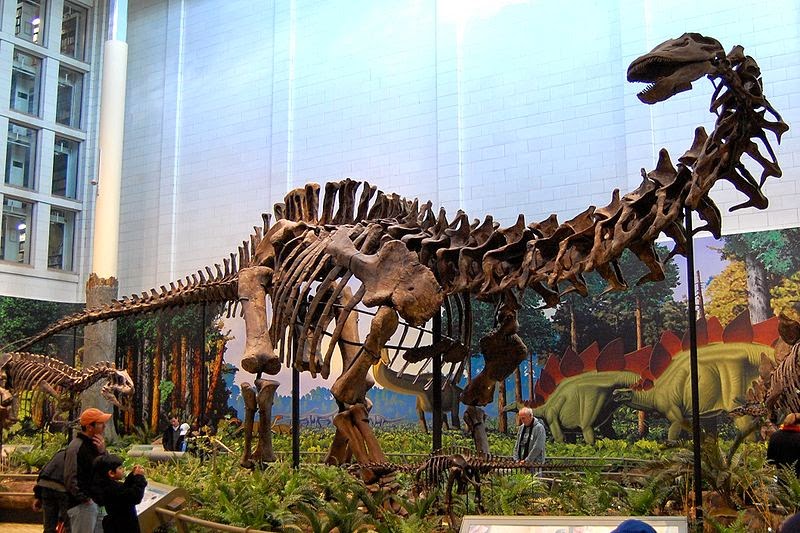
Sauropod dinosaur skeleton. Wikipedia.

The main argument here is basically the same as the one I used in questioning the Havasupai Canyon hadrosaur. The posture of the animal is incorrect. Observing this fifty years ago nobody would have really thought about that because that was when dinosaurs, especially sauropods, were thought to be slow, plodding tail draggers. Now that scientists have revised this opinion and reconstruct dinosaurs with their tails sticking out essentially straight behind, we can see the errors in this petroglyph. Indeed, had it really been made by a Native American who was co-existing with dinosaurs, he would have known that the tail should stick out straight and portrayed it that way. This in itself brands this petroglyph as a modern hoax.

As I have said before, in interpreting rock art we are all entitled to our own opinions and interpretations, but we are not entitled to make up our own facts.

REFERENCES:

Barnes, F. A., and M. Pendleton
1979    Canyon Country Prehistoric Indians, Their Cultures, Ruins, Artifacts, and Rock Art, Wasatch, Salt Lake City.


Wikipedia