Showing posts with label Pareidolia. Show all posts

Sunday, February 4, 2024

THE ROLE OF PAREIDOLIA IN CAVE ART:

Spotted horses, Pach Merle Cave, France. Online image, public domain.

The history of rock art research is replete with good ideas that get over-applied. From the original interpretation of “hunting magic” to David Lewis-William’s “shamans” interpretations that can be applied to some of the original examples are often then taken up and overused time and time again. Now a paper attributing the inspiration for painted caves in Spain to pareidolia seriously threatens to cause another run on that particular bank.Perhaps the first reference to the phenomenon of pareidolia in cave art involves the bison ceiling at Altamira Cave in Spain where rounded humps on the ceiling of a chamber seemingly inspired images of reclining bison.

Bison ceiling, Altamira Cave, Spain. Online image, public domain.

“The influence of pareidolia has often been anecdotally observed in examples of Upper Palaeolithic cave art, where topographic features of cave walls were incorporated into images. As part of a wider investigation into the visual psychology of the earliest known art, we explored three hypotheses relating to pareidolia in cases of Late Upper Palaeolithic art in Las Monedas and La Pasiega Caves (Cantabria, Spain). Deploying current research methods from visual psychology, our results support the notion that topography of cave walls played a strong role in the placement of figurative images—indicative of pareidolia influencing art making—although played a lesser role in determining whether the resulting images were relatively simple or complex. Our results also suggested that lighting conditions played little or no role in determining the form or placement of images, contrary to what has been previously assumed.” (Wisher et al. 2023) Sorry gentlemen, I totally disagree with your suggestion that lighting conditions played no role. The lighting conditions would have controlled the appearance of the features that you are attributing the pareidolia to.

Horse on cave wall, Las Monedas Cave, Spain. Image from cambridge.com.

“Pareidolia—the psychological phenomenon of seeing meaningful forms in random patterns, such as perceiving faces in clouds—is a universal feature of our visual system. It is likely a consequence of the evolution of our visual system adapting to allow partial or obscured profiles of potential predators to be rapidly identified through the conferral of meaning, and hence to minimize risk.” (Wisher et al. 2023)

Horse on cave wall, Las Monedas Cave, Spain. Image from cambridge.com.

“This process has been the subject of extensive psychological study, with existing debates regarding the particular cultural mechanisms that may cause pareidolia, e.g. do modern Western people see faces relatively frequently because our visual system has evolved to treat the visual stimuli of faces as ‘special’, or merely because we have visual expertise in face perception?” (Wisher et al. 2023) An obvious example of this is represented by the spotted horses of Pech Merle Cave in France where the shape of a horse’s head at the edge of a rock face suggested the panel of spotted horses.

Bison on cave wall, La Pasiega Cave, Spain. Image from cambridge.com.

“This discussion has focused on how heightened sensory awareness and the ambiguous nature of visual stimuli, induced by the darkness of caves, would have likely caused Palaeolithic people to experience visual imagery, priming them to depict the same animals they had perceived. There has also been extensive previous discussion pertaining to the integration of the rock support and its role in determining the placement of depictions within a cave, for example with the rock used to frame depictions or add depth and dimensionality to an animal motif.” (Wisher et al. 2023)

Aurochs in niche on cave wall, La Pasiega Cave, Spain. Image from cambridge.com.

Hypothesis 1: The majority of figurative depictions should integrate natural topographic features of cave walls.

Secondly ( and building on Hypothesis 1): As pareidolic imagery of animals generally does not incorporate detail beyond salient outline form or the natural features that triggered the pareidolic image, we further propose that simpler depictions of animals that are incomplete in form and/or feature no additional details beyond the outline should integrate natural features. By contrast, detailed depictions, i.e. those complete in form and/or featuring internal detail such as pelage, hair, eyes, and particularly those with stylistic features consistent with other contemporaneous depictions, may thus reflect pareidolia having no or minimal influence over the form and placement of depictions. It may therefore be expected that detailed depictions are less likely to be scaffolded onto natural topographic features when compared to simple depictions.

Horse on cave wall, La Pasiega Cave, Spain. Image from cambridge.com.

Hypothesis 3: Simpler depictions should have a stronger relationship to natural topographic features of the cave wall than detailed depictions.” (Wisher et al. 2023) While I can understand the reasoning behind their second and third hypotheses, I do not agree with them that having a bump on the cave wall or a crack in the rock will keep me from adding more detail. While the authors assume that the viewer will rely on the change of contour to imply whatever details were supposedly suggested by the rock feature, that would be no reason to keep me from touching it up to “improve” it. And, as the light source moves the appearance of the feature may change so it cannot be relied on to imply the details.

"Dr. Wisher and colleagues found that as many as 71% of images studied in the Las Monedas caves, and 55% in the La Pasiega caves, showed a strong relationship to the natural features of the cave wall, suggesting pareidolia may havew been a partial influence on the artists. Examples included where curved edges of the cave wall were used to represent the backs of animals such as wild horses, or where natural cracks were used as bison's horns. The archaeologists found that of those drawings with a strong relationship to natural features on the cave wall, the majority (80% in Las Monedas and 83% in La Pasiega) lacked additional details such as eyes or hair, which correlates with the simplistic nature of imagery influenced by pareidolia." (sci.news 2023) But the question is - how subjective or objective were these judgements? Without many more pictures illustrating concrete examples of images that they claim were influenced by pareidolia, I have to wonder how subjective their evaluations were - would you or I agree with their judgements?

Las Monedas, Spain. Image from cambridge.com.

Many cave walls are, by their nature, pretty rough. The rock surface can be smooth but it will still be contoured with swellinngs, low areas, projections, etc. It would be hard to place an image on many cave walls without having it interact with some kind of changes of contour. But, are those changes of contour the reason the image was placed where it was?

While I totally agree that some cave art was probably inspired by pareidolia (remember the Altamira bison and the Peche Merle horses), as usual I believe that this goes a little too far. Once someone saw a crack, or a bump, or whatever on the cave wall reminded him or her of an animal and then pictured it there, the idea of making pictures on the cave walls has been established and proliferated from there. They no longer needed pareidolia to prompt them to create cave art. So, some cave art was certainly inspired by pareidolia, I just cannot believe that the influence was this extensive.

NOTE: Some images in this posting were retrieved from the internet with a search for public domain photographs. If any of these images are not intended to be public domain, I apologize, and will happily provide the picture credits if the owner will contact me with them. For further information on these reports you should read the original reports at the sites listed below.


REFERENCES:

News Staff sci.news, 2023, Pareidolia May Have Stimulated Paleolithic Humans to Make Cave Art, 25 September 2023, https://www.sci.news/archaeology/paleolithic-pareidolia-12293.html. Accessed online 25 September 2023.

Wisher, Izzy, Paul Pettit and Robert Kentridge, 2023, Upper Palaeolithic Conversations with Caves: The Role of Pareidolia in the Figurative Art of Las Monedas and La Pasiega (Cantabria, Spain) 21 September 2023, Published online by Cambridge University Press. Accessed online 22 September 2023.


Saturday, May 27, 2023

HARAKBUT STONE FACE IN PERU:

The Harakbut stone face as it is approached in its river gorge. Online image, public domain.

Is it? Or is it not? This large rock formation which seems to resemble a crude sculpture of a human face is the subject of the debate – is it natural or man-made? These large, natural manifestations have always fascinated humans – how can geology resemble life so closely?

“The Harakbut Face, known by the native Harakbut tribesmen as the Rostro, which means face, is located in Peru’s Amarakaeri Communal Reserve. This vast area is situated in the southern Amazon region of Peru, and encompasses a region of 402,335.62 hectares (994,192 ac.). Located in the Madre des Dios region, the reserve takes up a great part of the homeland of the Harakbut tribe.” (Vuckovic 2020) This great stone face is a wonderful example of the phenomenon. Not only does it closely resemble a gigantic human visage from some angles, it is a stern visage.

The Harakbut stone face closeup. Online image, public domain.

“It is estimated that this native tribe lived in the basins of the Colorado and Madre des Dios rivers for several thousand years, and numerous complex myths and legends have survived to this day. One mentions the Harakbut as the ‘Warrior People,’ destined to protect the ancient forests of the Amarakaeri. Today the Amarakaeri Communal Reserve is home to ten indigenous communities and is hailed as Peru’s most pristine environment in the Amazon rainforest.” (Vuckovic 2020)

Humans seem to have an inborn tendency to accord phenomena such as this a spiritual significance. Although we now know about Pareidolia, in the eras before the modern science of psychology such resemblances seemed miraculous.

The Harakbut stone face closeup. Online image, public domain.

“Among the Harakbut, this location is utterly sacred. Agreed that it represents their most distant ancestor, these rock faces are said to be created by Toto, a powerful primordial spirit. However, whether or not this face is a man-made object remains debatable. Important research that was conducted on site can imply that this is in fact a lithological structure, a clear result of geomorphological processes. This again points us towards the widespread phenomena of pareidolia, through which the human eye often spots familiar symbols and shapes from natural objects and things. If this is in fact a fully natural creation, it is unmistakably lifelike and nature really outdid itself. But some staunch believers can still adhere to the claim that the Harakbut face is made by ancient man.” (Vuckovic 2020) And when approached from the one side it is amazingly convincing, although some missing elements like nostrils, ears and lips are apparent. Even seen from almost directly to the front it is still human face-like. It is only when the other side is seen that it becomes obvious that the so-called ‘Hakabut Face’ is the result of natural geomorphic processes, and is not manmade.

“Allegedly there are several of these big heads spread over the vast Harakbut territory, but El Rostro remains the iconic one. Located in a remote area of the rainforest, it is difficult to reach, requiring a challenging trek. But the sight of this incredible structure is a reward in itself. Perched over a wild and rapid flowing Amazonian river, emerging from the dense foliage, is an oddly realistic human face, its sharp lines jutting from the cliff face.” (Amazing Nature Blog 2023)

The Harakbut stone face. Note how the illusion falls apart on the right side view. Online image, public domain.

“This sacred location is made from sedimentary rock, aged and covered by a thin layer of bright green moss. One glance – both from profile and front – is enough to let you know that it is, without mistake, a human face peering towards the jungle. A sharp, aquiline nose with oddly straight and precise lines, combined with the jutting brow and prominent under bite lower jaw, all portray a serious and powerful male figure, akin to a great god, a tribal chieftain, or a venerated ancestor.” (Amazing Nature Blog 2023) While we do not have the right to demean the Harakbut for their beliefs, as modern, 21st century Westerners, we should recognize a duty to take such an example for what it really is – a superstition, but, also an amazing freak of nature.

NOTE: Some images in this posting were retrieved from the internet with a search for public domain photographs. If any of these images are not intended to be public domain, I apologize, and will happily provide the picture credits if the owner will contact me with them. For further information on these reports you should read the original reports at the sites listed below.

REFERENCES:

Amazing Nature Blog, 2023, The Mystery of the Harakbut Face: Man-Made Monument or Natural Phenomenon?, 25 April 2023, https://wildwingsnaturez.vercel.app/the-mystery-of-the-harakbut-face-man-made-monument-or-natural-phenomenon. Accessed online 29 April 2023.

Vuckovic, Aleksa, 2020, The Harakbut Face: Man-Made Monument or Natural Phenomenon?, 8 November 2020, https://www.ancient-origins.net. Accessed online 29 April 2023.

Sunday, March 15, 2020

BRONZE AGE CARVED STONES FROM ORKNEY - FIGURINES OR WHAT?


Two of the figurines
before cleaning.
Photo - finstown.orkney

Over the past few years enigmatic shaped rocks have been recovered on the British island of Orkney. The team discovering them has dubbed them "human figurines."


Photo - finstown.orkney

Compared to Paleolithic carvings, or other bronze age stone carvings from elsewhere, these are laughable - loom weights or fishing weights perhaps? I just don't see human figures in these.

"Figurine" shown in situ
next to hearth.
finstown.orkney

Perhaps they served as "deadmen" buried in the floor to tie cords to for holding something upright. Indeed, this quote gives one such possibility. "Some of the objects look remarkably like stylized representations of the human form whilst others look more like stones set upright into the floor of a Bronze Age building excavated by EASE Archaeology at the links of Noltland, Westray. These may have been used to tie mooring ropes onto, to help hold the roof on." (Heritagedaily 2019)


Internet photo.

"Dating the necked stones firmly will require further work, since they have also been found on Iron Age sites in Orkney. On initial evidence, the ones from Finstown possibly date to around the Late Neolithic or Early Bronze Age, roughly 2000 BC. Identifying the purpose of these stones, and if they are figurines, will also require further work, with a close study for abrasion, wear, and any other marks on these anthropomorphic objects." (Lisle 2019)


Note the smoothed neck
as if abraded by a
rope tied around it.
Internet photo.

I am tempted to think that these so-called "figurines" represent another example of pareidolia in rock art. On both March 2 and March 9, 2019, I wrote about the phenomena of pareidolia and mimetoliths in rock art. "This is manifested in pareidolia (recognizing ponies in the clouds, for instance), and also by fascination with mimetoliths (items that naturally look like something else - mimic them)." (Faris 2019)

"Pareidolia is a psychological phenomenon in which the mind responds to a stimulus, usually an image or a sound, by perceiving a familiar pattern where none exists. Common examples are perceived images of animals, faces, or objects in cloud formations, the Man in the Moon, the Moon rabbit, hidden messages in recorded music played in reverse or at high- or lower-than-normal speeds, and hearing indistinct voices in random noise such as that produced by air conditioners or fans." (Wikipedia)

Whatever these pieces of rock recovered in Orkney actually are, I certainly cannot see human figures in any of them, and so I have to classify them as mimetoliths, and examples of pareidolia manifested within the discoverers imaginations. Perhaps the "further work" mentioned above will provide enough information to better guess the purpose of these rocks.

REFERENCES:

Anonymous,
2019 A Team From ORCA Archaeology Has Discovered An Amazing Series of Half-Metre Tall Stone-Carved Objects, Heritage Daily, https://www.heritagedaily.com/2019/12/nine-possible-bronze-age-figurines-unearthed-at-substation-excavation-in-orkney/124965

Faris, Peter
2019 Are These Ute Wooden Maps? - or Apophenia - Pareidolia - Mimetoliths - Manuports, March 9, 2019, https://rockartblog.blogspot.com

2019 Pareidolia, March 2, 2019, https://rockartblog.blogspot.com

Lisle, Sean
2019 Nine Possible Bronze Age Figurine Unearthed at Substation Excavation in Orkney?, University of the Highlands Archaeology Institute, https://archaeologyorkney.com/2019/12/06/ nine-possible-bronze-age-figurines-unearthed-at-substation-excavation-in-orkney/

(https://en.wikipedia.org/wiki/Pareidolia)

Saturday, March 9, 2019

ARE THESE UTE WOODEN MAPS? - OR APOPHENIA - PAREIDOLIA - MIMETOLITHS - MANUPORTS


Supposed Ute map,
engraved in wood,
with explanation.

Supposed Ute map,
left side,
with explanation


Supposed Ute map,
right side,
with explanation.

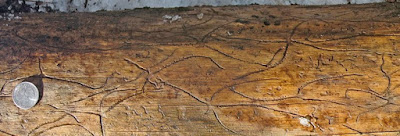
I have been writing recently on the phenomenon known as Apophenia - the "human tendency to seek patterns in random information." (Wikipedia) This is manifested in pareidolia (recognizing ponies in the clouds, for instance), and also by fascination with mimetoliths (items that naturally look like something else - mimic them).


Identified as a Map of Stratton
Open Space and Drainage.

Well, it turns out that there are plenty of people who experience that, whose facility for seeing artifacts in natural objects is considerably more sensitive than mine (or they are just a lot better at fooling themselves). I was recently sent a number of photos of pieces of pine branches showing insect boring patterns that the discoverer is certain represent maps created by Ute Indians. He has even been able to identify the area they portray, now a neighborhood in Colorado Springs, Colorado. Now, to me, they represent prime examples of Apophenia/Pareidolia, and even could be classified as Mimetoliths (mimicking actual maps), but the discoverer appears completely convinced by what he has found. Indeed, he apparently agrees that most pieces of wood that can be found with these markings are merely insect tracks, but he believes he can tell a difference and recognize the few examples that he has collected as "the real thing."


Map of Stratton Open Space,
Parks Department, City of
Colorado Springs, CO.

I think of this situation as paralleling the rock art/ogam controversy. I know those marks are not ogam, but I cannot convince the proponents - indeed, I have no way of proving it to them. This is the power of Apophenia, it is psychologically ingrained deeply into our makeup. Once, our ancestors were on the lookout for predators in the underbrush who could be recognized by the shape of a lion's ear through a break in the foliage, the contour of the side of a jaguar's head in a shadow, this is instinctive and was basic to our very survival. Our subconscious does this all the time, it is primal and not under our conscious rational control. Whereas scientific facts are merely new ideas on the surface that we trade between ourselves, nowhere near as powerful in our overall conscious-subconscious makeup.

So, I do not expect to be able to convince the discoverer of what I recognize as the truth - insect chewed wood. That would be merely boring fact. He has the power of belief on his side, and he knows down to his soul that he has made this important, historically significant discovery. He is, of course, wrong, but I almost envy him the strength of his belief. (Although I suspect that with a microscope we could detect the actual bite marks of the larvae that tunneled through the wood.)

This also represents the ideal time to introduce another term sometimes applied in this field - a Manuport. "In archaeology and anthropology, a manuport is a natural object which has been moved from its original context by human agency but otherwise remains unmodified." (Wikipedia) These pieces of tree limb are manuports because they interested their collector enough to pick them up and take them back to his residence. Mimetoliths that are seen to be interesting enough often become Manuports. In this case - you be the judge.

NOTEFor these particular objects I cannot use the term mimetolith (which basically translates as rock that mimics) because they are not rocks. Perhaps we can call them mimetoports to indicate that they are mimics that were collected by a human and transported. 

Also: I am purposely withholding the name of this individual to preserve his privacy. If he wants me to release it he can e-mail me and I will pass it along.

REFERENCE:

https://en.wikipedia.org/wiki/Apophenia

https://en.wikipedia.org/wiki/Manuport

Saturday, March 2, 2019

PAREIDOLIA:


The mountainous face on Mars
in the most favorable light.
Public domain.

One phenomenon that we have to keep in mind when discussing meaning or intention in rock art is pareidolia. "Pareidolia is a psychological phenomenon in which the mind responds to a stimulus, usually an image or a sound, by perceiving a familiar pattern where none exists. Common examples are perceived images of animals, faces, or objects in cloud formations, the Man in the Moon, the Moon rabbit, hidden messages in recorded music played in reverse or at high- or lower-than-normal speeds, and hearing indistinct voices in random noise such as that produced by air conditioners or fans." (Wikipedia)


The so-called face on Mars
under the more normal lighting
conditions. Public domain.


The moon rabbit
(dark areas). Public domain.

One example of pareidolia that recently received considerable attention among fringies was the so-called face on Mars, a rock formation that under certain lighting conditions resembles a human face, but under other lighting conditions can be seen to be just a mountain (of course that did not stop the fringies from adopting it as proof of alien civilization).


"Los toros," The bulls of Altamira,
Spain. Public domain.

I can think of a couple of excellent examples of pareidolia in classic rock art. The first (literally the first discovered) is the bulls of Altamira. Even back in the 1960s in the very small unit on Cave Painting and Paleolithic art in Gardner's Art Through The Ages we were told that the bulls were on the cave ceiling because natural rounded projections from the rock reminded the painter(s) of their shape, and they were painted to fit those contours and shapes.


Spotted horses, Pech-Merle, France.
Note: the horse's head fits shape of
rock wall on the right. Public domain.

The second example of pareidolia in cave painting that comes to mind is the Spotted Horse in Pech-Merle, where the horses head and placement were suggested by the shape of a rock projection on a corner of the cave wall. In both of these instances a form recognized in the shape of the rock suggested the content of the painting - pareidolia.

Robert Bednarik gave a number of examples of pareidolia in rock art in an excellent paper in 2016 (see below). Do yourself a favor and read it. What examples can you think of?

NOTE: Some images in this posting were retrieved from the internet with a search for public domain photographs. If any of these images are not intended to be public domain, I apologize, and will happily provide the picture credits if the owner will contact me with them. For further information on these reports you should read the original reports at the sites listed below.

REFERENCES:

Bednarik, Robert G.
2016 Rock Art and Pareidolia, Rock Art Research, Vol. 33, No. 2, pp. 167-181.

(https://en.wikipedia.org/wiki/Pareidolia)