
Shod footprint, Three Rivers, Otero
County, NM. Photo Jack and Esther
Faris, November 1988.

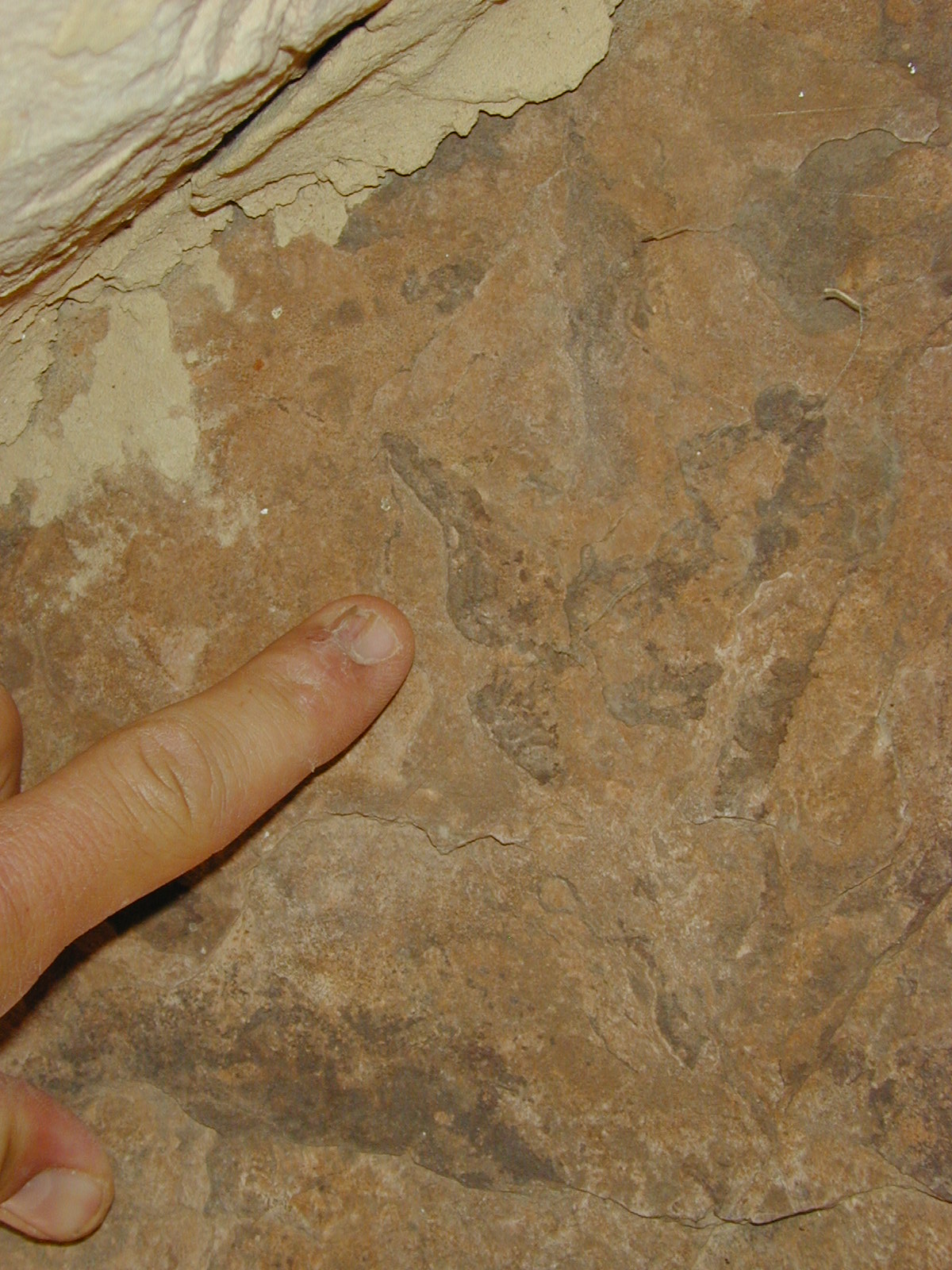
Closeup of shod footprint, Three Rivers,
Otero County, NM. Photo Jack and
Esther Faris, November 1988.
Esther Faris, November 1988.
As mentioned last week, a subject
of interest in rock art is the portrayal of footwear. What do these images
mean, what is their implication, what do they represent? Among the Ancestral
Puebloan peoples, and most other people of the southwest, the common footwear
was the sandal. For the sake of this discussion I will assume that any image of
the outline of a human foot that does not display toes represents shod foot,
showing a piece of footwear, sandal or moccasin.

Plaited sandal, Kayenta Anasazi,
Arizona, 900-1300 AD, yucca
leaves and cordage. Natural
History Museum of Utah.
Sandals
were woven out of plant fibers or bark (often juniper), but perhaps the most
common sandal was hand woven of yucca leaves (although especially fine examples
might be twined out of cotton fibers). More than one technique was used in
their production. The simplest ones were plaited with a warp in one direction,
crossed by a weft in the other direction in an over-under alternating pattern.
More complicated, and finer, results were obtained by twining, and the finest
examples were often decorated by using different colors of dyed material, or by
painting them subsequent to their weaving.

Twined yucca fiber sandal,
Glowacki, Fig. 10, p. 141.
Glowacki
observed in 2015 that "Changes in
sandal technology and the iconography depicted on murals and in rock art imply
widespread reorganization in Western Mesa Verde influenced in part by changing
relationships with an perceptions of Chaco and Aztec that altered local
interactions and practices. For example, twined sandals, made of finely woven
yucca with raised geometric designs on the tread or designs that were painted
or dyed after production were used until the early 1200s, subsequently being
replaced by plaited sandals." (Glowacki 2015:140)

Alex Patterson, 1992, A Field
Guide To Rock Art Symbols, p. 173.
These are
assumed to have been used as ceremonial dance footwear, given the amount of
work, and the specialized knowledge, required to produce them. "the intricacies of the unique
geometric designs on the tread, and the impracticality of wearing finely twined
sandals for daily use." (Glowacki 2015:140)

Footprint petroglyph, Spruce Tree
House, Mesa Verde, CO., Photo
Peter Faris, July 2002.
"The high frequency of sandal
imagery in Western Mesa Verde and the depictions of sandals on rock art panels
near habitations and on the inside and outside walls of rooms and kivas suggest
that twined sandals had a different role in Western Mesa Verde culture than in
other parts of the region."
(Glowacki 2015:140-42)

Alex Patterson, 1992, A Field
Guide To Rock Art Symbols,
p. 173.
"Twined yucca sandals fell into
disuse across the northern Southwest coincident with both the decline of Chaco
and the extreme drought conditions of the mid-1100s." (Glowacki 2015:142)

Franktown Cave sandal, Franktown,
Colorado. 3345 - 3033 B.C.
https://collectioncare.auraria.edu
The
ubiquity and time-depth of the plaited yucca sandal is easily illustrated by
the Franktown Cave sandal, recovered from a dry cave near Franktown, Colorado,
and dated from between 3345 and 3033 B.C.(www.collectioncare.auraria.edu) Indeed, anywhere and anytime that people had access to yucca they seem to have produced sandals for footwear.
Would an
image of a sandal or moccasin serve as a symbol of travel, or does Glowacki
have it correct that it is a symbol of ceremonial significance? In this latter
case a depiction of a sandal print, especially a geometrically decorated sandal
print, might represent a ceremonial dance. Or does it represent something else
entirely? What do you think?
NOTE: Some
of the images in this posting were obtained through an internet search for
"Public Domain." If I have used any images that were not intended to
be public domain please inform me and I will be happy to give full credit.
REFERENCES:
Glowacki,
Donna M.,
2015 Living
and Leaving, A Social History of Regional Depopulation in Thirteenth-Century
Mesa Verde, University of Arizona Press, Tucson.
https://collectioncare.auraria.edu/content/yucca-woven-sandal-franktown-cave
Patterson,
Alex
1992 A Field
Guide To Rock Art Symbols, Johnson Books, Boulder, CO.






 Posts
Posts

