Showing posts with label oldest date. Show all posts

Thursday, April 10, 2025

HAS THE OLDEST HUMAN STONE CARVING BEEN DISCOVERED IN SPAIN?


Marbella, Spain. Internet photograph, public domain.

The discovery of a piece of stone with intentionally human-made markings on it may provide the oldest human stone carving yet found. Note, I said stone carving. At this time the oldest painted image may be a painted pig-like creature in a cave on the Indonesian island of Sulawesi that dates back to approx. 5.5 ka. (Faris 2024)

“The carvings were found during excavations at the Coto Correa archaeological site, located in the Las Chapas neighborhood of Marbella, Spain. Coto Correa was first identified during the 1950s with the accidental discovery of stone tools that date from the Palaeolithic period, as well as other tools from the Chalcolithic and Late Bronze Age. The oldest stone tools date from between 1,500,000 5o 100,000 BC and confirms the presence of prehistoric settlers living in the Marbella region during the Early to Middle Palaeolithic, a period when modern humans began migrating out of Africa and began to replace other Homo species such as the Neanderthals and Homo Erectus.” (Milligan 2025)

“Until now, the roots of prehistoric rock art have been assumed to trace back to the Upper Paleolithic era, beginning around 50,000 BC. Cave paintings and engravings from that period have been found throughout Europe, frequently in caves and other times on large rocks or cliff faces. The choice of rock art theme suggests a desire to communicate about daily life in some instances, and an interest in conveying more complex ideas about nature, mythology and spiritual interests in others.” (Falde 2025) This is, of course, the result of the Eurocentric bigotry that prevailed during the last (the 20th) century.

View of stone showing incised lines in the center of the photograph. Internet photograph, public domain.

This stone has been tentatively dated to 200,000 years old. “An analysis of finds from ongoing excavations have identified a set of carved markings on a gabbro stone block that could be 200,000 years old, potentially predating the oldest known cave art by 100,000 years.  To confirm this finding, the Department of Culture is conducting a detailed geoarchaeological analysis: ‘The techniques applied for absolute dating consist of quartz analysis of different sediment samples, which will allow for a precise chronology of the samples.’” (Milligan 2025) Once this is accomplished there will be hard data upon which to build further analyses.

A few hypotheses have been put forward for the creation of these marks to date. “It’s possible the markings could have served as a form of early record-keeping, perhaps tracking events, quantities of objects, or notable achievements. Some suggest the markings could function as a form of identification, designating ownership over the stone itself. Alternatively, these carvings may have held symbolic or ritualistic significance, which if true would prove and intriguing glimpse into the cognitive abilities of ancient humans.” (Falde 2025) If, as suggested, the markings are tracking events or notable achievements, they would represent some form of mnemonic aide as they do not seem to present an image of an event or the accomplishment of a notable deed. It seems entirely possible that they are just some form of “kilroy was here”, just a record of presence.

Analysis is ongoing to establish firm dating and to examine it for any other markings. “’In addition, documentation work will be carried out using 3D scanning, which will allow for a high-resolution virtual composite of the set of marks. This will allow the entire surface to be studied in maximum detail, allowing for the identification of working marks and graphic elements,’ added the Department of Culture.” (Milligan 2025) Hopefully this will point to additional marks, more evidence for analysis.

So what do the marks represent? I personally do not see record keeping, tallies, or mnemonic aides. I think I see ‘tagging’. Humans seem to have a subconscious need to alter their environment, and I see no reason why pre-sapiens hominids would not have also possessed that trait. With more data and ongoing studies the team may be able to judge which hominid species had produced the markings, Neanderthal or Homo Erectus.

REFERRENCE:

Falde, Nathan, 2025, Oldest Rock Art: 200,000-Year-Old Carvings Found on Stone in Marbella, Spain, 14 March 2025, https://www.ancient-origins.net. Accessed online 3 April 2025.

Faris, Peter, 2024, A New Candidate for the Oldest Known Artwork, 10 August 2024, RockArtBlog, https://rockartblog.blogspot.com

Milligan, Mark, 2025, Discovery at Las Chapas could be the oldest stone carvings of human origin, 12 March 2025, https://archaeology.org/news/, Accessed online 13 March 2025.

Saturday, January 18, 2025

A NEWER CANDIDATE FOR THE OLDEST ROCK ART – 66,000+ YEAR-OLD HAND PRINT:


Maltravieso Cave entrance. Photograph from httpwww.turismoextremadura.com.

Every so often I get to write another column for RockArtBlog about a newly announced date breaking the record for the oldest rock art. You will find links to a number of them in the cloud index at the bottom of this blog. My column of 13 February 2021 concerned a pictographic image on the Indonesian island of Sulawesi that has been dated to at least 45,599 years ago. “Rock art researchers in Indonesia have announced the discovery of another candidate for the oldest representative rock art image, a picture of a Sulawesi Warty Pig found in a cave on the island of Sulawesi. The warty pig from Leang Tedongnge cave dates to at least 45,599 years ago, making it the earliest known representational work of art in the world (Sci-News 2021). Leang Tedongnge cave: the cave is located at the foot of a limestone karst hill. – (The) rock art panel is located on a ledge toward the rear of the cave and features at least three large figurative paintings of pigs.” (Faris 2021) Note that the researchers have limited their claim to “representative rock art” images, but not specifically defined what they intend that to mean. While we can all agree that a painting of a Warty Pig would be representative, one wonders what they would think of ancient hand prints. They cannot be called geometric or abstract so are they representative, or another special category?

Maltravieso Cave handprint (center of picture). Image from atlasobscura.com.

“Stencils and prints of the human hand are some of the earliest forms of deliberately created visual artwork preserved in the archaeological record. Maltravieso Cave houses more than 60 red hand stencils, but their precise ages have remained a mystery.” (Jackson 2024) This has now been corrected as a new paper describes the retrieval of Uranium-Thorium dates from carbonate crusts that have formed over a number of the handprints.

Photograph of Maltravieso Cave handprints above, and D-Stretch version below. Image from Standish et al., 2024, figure 6, page 6.

“U-Th dating of associated carbonate crusts has been applied to date parietal art in Maltravieso cave, Extremadura, Spain. Known for its large collection of red hand stencils (≥60), one example previously dated to >66.7 ka was taken to suggest Neandertal authorship. Here we present a more detailed U-series study of hand stencils within the cave, and place the results in the context of the chronology of these motifs worldwide. Twenty-two carbonate samples overlying pigment of hand stencils were dated from the cave’s Sala de las Pinturas and the Galería de la Serpiente. Minimum ages for the art range from the Holocene to the Middle Palaeolithic. Alongside published dating results from other sites, this demonstrates that Neandertals as well as modern humans could create these motifs.” (Standish et al. 2024:1)  These dates taken by Uranium-Thorium dating represent minimum ages because they are taken from material on top of the original hand print. This means that the actual hand prints must be even older. This minimum dating is pre-homo sapiens in this area so the hand prints must be Neanderthal.


Photograph of Maltravieso Cave handprints above, and D-Stretch version below. Image from Standish et al., 2024, figure 5, page 5.

Christopher Standish et al. (2024) re-stated this in their conclusions. “U-Th dating of carbonate crusts overlying painted rock art in Maltravieso cave indicates that the tradition of making hand stencils in Europe began prior to the Aurignacian; a conclusion that is consistent with wider chronological information for examples elsewhere. In Maltravieso, two samples from one stencil, including one sequence of four sub-samples that demonstrates closed-system behaviour of the carbonate and therefore reliability of the dates, gave minimum ages well within the range of the Middle Palaeolithic and long before the Initial Upper Palaeolithic; the oldest of these being 66.7 ka. Together with published dating evidence from sites elsewhere in the world, this suggests that Neandertals as well as modern humans created these enigmatic motifs.” (Standish et al. 2024:9) And as I said above “These dates taken by Uranium-Thorium dating represent minimum ages because they are taken from material on top of the original hand print. This means that the actual hand prints must be even older. This minimum dating is pre-homo sapiens in this area so the hand prints must be Neanderthal.”

In other words, the handprint was made considerably earlier than the arrival of modern humans in the area – thus, Neanderthal.

NOTE: Some images in this posting were retrieved from the internet with a search for public domain photographs. If any of these images are not intended to be public domain, I apologize, and will happily provide the picture credits if the owner will contact me with them. For further information on these reports you should read the original reports at the sites listed below.

REFERENCES:

Faris, Peter, 2021, A New Candidate for the Oldest Pictograph – The Sulawesi Pig, 13 February 2021. https://rockartblog.blogspot.com.

Jackson, Justin, 2024, Neanderthals were making hand stencil rock art more than 66,000 years ago, U-series dating suggests, 4 December 2024, Phys.org (online). Accessed online 4 December 2024.

Standish, Christopher D. et al., 2024, The age of hand stencils in Maltravieso cave (Extremadura, Spain) established by U-Th dating, and its implications for the early development of art, 19 November 2024, Journal of Archaeological Science: Reports 61, www.elsevier.com/locate/jasrep. Accessed online 3 December 2024.

Saturday, June 5, 2021

THE EFFECTS OF CLIMATE CHANGE ON THE PLEISTOCENE ROCK ART OF SULAWESI:


Warty pig pictograph, 45,000 year old painting, Leang-Tedongnge cave, Sulawesi, Indonesia. Internet photo, public domain.

It has only been a few months since the reports of the oldest known pictographs were reported in Sulawesi. As I wrote in my February 13 posting of this year (see below) “Rock art researchers in Indonesia have announced the discovery of another candidate for the oldest representative rock art image, a picture of a Sulawesi Warty Pig found in a cave on the island of Sulawesi. ‘The warty pig from Leang Tedongnge cave dates to at least 45,599 years ago, making it the earliest known representational work of art in the world. (Sci-News 2021) Leang Tedongnge cave: The cave is located at the foot of a limestone karst hill. – (The) rock art panel is located on a ledge toward the rear of the cave and features at least three large figurative paintings of pigs.’” (Faris 2021)

Here, we have hardly had time to appreciate the extreme estimated age of these wonderful images, when we are told that they are deteriorating, threatened by climate change. A new report from Sulawesi by Huntley, J., Aubert, M., Oktaviana, A.A. et al. explains that – “The equatorial tropics house some of the earliest rock art yet known, and it is weathering at an alarming rate. Here we present evidence for haloclasty (salt crystallization) from Pleistocene-aged rock art panels at 11 sites in the Maros-Pangkep limestone karsts of southern Sulawesi. We show how quickly rock art panels have degraded in recent decades, contending that climate-catalysed salt efflorescence is responsible for increasing exfoliation of the limestone cave surfaces that house the ~ 45 to 20-thousand-year-old paintings. These artworks are located in the world’s most atmospherically dynamic region, the Australasian monsoon domain. The rising frequency of El Niño-induced droughts from anthropogenic climate change (that is, higher ambient temperatures and more consecutive dry days), combined with seasonal moisture injected via monsoonal rains retained as standing water in rice fields and aquaculture ponds of the region, increasingly provide ideal conditions for evaporation and haloclasty, accelerating rock art deterioration.” (Huntley, J., Aubert, M., Oktaviana, A.A. et al. 2021:1)

“In almost all sites containing early art, the hand stencils and figurative motifs are heavily affected by exfoliation of the limestone cave wall/ceiling surfaces that comprise the artists’ ‘canvas’. The deposition of solutes (chiefly irons, silicones, and calcium carbonates) from the bedrock and surrounding environment concentrate and oxidise at the limestone’s surface, blocking pores to form a mineralized rind – a process known as case-hardening. The case-hardened surfaces of the Maros-Pangkep caves, co-created by biofilms including plentiful microbial mats, regulate water penetration on limestone surfaces, preventing rapid moisture uptake. While case-hardening makes the surface layer more resistant to weathering, the sub-surface zone immediately underneath is weakened by loss of cement matrices, the void spaces becoming susceptible to the accumulation of evaporites such as geological salts, especially where the outer crust has been breached.” (Huntley, J., Aubert, M., Oktaviana, A.A. et al. 2021:2)


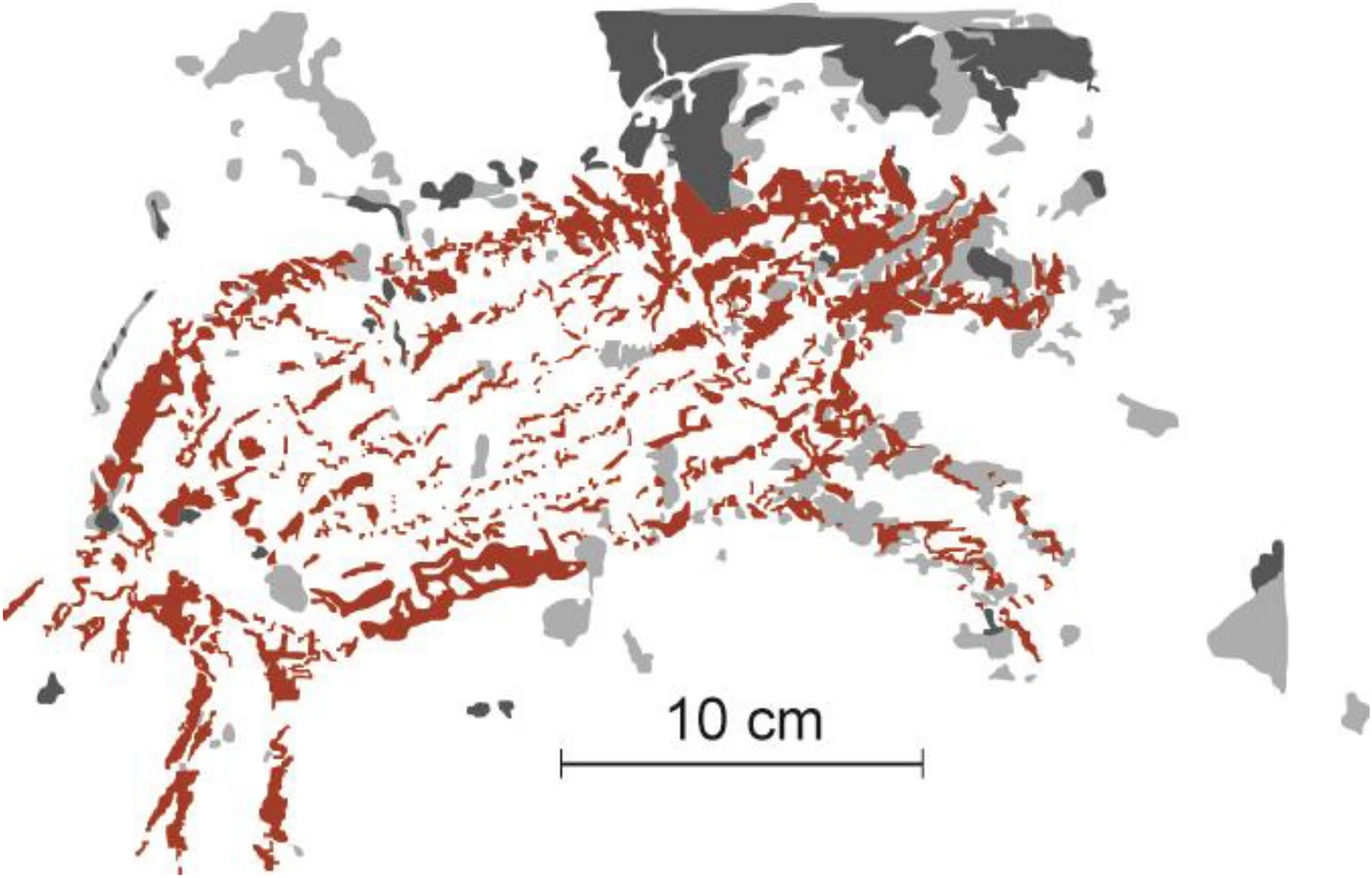
This illustration from the report shows the extent of the problem. “Rate of salt-induced exfoliation affecting a figurative painting of a suid. This rock art motif is located at Leang Pattae, a limestone cave open to the public at Taman Prasejarah Leang-Leang, Maros-Pangkep. The artwork is undated but it was executed in the same artistic style used to depict animals during the Late Pleistocene rock art phase. Dark grey shading highlights the exfoliated areas documented in 1950. The light grey highlights exfoliated areas documented in 2013.” (Huntley, J., Aubert, M., Oktaviana, A.A. et al. 2021:4)

Here, in the western United States, rock exfoliation caused by alkali salts is well known, but it is really a shame that the destruction of the oldest rock art currently known in the world is being degraded by a natural process, prompted by human-driven climate change.

NOTE: An image in this posting was retrieved from the internet with a search for public domain photographs. If this image is not intended to be public domain, I apologize, and will happily provide the picture credits if the owner will contact me with them. For further information on these reports you should read the original reports at the sites listed below.


REFERENCES:

Faris, Peter, 2021, A New Candidate for the Oldest Pictograph – The Sulawesi Pig, February 13, 2021, https://rockartblog.blogspot.com

Huntley, J., Aubert, M., Oktaviana, A.A. et al., 2021, The Effects of Climate Change on the Pleistocene Rock Art of Sulawesi, Science Reports 11, 9833 (2021), https://doi.org/10.1038/s41598-921987923-3

Sci-News Staff, 2021, 45,000-Year-Old Sulawesi Warty Pig Painting Found in Indonesian Cave, January 14, 2021, http://www.sci-news.com/archaeology/sulawesi-warty-pig-paintings-09250.html


Wednesday, November 14, 2018

BORNEO CAVE ART CLAIMED WORLD'S OLDEST ANIMAL IMAGE:


Panel from Borneo cave,
handprints at top right,
banteng at lower left.
www.livescience.com.

As more and more discoveries are made around the world it becomes increasingly obvious that the only thing special about the cave art in Europe is that it has been studied much more than elsewhere. Increasing attention to rock art in other parts of the world are now challenging all previous assumptions about who, what, and where was first. In other words our cultural-centric biases are showing.

"A 40,000-year-old painting of a mysterious, wild cow-like beast discovered in a Borneo cave is the oldest human-made drawing of an animal on record. The discovery indicates that figurative cave art - one of the most significant innovations in human culture - didn't begin in Europe as many scientists thought, but rather in Southeast Asia during the last ice age." (Geggel 2018)

"Previously, the oldest known animal painting in the world was an approximately 35,400-year-old babirusa, or "pig-deer," on the Indonesian island of Sulawesi." (Geggel 2018)


Banteng on panel from Borneo cave,www.livescience.com.


"A limestone cave in eastern Borneo features a reddish-orange painting of a horned animal, possibly a type of wild cattle that may have been found on the island at the time. The painting dates to at least 40,000 years ago, concludes a team led by archaeologist Maxime Aubert of Griffith University in Southport, Australia. This creature represents the oldest known example of a painted figure anywhere in the world the scientists report online November 7 in Nature." (Bower 2018)

Male banteng,.
http://zoochat.com, 
public domain.

A species of wild cow known as the banteng (Bos javanicus) still lives in the forests of Borneo and this image might represent the banteng, or an unknown prehistoric relative. In the banteng the horns are considerably larger on the male, as seen in this cave painting.

"The same cave walls contain two hand outlines framed in reddish orange pigment that were made at least 37,200 years ago, and a similar hand stencil with a maximum age of 51,800 years. Age estimates rest on analyses of uranium in mineral deposits that had formed over and underneath parts of each cave painting. Scientists used known decay rates of radioactive uranium in these deposits to calculate maximum and minimum dates for the paintings." (Bower 2018)

"The researchers collected calcium-carbonate samples from the Kalimantan cave drawings so they could do uranium-series dating - a technique made possible by radioactive decay. When rainwater seeps through limestone, it dissolves a small amount of uranium, Aubert told Live Science. As uranium decays, it turns into the element thorium. By studying the ratio of uranium to thorium in the calcium carbonate that is coating the cave art, researchers determined how old the initial coating was, he said." (Geggel 2018)

This is a good hard dating for these images, something not always available for rock art.


Handprints from Borneo cave,
red-orange are earlier, the
darker ones are later.
www.sciencenews.org.

"The team proposed that the prehistoric artworks can be divided into at least two chronologically distinct phases of art production. The first phase is characterized by hand stencils and large figurative paintings of animals that are reddish-orange in colour." (Brumm 2018)

"Hand stencils also characterize the later phase, but these stencils (and associated images) tend to be dark purple ("mulberry") in colour." (Brumm 2018)

The recently dated images from the Indonesian island of Sulawesi, and now these even earlier dates, should put to rest our old assumptions of cultural imperialism. Just because the rock art in Europe was found first, and studied the most extensively, does not mean that the Paleolithic Europeans were culturally more advanced. Indeed, with these new dates from the other side of the world it looks like we have some catching up to do.

NOTE: Some images in this posting were retrieved from the internet with a search for public domain photographs. If any of these images are not intended to be public domain, I apologize, and will happily provide the picture credits if the owner will contact me with them. For further information on these reports you should read the originals at the sites listed below.

REFERENCES:

Bower, Bruce,
2018 Like Europe, Borneo Hosted Stone Age Cave Artists, November 7, 2018, https://www.sciencenews.org/article/oldest-known-drawing-figure-found-cave-art-borneo

Brumm, Adam,
2018 Borneo Cave Discovery: Is the World's Oldest Rock Art in Southeast Asia?, November 8, 2018, https://www.viw.com.au/index.pho/news/16298-borneo-cave-discovery-is-the-world-s-oldest-rock-art-in-southeast-asia

Geggel, Laura,
2018 World's Oldest Animal Drawing, Discovered in Borneo Cave, Is a Weird       Cow Beast, November 7, 2018, https://www.livescience.com/64034- oldest-figurative-cave-art.html

http://photos.zoochat.com

Saturday, October 27, 2018

ANOTHER CANDIDATE FOR ONE OF THE EARLIEST EXAMPLES OF ROCK ART:


Silcrete fragment with red ocher
marks, Blombos Cave, South
Africa. www.newsweek.com,
Public domain.

The ever fruitful Blombos Cave in South Africa has produced another candidate for the earliest drawing ever.

"Archaeologists who excavated a seaside cave in South Africa have discovered what they say is the world's oldest drawing. It is an abstract pattern, a crosshatch of red lines, like a hashtag, on a rock flake. The scientists who found it determined that the pattern is about 73,000 years old. This mark is about 30,000 years older than Paleolithic animal figures and hand stencils scrawled on cavern walls in Europe and Indonesia." (Guarino 2018)

"Blombos Cave is an archaeological site located in Blomboschfontein Nature Reserve, about 300 km east of Cape Town on the Southern Cape coastline, South Africa. The cave contains Middle Stone Age (MSA) deposits currently dated between c. 100,000 and 70,000 years Before Present (BP), and a late Stone Age sequesce dated at between 2000 and 300 years BP. The cave site was first excavated in 1991 and field work has been conducted there on a regular basis since 1997, and is ongoing." (Wikipedia/Blombos)

Previous art-related discoveries at Blombos have included the ocher crayons, and seashells with traces of ocher in them, apparently used as containers for mixing liquid paint. (See https://rockartblog.blogspot.com - Oldest Petroglyphs So Far?, August 25, 2018, and A PaleolithicArtist's Tool Kit in Blombos Cave, South Africa, February 10, 2012)

"University of the Witwatersrand archaeologist Luca Pollarolo, was cleaning fragments of rock from Blombos Cave when he found perpendicular lines scrawled on a flake of silcrete rock. The study authors determined that he medium was ocher, and iron-rich rock that can be as soft as lipstick." (Guarino 2018)

The fact that the inhabitants of Blombos Cave were working with silcrete as a tool rock 73,000 years ago, suggests two types of technology had been developed. They not only had the technology to flake stone tools, but they also had learned to heat treat the stone to make it easier to work.
"Silcrete is an indurated soil duricrust formed when surface sand and gravel are cemented by dissolved silica. Tools made out of silcrete which has not been heat treated are difficult to make with flintknapping techniques. In South Africa at Pinnacle Point researchers have determined that two types of silcrete tools were developed between 60,000 and 80,000 years ago and used the heat treatment technique." (Wikipedia/Silcrete)

"After Pollarolo identified the hashtag, the authors of the new study attempted to re-create this pattern. They used stone flakes and pieces of ocher from Blombos to draw on rock. "There was absolutely no doube that these were drawn with an ocher pencil or an ocher crayon," Henshilwood said. "We could even tell the direction that the ocher pencil was drawn across the surface." The crayon made stroke marks, the way a paintbrush does across a wall. The hashtag piece is a fragment of a larger drawing, the authors determined."  (Guarino 2018)

"The scientists "used a battery of impressive techniques to demonstrate crayon stroke direction, the method of ocher application" as well as the ocher's chemical composition, said archaeologist Lyn Wadley, from the University of Witwatersrand in South Africa, who was not involved with this research. It is "perfectly feasible," she added, that the Blombos inhabitants could make pattern drawings. This would indeed be the oldest set of such lines that is made with an ocher 'crayon' rather than a sharp instrument, and constitute the oldest evidence of drawing with a crayon," George Washington University paleoanthropologist Alison Brooks said." (Guarino 2018)

The existence of this marked flake of rock not only indicates that the people knew two types of technology; flintknapping, and heat treating, but they had also achieved symbolic thought illustrated by the use of ocher in making marks on the rocks. While it is not possible to determine a purpose for the marks, we can say with confidence that there was a purpose to them. The fact of their existence illustrates that someone purposely created them.

NOTE: The image in this posting was retrieved from the internet with a search for public domain photographs. If this image was not intended to be public domain, I apologize for its misuse. For further information on these reports you should read the originals at the sites listed below.


REFERENCE:

Guarino, Ben
2018 Archaeologists Just Found the Oldest Drawing. It's a 70,000-Year-Old Hashtag, 13 September 2018, Baltimore Sun.

https://en.wikipedia.org/wiki/Blombos_Cave

https://en.wikipedia.org/wiki/Silcrete

www.newsweek.com

Saturday, August 25, 2018

OLDEST PETROGLYPHS SO FAR?


100,000-year-old engraved
ocher, Blombos Cave, South
Africa. sciencemag.org.
Public domain.

What might indeed be the oldest date for a petroglyph so far has been found on a block of ocher dated to approximately 100,000 years BP. This discovery came from Blombos Cave in South Africa. Other ocher blocks in Blombos have been given dates of 77,000 years of age. These discoveries consist of pieces of ocher that have engraved lines or cross-hatching on them and they have engendered considerable debate on the origins of symbols and their meaning.


77,000-year-old engraved
ocher, Blombos Cave, South
Africa. smithsonian.org.
Public domain.

All students of this question seem to share the assumption that the ocher was ground to make a pigment powder that can be mixed into paint for other use. What the current debate seems to be about is whether the designs on the ocher have any symbolic significance or whether they were perhaps only doodles.

100,000-year-old engraved
ocher, Blombos Cave, South
Africa. sciencemag.org.
Public domain.

"About 100,000 years ago, ancient humans started etching lines and hashtag patterns onto red rocks in a South African cave. Such handiwork has been cited as the first sign our species could make symbols—distinct marks that stand for some meaning—and thus evidence of a sophisticated mind. But a new study, reported here this week at Evolang, a biannual conference on the evolution of language, finds that these markings and others like them lack key characteristics of symbols. Instead, they may have been more for decoration or enjoyment." (Erard 2018)


Checkered gunstock,
www.cs.uwyo.edu,
Public domain.

While either of these explanations is equally good, and probably equally unprovable, they do not cover all of the possibilities. Were I tasked with grinding a quantity of powdered pigment from small pieces of ocher, I imagine that one of my concerns would involve having a secure grip. In many other applications that involve manipulating a small object that secure grip is achieved by modifying the surface with knurling or checkering. What if these patterns of lines incised into the surface of the ocher represent checkering and have no symbolic or decorative  significance at all? Or, to phrase that in another way, instead of having symbolic or decorative significance, perhaps they just represent an engineering solution to the problem of securely holding a small object. Now, I will admit that they look like decoration to me, but that does not mean that they are not also meant to assist with a secure grip. The checkering on the wooden stock of a rifle is meant to be decorative as well as help provide a secure grip. Possibly they represent the first example of knurling or checkering, the first known manifestation of engineering - not art, and that, in its own way, is just as exciting.

NOTE: Some images in this posting were retrieved from the internet with a search for public domain photographs. If any of these images are not intended to be public domain, I apologize, and will happily provide the picture credits if the owner will contact me with them. For further information on this report you should read the original at the site listed below.

REFERENCES:

Erard, Michael
2018 Is This 100,000-Year-Old Hashtag the First Humanmade Symbol - or Just a Pretty Decoration?, April 20, 2018, http://www.sciencemag.org/news/2018/04/100000-year-old-hashtag-first-human-symbol-or-just-
pretty-decoration

Saturday, May 19, 2018

THE EARLIEST DATES IN COLORADO, EAGLE ROCK SHELTER:


Eagle Rock Shelter, 5DT813,
Delta County, Colorado.
Photograph cpr.org,
Public Domain.

The oldest dates recovered so far in Colorado have come from an excavation at Eagle Rock Shelter (5DT813) in Delta County, supervised by Dr. Glade Hadden, recently of the Montrose office of the Bureau of Land Management (BLM). Beginning in 2007, the BLM and Western Wyoming Community College collaborated upon this excavation resulting in some remarkable findings.

       
"Since 2007, the BLM and Western Wyoming Community College have collaborated on the excavation of the Eagle Rock Shelter (Site 5DT 813) in the northern portion of the Gunnison Gorge National Conservation Area. Excavations at the site have to date uncovered evidence of habitation within the shelter spanning the range of human occupation of North America." (Hadden, quoted in Bannister2013:1)


Panel 1, Eagle Rock Shelter,
Photograph Carol Patterson.

"Eagle Rock Shelter is a fairly large rock shelter located on the first bench above the Gunnison River. The site was originally recorded by the BLM in 1988 after it was reported as a looted site. After receiving the report, BLM archaeologists, along with staff from Alpine Archaeological Consultants, recorded the shelter and assessed the damage from looters. Their conclusion at the time was that the shelter may still contain some in situ deposits and that BLM should initiate an excavation to recover information missed by the looters. The shelter walls contain dozens of petroglyphs spanning the Archaic Period (ca. 7,000 years BP to roughly 2,000 years BP), the Formative Period (ca. 300 AD to 1,200 AD) and the Late Prehistoric (Numic or Ute) period. The BLM concluded at the time that there was a reasonable chance that some deposits from these time frames may still be intact inside the shelter." (Hadden, quoted in Bannister2013: 1)

"The Archaic period is an era in the human history of Colorado dating from ca. 6500-AD 200. It is one of he three prehistoric periods used by archaeologists to characterize broad cultural changes that occurred throughout the Americas. It was preceded by the Paleolithic Indian period (ca. 11,500 - 7000 BC), extending back into the late Ice Age, and was followed by the Formative period (1000 BC - AD 1450)." (Black 2018)

       
Drawing of panel 1, Eagle
Rock Shelter, Carol Patterson.

"In 2007, BLM archaeologist Glade Hadden and Dr. Dudley Gardner of Western Wyoming Community College visited the site with an eye to establishing a college archaeological field school. Our assessment then was that the site may prove to be an ideal field school project with a high probability of finding undisturbed Formative and Middle to Late Archaic occupation deposits. Excavations began by delineating the damage to the site from the looting episode. After the first year we had concluded that, while most of the later Formative and Late Prehistoric levels had been destroyed, there were good indicators of intact Late Archaic and Formative period levels still in place. Over the next few years, WWCC and BLM continued to excavate and uncovered numerous intact occupational levels including Ute, Fremont hearths (Formative period), and Archaic hunter/gatherer camps, with a degree of preservation that was remarkable. Perishable fibers, cordage, leather, and wooden artifacts were found including a 3,000 year BP basked, dart foreshafts, an early archaic Pinto point with sinew wrap still in place, stone, bone, and wood tools, beads, including bone beads in both round and disk form, eagle bone beads, food preparation impliments, ground stone, and ocher." (Hadden, quoted in Bannister2013: 2)


Panel , Eagle Rock Shelter,
Photograph Carol Patterson.

"By 2010, we had established that the shelter occupation dated back at least to 8,000 years BP and contained undisturbed occupations representing all phases of known human occupation for the area. In 2011, we excavated down through the intact Archaic levels and discovered hearths, with the first dating to ca. 9,000 years BP, well within the Paleo-Indian period, and finally a single hearth which yielded two individually certified dates of 12,800 years BP. The hearth contained charred bones (including one element of a late Pleistocene mammal), charred seeds, grasses, as well as stone tools and debris. The date from the older hearth places the early occupation of the shelter to the end of the last Ice Age, and represents one of the earliest Clovis sites in North America, placing it among a small handful of stratified Clovis/Paleo-Indian occupation sites in the western hemisphere - and currently the oldest archaeological site in Colorado." (Hadden, quoted in Bannister2013: 2)


Drawing of panel 8, Eagle
Rock Shelter, Carol Patterson.

What seems remarkable to me in this is that it has not been long since all archaeological references insisted that there was no habitation of North America that early. It was argued that Clovis (11,500 - 11,000 BP) was the first culture to inhabit North America. It should be noted that there is no mention of any Clovis culture affiliation in any of the material from Eagle Rock Shelter.

"The site is important because of the Paleo-Indian component, but that is far from the only significant component, says Hadden. "We have some of the most amazing stuff ever found in archaeological sites in Colorado right here. They're not unique, but they're amazing." In all, the site contained more than 50 hearths, and at least 42 different occupational contexts, including some gaps in occupation later on. In one of those layers was a 7,000-year-old woven yucca fiber basked that archaeologists estimate looters missed by about eight inches.  It's the oldest known basket in Colorado and the second-oldest found in North America. "And it has a nice provenance," said Hadden. "We know exactly where it came from. . . and the dry climate has maintained it beautifully."" (Meck 2016)

"Another find that could be a game-changer is a Middle Archaic Pinto point with sinew wrapped around the base. Pinto points, found in this area, are thought to date 5,000-6,000 years, but the sinew dates back 8,000 years. That could push the occupation dates of sites in the Escalante Canyon near Delta back possibly 2,000 more years, said Hadden." They also found tanned animal hides, a yucca-fiber sandal, and hundreds of projectile points, some dating back 12,000 - 13,000 years." (Meck 2016)

Eagle Rock shelter also includes rock art, although none of it can yet be associated with the earliest occupations of 12,000 to 13,000 years ago, and it was recorded in detail by Dr. Carol Patterson and Dr. Alan Watchman.

They divided the rock art there into sixteen panels for their comprehensive 2006 report, and found that most of the rock art can be attributed to the Archaic and Formative eras. Their description of panel one is reasonably representative of most of the rock art in Eagle Rock Shelter. For panel one their report stated "Two eras are represented in this panel. The large animals are of the Archaic Era with branching antlers, large bodies and long thin legs and cloven feet. The smaller animals with stubby legs and round bodies, and the anthropomorph with stick legs and arms, along with the sinuous lines belong to the Formative era.
This panel exhibits characteristics of the Archaic Era with large horned animals, stick figure type anthropomorphs and abstract lines (2400 BP and older). It is superimposed in some areas by later, Formative Era (2400 to 700 PB) quadrupeds, and some later scratched and gouged lines. Determining age is difficult because of the strong weathering which has affected the surface and the glyphs. As no rock surface coatings are present a direct approach to dating is not possible. Varnish has not reformed in the peckings and so an indirect age estimate of less than about 2000 years may be approximate for most of the motifs." (Patterson and Watchman 2006:26 & 27)

While it would have been exciting to have examples of rock art from the earliest Paleolithic occupation, the fact that we now have hard dates from that early, plus the great detail of the rock art recording, provide us with a wealth of material to consider. A good job all the way around.

NOTE: For more complete information I would refer you to the resources listed below.

REFERENCES:

Banister, Craig
2013 "Eagle Rock" Clovis/Paleo Tour, The Surveyor (Newsletter of the Colorado Archaeological Society, Vol. 11, No. 4, Fall 2013, pages 1 & 2.

Black, Kevin
The Archaic Period in Colorado, https://coloradoencyclopedia.org/article/archaic-period-colorado, accessed April 30, 2018.

Lofholm, Nancy
2016   A Basket Older Than God . . . Well, Jesus, July 1, 2016, www.cpr.org/news/story/basket-older-godwell-jesus

Meck,Tamie
2016 Eagle Rock Shelter Offers New Insights Into Paleo-Indian Culture, Sept. 6, 2016, http://www.deltacountyindependent.com/eagle-rock-shelter-offers-new-insights-into-paleo-indian-culture-cms-4597

Patterson, Carol, Dr., and Dr. Alan Watchman
2006 Gunnison River Rock Art Site (5DT813), Delta County: Documentation, Evaluation, and Management Plan. Submitted for Julie Coleman, BLM Archaeologist, BLM Field Office, Montrose, CO, 80401, Urraca Archaeological Services, Montrose, Colorado

Saturday, April 7, 2018

THE EARLIEST HUMAN DATE IN NORTH AMERICA - SO FAR (PART ONE):


Yukon scene with close-up of
bone with cut marks inset.
ancientorigins.com.
Public Domain.

I have long been interested in the possibility as to whether any rock art exists created in Beringia by the first immigrants to North America. I can see no reason why they would not have created rock art, pretty much everybody else did in prehistoric North America.


Close-up of bone fragment
with cut marks.
umontreal.ca,
Public Domain.

Now, materials recovered from the Bluefish Caves in the Yukon between 1977 and 1987, by archaeologist Jacques Cinq-Mars have belatedly provided evidence that humans had arrived in North America 24,000 years ago. (Boissoneault 2017) "At the time Cinq-Mars and his team concluded that the Bluefish Caves showed evidence of occasional human use as much as 30,000 years ago." (Eamer 2017) - In part 1 I will present the early date, and in part 2 I will add some speculations about the rock art.


Fragment of horse mandible
from Bluefish Caves,
smithsonianmag.com
Public Domain.

Naturally, Cinq-Mars' early dates raised considerable controversy and disagreement, after all, back then we all knew that the Clovis people of 13,000 years ago were the first inhabitants of North America.

"The discord surrounding Cinq-Mars' discovery resulted in a portion of the collection never being thoroughly analyzed and researchers eventually lost interest. But now, 40 years after Cinq-Mars' initial discovery, it seems the archaeologist has been vindicated. Canadian scientists Lauriane Bourgeon and Ariane Burke, assisted by University of Oxford professor Thomas Higham, conducted a two-year re-analysis of the bones found in the Bluefish Caves, poring over 36,000 bone fragments held in a collection at the Canadian Museum of History and studying fragments that hadn't previously been taphonomically classified. After doing a thorough classification of the markings on the bones as made by natural forces or humans, they conducted radiocarbon dating of those they deemed to have been marked by humans. The earliest bone to show distinct human-made marks - a horse jaw, sawed by a stone tool that indicates the hunter was attempting to remove the tongue - dates to 24,000 years ago." (Boissoneault 2017)


Diagram of placement of the
horse mandible fragment,
umontreal.ca,
Public Domain.

"Recent genetic studies suggest that some ancient people rode out the hostile conditions of the Last Glacial Maximum in isolation in the relatively hospitable Beringia - a continent, now mostly underwater, that once spanned from Siberia to Canada's Mackenzie River - before moving deeper into North America when conditions improved. Archaeological evidence of their presence has been elusive, but the butchered bones of the Bluefish Caves might provide that missing link." (Eamer 2017) So if the cut marks are interpreted correctly, and if the radiocarbon dates are correct, people were in North America as far back as 24,000 years ago.


Tools from Bluefish Caves,
rperon1017blog.files.wordpress.com,
Public Domain.

The results of Cinq-Mars' excavation also provide evidence supporting the Beringia Standstill Hypothesis, the theory that during the last glacial maximum a population remained standing still in Beringia, cut off from moving further south by glaciation. "John Hoffecker, an archaeologist and human paleoecologist at the University of Colorado and proponent of the Beringia standstill hypothesis, agrees that the cut-marked bones are strong evidence of early human occupation. But what stunned him, he says, was a comment - taken from Cinq-Mars's original, unpublished notes - that stone tools were found in the lowest and oldest cave deposits. "As soon as I saw the information, I realized that there is a pretty solid case for the Last Glacial Maximum occupation 24,000 years ago."" (Eamer 2017)


But this is RockArtBlog - what does this have to do with rock art? Well, we know people make rock art, and people from 24,000 years ago might well have made rock art too. As Eamer stated above, Beringia is now "mostly underwater" but, in the portions remaining available to us there is the possibility of rock art as old as 24,000 years. What a find that would be, what might it look like? - To Be Continued.

NOTE: Some images in this posting were retrieved from the internet with a search for public domain photographs. If any of these images are not intended to be public domain, I apologize, and will happily provide the picture credits if the owner will contact me with them. For further information on these reports you should read the originals at the sites listed below.

REFERENCES:

Eamer, Claire
2017 Archaeological Find Puts Humans in North America 10,000 Years Earlier Than Thought, January 13, 2017, https://www.hakaimagazine.com/article-short/archaeological-find-puts-humans-north-america-10000-years-earlier-thought

Boissoneault, Lorraine,
2017 North America 10,000 Years Earlier Than We Thought, https://www.smithsonianmag.com/science-nature/humans-may-have-arrived-north-america-10000-years-earlier-we-thought-180961957/