Showing posts with label paleolithic art. Show all posts

Saturday, November 4, 2023

THERE’S SOMETHING FISHY ABOUT THIS PETROGLYPH – SALMON:

Salmon jumping a waterfall. Internet image, public domain.

Improved analytical techniques have made it possible to trace hominin use of fish for food back a considerable distance in the historical record. In 2011 Hardy and Moncel wrote about fish remains associated with Neanderthal occupation 125 – 250,000 years ago.

“Fishing and fowling are often used as markers of modern human behavior, despite their remains having been reported from numerous early hominin (as far back as 1.95 Ma) and Neanderthal sites. In fact, fishing is difficult to detect in the archaeological record for several reasons: 1) many coastal sites are lost due to rise in sea level; 2) fish bones are fragile and may be lost due to taphonomic processes; 3) many fish bones are small and may require specialized recovery techniques; and 4) the widespread assumption that fishing is a modern human behavior may lead investigators not to look for evidence in the first place. The argument that Neanderthals did not fish has recently been bolstered by stable isotope research that suggests that Neanderthal dC13 values do not match those of fish. This evidence must be treated with caution, however, as dC13 for fish can vary greatly, particularly from freshwater fish.

Sites with possible evidence of Neanderthal consumption of fish include Milan, Almada and Abreda Caves, Spain, Grotte XVI, France, Devil’s Tower and Vanguard Cave, Gibraltar, Raj Cave, Poland, Grotta Maggiore, Italy, UstKanskaya Cave, Siberia, and Figueira Brava Cave, Portugal. Evidence at these sites includes the recovery of osteological remains, fish bones in association with hearths, and cut-marks on fish bones. At Payre, residues and use-wear indicative of fish are found in the absence of osteological remains. Fish may have been processed off-site (at local streams or rivers), and the tools returned to the site or fish may have been processed on site but the bones did not preserve. In Level Fa, all of the artifacts with fish residues are located in one square meter near the wall, a possible indicator of a specialized intrasite activity area. These results highlight the difficulty in recognizing fish consumption archaeologically and suggest that fish consumption by Neanderthals may be underrepresented. The growing list of sites with fish remains as well as the detection of fish processing in the absence of fish bones at a site further suggests that fish consumption should not be seen as exclusively in the domain of modern humans.” (Hardy and Moncel 2011:7-8) I know of no rock art of fish attributable to Hominin (including Neanderthal) sources but we now know they procured them somehow and ate them.

Hardy et al. (2013:30) again reported on fish remains at Abri du Maras. Remains found there include bones and scales of chub and perch. “Estimated body weights range between 550 and 850 g. Few predators are able to catch and carry fish of this size. Hence, the possibility of Neanderthals as predators cannot be discarded, and the presence of these fish remains in layer 4 may be considered the result of anthropic activity. Once again, the combination of residue and zooarchaeological analyses provides corroborating evidence and strengthens the case of Neanderthal fishing.” (Hardy et al. 2013:30) So Neanderthals caught and ate fish, probably including salmon, but as far as we know they did not leave any images of fish in rock art.

Salmon carving in Abri Poisson Cave, France. Internet image, public domain.

Salmon carving in Abri Poisson Cave, France. Showing attempted removal of the carving from the cave ceiling. Photograph Heinrich Wendel.

Then we reach the Paleolithic Period and the high point of cave art. Abri du Poisson (Fish Shelter) is known for a beautiful relief carving of a salmon. A series of holes were drilled around the fish and chiseling had begun to undercut that section when the vandals were discovered and saved. The damage can be seen in these photographs of the panel in situ. The shelter is discovered by Paul Girod in 1892 which recognizes an Aurignacian level . It was not until 1912 that Jean Marsan identified the superb fish that made the site famous. Represented life-size (1.05  m ), it is engraved and carved in low relief on the ceiling of the vault, highlighted with red color. It is a becquart salmon, with its jaw turned up; the attitude is characteristic of the male exhausted by spawning. The theme is rare since only a dozen fish have been identified in Paleolithic cave art. Other parietal works have since been identified by Christian Archambeau and Alain Roussot, including a black negative hand and incomplete animal engraved figures.The attribution of these works to the Gravettian (- 25 000 years) is likely; it makes engraved salmon one of the oldest representations of fish known in the world, possible testimony of prehistoric fishing activities. (Wikipedia)

Carved reindeer antler. Lortet, Hautes Pyrenees, France. Internet image, public domain.

Somewhat later, during the Magdalenian Period (18,000 to 15,000 BC), an artist produced a carving on reindeer antler of wading or swimming reindeer with salmon swimming around their legs which was recovered from the Grotte de Lortet in France.

Broken carved bone salmon. Grotte de Lortet, France. Internet image, public domain.

Maz, D'Azil, France. Image from www.donsmaps.com.

Other carvings of salmon include a broken fragment of bone with the head of a salmon at one end, and a broken spear thrower with a salmon carved into it. One might almost be tempted to assume it was intended for spear fishing.

There are also representations of other fish in European Cave Art, indeed elsewhere in the world as well, but I am focusing on salmon in this column.

Closer to home, the culture of the Pacific Northwest Coast tribes of North American relied to a great extent on the availability of salmon.

“Salmon are an essential component of the ecosystem in Tsleil-Waututh Nation’s traditional, ancestral, and contemporary unceded territory, centred on present-day Burrard Inlet, BC, Canada, where Tsleil-Waututh people have been harvesting salmon, along with a wide variety of other fishes, for millennia. Tsleil-Waututh Nation is a Coast Salish community that has called the Inlet home since time immemorial. This research assesses the continuity and sustainability of the salmon fishery at təmtəmíxʷtən, an ancestral Tsleil-Waututh settlement in the Inlet, over thousands of years before European contact (1792 CE). We apply Zooarchaeology by Mass Spectrometry (ZooMS) analysis to 245 archaeological salmon vertebrae to identify the species that were harvested by the ancestral Tsleil-Waututh community that lived at təmtəmíxʷtən. The results demonstrate that Tsleil-Waututh communities consistently and preferentially fished for chum salmon (Oncorhynchus keta) over the period of almost 3,000 years. The consistent abundance indicates a sustainable chum salmon fishery over that time, and a strong salmon-to-people relationship through perhaps 100 generations. This research supports Tsleil-Waututh Nation’s stewardship obligations under their ancestral legal principles to maintain conditions that uphold the Nation’s way of life.” (Efford et al. 2023) Burrard Inlet, British Columbia, is on the east side of the Strait of Georgia, where the modern city of Vancouver is located. Approximately 40 miles west across the open water is Nainamo on Vancouver Island, British Columbia, Canada. These are both in the Coastal Salish culture group.

“Tsleil-Waututh is a distinct, Indigenous Coast Salish nation whose ancestral and contemporary territory is centred on səlilwət, part of the inlet ecosystem that is now also known as Burrard Inlet, British Columbia, Canada. Since European contact in 1792 CE, colonial development and resource extraction have driven dramatic change and development in Tsleil-Waututh territory to the extent that today it includes Canada’s busiest port and metropolitan Vancouver, a city of 2.5 million people. Consequent damage to and loss of vulnerable ecosystems, habitats, and animal and plant populations have impacted Tsleil-Waututh ways of life and greatly reduced their ability to harvest important traditional foods. Despite these impacts, the area is rich with archaeological evidence of Tsleil-Waututh’s relationship to the lands and waters throughout their territory and confirms Tsleil-Waututh oral histories and traditional knowledge of continuous connections to land, waters, plants, and animals.” (Efford et al. 2023)

“Both oral histories and the archaeological evidence identify chum as being particularly important for Tsleil-Waututh communities over the millennia. The consistency of the comparative abundance of salmon species across time suggests that Tsleil-Waututh Nation’s chum salmon fishery was a stable and sustainable salmon fishery, maintained over the course of almost 3,000 years. We would expect to see a drop off in the abundance of chum salmon over time, or a switch to another species as the most abundantly harvested, if the fishery had been unsustainable, or if there had been a major ecological impact. Instead, through this work as others, we see consistent use of salmon, particularly chum salmon, as well as herring, anchovy, and eulachon over millennia.” (Efford et al. 2023)

In their 2018 article on rock art of the Tsleil-Waututh people Arnett and Morin purposely avoided ascribing any particular identities or meanings to the imagery, focusing instead on their cultural significance of marking important locations to the Tsleil-Waututh people.
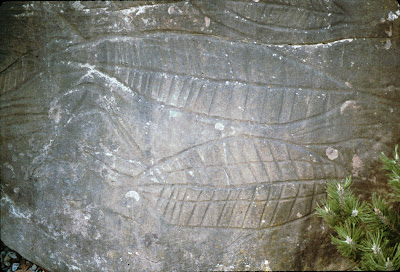
Nanaimo, Vancouver Island, British Columbia, To Welcome the Salmon Back From the Sea, removed from Jack Point, Vancouver Island. Photograph J&E Faris, 1992.

“In this article we have described the specific historical and cultural context of rock art production in the territory of one Coast Salish group. The rock paintings are best understood in terms of marking culturally significant places in the Tsleil-Waututh landscape so that future generations might know their significance.” (Arnett and Morin 2018) Their paper included no illustrations that could be identified as images of salmon. As I stated above, however, as a branch of the Coastal Salish culture they were culturally related to the people who produce other rock art of the area. One particularly important concentration of Salish is found at Nainamo on Vancouver Island, and, at Nainamo, there are images of salmon. These are on a boulder that was recovered from Jack Point in Vancouver Island, which is just a few miles to the east of Nainamo. This petroglyph panel on this boulder shows a group of salmon, supposedly to welcome the return of the salmon to begin their spawning run.

So, we find that across the Northern Hemisphere, and through a period of tens of millennia, salmon were considered a valuable food source and were of great spiritual and ceremonial significance.

NOTE: Some images in this posting were retrieved from the internet with a search for public domain photographs. If any of these images are not intended to be public domain, I apologize, and will happily provide the picture credits if the owner will contact me with them. For further information on these reports you should read the original reports at the sites listed below.

REFERENCES:

Choi, Charles Q., 2011, World’s Oldest Fish Hooks Show Early Humans Fished Deep Sea, 24 November 2011, https://www.livescience.com. Accessed online 30 August 2023.

Efford, Meaghan et al., 2023, Archaeology demonstrates sustainable ancestral Coast Salish salmon stewardship over thousands of years, 25 August 2023, https://journals.plos.org. Accessed online 31 August 2023.

Hardy, Bruce and Marie-Helene Moncel, 2011, Neanderthal Use of Fish, Mammals, Birds, Starchy Plants and Wood 125 – 250,000 years ago, August 2011, Plos ONE 6(8), DOI:10.1371/journal.pone.0023768. Accessed online 13 September 2023.

B.L. Hardy et al., 2013, Impossible Neanderthals? Making String, Throwing Projectiles and Catching Small Game during Marine Isotope Stage 4 (Abri du Maras, France), Quaternary Science Reviews 82 (2013) 23-40. Accessed online 13 September 2023.

Arnett, Chris and Jesse Morin, 2018, The Rock Painting/Xela:Is of the Tsleil-Waututh: A Historicized Coast Salish Practice, Ethnohistory 65:1, American Society for Ethnohistory. Accessed online 16 September 2023.

Walls, Alex, 2023, Salmon bones confirm sustainable chum fishery for 2,500 years under Tsleil-Waututh Nation, 20 August 2023, https://phys.org. Accessed online 30 August 2023.

Wikipedia, Fish Shelter, https://fr.wikipedia.org/wiki/Wikip%C3%A9dia:Accueil_principal. Accessed online 30 August 2023.


Saturday, June 24, 2023

ROCK ART AND PALEO-SYNANTHROPY:

Synanthropy is the term used to describe the process of wild species that have adapted to living in the vicinity of humans and find benefits from it, but are in no way domesticated. In my suburb we have a large number of cottontail rabbits and quite a few squirrels. Additionally, we see raccoons once in a while. This means that we also have foxes and even the periodic coyote sighting. Our daughter's family lives outside of town in a suburban enclave next to a large golf course and they have deer in their yard almost daily. These are all examples of present day synanthropy.

So we can expect that certain animals, birds, and insects, lived in synanthropy with our Paleolithic ancestors, so what? What can that possibly have to do with rock art?

European red fox. Internet image, public domain.

Marshall wrote in New Scientist Online that there are “animals such as urban foxes that live alongside us, and benefit from doing so, are called synanthropes. They aren’t domesticated like dogs or cows. But they are adapted to a human-centric life. Some urban foxes have skull shapes that differ from country-dwellers and more closely match domesticated dogs. Other examples include rats, dandelions and trash pandas – sorry, I mean raccoons.” (Marshall 2023)

The prevailing view up until now has been that synanthropy could not have developed between animals and hunter gatherers because the humans did not leave enough trash (bones, food remains, etc.) to attract animals.

“It’s generally thought that synanthropy began with the agricultural revolution, around 10,000 years ago. That’s when people started settling down in the same place instead of moving around, and crucially when they started storing large quantities of food and accumulating rubbish. The main explanation for the existence of domestic cats is that wild cats started living near human settlements to prey on the mice that were eating our grain. However, it now looks like that’s wrong.” (Marshall 2023)

“Very little research has explored the idea of synanthropic animals before the rise of agriculture, so what follows is tentative. It’s based largely on the work of Chris Baumann at the University of Helsinki in Finland, who has been studying palaeo-synanthropies for the last few years. In April he published a review in Archaeological and Anthropological Sciences, summarizing everything that’s known.” (Marshall 2023) These early assumptions were that people would need to be settled, and producing food surpluses to attract the animal pests and predators.

“How widespread were these palaeo-synanthropies? The short answer is we don’t know. The European evidence is limited to the east and to the last 42,000 years, where studies have been done. Baumann suspects palaeo-synanthropies were both older and more widespread, but he needs direct evidence.” (Marshall 2023) And, I would add this caveat to Marshall's statement "we don't know." I believe we can rightfully say that we do know that paleo-synanthropies had to have existed. We just do not have the data to quantify it.

These early assumptions were that people would need to be settled, and producing food surpluses to attract the animal pests and predators.This, however, does not take in other factors that might also lead to synthropic relationships between humans and animals. Baumann (2023) expanded that understanding somewhat.

European aurochs - paleolithic. Internet image, public domain.

Aurochs, Lascaux Cave, France - paleolithic. Internet image, public domain.

Chris Baumann (2023) explained his theory of human impact on the landscape as providing a niche for human-animal synanthropy. “Key features of this new niche are anthropogenic food waste from mobile hunter-gatherers as a stable food base for small opportunistic scavengers and a human-near environment safe from large predators. By linking the niche to human behavior rather than to a specific location or structure, this niche was accessible for a long time, even in the Late Pleistocene. Like modern synanthropic animals, members of the paleo-synanthropic niche experienced an increase in population density and a decrease in home range. This, in turn, made it easier for humans to capture these animals and use them as resources for meat, fur, or feathers, as seen in the zooarchaeological record of many European Late Pleistocene sites.” (Baumann 2023)

Wisent, or european bison. Illustration pikist.com, public domain.

Wisent, or european bison. Altamira Cave, Spain. Internet image, public domain.

Baumann’s summary focuses on this phenomenon developing as a relationship between hominins and small predators. “Paleo-synanthropic behavior is an adaptation to the micro-environment created by Late Pleistocene hunter-gatherer societies. The resulting niche allowed small to medium-sized opportunistic generalist carnivores or omnivores to gain access to a long-term food resource, i.e., anthropogenic food waste. In addition, this niche provided security against large carnivores, which was ensured by their displacement by humans. As a result, the inhabitants of this new niche experienced population growth and a reduced home range. The paleo-synanthropic niche is not linked to specific geographic regions but is tied to human behavior and is therefore regionally flexible. This enabled paleo-synanthropes to exploit their niche for a long time. The high population density of these animals and their proximity to humans also allowed humans to use them as a resource for meat, fur, or feathers.” (Baumann 2023) Baumann points to human food waste as the mechanism that led to Paleo-synanthropy, focusing on small animals such as foxes and ravens – but I would like to suggest another possibility that could lead to the same relationship with larger animals such as horses, aurochs, deer, etc.

Przewalskis horse (Eurasian wild horse). Internet image, public domain.

 Horses (and rhinoceros), Chauvet Cave, France. Internet image, public domain.

 Horses, Lascaux Cave replica, France. Internet image, public domain.

All assumptions about the Paleolithic Europeans who left us the magnificent cave paintings tell us they lived somewhere in the vicinity of those caves, and according to some dating studies they lived there for long periods of time, at least many generations. Or, perhaps they roamed a larger area in smaller groups, but reassembling on special occasions at the caves for ceremonial purposes.

European Red Deer stag (note the curved tines on the antlers). Internet image, public domain.

European Red Deer (note the curved tines on the antlers). Lascaux Cave, France. Internet image, public domain.

Close-up of the Red Deer (note the curved tines on the antlers). Lascaux Cave replica, France. Internet image, public domain.

Red Deer (note the curved tines on the antlers). Lascaux Cave, France. Internet image, public domain.

They also had fire as a vital tool for heat, light, and even possibly processing some materials such as stone for their tools. This use of fire would require a considerable amount of fuel, eventually leading to the thinning of the forest for firewood around their area of residence, to say nothing of the possibility of accidental fire escaping into the forest. Thinning the forest would, of course, lead to more scrub and grassland in that area, and various grazers and browsers would benefit from the increased food supply. This suggests the possibility that the cave images of deer, horses, and aurochs, were inspired by an increased presence of those animals caused by the increase of grass and shrubbery for grazing and browsing, in synanthropy with their human neighbors. And, increased numbers of animals would also provide increased food for the humans. This would lead to a situation which we can refer to as Paleo-synanthropy, but based upon a different cause and effect than imagined by Baumann.

“Synanthropy may go back several tens of thousands of years. What’s more, other hominins like Neanderthals might have had their own synanthropic companions.” (Marshall 2023)

Many of the assumptions about the Paleolithic Cave Art in Europe center on the relationships of the human population with the animals around them. Given the cohabitation of the humans and animals in the same landscapes it seems reasonable that a synanthropic relationship could have existed between them. This would provide such a relationship. Fire not only provided light for the cave artists, and charcoal for a pigment, fire may have been an important factor in the presence of these animals portrayed in the caves. And, although Baumann chose not to speculate on this, might not synanthropy have been the earliest step toward animal domestication?

NOTE: Some images in this posting were retrieved from the internet with a search for public domain photographs. If any of these images are not intended to be public domain, I apologize, and will happily provide the picture credits if the owner will contact me with them. For further information on these reports you should read the original reports at the sites listed below.

REFERENCES:

Baumann, Chris, 2023, The paleo-synanthropic niche: a first attempt to define animal adaptation to a human-made micro-environment in the Late Pleistocene, 20 April 2023, Archaeological and Anthropological Sciences (2023) 15:63. Accessed online 17 May 2023.

Marshall, Michael, 2023, Our Human Story: Animal Companions, New Scientist, newscientist.com. Accessed online 9 May 2023.

Friday, June 2, 2023

ARE SHADOWS PORTRAYED IN ROCK ART? THEY ARE CERTAINLY IMPLIED IN CAVE ART:

The philosophical search for shadows and the question of their existence in rock art:

Aurochs, horse and deer, Lascaux Cave, France. Internet image, public domain.

The idea for this began with an article from the online site JSTOR Daily dated 1 December 2021, by Roy Sorensen titled "Do We Actually See Shadows?"

Sorensen approached this as a philosophical question beginning with Fridugisus of Tours in the 8th century who wrote "a short treatise which deals with the nature of nothing and darkness. The epistle was written probably during the author's residence at Tours. It is addressed "to all the faithful and to those who dwell in the Sacred Palace of the most serene prince Charles (Charlemagne). It dealt with the question, are nothing and darkness real things? (Some suggest that this was inspired by the Biblical use of the words in the first chapter of the Book of Genesis). If the Bible uses the words 'nothing' and 'darkness', it seemed that there must be things corresponding to those words. Fridugisus accepts this answer and defends it both by arguments from authority and by arguments from reason." (Wikipedia)  Is nothing or nothingness a real thing, and is darkness a real thing in and of itself"

Sorensen, in effect, was asking that if a shadow is composed of the absence of light, how can we see the presence of the absence of something? In other words, we see because of the light illuminating the things around us. How can we see something it is not illuminating? He goes to considerable historical detail referencing, among others, Plato's "Allegory of the Cave." He brings in the Metaphysical with the question if you spin a ball does the shadow of the ball spin?" Some say "yes." but can you see the shadow spinning?

Sorensen gets deeper with this but what drew my attention was his reference to Medieval artists who did not paint shadows. He stated "Shadows were fringe phenomena in the Dark Ages. They are rarely depicted in the era's paintings. Perhaps the artists portrayed only what they believed to be visible." (Sorensen 2021)  This can be checked and I did so, searching online for public domain medieval paintings.

The Trinity (detail) in Saint Augustine’s City of God”, about 1440–50, Master of the Oxford Hours. Tempera colors, gold and silver paint, and ink on parchment, 14 ¼ x 10 ¾ in. (36.2 x 27.3 cm). The J. Paul Getty Museum.

A few, very faint traces of shadows beneath the figures. Shading on the figures, yes, but they cast no shadows in their environment.

“Saint Martin Dividing His Cloak” in the Prayer Book of Charles the Bold, 1469, Lieven van Lathem, made in Ghent and Antwerp. The J. Paul Getty Museum.

Likewise, shading within the elements of the painting, but no cast shadows.

Medieval women hunting. Internet image, public domain.

And again, no shadows cast by the women and their dogs in the environment.

Now since I warp everything toward the question of how it applies to rock art I began looking for examples of rock art that somehow portrayed shadows. I looked at examples from literally all over the world (my photos, books, online) but could find no instances of what can be identified as a shadow. Then I remembered that I had done a column on counter-shading on the images of horses in European Cave Art back in January 2022, so I went back to my own notes.

Torch illuminating a cave. Image from Medina-Alcaide et al., 16 June 2021.

In looking at my file for that article I found the paper by a team of Spanish researchers on cave lighting. This simple, but clever, experiment used a variety of sources of fire to illuminate a cave, one of which was a hand-held torch. Others were things like small fires on the floor of the cave and animal fat lamps. To my way of thinking the hand-held torch would give the most dramatic effect.

I started looking at the Paleolithic paintings of animals in European Caves, such at Lascaux, Chauvette, Les Trois-Freres, and Tito Bustillo and found shadows under the animals, but not shadows painted by the cave artists. Now the nature of torch light is that it acts much like a point source and, depending on how high you hold it, the irregularities of the stone wall in a cave will have shadows of their own underneath any change of contour in the surface.

Horses and Aurochs, Lascaux Cave, France. Early Magdanenian period (17,000 BCE). Internet image, public domain.

The first image I noticed this effect on is this one from Lascaux. The small horse on the left and the Aurochs have their hooves approximately on the upper edge of the shadow on the cave wall. And once I saw this, examples started jumping out at me all over the place. It must be remembered, these are not shadows created by the artist or image maker, they are shadows on the cave wall created by the angle the light of the torch is falling from, but the image maker has used them cleverly to create the desired effect. Other effects that visually approximate shadows under animals painted on cave walls can be color change in the stone wall, and/or other sources of discoloration. And not all are done this way, indeed most panels also have animals that are not standing on shadows, but it turned out a surprising number are.

Aurochs, Horses, and Deer, Lascaux Cave, France. Internet image, public domain.

There were a great number of examples from Lascaux Cave in France. In this one we see horses, aurochs, and a deer with their feet on the top edge of the shadow on the cave wall.

Aurochs, Lascaux Cave, France. Internet image, public domain.

Horse, Lascaux Cave, France. Internet image, public domain.

In some examples the shadow seems to be the result of a color change in the stone surface. Also, we need to keep in mind that these modern photographs were made in lighting that is as even as possible to show up the images, not to accentuate shadows underneath them.


Horse and two superimposed mammoths, Chauvet Cave, France. Illustration from Jean-Marie Chauvet, et al., 1996, “Dawn of Art: The Chauvet Cave.

Although this is not a strong example we can see the break in the cave wall underneath thehorse and mammoths and it would be shadow under the right lighting conditions.

Mammoth, Chauvet Cave, France. Illustration from Jean-Marie Chauvet, et al., 1996, “Dawn of Art: The Chauvet Cave, p. 58.
Owl, Les Trois Freres Cave, France. 15k BP. Illustration from Paul Bahn and Jean Vertut, “Journey Through the Ice Age,” fig. 10.24, p. 155.
Horse, Tito Bustillo Cave, Spain. Ca. 25k BP. Bahn, Paul, and Jean Vertut, 1997, “Journey Through The Ice Age,” University of California Press, Berkley, California.

From these various illustrations, and from various ages and locations, we see that this design factor was used across a large geographic area and for a very long time. The fact that it is associated with a large number of different animals also is a strong suggestion that it is not just associated stylistically with aurochs, or horses, etc., but that it may indeed have been the simulation of the creature's shadow that was the goal.

So, is this a real phenomenon? Well yes, it is real in that we have seen it exists. But was the placement of animals so that they are standing on a shadow, or an area of color change in the stone intentional, or a coincidence? That is to be decided in the future, probably with a whole lot of arguing involved. But, I will end with this, the cave artists were certainly intelligent and sophisticated enough to have done this intentionally.

NOTE 1: Some images in this posting were retrieved from the internet with a search for public domain photographs. If any of these images are not intended to be public domain, I apologize, and will happily provide the picture credits if the owner will contact me with them. For further information on these reports you should read the original reports at the sites listed below.

NOTE 2: This paper was presented at the 2023 IFRAO (International Federation of Rock Art Organizations) Rock Art Symposium, Valcamonica, Italy, by the author on 27 May 2023.

REFERENCES:

Medina-Alcaide et al., 16 June 2021, The conquest of the dark spaces: An experimental approach to lighting systems in Paleolithic caves”, https://journals.plos.org/plosone/article?id=10.1371/journal.pone.0250497 (Public Library of Science)

Sorenson, Roy, 1 December 2021, “Do We Actually See Shadows?”, https://daily.jstor.org/ (short for Journal Storage).

Illustration credits:

Illustrations 1 – 9 are Public Domain images from online.

Illustrations 10 – 11: Jean-Marie Chauvet, et al., 1996, “Dawn of Art: The Chauvet Cave (The Oldest Known Paintings in the World)”, H. N. Abrams, New York.  

Illustrations 12 - 13: Bahn, Paul, and Jean Vertut, 1997, “Journey Through The Ice Age,” University of California Press, Berkley, California.

Saturday, March 13, 2021

OBESE FIGURES IN PALEOLITHIC ART:


 "Venus" of Willendorf, 4.4", carved limestone, covered with ochre, ca. 25,000 BCE, Austria. Internet photo, Wikipedia, Public Domain.

Among the many mysteries in Paleolithic art are the chubby little femalefigures first named by French researchers as “Venus” figures. Their purpose/uses are unknown but among the questions is the obesity or chubbiness displayed by so many of them. These figures, primarily figurines although they include a painted figure and a bas-relief, have been found from Italy through France and Germany to Russia. So why are the figures predominately portly with a few shown as extremely obese?


Lespugue "Venus", ca. 25,000 year old, Photo Musee de l'Homme, Paris.

Now a new study has tackled that question with a clever approach. They measured figurines and cave art and calculated in the distance from the glacial front at the time of their creation.  “Figurines of woman with obesity or who are pregnant (“Venus figurines”) from Upper Paleolithic Europe rank among the earliest art and endured from 38,000 to 14,000 BP (before present), one of the most arduous climatic periods in human history. We propose that the Venus representation relates to human adaptation to climate change. During this period, humans faced advancing glaciers and falling temperatures that led to nutritional stress, regional extinctions, and a reduction in the population. We analyzed Paleolithic figurines of women with obesity to test whether the more obese figurines are from sites during the height of the glacial advance and closer to the glacial fronts. Figurines are less obese as distance from the glaciers increases. Because survival required sufficient nutrition for child-bearing women, we hypothesize that the overnourished woman became an ideal symbol of survival and beauty during episodes of starvation and climate change in Paleolithic Europe.” (Johnson et al. 2020)


"Venus" of Hohle Fels, mammoth ivory, ca. 40,000 - 35,000 BCE, Schelklingen, Germany. Internet photo, Wikipedia, Public Domain.

The results of this analysis seem to confirm a theory published in 2014 in the journal Endocrinology. “We propose here that the ability to thermoregulate in extreme heat or cold afforded powerful survival advantages and therefore commanded much higher selection coefficients than those for thrifty genes, which purportedly provided merely a slight fecundity advantage. Moreover, to reproduce you must survive. Survival advantages must therefore supersede fertility advantages. Genes that were essential to survival, particularly in newborn or young children, such as those that control thermoregulation would be of greater importance than thrifty genes because they would allow an individual to survive to reach reproductive age.” (Sellayah et al. 2014)

"Venus" of Laussel, France. carved limestone, painted with ochre, 18.11" high, ca. 25,000 BCE. Internet photo, Wikipedia, Public Domain.


Chauvet "Buffalo Woman", France. Photo pinterest.com, Public Domain. A woman's obese lower torso formed from the front legs of a buffalo and a lion with the addition of the vulva.

In other words, the closer to the glacier front the more obese the female portrayals in cave art and figurines. This would seem to provide a survival advantage in two ways. One, the extra adipose tissue could be drawn on for nutrition at times of nutritional stress, and two, extra body fat provides extra insulation against the cold. Additionally, with these reserves a woman would be more reliably fertile and so would insure a next generation for the clan, and just might pass this trait to obesity on genetically to her offspring. This suggests that such a woman would be highly regarded within the group and looked up to by others.


"Venus" of Gagarino, carved ivory, ca. 21,000 - 25.000 BCE, Russia. Internet photo, Wikipedia, Public Domain.

The attitude of a group toward the “ideal” figure is heavily influenced by the examples of persons in the upper echelons of society.

“An important cultural question is, ‘what is a ‘good’ - desirable, beautiful, impressive - body?’ The answers are legion; here I examine why bigger bodies represent survival skill, and how this power symbolism is embodied by behaviors that guide larger persons toward the top of the social hierarchy. Bigness is a complex concept comprising tallness, boniness, muscularity and fattiness. Data show that most people worldwide want to be big - both tall and fat. Those who achieve the ideal are disproportionately among the society’s most socially powerful.” (Cassidy 1991)


"Venus" of Dolni Vestonice, Czech Republic. Ceramic, ca. 29,000 - 25,000 BCE, one of the oldest known ceramic articles. Internet photo, Wikipedia, Public Domain.

The concept of large bodoy mass being considered desirable is not foreign to history. In the reports of western explorers of the 17 and 18th centuries we read of the Polynesian ideal of beauty involving considerable body mass and gives us a tangible example of the concept in action.  Writing about the native Hawaiian race in 1917 MacCaughey stated: “Many of the chiefs and women of their families have been remarkable, not only for their height, but also for their weight. Four hundred pounds was formerly not unusual for one of this favored class, and three hundred pounds was the prevalent weight among the nobility. This corpulence was much more common among the women than the men.” (MacCaughey 1917:169)


Figure from Brassempouy, mammoth ivory, 3.65 cm. high, ca. 26,000 - 24,000 BP. Internet photo, Wikipedia, Public Domain.

As far as the question of the likelihood of reproduction, it is well known that being underweight for a woman severely effects her fertility. “If you’re underweight and have too little body fat, you may have too little progesterone and higher than normal levels of the stress hormone cortisol, either of which could impair ovulation and implantation. ‘If you underweight, your body sensed this as stress and shuts off the reproductive system to focus on things that are essential to survival.’” (Colin 2020)


"Venus of Polichenelle", carved green steatite, 61mm high, ca. 27,000 BP, Grimaldi, Italy. Internet photo, Wikipedia, Public Domain.

While it is true that being obese can also affect a woman’s hormones and interfere with reproduction, all in all it seems that being somewhat overweight must have been seen in the Paleolithic society as more attractive, and more likely to bear children. While this new study (Johnson et al. 2020) can not help settle whether these “Venus” figurines are objects of devotion or pornography, it does help us understand the social background that led to their creation.

NOTE: Some images in this posting were retrieved from the internet with a search for public domain photographs. If any of these images are not intended to be public domain, I apologize, and will happily provide the picture credits if the owner will contact me with them. For further information on these reports you should read the original reports at the sites listed below.


REFERENCES:

Cassidy, C. M.1991, The Good Body: When Big is Better, Medical Anthropology 13(3),Sept. 1991, pp.181-213

Colin, Stacey2020 How Body Weight and Body Mass Index (BMI) Affect A Woman’s Fertility and Ability to Conceive, February 24, 2020, https://www.everdayhealth.com/fertility/body-weight-bmi/

Johnson, Richard J., Miguel A. Lanaspa, John W. Fox, 2020, Upper Paleolithic Figurines Showing Women with Obesity May Represent Survival Symbols of Climatic Change, December 1, 2020, Obesity, Journal of the Obesity Society, https://doi.org/10.1002/oby.23028

MacCaughey, Vaughan1917 The Physique of the Ancient Hawaiians, Scientific Monthly, August 1917, Vol. 5, No. 2, pp. 166-174, published by the American Association for the Advancement of Science, URL: https://www.jstor.org/stable/22645

Sellayah, Dyan, Felino R Cagampang, Roger D. Cox2014, On the Evolutionary Origins of Obesity: A New Hypothesis, May 1, 2014, Endocrinology, Vol. 155, Issue 5, p. 1573-1588

Wikipediahttps://en.wikipedia.org/wiki/Venue_figurine