Showing posts with label Mayan. Show all posts

Saturday, November 12, 2022

CACAO IN THE AMERICAN SOUTHWEST AND ROCK ART:


One minor, but enjoyable, facet of the study of rock art in the American Southwest is the search for Mesoamerican influences in the imagery. Many examples of large-eyed anthropomorphs, for instance, have been labeled (whether righly or wrongly) as Tlaloc, the Aztec rain god. I have previously written about so-called abstract examples of rock art that resemble glyphs in Mayan or Aztec writing. On 30 October 2021 I published “Symbols for Geologic Phenomena in Rock Art – Earthquakes Revisited” (Faris 2021) in which I showed a symbol in New Mexico that resembled the Aztec glyph representing earthquakes. On 15 August 2015, I published “Wind Symbols in Rock Art of Chaco Canyon” showing a petroglyph in Chaco Canyon that appears identical to Mesoamerican breath/speech/wind scrolls. (Faris 2015) I make no claims to being a Mayanist, linguist, or epigrapher, so these comparisons may be on shaky ground, but it is an interesting question. Now, I am presenting another Mayan symbol that has possible relatives in the American Southwest – the glyph for cacao.
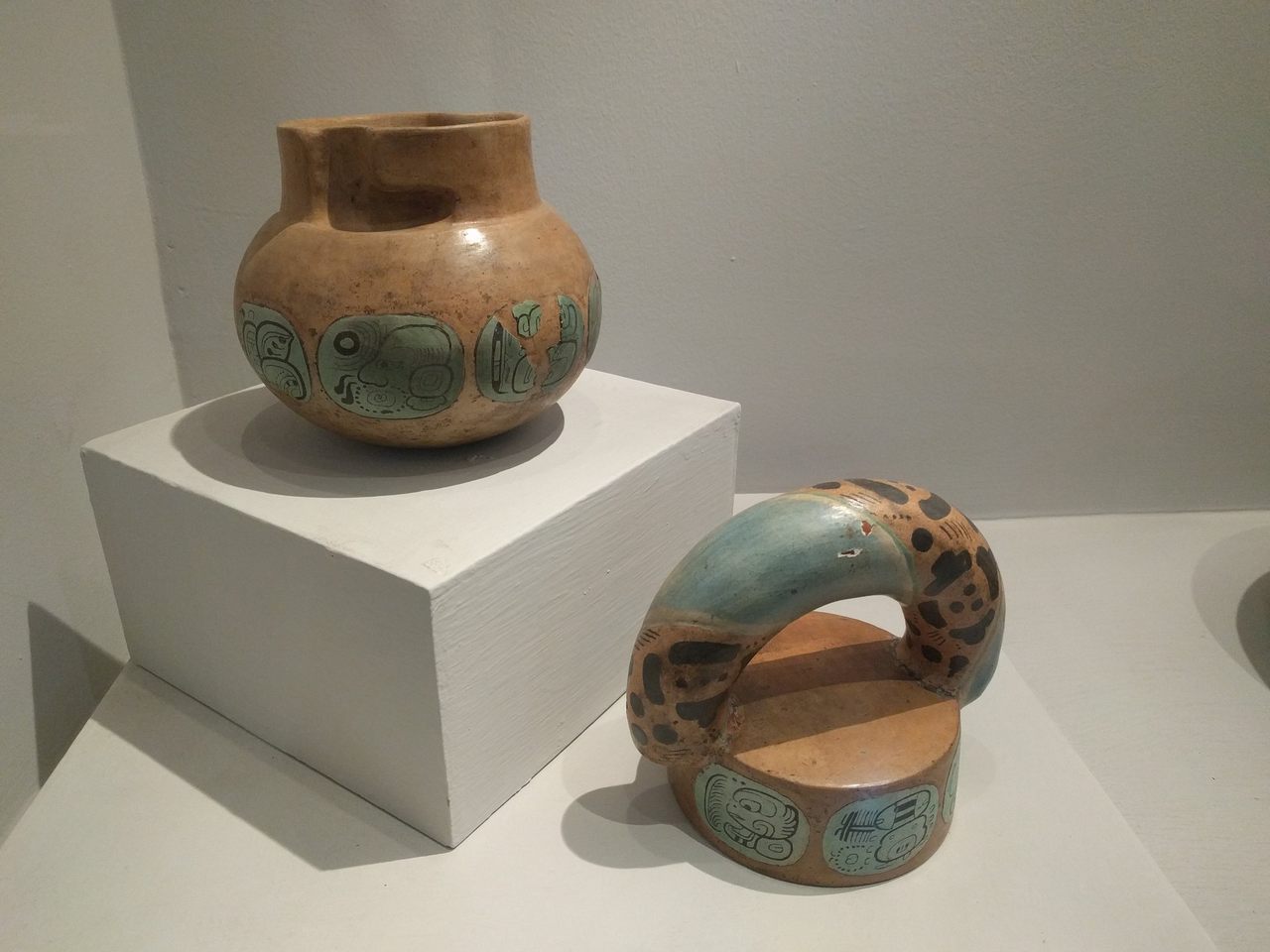
Rio Azul cocoa pot, Mayan, Guatemala. Illustration from atlasobscura.com.

Cacao, the flavoring ingredient of our modern chocolate was of huge  importance to the Maya. “During the Classical Period of the Maya, from approximately 250 – 900 A.D., chocolate was a cornerstone of daily life. It was currency, a ritual ingredient, and a pleasurable drink. But until recently, the details of Maya life were fairly opaque, largely due to the destruction wrought by the conquering Spanish. In the 1980s, after intense effort by Mayanist scholars, there was breakthrough after breakthrough in deciphering Maya glyphs, the written symbols that survived in codices, stone carvings, and pottery. One milestone was the examination of a remarkable ancient vessel, which was found by an unlikely party, to contain chocolate.” (Ewbank 2019)

Of these glyphs on the vessel, drawn by Stuart, the two on the right of the top two lines read cacao. Drawing by David Stuart.

This vessel was found in an untouched Mayan tomb. “In 1984, archaeologists discovered a pristine Maya tomb in the Rio Azul region of Guatemala. Among the royal offerings, they found an exquisite pot. Topped with a twist-top and a handle painted like jaguar skin, it contained an intriguing residue.” (Ewbank 2019:1)

“The archaeologists and anthropologists working on the Rio Azul project mused over whom to send the residue to for analysis. ‘Okay, well, who knows the chemistry of chocolate really well?’ Stuart says with a chuckle. So, they called the number on the back of a Hershey’s bar and got in touch with W. Jeffrey Hurst, an analytical chemist at the Hershey Food Corporation Technical Center. The chocolate company had labs full of PhDs, where Hurst and chemist colleague Stanley M. Tarka tested the residue. Sure enough, says Stuart, ‘they ran the chemical signatures, and they were spot on.’ Hershey chemists found caffeine and theobromine in the residue. ‘The only plant or organic material in all of ancient America that can produce those two chemical signatures together are cacao.” (Ewbank 2019:2)

This pot also had a number of Mayan glyphs on the outside, and the excavators called in Mayanist David Stuart to decipher them. “’I was actually the person they brought on to read all of the hieroglyphs that they found in their excavations, which was a pretty cool job to have,’ Stuart says. While Stuart only saw photographs of the pot, he was nevertheless struck by it. ‘Wow, that is one bizarre vessel,’ he remembers thinking. Not only did it have an unusual shape, but the glyphs adorning it were remarkably well preserved. ‘and then it was like, Wait a minute, two of them spell out the word kakaw.’” (Ewbank 2019:2) Kakaw is the Mayan equivalent for our modern word cocoa, one of the few Mayan words that are also common in our modern English.

Chaco canyon cylindrical jars, American Museum of Natural History. Photograph by Marianne Tyndall.

At Chaco Canyon in western New Mexico the archaeologists who excavated Pueblo Bonito found a large number of cylindrical pieces of pottery. “Scientists have long puzzled over the purpose of tall, cylindrical jars found in the northwestern New Mexico site known as Pueblo Bonito in Chaco Canyon. Speculations range from vessels for corn beer or, with skin stretched over the tops, for drums.” (Ehrenberg 2009)

Patricia Crown of the University of New Mexico “had learned of similarly sized jars from some Maya sites that researchers knew were specialty vessels for cacao drinks. (When the symbols on the Maya jars were finally deciphered, they read the equivalent of ‘This is Bill’s cacao vessel’) Crown sent shards from several jars and a pitcher to paper coauthor Jeffrey Hurst, a specialist in analysis of cacao remains with the Hershey Center for Health and Nutrition in Hershey, Pa.” (Ehrenberg 2009) This is the same scientist who had done the analysis for the Mayan pot from the Rio Azul site.

“Using mass spectrometry and high performance liquid chromatography, Hurst analyzed the traces of residue on the jar shards. Cacao has more than 500 compounds, but theobromine gives it away. The chemical could have only come from the cacao plant, a neotropical tree that doesn’t grow north of Mexico. Three of the five shards had traces of theobromine, the pitcher shards did not Crown says.” (Ehrenberg 2009) This analysis, then, seems to provide proof that Mexican cacao was present in the American Southwest.

Indeed, “this is not only evidence for cacao use north of the Mexican border, but, if these sherds are indeed from cylinder jars, it is evidence for how cylinder jars were used in rituals in Pueblo Bonito. At least on some occasions, the jars held a drink made from cacao seeds brought from a great distance.” (Crown and Hurst 2009: 2112)

“Pueblo groups and an ensuing Southwest society traded turquoise for Mesoamerican cacao for about five centuries, from around 900 to 1400, proposes a team led by archaeologist Dorothy Washburn of the University of Pennsylvania in Philadelphia. Surprisingly, large numbers of people throughout Pueblo society apparently consumed cacao, from low-ranking farmers to elite residents of a multistory pueblo.” (Bower 2011)

“Whether Chacoan ritual practitioners appropriated and adapted the use of cacao and cylinder vessels to existing ritual in a way that was uniquely southwestern or adopted a Mesoamerican ritual remains and open question.” (Crown and Hurst 2009: 2112)

If cacao itself was present at Chaco Canyon it could only have been traded in from Mesoamerica, and with the physical presence of cacao, is it not conceivable that the Mayan symbol designating cacao could have come north with it? “Cacao: that is, chocolate. ‘It’s one of the few words we use that is actually Mayan,’ Stuart says. The Maya glyph for cacao, as it appears on the Rio Azul vessel, looks like a fish. But ‘it turns out the fish is a phonetic sign,’ Stuart says. He recognized that the glyph combining a fish (ka), a comb or fin (ka), and the sign for –w(a) was, of course, Kakaw. While Mayanist Floyd Lounsbury was the first to phonetically decipher a cacao glyph a decade prior, deciphering the cacao glyph on a Maya vase was a breakthrough.” (Ewbank 2019)

Fish variant of Mayan glyph for cocoa. Drawing by David Stuart. Internet illustration, public domain.

So the fish provides for the syllable KA, the fin provides another KA, and the small ear-like oval is the W, adding up to KAKAW or cacao.

Head variant of Mayan glyph for cocoa.  Drawing by David Stuart. Internet illustration, public domain.

In another rendering of the glyph the fish is replaced with a head and two fins provide the KA and the KA, with an ear-like oval still providing the W. So. if we are going to find an equivalent to the Mayan Kakaw glyph in the American Southwest we should look for a pair of fin or comb like shapes with the ear-like oval. And I have indeed found at least a couple of examples that just might fill this bill.

Mesa Prieta, Rio Arriba county, New Mexico. Photograph Peter Faris, 14 May 1997.

Mesa Prieta petroglyph, kakaw highlighted on photograph. Peter Faris.

Drawing of glyph, Peter Faris.

My first possibility is found on Mesa Prieta in Rio Arriba County, New Mexico. Two fans or combs are contained in a circle with the oval ear-like oval appended to it, much like the second, or face variant, example of the Mayan glyph.

Taos county, San Luis Valley, northern New Mexico. Photograph Peter Faris, March 1995.

Petroglyphs highlighted on photograph. Illustration by Peter Faris.
Drawing of glyph. Peter Faris.

Another possibility, although somewhat weaker, also has two fans or combs with an ear-like oval, but without the enclosing circle. This one is in the San Luis Valley, in Taos County in Northern New Mexico.

Were these meant to be references to cacao in northern New Mexico? I really do not know, but it is certainly fun to do the speculation.

NOTE: Some images in this posting were retrieved from the internet with a search for public domain photographs. If any of these images are not intended to be public domain, I apologize, and will happily provide the picture credits if the owner will contact me with them. For further information on these reports you should read the original reports at the sites listed below.

REFERENCES:

Bower, Bruce, 2011, Pueblo trade for chocolate big-time, 17 March 2011, https://www.sciencenews.org, accessed 17 September 2022

Crown, Patricia L., and W. Jeffrey Hurst, 2009, Evidence of cacao use in the Prehispanic American Southwest, pp. 2110-2113, PNAS, 17 February 2009, Vol. 106, No. 7, www.pnas.org.

Ehrenberg, Rachel, 2009, Chocolate may have arrived early to U. S. Southwest, 2 February 2009, https://www.sciencenews.org, accessed 15 October 2022.

Ewbank, Anne, 2019, Archaeologists, Mayanists, and Hershey’s Collaborated to Reveal This Ancient Vessel’s Secrets, 21 February 2019, https://atlasobscura.com/articles/mayan-chocolate?, accessed 15 October 2022.

Faris, Peter, 2021, Symbols for Geologic Phenomena in Rock Art – Earthquakes Revisited, 30 October 2021, https://rockartblog.blogspot.com/2021/10/symbols-for-geologic-phenomena-in-rock.html

Faris, Peter, 2015, Wind Symbols in Rock Art of Chaco Canyon, 15 August 2015, https://rockartblog.blogspot.com/2015/08/wind-symbols-in-rock-art-of-chaco-canyon.html 

Saturday, August 13, 2022

BALLCOURT PETROGLYPHS IN MEXICO MARK SACRIFICE SITES:

On 28 August 2021, I posted a column titled “T-Shaped Doorways, Ballcourts, Pipettes, and the Wind” (Faris 2021) which postulated a relationship between the rock art symbols known as pipettes, Ancestral Pueblo T-shaped doorways, the Mayan character for wind, and Mesoamerican ballcourts.

Ballcourt petroglyph from El Gentil site. Photograph Alex Badillo, Figure 6A. page 12.

Now, a concentration of thirty petroglyphs representing the ballcourts themselves has been recorded in Mexico on the north slope of the Sierra Sur. Representations of ballcourts carved in stone have been found throughout a large area of Mesoamerica but this column will visit the thirty newly discovered ones near Quiechapa.

Contour diagram of a cluster of Ballcourt petroglyphs. Diagram by Alex Badillo, from Figure 8. page 15.

“During an archaeological survey in the municipality of San Pedro Martir Quiechapa, Oaxaca, Mexico, archaeologists from the Proyecto Arqueologico de Quiechapa (PAQuie) encountered and documented a number of carved stone elements. Of particular interest are the 30 representations of ballcourts carved into natural rock outcrops at two sites in the region. This is the highest density in which this type of ballcourt representation occurs throughout Mesoamerica.” (Badillo 2022)


Contour diagram of Ballcourt petroglyph from El Gentil site. Diagram by Alex Badillo, from Figure 10. page 18.

These carved ballcourts were found in two groupings. At a location named El Gentil, twenty-two carved ballcourts measured from 8.0 cm to 34.1 cm in length. (p. 13) Eight more carved ballcourts were identified at a location named El Derrumbadero, with more considered possible ballcourts but too eroded for positive identification.

“It’s not clear what the carvings were used for, but the researchers suggested that ancient Mesoamericans may have used them for rituals. The Spanish priest Juan Ruiz de Alarcon (lived 1581 to 1639), who lived in what is now Mexico following Spain’s conquest of the area in the 16th century, ‘describes certain rituals during which a [Mesoamerican] priest would have people spill blood into small cavities that they had made in stone,’ Badillo wrote in the study, noting that those cavities could include the ballcourt carvings.” (Jarus 2022) This is not the fallback designation of “ritual or ceremonial” for any feature not immediately understood so often indulged in by archaeologists. This is, in fact, a very reasonable proposition given the ritual and ceremonial nature of the hipball game played in the large architectural ballcourts. This could, of course, be tested with blood protein residue testing.

"The Classic Maya ballgame was far more than a frivolous sport: it was, rather, a ritual correlation of war and human sacrifice. - the Classic Maya confirm the nature of the ballgame by the emphasis chosen in their ballgame art and inscriptions: in that art, they saw the ballgame as part of a larger ritual cycle, with a focus on huan sacrifice." (Miller and Houston 1987:63)

Mayan Ballcourt from Monte Alban, view from above. From Badillo, Figure 6B, page 12.

"The association between human sacrifice and the ballgame appears rather late in the archaeological record, no earlier than the Classic era. The association was perticularly strong within the Classic Veracruz and the Maya cultures, where the most explicit of human sacrifice can be seen in the ballcourt panels - for example at El Tajin (850-1100 CE) and at Chichen Itza (900-1200 CE) - as well as on the decapitated ballplayer stelae from the Classic Veracruz site of Aparicio (700-900 CE). The Postclassic Maya religious and quasi-historical narrative, the Popol Vuh, also links human sacrifice with the ballgame. Captives were often shown in Maya art, and it is assumed that these captives were sacrificed after losing a rigged ritual ballgame." (Wikipedia)

So the range of these sacrifices ranged from auto-da-fe in which a participant let some of his own blood as a sacrifice to the gods, to the death by execution of a prisoner. We are told that the gods needed regular infustions of blood to keep the world operating in order.

"These seemingly inert stone carvings in Quiechapa's landscape may have been part of deeply meaningful and active social performances that included ritual bloodletting for many possible purposes, including mainting balance and agricultural fertility, marking important moments in time, or fomenting intra- and inter-community bonds. However, further studies that attempt to understand the details of these fitual performances are required to go beyond the hypothetical understanding of these features. In the end, many more questions are left unanswered about the meaning of these carvings and how they were understood and used in the pre-Hispanic past by the prople who lived in rural Quiechapa on the northern slope of the Sierra Sur region." (Badillo 2022:27-8)

As I stated above, whether or not sacrificial blood was ever deposited in these ballcourt-shaped carvings could be relatively easily determined with blood protein residue testing of the kind that is performed on stone tools. It would be really interesting to find out on way or another.

Ballcourt at Toninas, Chiapas, Mexico. Illustration from latinamericanstudies.org.

Another aspect of the ritual significance of the Maya ballgame has recently presented itself in excavations at Tonina. "Tonina, meaning 'house of stone' in the Tzeltal language was originally called Po'p, Po or Popo in Classic Maya texts. The city is located in the Chiapas highlands of southern Mexico, east of the town of Ocosingo. The site contains two groups of temple-pyramids set on terraces rising some 71 metres above a central plaza, two ballcourts, and over 100 carved monuments that mainly date from the 6th century through to the 9th centuries AD during the classic period." (HeritageDaily 2022)

In one of the larger temple pyramids researchers discovered a crypt in 2020. A labrynth containing a series of small vaults and rooms connected by stairways led to an antechamber and the crypt at a depth of 8 meters inside the pyramid and dating from the 7th and 8th centuries AD. "The antechamber and crypt have small niches where the researchers found more than 400 vessels filled with organic material such as human ashes, charcoal, rubber and roots. A miicroscopic analysis of the organic material revealed that the human ashes (likely the remains of high-ranking people or Maya rulers) was used in the vulcanization process for hardening rubber, used for making balled used in Maya ritual ball games played in the ballcourts at Tonina." (HeritageDaily 2022)

The discovery that the ball itself used in the sacred Maya ballgame is created with the ashes of sacred ancestors gives a whole new level of meaning to the ritual importance of the game and the rites associated with it.

NOTE: Some images in this posting were retrieved from the internet with a search for public domain photographs. If any of these images are not intended to be public domain, I apologize, and will happily provide the picture credits if the owner will contact me with them. For further information on these reports you should read the original reports at the sites listed below.


REFERENCES:

Badillo, Alex Elvis, 2022, Ballcourt Representations in Quiechapa, Oaxaca, Mexico: Ritual Offerings, Fertility, and Life, 11 January 2022, Cambridge University Press (online), https://www.cambridge.org

Faris, Peter, 2021, T-Shaped Doorways, Ballcourts, Pipettes, and the Wind, RockArtBlog, https://rockartblog.blogspot.com/search/label/pipettes

HeritageDaily, 2022, Maya crypt contains cremation burials used for making rubber balls in ritual ball games, 2 August 2022, accessed 2 August 2022.

Jarus, Owen, 2022, Ancient ritual bloodletting may have been performed at carvings found in Mexico, 3 May 2022, https://www.livescience.com, accessioned 4 May 2022.

Miller, Mary Ellen, and Stephen D. Houston, 1987, The Classic Maya Ballgame and its Architectural Setting, Academia.edu

Wikipedia, Mesoamerican Ballgame, https://en.wikipedia.org/wiki/Mesoamerican_ballgame. Accessed on 18 June 2022.


Sunday, February 21, 2021

NEW MAYAN CAVE PAINTINGS DISCOVERED IN YUCATAN:


New Mayan cave paintings discovered in the Yucatan.

An important discovery of Mayan paintings has been discovered in a cave 12 meters below ground in the eastern Yucatan by a team of archaeologists led by Sergio Grosjean Abimerhi.

“’It’s not the only cave with paintings in Yucatán but it is the most important because they have many elements: birds, mammals, a cross, geometric figures, human forms and among those that of a warrior as well as [prints made with] the front and back of hands,’ Grosjean said.” (Mexiconewsdaily)

   
     New Mayan cave paintings discovered                           in the Yucatan.

“The director of the Mexican Institute of Ecology, Science and Culture - a non-governmental organization that conducts environmental and cultural investigations - said that like cave paintings found in other parts of Yucatán, the newly discovered artwork ‘shows the high degree of evolution of the Mayan culture’. Grosjean explained that the colors of the paintings are derived from a wide range of natural pigments and other materials such as red earth, which is known in the local Mayan language as k’ankab. He added that neither the age of the paintings nor their exact significance has yet been determined but stressed ‘they’re the most important we have seen.’” (Mexiconewsdaily)

These painted images are noticeably different from much of the Mayan art we see with its formalized figures and inscriptions on steles and temples. This does not show as an organized scene of anything at all but a collection of symbols and images, probably done a little at a time over a longer period, and probably not by the same people who created the formal, public art of Mayan cities. Being in a cave, instead of on public display, would lead us to assume that they were produced for a much more private purpose, and for a much smaller audience.


      New Mayan cave paintings discovered in                           the Yucatan.

“In the coming days the team Grosjean leads will return to the cave with archeologists from the National Institute of Anthropology and History (INAH) to carry out further identification work. ‘At the moment, we can’t reveal the exact location [of the cave] because undortunately in Yucatán, the looters and vandals are one step ahead of us,’ Grosjean said.” (Mexiconewsdaily)

Press reports do not mention any nearby Mayan cities or major sites so, in lieu of that knowledge, I will make some assumptions. I assume that these were not done by an important scribe or cleric from some kingdom, but by a local in a rural village or small town. He was probably acting equivalently to the scribes or clerics who produced major inscriptions and pictures, but for a rural or village audience instead of the court of an important city or capital. Without the formalized education or training of that scribe or cleric this creator was doing the best he could to produce the equivalent results on his own.


      New Mayan cave paintings discovered in                           the Yucatan.

Grosjean stated that “neither the age of the paintings nor their exact significance has yet been determined but stressed ‘they’re the most important we have seen.’” (Mexiconewsdaily) Well, that is demonstrably nonsense, but they do allow us, if the assumptions above are correct, to compare the tangible remains of rites or practices of difference levels of society, to compare the spiritual and intellectual life of the serfs with the royalty, so to speak.

NOTE: Some images in this posting were retrieved from the internet with a search for public domain photographs. If any of these images are not intended to be public domain, I apologize, and will happily provide the picture credits if the owner will contact me with them. For further information on this you should read the original report at the site listed below.

REFERENCES:

Staff,2018 Treasure Trove of Mayan Cave Paintings Discovered in Yucatan, July 25, 2018, https://mexiconewsdaily.com/news/cave-paintings-discovered-in-Yucatan/

Thursday, May 9, 2019

ORIGINS OF THE OUTLINED CROSS VENUS SYMBOL:


Four-armed outlined cross Venus
symbol. Redrocks, AZ.
Photo Paul and Joy Foster.

The 4-armed symbol representing the planet Venus seems to have been ubiquitous prehistorically among cultures in Mexico and much of Central America. This, to such an extent that when we find it in contiguous areas like the American Southwest we also tend to apply that meaning to it. But how did that symbol, the outlined 4-armed cross or star, get to be associated with the planet Venus. In order to approach that question I had to look into the background of the subject.

In 1996, John B. Carlson wrote a paper titled "Transformations of the Mesoamerican Turtle Carapace War Shield, A Study in Ethnoastronomy", that looked at war shields from Mesoamerica and the American Southwest. He found that a common subject for the decoration of these symbols of conflict was the crucifix representing the planet Venus.

"It is now well understood that, at least from Late Formative times in Mesoamerica (around the beginning of the Common Era and probably much earlier), the planet Venus was viewed as a powerful male god of warfare and sacrifice. The evidence for this cult of Venus-regulated warfare and sacrifice comes from various archaeological sources, including inscriptions and iconography, from Spanish chronicles and ethnohistorical sources, and from Pre-Columbian codices." (Carlson 1996:100) Additionally, Carlson noted a frequent portrayal among Mayan (and Aztec) stela and other carvings, of a turtle carapace used by a god or important person as a shield (below).

One of the attributes of the turtle in Native American belief, and I assume Mesoamerican as well, is protection, because the turtle is protected by his shell. The step from that observation to the use of a large tortoise carapace as a shield is an obvious one. And, if Carlson, and others, are right about the connection between Venus and warfare, then the connection of the turtle to Venus is implied as well. But where did that symbol of the outlined 4-armed cross come from?


Carved shell turtle pendant,
Mayan, Tikal, 700-900 C.E.
John B. Carlson.

Carlson opened his paper with an illustration of a "Late Classic Maya carved shell pendant with the image of the eighth Maya day-sign Lamat, the symbol for the Great Star or Venus, represented on the carapace of a turtle. It was excavated in a Late Classic Period (ca. 700-900 C.E.; Imix ceramic phase) burial PNT-009 in structure 5C-49 in the Mundo Perdido group of Tikal by Juan Pedro Laporte." (Carlson 1996:1) This sign generally consists of an outlined cross with a circle in each quadrant.

Mayan glyph of the day sign
for Lamat, the eighth day.
The symbol for Venus.

This certainly establishes that there is a relationship, but not why a turtle is associated with Venus and warfare. He does go on "In Mesoamerican (and most Native American) iconography, turtles appear in a diversity of ritual and ceremonial contexts." (Carlson 1996: 106)


Mayan merchant warrior "Four Dog",
from Templo Rojo, Cacaxtla.
Turtle shell shield in lower right of picture.

Carlson lists a number of these, among the the following statement: "Turtle shells, usually from large marine turtles but also from those of smaller freshwater species, were used as shields in Mesoamerica, as demonstrated in iconographic and archaeological record and in the codices. . . . A beautiful example of such a sea turtle carapace war shield is the one carried by a historical character, the armed merchant warrior named "Four Dog," shown in a portrait as an impersonator of the Maya Merchant God L in the Templo Rojo of Cacaxtla. It is stowed on the lower back of the "cacaxtli" merchant's packframe which, in turn, is propped up by his lance. This Epiclassic mural likely dates from the 8th or perhaps 9th century C.E., placing it in the same general period as the Tikal shell." (Carlson 1996:107) He goes on to give many more examples of turtle/Venus/shield combinations but I think that this is satisfactory for our purposes.


Ecuadorian snapping turtle plastron.
Internet - Public Domain.

At this point I asked myself which turtle has such a symbol naturally on its upper shell (carapace), in other words what turtle is the actual model for the Venus symbol. That proved a little more difficult and a few hours of searching the internet failed to provide me with an actual model. At this point I realized that there are, in effect, two portions to a turtle's shell, the upper part known as the carapace, and the lower or under part, the plastron. Searching images of turtle plastrons fairly quickly provided the image I was looking for. The plastron of the snapping turtle has the basic shape of the Venus symbol with the four legs representing the circles in the four quadrants. Matching species of snapping turtles to the territory of the Maya the two likely candidates are the Common Snapping Turtle and the Ecuadorian Snapping Turtle, both of which have ranges that include some or all of the Mayan territory. And, it strikes me, if you want to use a turtle as a symbol of war, the turtle who can take off your finger or toe is certainly a good model to go by.


Personified star with eagle attributes,
Petroglyph Park, Albuquerque, NM.
Photo Peter Faris, 1988.

Carlson continues in his paper showing examples of the outlined cross, with or without the dots or circles in the four quadrants, as examples of Mesoamerican cultural influence on the Native peoples of North America. Some of that might indeed be true although I may not take it quite as far as he has. Where I part company with him, however, is his attribution of this Venus image to the personified star image of the Northern Rio Grande pueblo peoples. On August 11, 2012, I posted a column titled HALLEY'S COMET AND THE ORIGIN OF THE STAR KACHINA in which I suggested the possibility of Halley's Comet as the inspiration for that personified star symbol. I see the star with a tail as more probably a comet (a planet with a tail) than as the planet Venus. Ancillary subjects would also include turtle images in rock art. But,all in all the paper by John B. Carlson is an enjoyably impressive piece of scholarship, and I highly recommend it.

NOTE: Some images in this posting were retrieved from the internet with a search for public domain photographs. If any of these images are not intended to be public domain, I apologize, and will happily provide the picture credits if the owner will contact me with them. For further information on this report you should read the original report at the site listed below.

REFERENCE:

Carlson, John B.
1996 Transformations of the Mesoamerican Turtle Carapace War Shield, A Study in Ethnoastronomy, p. 99-122, Archaeoastronomy, Volumes XII-XIII, Songs From the Sky: Indigenous Astronomical and Cosmological Traditions of the World, Von Del Chamberlain, John B. Carlson, M. Jane Young, editors, Center for Archaeoastronomy, College Park, MD, USA.

Saturday, June 27, 2015

PAINTED HANDPRINTS AT THE MAYAN SITE OF SAN GERVASIO, COZUMEL, MEXICO:


Las Manitas, San Gervasio, Cozumel, Mexico.
Photograph Peter Faris, March 2015.


Las Manitas building group. Las Manitas marked by
the arrow. La Tumba to its lower left and Chichen
Nah to lower right. Hajovsky, p. 18.

On March 21, 2015, I visited the Mayan site of San Gervasio on the island of Cozumel. There, in a structure known as Las Manitas (or the Little Hands) are found walls decorated with red painted hand prints.


Las Manitas, San Gervasio, Cozumel, Mexico.
Photograph Peter Faris, March 2015.

Mayan settlement of the area began in the Early Classic Period (300 AD to 600 AD). (Hajovsky 2014:4) Las Manitas was constructed during the Terminal Classic (1000 - 1200 AD) and served as the residence of the halach uinik or Mayan ruler of Cozumel during that Terminal Classic Period. It has an outer room that was the residence and an inner sanctum that was a household shrine. (Wikipedia)

Hand prints from Las Manitas, San Gervasio,
Cozumel, Mexico. Photograph Peter Faris,
March 2015.
 
Floor plan of Las Manitas, San Gervasio,
Cozumel, Mexico. Hajovsky, p. 19.

"The structure was originally a one room dwelling, but later renovated by an elite family to include an outer room with an open, colonnaded front with plastered benches and a small inner-sanctum within the original interior room. The renovated building was purely Mayapan in style. In the 1970s, a colorful mural was still visible on the interior wall, but vandals have since chipped it away. During the 1970 excavations, a limestone sculpture of a sea-turtle was discovered in the rubble. It had probably been plastered upside-down into the ceiling, similar to others found at Mayapan. Today the turtle sculpture can be seen in the city museum. Under the floor of the interior room a tomb was also found, covered over with a huge cap-stone." (Hajovsky 2014:19)
 
 
La Tumba, San Gervasio, Cozumel, Mexico.
Photograph Peter Faris, March 2015.

Las Manitas is accompanied by a couple of other structures that appear to have been in relationship with it .  In front of Las Manitas was a structure known as La Tumba (The Tomb). It was presented by my guide as a low pyramid, but is described in literature as an altar platform. It once supported a thatch-roofed building with a group of benches arranged around an altar. Underneath this platform was a vaulted-roofed tomb. Discovered in 1973, it is the only one of its kind discovered at San Gervasio to date. (Wikipedia)
 

Chichan Nah, San Gervasio, Cozumel, Mexico.
Photograph Peter Faris, March 2015.
 
To the east of La Manitas is found the Chichan Nah meaning small house. Also known as The Oratorio, it was constructed during the Post Classic Period (1200 - 1650 AD). This is believed to have been an oratorio, or chapel, used by the family of the halach uinik who lived in Las Manitas. It consist of a large outer room with a small inner sanctum containing an altar. (Wikipedia)

San Gervasio is believed to have been influential in the coastal ocean trade during the Mayan period. Although it does not contain the grand constructions of many mainland Mayan sites, its site on a relatively flat island covered with scrub forest means it did not have to soar over jungle canopy to look impressive to the subjects who supported it.
REFERENCES:
Hajovsky, Ric
2014    The Yellow Guide to The Mayan Ruins of San Gervasio, CZM,S. de R. L. de C. B., Cozumel, Q. Roo, Mexico
Wikipedia


Saturday, December 6, 2014

SPEECH SCROLLS IN ROCK ART?


Chaco Canyon, trail to Penasco Blanco, San Juan county,
New Mexico. Photograph Peter Faris, May 1994. 

A familiar convention in Mesoamerican art is the speech scroll, a curved line or shape in front of the mouth used to indicate that the possessor is speaking. We do know that the rock art creating peoples of Mesoamerica, including Aztec, Maya, and Zapotec, all had symbols to represent speech or sound. These we generically lump together under the title “speech scrolls”. Examples exist in stone sculpture, on painted pottery, and in the few remaining books that survived the Spanish destruction, the codexes. We also know that these peoples had influence on the cultures and rock art of the American southwest. With this in mind I have kept an eye out for the general shape of a Mesoamerican speech scroll in rock art.
Aztec god Xochipilli, p.4, Archaeoacoustics
 Graeme and Lawson, 2006.


Aztec Codex Boturini, Fig. 11, p. 39, The Road To
Aztlan, Fields and Zamudio-Taylor, 2001. 

The Mesoamerican speech scroll was a curved line or scroll found issuing from the mouth, or in the general area of the mouth. My assumption is that a speech scroll connected to the mouth would represent a sound being made (speaking) where a speech scroll that is not connected to the mouth would represent a sound that had been made (previous speaking), but this might just be over thinking the problem. They could, in fact, just be two variations of exactly the same thing, a generic vocalization.

The petroglyphs at the top of this posting are to be found in Chaco Canyon, New Mexico, and bear an uncanny resemblance to many examples of the Mesoamerican speech scroll. Do they actually represent speech? I do not know, and we probably cannot know.  Indeed, without a figure in the picture to represent a speaker I must assume that it is unlikely that this was actually intended as a speech scroll. We do, however, know that there were contacts between the people of Chaco Canyon and Mesoamerican civilizations so there is the possibility that some of the imagery also made it to New Mexico. In any case it is fun to speculate.


Figure with speech scroll, carved
Mayan stela, from pu5h.info.


Mayan pottery cups with Camazotz, the bat god.

I have included some examples of Mesoamerican speech scrolls above for comparison, and below I have also included a European example of the same thing.


Figure with banderole (speech scroll),
Bernhard Strigel, 1506, Wikipedia.

As a side note, this phenomenon is also represented in our European art history as is explained in this comment from Wikipedia. “A speech scroll, also called a banderole or phylactery in art history, is an illustrative device denoting speech, song, or, in rarer cases, other types of sound. Developed independently on two continents, the device was in use by European painters during the Medieval and Renaissance periods as well as by artists within Mesoamerican cultures from as early as 650 BC until after the 16th century Spanish conquest. While European speech scrolls were drawn as if they were an actual unfurled scroll, Mesoamerican speech scrolls are merely scroll-shaped, looking much like a question mark.” (Wikipedia)

SOURCES:

Fields, Virginia M., and Victor Zamudio-Taylor,
2001    Aztlan: Destination and Point of Departure, pages 38 – 77, The Road To Aztlan: Art From A Mythic Homeland, edited by Fields, Virginia M., and Victor Zamudio-Taylor,
Los Angeles County Museum of Art, Los Angeles.

Scarre, Chris and Graeme Lawson, editors
2006    Archaeoacoustics, McDonald Institute for Archaeological Research, Cambridge.

Wikipedia

Friday, January 4, 2013

MAYAN ROCK ART IN GEORGIA?


Forsythe petroglyph boulder, Georgia.
http://ts1.mm. bing.netthid=H.4516085962048560&pid=15.1


Forsythe petroglyph boulder, Georgia. http://www.examiner
.com/article/mayan-message-of-doom-carved-on-north-
georgia-boulder-new-research-reveals.

A brand new television series aired on 28 December, 2012, on History2 channel titled America Unearthed follows the adventures and logic(?) of Scott Wolter, a forensic geologist, as he tackles some of the tough, unanswered questions in American history – where have we heard this before? Episode 1, Season 1, was titled American Maya Secrets, and purports to prove that there was pre-Columbian Mayan presence in Georgia.

One piece of evidence was the Forsythe Petroglyph boulder which he declared was “so Mayan in appearance.” As you can see just about the only thing similar between the Forsythe Petroglyph boulder and Mayan petroglyphs is that they are both petroglyphs, carved into rock. Wolter interviewed a “rock art expert” who asserted that the markings on the Forsythe boulder were astronomical and fit the patterns of constellations. Apparently, the row of pits along the top spine of the boulder were some kind of counting system, this indicating a recurring astronomical phenomenon. Since we all know that the Mayans were consummate astronomers this proves the connection, doesn’t it?

Another piece of evidence he cited was that Mayan blue pigment was made with the special ingredient of palygorskite clay, which he claimed is rare in the Yucatan but common in Georgia.

According to Wikipedia “Palygorskite is known to have been a key constituent of the pigment called "Maya Blue", which was used notably by the pre-Columbian Maya civilization of Mesoamerica on ceramics, sculptures, murals and (most probably) Maya textiles. The clay mineral was also used by the Maya as a curative for certain illnesses, and there is evidence to show it was also added to pottery temper. A Maya region source for palygorskite was unknown until the 1960s, when one was found at a cenote on the Yucatan Peninsula near the modern township of Sacalum, Yucatan. A second possible site was more recently (2005) identified, near Ticul, Yucatan. The Maya Blue synthetic pigment was also manufactured in other Mesoamerican regions and used by other Mesoamerican cultures, such as the Aztecs of central Mexico. The blue coloration seen on Maya and Aztec codices, and early colonial-era manuscripts and maps, is largely produced by the organic-inorganic mixture of anil leaves and palygorskite, with smaller amounts of other mineral additives. Human sacrificial victims in Postclassic Mesoamerica were frequently daubed with this blue pigmentation.” (Wikipedia) This doesn’t sound that “rare” to me.
To examine this evidence Wolter submitted a sample of palygorskite from Georgia and what he claimed was a sample of the Mayan blue paint from an actual Mayan mural to laboratory analysis. The results of the analysis suggested that there was a common mineral balance between the two samples. To the best of my knowledge, however, he did not also have a control sample of Central American palygorskite tested. It may indicate the actual scientific ethics and standards of this program and its host that they were apparently willing to deface a Mayan mural to supposedly test their dubious claims.

A review of the show on JasonColavito.com discussed the so-called evidence provided by a mound site in Georgia. “Wolter, regular readers will remember, is (in)famous for his claims that the Kensington Rune Stone is real evidence of a Viking exploration of Minnesota and that the Bat Creek Stone was a real ancient Hebrew artifact discovered in the United States. Needless to say, his claims hold very little weight, as I discussed before.

The program discusses what it calls the “Track Rock site” in Georgia, a mound site which the program claims is evidence that the Maya came to Georgia. The program asserts that the U.S. federal government prohibits access to the site. At first the show implies through lighting and mood music that this is for conspiratorial reasons, and then Wolter just explicitly says so.

Despite what America Unearthed claims, the Track Rock Gap Archaeological site is open to the public
 (for free, no less!), and the government offers directions to help you get there and brochures to help you find your way around the site. The only thing prohibited is archaeological excavation without following the formal application process. Since Scott Wolter is no archaeologist and has no interest in conducting real research, this must be the actual reason the “government” blocked him from trampling through the site, if that is what they did at all.

The US Forest Service has a web page
(listed below) debunking the claim that the Maya built the mounds and stone walls found at what is properly called the “Track Rock Gap Archaeological Site.” The mounds were constructed by the Creek and Cherokee around 1000 CE, after the Classic Maya had collapsed.”  (JasonColavito.com, 12/23/2012)

America Unearthed misses the mark of serious science or history by building a construct of untested assumptions and then using that to prove the point it was trying to make all along. No alternate evidence or meanings of the evidence were considered or tested.   That said, this is the type of programming that conspiracy theorists as well as urban legend aficionados will enjoy. After all, don’t we all enjoy a little fiction?
While I certainly cannot say that there was no pre-Columbian contact between Georgia and the Yucatan peninsula of the Mayans, I can state that there was no proof of it in this program.

REFERENCES:

http://www.fs.usda.gov/detailfull/conf/home/?cid=stelprdb5221888&width=full

JasonColavito.com

Wikipedia