Showing posts with label paleolithic. Show all posts

Saturday, September 19, 2026

EASTERN IBERIAN CAVE USED FOR 24K YEARS:

Cova Dones (Cave of the Women), Spain. Internet image, public domain.

Finding caves occupied and decorated during the Paleolithic is no longer a unique phenomenon, neither is finding traces of Roman occupation in Iberia and Europe. Finding a cave that has both Paleolithic art and traces of Roman occupation is somewhat less common. Add to that, this cave is on the eastern side of the Iberian peninsula, not in the Franco-Cantabrian region where most of the decorated caves in Europe are found and we have something that is almost unique. This is Cova Dones, the Cave of the Women

Horse head painted with red clay, Cova Dones, Spain. Internet photograph, public domain.

The art in Cova Dones was discovered in 2021 and is being studied by a team of academics. (Ruiz-Redondo et al. 2023:1) “So far, we have identified more than 110 graphic units, including at least 19 zoomorphic representations, located in three different zones of the cave. Despite being deep inside the cave (the main decorated area is approximately 400m from the entrance), all zones, and the panels and figures they contain, are easily accessible without any climbing required. The depicted animals are seven horses, seven hinds (female red deer), two aurochs, a stag, and two indeterminate animals. The rest of the art consists of conventional signs (rectangles, meanders), several panels of ‘macaroni’ (‘flutings’ made with either fingers or tools dragged across a soft surface), isolated lines, and poorly preserved unidentified paintings. The variability and rarity of the technical features of the artworks are noteworthy because the assemblage includes different types of engravings and paintings.” (Ruiz-Redondo et al. 2023:2)

Aurochs painted with red clay, Cova Dones, Spain. Internet photograph, public domain.

The cave possesses a wide variety of human made markings and images.  “The variability and rarity of the technical features of the artworks are noteworthy because the assemblage includes different types of engravings and paintings. The engravings comprise the classic single-trait outlines of figures, but also figures shaded by scraping the mondmilch (a type of limestone precipitate) on the surface of the walls. This technique is rare in Paleolithic cave art and previously unknown in eastern Iberia. The painting technique is no less surprising; motifs were created through the application of red clay on the walls, instead of the usual diluted ochre or manganese powder. This iron-rich clay is abundant on the floors of the cave. Examples of such technique are known in the Mediterranean area and beyond (e.g. Ardales, Bernifal, Higuerón, La Pasiega, Pileta, Rouffignac), but they are rare in all of these sites (except at La Baume Latrone). In Cova Dones the entire painted corpus (>80 graphic units) is made using this technique.” (Ruiz-Redondo et al. 2023:2-3) The variety mentioned above may suggest that the images were produced over quite a period of time by many different artists.

Cova Dones, Spain. Internet photograph, public domain.

There are also a number of scratched claw marks of a scale that would match the claws of a cave bear, in one location scratched across some of the finger fluting. “Stylistic analysis of the figures points to a pre-Magdalenian age (>20 ka cal BP) and, considering the date for the extinction of the cave bear, we estimate that at least part of the rock art must be more than 24,000 years old.” (Ruiz-Redondo et al. 2023:4)

Cova Dones, Spain. Internet photograph, public domain.

“While the project is still in its early stages, preliminary results reveal an enormous potential for research at the site and establish this assemblage as arguably the most important for the eastern Iberian coast. Its iconographic and technical features make it one of the few major Pleistocene decorated sites of eastern Iberia.” (Ruiz-Redondo et al. 2023:4) This decorated cave is far from done presenting researchers with surprises.

Roman inscription, Cova Dones, Spain. Image from University of Alicante, San Vicente del Raspeig, Spain.

Along with the Paleolithic cave art this cave holds a large number of inscriptions in Latin carved into the walls. “Archaeologists recorded the inscriptions during a 2026 campaign at Cova de les Dones, near Millares in Valencia. Most date from the first and second centuries CE. The new finds raise the known number of Latin texts at the site from about 15 to at least 129. The inscriptions sit on the walls and ceilings of a chamber more than 200 meters underground. Researchers call the space the Roman Sanctuary. Their location and tight grouping point to a planned place of worship rather than a cave used for occasional religious visits. Five votive inscriptions refer to a goddess addressed as Domina, meaning ‘the Lady.’ Three also contain the word ‘MALACI,’ and unknown title or name linked to the goddess. Researchers are still working on its exact reading and meaning. The title might relate to water, and important feature of the underground setting.” (Radley 2026) Another possibility is that the word MALACI may be a millennia-old ‘Kilroy was here.’

Roman ring, and coin of Hadrian, Cova Dones, Spain. Internet images, public domain.

And, along with the inscriptions in Latin were found a large number of artifacts including many spindle whorls which point to a focus on female activities or concerns. Other finds include rings and a coin featuring the emperor Hadrian. (Radley 2026)

It is always interesting when a discovery opens up a new area or field of inquiry, and Cova Dones has provided more than one.

NOTE: Some images in this column were retrieved from the internet with a search for public domain photographs. If any of these images are not intended to be public domain, I apologize, and will happily provide the picture credits if the owner will contact me with them. For further information on these reports you should read the original reports at the sites listed below.


REFERENCES:

Radley, Dario, 2026, 120 Roman inscriptions reveal a mysterious goddess worshiped in Spain’s Cave of the Women, 21 August 2026, https://archaeologymag.com/2026/08/roman-inscriptions-mysterious-goddess-spain-cave/. Accessed online 22 August 2026.

Ruiz-Redondo, Aitor et al.,2023, Cova Dones: a major Paleolithic cave art site in eastern Iberia, Antiquity, Vol. 97, 396, 1-5. https://doi.org/10.15184/aqy.2023.133. Accessed online 11 August 2026.

Saturday, May 9, 2026

ANOTHER CLAIM OF PALEOLITHIC WRITING:

Pictographic tablet featuring an account of 33 measures of oil, from Godin Tepe, Iran (Courtesy Dr. T. Cuyler Young, Royal Ontario Museum, Toronto).

A recent paper by Christian Bentz and Ewa Dutkiewicz of the Saarland University in Saarbruken, Germany investigated deeply the human applied marks on Paleolithic carved bone and stone to attempt to gain deeper understanding toward their possible significance. “First, our analyses illustrate that these sign sequences are clearly distinguishable from modern day writing. Second, however, their statistical properties are comparable to sign sequences on the earliest protocuneiform tablets. Third, Paleolithic signs were systematically applied to yield higher information density on certain types of objects, e.g. ivory figurines compared to tools.” (Bentz and Dutkiewicz 2026:1) We need to carefully distinguish between what these authors claim and what the headline editors of reports on it have stated. Bentz and Dutkiewicz have not claimed that these marks constitute a form of writing. “However, they prove that the first hunter-gatherers arriving in Europe already applied sign sequences of comparable complexity in a deliberate, systematic, and conventional manner—several ten thousand years before the advent of genuine writing.” (Bentz and Dutkiewicz 2026:1) News outlets and others who have referred to their paper have, unfortunately, tended to use the word ‘writing’ in their descriptions.

To set the scene - “At the beginning of the Upper Paleolithic around 45,000 calibrated years before present (cal BP), modern humans arrived in Eastern and Central Europe. On their journey they encountered their distant relatives—Neanderthals. In this time of migrations and population turn-overs, modern humans produced a panoply of so-called mobile objects, such as tools and figurines made of ivory, bone, or antler. These are present right from the earliest period of the Upper Paleolithic, the so-called Aurignacian technocomplex. Especially the Dordogne region in southwestern France, the cave systems of the Swabian Jura in southwestern Germany, and a cluster of sites in Belgium have yielded hundreds of objects adorned with sequences of geometric signs.” (Bentz and Dutkiewicz 2026:1) Many explanations for these signs on the ivory, bone and antler carvings have been proposed. People have tried to make them out to be complicated mathematical or calendrical records. Many of us have suspected that some of them represent tallies.

Pendant, 41.5 kbp, Stajnia Cave, Poland. Image from Sci Rep 11, 22078, 2021.

A press release from Saarland University, where Bentz and Dutkiewicz are both employed states that “More than 40,000 years ago Ice Age humans were carving repeated patterns of dots, lines, and crosses into tools and small ivory figurines. A new computational study of more than 3,000 of these Paleolithic signs reveals that they were not random decorations but structured sequences with measurable  complexity. Surprisingly, their information density rivals that of proto-cuneiform, the earliest known writing system that emerged around 3,000 BCE.” (Saarland University) This part depended on the statistical analysis that goes way beyond my ability, and sometimes past believability.

“the people of the Swabian Aurignacian were among the first modern humans to settle in Central Europe. They inhabited the caves of the Lone and Ach Valleys around 43,000 to 34,000 calibrated years ago. They have left behind a panoply of tools and mobile artwork—testimony to their technical skills, and their rich culture. This includes a collection of several dozen ivory figurines, representing animals occurring in the environment at the time, as well as mystical figures of an imaginary world forever lost to us. A subset of these mobile artifacts carry sequences composed of overall more than 3000 signs intentionally carved into their surfaces.” (Bentz and Dutkiewicz 2026:7)

“Our analyses show that these sequences are clearly statistically distinct from those generated with modern day writing systems to represent spoken languages. However, they have a very similar “statistical fingerprint” as the earliest numeric and numeroideographic protocuneiform tablets stemming from the Uruk V period of 3500 to 3350 BC. Moreover, the Aurignacian sequences were not indiscriminately applied to different objects, rather, ivory figurines carry the sequences of highest information density—independent of material constraints such as volume and preservation.” (Bentz and Dutkiewicz 2026:7)

“The hunter-gatherers of the Swabian Aurignacian have hence developed a sign system with some incipient design features also found in writing, that is, an inventory of different sign types and their linear arrangement, but lacking other design features, e.g. productive combinatoriality of different sign types as well as the rebus principle. It remains hard—or impossible—to prove that Aurignacian sign systems served the same numero-ideographic functions as protocuneiform. Moreover, there is another stark contrast between them: Protocuneiform developed into a full-blown writing system representing the Sumerian language within the subsequent 1,000 y. The sign sequences of the Swabian Aurignacian, on the other hand, were stable in terms of information density—for 10,000 y—and then disappear.” (Bentz and Dutkiewicz 2026:7) But, what sort of information were they recording. One possibility is that they were recording details of the animals that were so important to their lives.

Marked clay envelope with tokens it contained. Image from Musee du Louvre.

This seems to be very much a descendant of the seminal 1978 article in Scientific American by Denise Schmandt-Besserat. Her breakthrough identified the beginnings of Mesopotamian hieroglyphs as being marks on the clay seals of packages and clay envelopes indicating their contents. “The earliest examples of writing in Mesopotamia may not, as many have assumed, the result of pure invention. Instead they appear to be a novel application late in the fourth millennium B.C. of a recording system that was indigenous to western Asia from early Neolithic times onward. In this view the appearance of writing in Mesopotamia represents a logical step in the evolution of a system of record keeping that originated some 11,000 years ago.” (Schmandt-Besserat 1978:59) One of the pieces of evidence presented by Bentz and Dutkiewiecz of a piece of clay with some indentations in it.


Ach Valley tusk fragment found in Geissenklösterle Cave, Germany. Image from www.astronomytrek.com.

One of the other examples covered in Bentz and Dutkiewiecz is a car ved piece of mammoth ivory called the Ache Tusk. Also known as the so-called ‘Adorant’ it was recovered from Geissenklosterle Cave. “Geissenklosterle is an archaeological site of significance for the central European Upper Paleolithic, located near the town of Blaubeuren in the Swabian Jura in Baden-Wurttemberg, southern Germany. First explored in 1963, the cave contains traces of early prehistoric art from between 43,000 and 30,000 years ago, including some of the oldest known musical instruments and several animal figurines.” (Wikipedia) One side of this artifact has a carved, seemingly anthropomorphic, figure, and the other side has a large number of dots. This has been proposed in the past to be a calendrical inscription.

Carved animal, Geissenklösterle Cave, Germany. Internet image, public domain.

Many of the carved animals from Geissenklosterle Cave are engraved with patterns of carved diamonds, Xs or Vs. These diamonds, Xs and Vs carved on ivory figurines might well represent hair. Their locations are in the same places that long hair would be found on the animals, as in the lion’s mane, the body of the wooly mammoth and the hairy line down the croup of the horse. This usage would be recording information and thus is totally compatible with the premise of Bentz and Dutkiewicz. Details of winter vs. summer pelage might be important to teaching hunting skills.

Carved ivory mammoth, Vogelherd Cave, Germany. Internet image, public domain.

Wooly mammoth. Internet image, public domain.

Recovered from Vogelherd Cave are carved horses, lions, and unknown animals dating back to ca. 40k years BCE. Anotheer example is a carved ivory mammoth from Vogelherd Cave located in the eastern Swabian Jura of southwestern Germany. Patterns of Xs and diamonds range around its body possibly represented the hair of a wooly mammoth.

Carved ivory horse, Vogelherd Cave, Germany. Image from Donsmaps.com.

Wild horse in winter pelage. Image from Wikipedia.

All of this is to bring me to my point that the press reports are unfair to Bentz and Dutkiewicz. Every article headline that used the word ‘writing’ led readers to unfound assumptions. Their primary claim was that the marks may have represented data and that is totally true, they do. The data just isn’t written. X marks representing hair on an animal is a record of data, a record of where the animals heavy winter pelage might be found for example. Dots of related marks may represent tallies. While Schmandt-Besserat came up with these concepts first, and somewhat deeper and more insightful analysis, their paper is a reasonable contribution to the literature. I have only one other criticism, they did not cite Schmandt-Besserat in their paper or list her in their references, but this was probably just an oversight.

NOTE: Some images in this column were retrieved from the internet with a search for public domain photographs. If any of these images are not intended to be public domain, I apologize, and will happily provide the picture credits if the owner will contact me with them. For further information on these reports you should read the original reports at the sites listed below.

REFERENCES:

Bentz, Christian and Ewa Dutkiewicz, 2026, Humans 40,000 y ago developed a system of conventional signs, 14 January 2026, PNAS, Vol. 123, No. 9, https://doi.org/10/1073/pnas.2520385123. Accessed 4 February 2026.
Saarland University, 40,000-year-old signs show humans were recording information long before writing, Science Daily, 25 February 2026. www.sciencedaily.com/releases/2026/02/2600225001301.htm. Accessed online 4 February 2025.

Wikipedia, Geissenklosterle, https://en.wikipedia.org/wiki/Geissenklosterle. Accessed 10 April 2026.

Saturday, October 18, 2025

DID PALEOLITHIC ARTISTS HAVE THE BLUES?

Azurite mineral deposit. Internet image, public domain.

I have posted previous columns about the use of the color blue in rock art and other ancient art (click on ‘color’ in the cloud index at the bottom). Recently, one column was about the discovery of indigo on grinding stones dated 34,000 years ago. Now we have evidence of the use of a blue mineral pigment, azurite, in Europe from about 13,000 years ago.

Doctor Izzy Wisher of the Department of Archaeology and Heritage Studies, and the Department of Linguistics, Cognitive Science and Semiotics of Aarhus University, Denmark, wrote: “Blue pigments are absent in Palaeolithic art. This has been ascribed to a lack of naturally occurring blue pigments or low visual salience of these hues. Using a suite of archaeometric approaches, the authors identify traces of azurite on a concave stone artifact from the Final Palaeolithic site of Mühlheim-Dietesheim, Germany. This represents the earliest use of blue pigment in Europe. The scarcity of blue in Palaeolithic art, along with later prehistoric uses of azurite, may indicate that azurite was used for archaeologically invisible activities (e.g. body decoration) implying intentional selectivity over the pigments used for different Palaeolithic artistic activities.” (Wisher et al. 2025:1) The evidence was found as trace deposits in between the grains of a grinding stone, presumably used to grind the azurite as a pigment, or somehow shape it.

Blue pigment residue found at site in Central Germany. Photograph by Izzy Wisher.

Detection of these mineral traces depended upon a suite of techniques available to modern, cutting-edge laboratories. “To characterize the composition and crystalline structure of the blue residue, and to determine whether it resulted from the processing of a blue pigment, we deployed a suite of archeometric methods: micro- and x-ray florescence (μXRF/XRF); scanning electron microscopy coupled with electron dispersive spectroscopy (SEM-EDS); particle induced x-ray emission (PIXE); Fourier transform infrared spectroscopy (FTIR); fibre optic reflection spectroscopy (FORS); multi-collector inductively coupled plasma mass spectrometry ((MC-)ICP-MS); and multiband imaging.” (Wisher et al. 2025:5) Presumably this is why the paper lists a team of fifteen scientists involved in this investigation.

Azurite deposit on artifact. Internet image, public domain.

The team “confirmed the traces were from the vivid blue mineral pigment azurite, previously unseen in Europe’s Paleolithic art. Their results are published in the journal Antiquity. ‘This challenges what we thought we knew about Paleolithic pigment use,’ says lead author of the study, Dr. Izzy Wisher from Aarhus University. Until now, scholars believed Paleolithic artists predominantly used only red and black pigments – no other colors are present in the art of this period. This was thought to be due to a lack of blue minerals or their limited visual appeal.” (Phys.org 2025) I certainly have to disagree with the ‘limited visual appeal’ statement. What is more beautiful and attention grabbing than a bright blue stone? Remember the importance of turquoise throughout human history. Now, shortage of natural sources makes much more sense because azurite is not that common.

Azurite ore deposit from Serbia. Internet image, public domain.

"Azurite is a soft, deep-blue copper mineral produced by weathering of copper ore deposits. During the early 19th century, it was also known as chessylite, after the type locality at Chessy-les-Mines near Lyon, France." (Wikipedia)

The three areas of blue residue present on the sandstone layer of the stone artefact from Mühlheim-Dietesheim. Area A, due to its more accessible location on a flatter area of the sandstone, was the primary focus of archaeometric analyses. Scale bar is 50mm (figure by authors). Figure 1, page 3, Wisher et al., 2025.

I only know of two older examples of the human use of blue pigment. “’It’s nearly the oldest blue pigment in the world – the only other known example that predates our case is from Siberia, where traces of blue-green pigment were found on figurines dating to around 19-23,000 years ago,’ Dr. Izzy Wisher, lead study author and archaeologist at Aarhus University in Denmark, told IFLScience. There is also evidence from Georgia, dating to 32,000–34,000 years ago, of people potentially creating a purplish-blue pigment from crushed indigo plants (Isatis tinctoria), the same plant that would later give rise to the dyes behind blue jeans. Outside of these rare cases, however, true blue pigments are exceptionally scarce in the prehistoric world.”(Hale 2025) We do not know what this azurite was to be used for, but it was obviously possessed and used for something by these ancient peoples.

So, it would seem that the conclusion has to be that yes, they had the blues, but apparently did not use them in their pictographic art.

NOTE 1: The above reference to IFLScience refers to the website https://iflscience.com.

NOTE 2: Some images in this posting were retrieved from the internet with a search for public domain photographs. If any of these images are not intended to be public domain, I apologize, and will happily provide the picture credits if the owner will contact me with them. For further information on these reports you should read the original reports at the sites listed below.


REFERENCES:

Hale, Tom, 2025, Dating Back 13,000 Years, One Of The Earliest Uses Of Blue Pigment Has Been Unearthed, 29 September 2025, https://www.eflscience.com. Accessed online 29 September 2025.

Phys.org, 2025, Europle’s oldest blue mineral pigment found in Germany, September 2025, https://phys.org/. Accessed online 29 Septembe 2025.

Wikipedia, Azurite, https://commons.wikimedia.org/w/index.php?curid=164155

Wisher, Izzy et al., 2025, The earliest evidence of blue pigment use in Europe, Antiquity, https://doi.org/10.15184/aqy.2025.10184. Accessed online 19 September 2025.


Saturday, September 7, 2024

PALEOLITHIC THAUMATROPES, KIDS TOPS? RONDELLES REVISTED:

Paleolithic rondelles, online image, public domain. 

On 20 April 2019, I wrote a column in RockArtBlog titled “Prehistoric Animation – Paleolithic Thaumatropes?” It discussed one possible purpose for the myriad of Magdalenian bone discs that have been recovered in Europe. At that time I had not seen a paper from a team headed by Andy Needham (January 2019) of the University of York in the U.K. that had decided that these artifacts were most likely spindle whorls.

Paleolithic rondelle, image from hominides.com.

Scapula with rondelles cut out, from Mas d'Azil. Photograph from donsmaps.com, Don Hitchcock, 2014.

“Enigmatic circular discs, referred to as ‘rondelles’ are primarily associated with the Magdalenian, a late Upper Paleolithic period dating to between 20,500  - 13,000 Cal. BP and focused around northwest Europe. Spatially, the Magdalenian is especially associated with Spain and France, regions that were used as refugia during the Last Glacial Maximun (LGM) and from where the culture emerged. However, sites are also reported as far west as Portugal and north as the UK, Germany, the Netherlands and Belgium and as far east as Poland. Rondelles are especially temporally concentrated between 14,000 – 13,000 BP, while spatially they are found across much of the Magdalenian range, but in particular southern France and northern Spain around the Pyrenees, as well as to the north and east in Germany and Poland, with clear gaps in the northwest, especially the UK.” (Needham et al. 2019) So, this is likely to have been a Magdalenian cultural phenomenon.

Rondelle from Mas d'Azil, online image, public domain.

Stone rondelle. Photograph from donsmaps.com, Don Hitchcock, 2014.

“Various theories have been put forward as to their use, including clothing decoration and large buttons. These are unlikely primary uses, since all have just one, central hole. If they were meant to be sewn to clothing they would have two or more holes to facilitate attachment, or would have the hole close to one edge if they were meant to be worn as a pendant. As my colleague Ann Dayton first pointed out, (pers. Comm.) December 2014) their most likely use is as the weight (normally called a whorl) for a drop spindle in the spinning of fibers into yarn. This is borne out by the fact that the overwhelming majority have a central hole, all of similar dimensions, 2 to 4 mm, and by the fact that many are not decorated in any meaningful or artistic way, and are also made of other materials (sandstone, slate) than bone. The most likely use for these objects is as spindle whorls.” (Hitchcock 2015) This is obviously a reasonable proposal for the single-hole discs that have a large enough hole to insert a spindle shaft through.

Spinning fiber into cordage, photograph from pinterest.

“The results from the function experiments testing use of rondelles as spindle whorls certainly suggest these objects were capable of spinning a length of sheep wool into yarn, although not dog fur. Given that the whorls rotate centrally around an axis, it is important to their function that they sustain a rotation for a period of time which requires symmetry in the rondelle shape. This ability, to stay in rotation around the axis, is a function of the mass and the distance of the rondelle from the axis, also known as the mass moment of inertia. This, to prevent oscillation, the whorl needs to possess symmetry, both centrally and in its diameter, which makes these variables crucial in the production method. Maintaining symmetry can be difficult to attain where the material is naturally uneven across the surface such as bone.” (Needham et al. 2019) While I am not a weaver or spinner, it does seem that a yarn or thread spindle would need to rotate fairly smoothly, and a out-of-true whorl (not evenly weighted on all sides) would wobble.

“This suggests that knowledge of spindle whorl function, the identification of the crucial technical requirements and the skill to produce the whorl is more important than any one particular production method. Further investigations could utilize different materials such as stone, in order to increase the mass of the rondelle.” (Needham et al. 2019) Up to this point Needham et al. (2019) seems to be arguing that these discs are spindle whorls the next quotation appears to moderate that argument somewhat.

Slate rondelles. Photograph from donsmaps.com, Don Hitchcock, 2014.

“Whilst a broad array of functions has been previously proposed for rondelles, our experiments were limited to exploring just two. Previous research has made a strong case for rondelles functioning as thaumatropes; results from our research support this theory, with carved figures taking on an animated appearance when rondelles were strung and spun. However, rondelles can serve as functional spindle whorls, and thus their utility in spinning fibers cannot be ruled out as possible function.” (Needham et al. 2019) Very clever, let’s just combine the possibilities into one single proposal.

“Demeshenko (2006) argued that the presence of weaving tools at particular locations in Upper Palaeolithic sites on the Russian Plain indicated specific activity areas related to weaving. Imprints on clay, carvings on figurines and these tools constitute the first physical evidence of weaving. The early evidence for the utilization of plants for basketry is known from Israel (23000BP). Although plants were used most probably for making cord and probably nets, there is, however, so far no tangible record indicating textile production (Nadel et al. 1994). It is important to remember that the cold environment of the tundra in which textile production first appeared, rather than the warm climate of the Mediterranean or the Caucuses, does not necessarily mean that it was linked with clothing, since animal skins and fur unarguably provided the best protection against the cold.” (Janik and Bates 2012) There is no need for a spindle whorl in the creation of mats and basketry, and the most common means of producing cordage involves rolling the fibers on the thigh, not spindling.

Although it is difficult to see how a one-holed disc would have functioned as a thaumatripe (how would you attach the cord to rotate it?), many examples with complementary designs on the two sides certainly would have worked well in this role. Two-holed or multi-holed discs certainly would not hav functioned in the capacity of a spindle whorl, and many one-holed examples have a central hole so small that it is hard to see any kind of substantial shaft fitting through it to use as a whorl. One-holed discs with a small central hole may have had a small stick projecting through it and functioned as a spinning top. Not all are symmetrically balanced either. Finally, I have seen no report of Magdalenian fabrics associated with rondelles, although a nuber of the Magdalenian "Venus" figures have indications of textures that some interpret as fabric.

Children's spinning tops, image from aliexpress.com.

We know that most indigenous cultures produced cordage, usually from plant fibers, but the overwhelming number of examples I have seen have the maker rolling the plant materials on their thigh with one hand while holding one end firm with the other hand to twist them. All in all, I do not think we have any one overall solution to the question of these Paleolithic discs. Perhaps they were intended for a number of different uses. For now I am going to go with the idea that they were intended as spinning tops for the kids to play with. At least that is not controversial.

NOTE 1: Some images in this posting were retrieved from the internet with a search for public domain photographs. If any of these images are not intended to be public domain, I apologize, and will happily provide the picture credits if the owner will contact me with them. For further information on these reports you should read the original reports at the sites listed below.

NOTE 2: For the sake of space I have omitted citations in the quotations above. For that information I refer you to the original publications referenced below.

NOTE 3: A very comprehensive presentation of rondelles may be found at Don’s Maps “Discs From The Stone Age” (https://donsmaps.com/discs.html).

PRIMARY REFERENCES:

Faris, Peter, 2019, Prehistoric Animation – Paleolithic Thaumatropes?, 20 April 2019, https://rockartblog.blogspot.com.

Janik, Lila, and Jennifer Bates, 2012, The Origins of Weaving Project, copyright 2012, first published 2015, https://www.arch.cam.ac.uk. Accessed online 15 March 2024.

Hitchcock, Don, and Ann Dayton, 2015, Discs from the Stone Age,  https://donsmaps.com/discs.html. Accessed online 8 January 2024.

Needham, Andy et al., 2019, Spinning in Circles: The Production and Function of Upper Palaeolithic Rondelles, Exarc Journal, Vol. 2019, Issue 3. Accessed online 12 January 2024.

SECONDARY REFERENCES: (cited in Janik and Bates)

Demeshenko, S. A., 2006, Osobennosti ukrashehij Kostenkovsko-Avdeevskoj kultury, Rossijskaya Arheologiya 1:5-16

Nadel, A. D., Werker, E., Schick, T., Kislev, M. E. and Stewart, K., 1994, 19,000 years-old twisted fibers from Ohalo II, Current Anthropology 35, 4:451-458.

Saturday, July 27, 2024

STONE BLINDS AND DRIVELINES REVISITED – BALTIC SEA ‘BLINKERWALL':

Rollins Pass Driveline, Grand County, CO.,1 mi. of fence, 174 pit blinds & 184 cairns, ca. 6,000 - 3,000 BC, Photograph Peter Faris,  25 July 1987.

One interesting facet of the study of geoglyphs is the fact that many of them are connected to hunting in some way. Some are just simple hunting blinds where the hunter can be concealed while waiting for prey. Some are complex traps for prey, and some are meant to influence the movement of the animals in such a way that benefits a waiting hunter. This last seems to be the case for the recently discovered wall under the Baltic Sea.

Back on 14 February 2015 I published” Stone Blinds and Drivelines – Rollins Pass, CO.” on RockArtBlog, about visiting the vast stone drivelines and hunting blinds on Rollins Pass in the Colorado Rockies with Doctor James Benedict, the noted high mountains archaeologist. Most of the drive lines are now only one or two stones high, any animal could easily step over them, but apparently they are still doing the job today that they were constructed for long ago. “Dr. Benedict stated that one day during one of his recording trips to the site he watched a deer or elk wandering up the slope stop and divert to the side when it came to one of the drive lines, even in their modern broken down and aggraded condition.” (Faris 2015) Apparently their effectiveness depends on the artificial appearance of a straight line in the natural environment. Benedict had estimated that more than a mile of stone walls remain on that location.

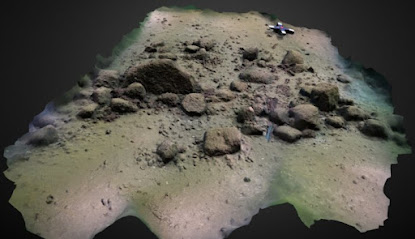
3-D model of the west end of the Blinkerwall. Image by Phillipp Hoy, Rostock University, Rostock, Germany.

Now, in 2021, such a construction has been located under the Baltic Sea dating back to before the rise in sea levels at the end of the glaciations period, estimated to be roughly 11,000 years ago there.

“In 2021, Jacob Geersen, a geophysicist with the Leibniz Institute for Baltic Sea Research in the German port town of Warnemünde, took his students on a training exercise along the Baltic coast. They used a multibeam sonar system to map the seafloor about 6.2 miles (10 kilometers) offshore. Analyzing the resulting images back in the lab, Geersen noticed a strange structure that did not seem like it would have occurred naturally. Further investigation led to the conclusion that this was a manmade megastructure built some 11,000 years ago to channel reindeer herds as a hunting strategy. Dubbed the "Blinkerwall," it's quite possibly the oldest such megastructure yet discovered, according to a new paper published in the Proceedings of the National Academy of Sciences—although precisely dating these kinds of archaeological structures is notoriously challenging.” (Ouellette 2024) The assumption is that it functioned with the local reindeer exactly like Dr. Benedict (above) related for the Rollins Pass drive lines. The reindeer would divert and follow the fence to a location where the hunters waited in ambush.

The Blinkerwall, the oldest structure in the Baltic Sea. Illustration by Michal Grabowski.

“The discovery is made up of more than 1,300 stones and roughly 300 larger boulders, and it stretches for more than half a mile along the seafloor. Resting nearly 70 feet underwater in the Bay of Mecklenburg, the wall stands, on average, about 1.5 feet tall. Natural events, such as glacial deposits or other land movements, cannot account for this structure’s existence, researchers report in a study published Monday in Proceedings of the National Academy of Sciences. Instead, they argue, the roughly 11,000-year-old wall was a tool built by hunters to guide and trap reindeer, which tend to travel along straight elements of the landscape, such as cliff sides or streams. ‘Hunters tapped into the natural behavior of the animals and created their own linear feature,’ Ashley Lemke, an underwater archaeologist at the University of Wisconsin-Milwaukee who was not involved with the research, tells Science’s Andrew Curry. ‘It’s not an obstruction, it’s a trail. They follow it to where the hunters are waiting.” (Thorsberg 2024) This preceding description is a very good explanation of how and why such drivelines work.

Scan of the west end of the Blinkerwall.

"'At this time, the entire population across northern Europe was likely below 5,000 people. One of their main food sources were herds of reindeer, which migrated seasonally through the sparsely vegetated post-glacial landscape. The wall was probably used to guide the reindeer into a bottlenick between the adjacent lakeshore and the wall, or even into the lake, where the Stone Age hunters could kill them more easily with their weapons,' explains Marcel Bradtmoller from the University of Rostock. The last reindeer herds vanished from these regions approximately 11,000 years ago due to climate warming and forest expansion. Consequently, the stone wall was probably not constructed after this period. If this is accurate, it would classify the wall as the oldest human-made structure ever found in the Baltic Sea." (Waters 2024)

The animals are diverted along the construction by its very existence on the site, ending up exactly where the waiting hunters want them to be for maximum advantage in harvesting game. Since reindeer migrate in large groups the harvest could have been quite large, illustrating the effectiveness of such a tactic.


Detailed structure of the Bay of Mecklenburg including the location of the Blinkerwall. Bathymetric data from The Federal Maritime and Hydrographic Agency Bundesamt für Seeschifffahrt und Hydrographie (BSH).

The only other possible explanation for this wall (other than it being a drive line) was what the authors (Geersen et al.) call ‘stone fishing.’ “In the absence of basal complexes and basement rocks in Northern Germany, glacially derived stones were used for construction purposes in this area toward the end of the last millennium. The demand for stones resulted in the birth of stone fishing as a profession. Stone fishing represents an anthropogenic effort to move and conquer boulders from the marine environment using stone pincers and ropes. -  After 1906, stone fishing was prohibited, and the stones were left in place being identified as important habitat and also useful for coastal protection. Because stone fishing (had) concentrated on the near-coastal waters and was not done in the central basins, we consider an anthropogenic movement of the stones for the purpose of stone fishing an unlikely candidate to explain the construction of the Blinkerwall. Furthermore, it seems unlikely that within the 18th and 19th century, stone fishers would have been able to place the stones next to each other over a distance of about 1 km given the water depth of about 21 m. Let alone the fact that their intention was to remove the stones rather than place them elsewhere on the seafloor.” (Geersen et al. 2024)

So, logically, the fact that the wall is now under 21 meters of water and that it was constructed by humans, the most likely explanation for it is that it was constructed when that area was still dry land, which dates it to the end of the last Ice Age. A very impressive accomplishment for people back then, and an impressive job of deduction for the authors (Geersen et al. 2024) of the report.

NOTE 1: Some images in this posting were retrieved from the internet with a search for public domain photographs. If any of these images are not intended to be public domain, I apologize, and will happily provide the picture credits if the owner will contact me with them.

NOTE 2: I have not included secondary citations in the References (below). For further information on these reports and all sources you should read the original reports at the sites listed below.


REFERENCES:

Faris, Peter, 2015, Stone Blinds and Drivelines – Rollins Pass, CO., 14 February 2015, https://rockartblog.blogspot.com.

Geersen, Jacob, Marcel Bradtmoller, Jens Schneider von Deimling and Harald Lubke, 2024, A submerged Stone Age hunting architecture from the Western Baltic Sea, 12February 2024, PNAS, Vol. 121, No. 8, https://www.pnas.org. DOI.org/10.1073/pnas.231008121. Accessed online 20 May 2024.

Ouellette, Jennifer, 2024, Scientists found a Stone Age megastructure submerged in the Baltic Sea, 14 February 2024. Proceedings of the National Academy of Sciences 2024, DOI: 10.1073/pnas.2312008121, https://arstechnica.com. Accessed online 17 February 2024.

Thorsberg, Christian, 2024, Stone Age Wall Discovered Beneath the Baltic Sea Helped Early Hunters Trap Reindeer, 13 February 2024, https://www.smithsonianmag.com. Accessed online 17 February 2024.

Waters, Conny, 2024, Underwater Drone Images Reveal Oldest Human-Made Structure In The Baltic Sea, 13 February 2024, https://ancientpages.com. Accessed online 14 February 2024.

Saturday, January 15, 2022

ARE SHADOWS PORTRAYED IN ROCK ART – THEY ARE IMPLIED IN CAVE ART:


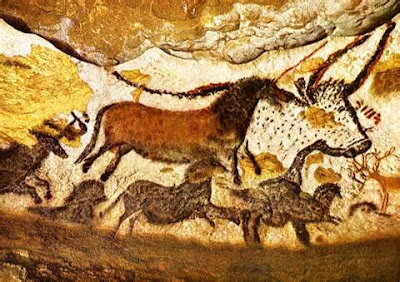
Auroch, Lascaux cave, Spain. Online photograph, public domain.


Another auroch, Lascaux cave, Spain. Online photograph, public domain.

I have been trying for a while now to find a pictograph or petroglyph of a human, animal, or other object, that also includes a representation of the shadow of that human, animal, or object. Why are there no representations of shadows in rock art? Shadows are certainly important in rock art. Shadows produce the pointers in archeoastronomy calendar sites. Shadows allow us to see faint rock art under certain conditions of lighting, and shadows from low-angle side lighting allow us to clearly see shallow petroglyphs. I cannot, however, find a convincing example of a shadow included in a rock art portrayal, in other words the image of a shadow in a pictograph or petroglyph.


Horses, Lascaux cave, Spain. Online photograph, public domain.

There are, however, many instances where the artists of Paleolithic European painted caves incorporated shadows in their work. I find it fascinating that so many of the animals portrayed on the walls of painted caves in Europe are shown standing with their feet right at a breaking point in the slope of the wall, so that with a light source held up they are standing on a shadow.


Owl, from Le Trois Freres, France. fig. 10.24, p. 155, Bahn, Journey Through The Ice Age.

In an interesting essay on the philosophy of shadows Roy Sorensen wrote about eights century monk Fridugisus of Tours who read the bible to prove the existence of shadows when he could see the shadows on the page. Sorensen commented: “I do not trust my eyes! Instead of reading between the lines of divine testimony, I read between the lines of scientific testimony. I ask: Do astronomers presuppose the existence of shadows when they calculate the altitude of lunar mountains? Do physicists imply that shadows move when the measure waves in a ‘shadow tank’? (The tank is filled with transparent water!)” (Sorensen 2021) (Our Paleolithic artists would have seen this effect where bright sunshine shone onto the bottom of a stream or pond through ripples in shallow water – a natural shadow tank. I would bet that they noticed it as well, but did they try to analyze it?)


Horse, Tito Bustillo cave, Asturias, Spain. Fig. 5.3, p.64, Bahn, Journey Through The Ice Age.

Sorensen’s basic question is then, do shadows really exist? Shadows are the absence of light, does the absence of something here indicate the existence of something else? In this we are dependent on our own basic senses.  “Shadows were fringe phenomena in the Dark Ages. They are rarely depicted in the era’s paintings. Perhaps the artists portrayed only what they believed to be visible. In De Anima, Aristotle writes that each sense has its own proper object: ‘Sight has color, hearing sound, taste flavor.’ Color requires light. No light, no sight. That is why we cannot see in the dark! The negative metaphysician takes exception. In a blackout, you do not hear the darkness or taste the darkness. You see the darkness. It even looks a certain way: dark all over, not red all over. You must inform a blind companion of the darkness. For a blind person cannot see the darkness. It no more looks dark to them than it looks dark behind your head. To see the darkness behind your head, you must turn around.” (Sorensen 2021)


Mammoth, Chauvet cave, France. p. 58, , Dawn of Art, the Chauvet Cave.

Then Sorensen goes on to discuss the reality (or not) of shadows. “To see is to see light. Shadows cannot absorb light. Any light present in a shadow is pollution. For a shadow is an absence of light. Absences of light cannot block light. Metaphysicians who think reality is always positive deny the visibility of shadows. We see only light, they say. A shadow is a hole in the light, not a part of what is seen, they say.” (Sorensen 2021) Were the painters in the great decorated caves of Europe Positive Metaphysicians who believed that shadows did not exist?


A horse and two mammoths, Chauvet cave, France. p. 46, Dawn of Art, the Chauvet Cave.

On a relatively uneven cave wall any projection would also cast a shadow from an elevated light source. Perhaps the cave artists did not bother painting shadows because they were counting on the real thing being seen, produced by a light source like a flaming torch held high.

I do not think of the creators of this art as Metaphysicians at all, whether positive or negative. They were practical Opticians who used the effects of light that they could observe to produce the effects they sought in their portrayals. They did not need to paint shadows under their aurochs, horses, mammoths, etc. They could use the real shadows produced by a higher light source and a change in the angle of the wall of the cave to give the image a real shadow – if shadows are real.

If you can find an example of a shadow painted or pecked into a rock art image please send it to me. This could go on a while longer.

NOTE Images in this posting were retrieved from the internet with a search for public domain photographs. If any of these images are not intended to be public domain, I apologize, and will happily provide the picture credits if the owner will contact me with them. For further information on this you should read the original report at the sites listed below.

REFERENCE:

Sorensen, Roy, 2021, Do We Actually See Shadows?, 1 December 2021, https://daily.jstor.org/