Showing posts with label fraud. Show all posts

Saturday, November 14, 2020

PETROGLYPHS SUGGESTING THAT METEORS WERE RECORDED IN ANCIENT MOROCCO ARE QUESTIONABLE:

Ida 1, Photo Abderrahmane Ibhi.

An article in online magazine Meteor News, on January 19, 2019, reported petroglyphs carved into stone recording a meteor fall in Morocco. The find in the rural village of Ida Oukazzou, in the Tiwrare area, about 100 km north of Agadir, Morocco, consisted of three rounded rocks named by the investigators Ida 1, Ida 3, and Ida 3.


Ida 2, Photo Abderrahmane Ibhi.

“The characteristics for Ida1 and Ida2: length 20 cm, width 17 cm, thickness 5 cm and length 18 cm, width 15 cm, thickness 5 cm respectively. These are two pebbles of melanocratic cryptocrystalline quartz sandstone of subcircular form and very flat. They show traces of corrosion and a surface calcification layer consisting of thin platelets of carbonates. After careful cleaning Ida 1 (brushing and vinegar), the only engraved side of this piece offers a spectacular scene of a man and a woman seemingly distraught by the fall of a meteor (Figure 1). Identically on Ida 2, not yet cleared of its gangue of clay and sand and under the secondary precipitation of carbonate layers, we can identify a scene that includes a fleeing anthropomorphic and a huge fireball (Figure 2).” (Abderrahmane et al. 2019:1)

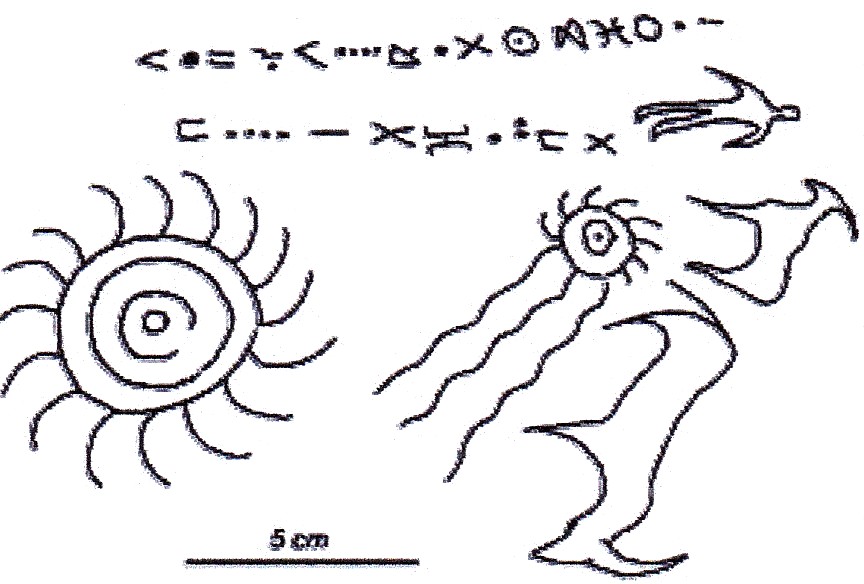
Ida 3, Photo Abderrahmane Ibhi.


              Ida 3 drawing, Photo                                 Abderrahmane Ibhi.

“Ida 3 (length 35 cm, width 27 cm, thickness 12 cm) is a thin, leucocratic sandstone pebble, rather flat and more or less square in shape. After cleaning, Ida 3 symbolizes a scene that includes an anthropomorphic, two cattle of different sized, a meteor and a figurative of the Sun with concentric circles in the center. To complete this ideogram, the artist has arranged two lines of inscriptions with Tifinagh characters with dull incised lines (Figure 3), this showing an image-inscription association which is arranged in the empty interval where it integrates harmoniously. These Tifinagh inscriptions, difficult to translate, are quite old, it is impossible to date them accurately.” (Abderrahmane et al. 2019:2)

Here is where I begin to doubt the whole story. “The astronomical observations reveal that these sculptures are those of a meteor, the three petroglyphs seem to represent the impact of a great meteorite that has frightened the inhabitants and that the artist has certainly experienced this astronomical event spectacular enough to be recorded on the rock.” (Abderrahmane et al. 2019:2)

These just do not strike me as fully believable. They admit to a cleaning with brush and vinegar. This treatment removed the calcite (which might have been datable) and seems to have also removed any patination which have allowed other analyses to be made. There is no mention of the circumstances of the discovery, were they buried, face up or face down, where and when? We are not even given many details of their claimed examination “performed with a binocular magnifier equipped with an integrated digital camera.”  (Abderrahmane et al. 2019:1) Such an examination should have offered clear evidence of tool marks which would have provided a great deal of information. Were I examining a supposed petroglyph with a binocular magnifier with an integrated digital camera I would have photographs of tool marks to help determine questions of possible age and authenticity. From what I can see in the photographs provided I feel the lines are suspiciously even, suggesting that they were created with a metal chisel, but without close-up photographs I can never personally know.

These just do not look believable to me, short of being able to examine the carving and surfaces with magnification I will remain skeptical. Whether the authors perpetrated the fraud, or have been taken in by someone else’s fraud, I also do not know, but I will give them the benefit of the doubt on this one for now and assume that they are naive but innocent, but I just cannot buy it.

NOTE: Some images in this posting were retrieved from the internet with a search for public domain photographs. If any of these images are not intended to be public domain, I apologize, and will happily provide the picture credits if the owner will contact me with them. For further information on this report you should read the original report listed below.

REFERENCE:

Abderrahmane, Ibhi, Fouad Khiri, Lahcen Ouknine, Abdelkhalek Lemjidi, and El Mahfoud Asmahri, 2019 This Discovery of Mysterious Petroglyphs Suggests That a Meteor Has Been Observed in Ancient Times in Morocco, eMeteorNews, Vol. 4, Issue 1, January 2019

Saturday, September 19, 2015

HUMAN AND DINOSAUR COEXISTENCE:


Supposed Cambodian stegosaur
carving, artalien.net

Episode ten of season four on Ancient Aliens, on H2 channel, was named Aliens and Dinosaurs. This program proved the coexistence of humans and dinosaurs by various lines of evidence. One was the stone carving at Angkor that seems to portray a stegosaur. One was a dinosaur track site in Texas that includes what they identified as a human footprint along with the petrified dinosaur imprints. And finally, they dragged out the Ica Stones as proof.

First - the Cambodian temple stegosaur is a decorative carving of an animal in a rondelle on a temple at Angkor

"Young earth creationists Don Patton, Carl Baugh, and some of their associates and followers have argued that a stone carving on the wall of the Ta Prohm temple in Cambodia was based on a live Stegosaurus dinosaur seen by the artist. There are problems with this interpretation, even aside from extensive evidence that humans did not appear on earth until at least 60 million years after non-avian dinosaurs* went extinct. First, the image in question differs in several significant ways from actual stegosaurs. Second, the main evidence for the Stegosaurus interpretation consists of a row of lobes along the back of the carving animal. Although superficially resembling the bony back plates of stegosaurs, there are a number of alternate explanations, including the possibility that they merely represent background vegetation or decorative flourishes, similar to many others on and around other carvings on the temple. The lobes may also represent exaggerated dorsal spines of a chameleon or other lizard. When all features and factors are considered, the carving is at least as compatible with a rhinoceros or chameleon as a stegosaur. Moreover, even if it represents a stegosaur, the carving could have been based on fossil remains rather than the artist seeing a live stegosaur." (Kuban 2014)

"Ta Prohm is the modern name for a temple at Angkor, Cambodia. It was built in the late 1100's and early 1400's as a Buddhist monastery. Originally called Rajavihara, it was among many other Buddhist and Hindu temples produced by the Khmer civilization from the eighth through the fourteenth century A.D. The temple was commissioned by self-proclaimed "god-king" Jayavarman VII, one of the most renowned monarchs and builders of the empire. Statues depicting him in Buddha-like poses are found throughout the region. Ta Prohm was built in honor of his mother and dedicated in 1186. The temple's stele records that it was home to more than 12,500 people, including 18 high priests and 615 dancers, with 80,000 thousands more people in surrounding villages providing various services and supplies. Some question whether these figures may involve some exaggeration, but clearly the temple was an active and impressive complex." (Kuban 204)

The protagonists of the young earth Creation theory argue that most of the carvings in these panels are detailed enough to allow the viewer to identify exactly which animal is being portrayed, and yes, many of them are that exact. But many others are not. Indeed, it is the details that are argued on both sides because that is what there is to analyze. What we see in the rondelle is an apparently four-legged animal, with fairly thick legs, relatively large horns on top of the head, a pointed tail, and a high-curved-back above which are a row of decorative petals to fill the background of the rondelle. There are no spikes on the tail - stegosaurus had large spikes on his tail. Stegosaurus did not have horns on his head, and his head was relatively much smaller than in the carving. As to the identification of the plates across his back upon which the whole identification rests, many of the other decorative rondelles there (and dozens can be found online) fill the background space with a range of petals as if the creature is in front of a flower. I do not believe that these are meant to be connected with the animal at all.

Unidentified figure second down from the so-called stegosaur. Credit: Colin Burns, from Kuban, Fig. 11, http://www.bible.ca/tracks/tracks-cambodia.htm

If we have to take seriously the Creationist's arguments about anatomical correctness, then I need to hear them give a logical explanation for the creature portrayed in the second rondelle down from the so-called stegosaur. It portrays an ugly little naked humanoid with a tail and legs like a goat.  If the one carving proves that humans and dinosaurs co-existed on 12th century Cambodia, then this other carving seemingly proves that the ancient Greek god Pan was there with both the humans and dinosaurs too. And do the Creationists really want to get into explaining the pros and cons of that?

Second - As to the dinosaur track site in Texas including a human footprint, that was bogus. It was easy to see that what they were identifying as a human footprint was just a portion of a larger dinosaur track, apparently a three-toed therapod track. I will refer you to Glenn Kuban's excellent online analysis debunking this one (see reference listing below).

And third - the Ica stones. One of the so-called experts that they had testifying to the importance of the Ica stones was so ignorant that he kept calling them Inca stones. On April 25, 2915 I posted a column titled DINOSAURS IN ROCK ART - PERU'S ICA STONES, in which I expressed my reasoning why I believe them to be modern forgeries instead of ancient artifacts. However, I should add that if they are not forgeries - if they actually prove that humans and dinosaurs coexisted, the fact that they are modern not ancient supposedly proves that humans and dinosaurs are still coexisting somewhere, but that gets us way too far into cryptozoology, and is not my field.

All in all, episode ten of season four of Ancient Aliens was laughable, but unfortunately some people actually seem to believe this stuff. Maybe we need the aliens after all, there still isn't enough intelligent life on this planet.

REFERENCES: 

Kuban, Glenn
2014    Man Tracks? A Topical Summary of the Paluxy "Man Track" Controversy, http://paleo.cc/paluxy/mantrack.htm
2014    Stegosaur Carving on a Cambodian Temple?, http://paleo.cc/paluxy/stegosaur-claim.htm


Dinosaurs in Ancient Cambodian Temple, http://www.bible.ca/tracks/tracks-cambodia.htm