Showing posts with label Picture Canyon. Show all posts

Saturday, February 6, 2021

A PETROGLYPHIC AGE NOTATION?


Picture Canyon, Baca County, Colorado. Photograph Peter Faris, 21 September 1986.

In Picture Canyon, southeast Colorado, there is a petroglyph of a woman’s figure with seventeen circles (sixteen complete and one incomplete) on her torso. Previous discussion as to what they represent has focused on decorative patterns on her clothing, or showing that she is a victim of smallpox with the circles supposedly representing the lesions on her body. I am writing this to suggest a different possibility - that the circles on her torso represent her age.
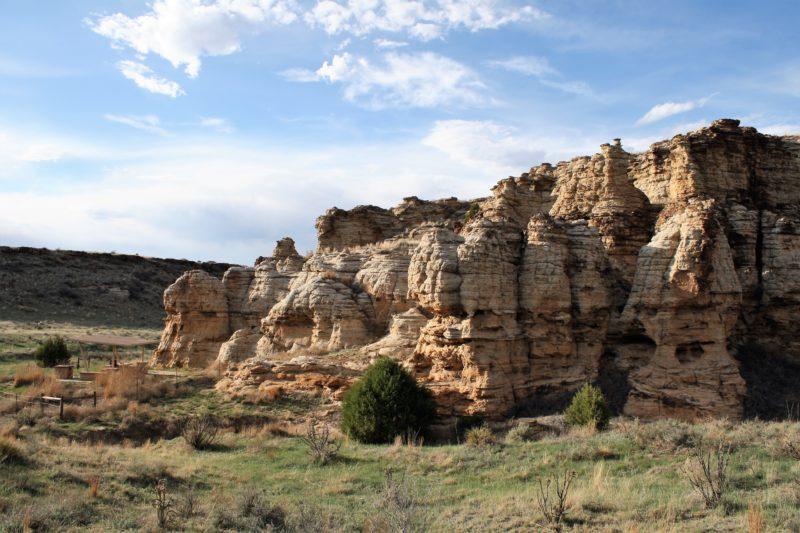

Picture Canyon, Baca County, Colorado. Internet photo, Public Domain.

The petroglyph has been chalked (or perhaps highlighted with white paint) at some indeterminate time in the past and seems to sport an intricate hairdo. This hairdo has been speculated to represent butterfly hair whorls as worn by adolescent unmarried young Hopi women. The circles on her torso are not freestanding, most are connected to each other by short lines.


E. B. Renaud's record, "Eighth Report: Pictographs and Petroglyphs of the High Western Plains (1936)."

The first record of this petroglyph that I have been able to find is a black and white drawing in E. B. Renaud’s Eighth Report: Pictographs and Petroglyphs of the High Western Plains (1936). In this report Renaud illustrated the petroglyph and designated it as site 147. He defined it as a representation of smallpox. The illustration in Renaud’s report, however, fails to show the short line segments connecting the circles on the woman’s body. There are a number of other discrepancies in details between Renaud’s illustration and modern photos, but that is fairly common with Renaud’s illustrations and reports. He used many local residents as agents and informants and did not apparently double check much of the material they provided.

In his report “Picture Writing of the American Indians”, Garrick Mallery gave the following description of time notation by the Dakota tribe.

Fig. 182, page 265, Mallery, Garrick, 1936, Eighth Report: Pictographs and Petroglyphs of the High Western Plains.

“Dr. William H. Corgusier, surgeon, U.S. Army, gives the following information: ‘The Dakotas make use of the circle as the symbol of a cycle of time; a small one for a year and a large one for a longer period of time, as a life time, one old man. Also a round of lodges or a cycle of seventy years, as in Battiste Good’s Winter Count. The continuance of time is sometimes indicated by a line extending in a direction from right to left across the page when on paper, and the annual circles are suspended from the line at regular intervals by short lines as in Fig. 182, upper character, and the ideograph for the year is placed beneath each one. At other times the line is not continuous, but is interrupted at intervals by the yearly circle, as in the lower character of Fig. 182.’” (Mallery 1893:285)

As Mallery’s Fig. 182 illustrates a succession of years can be presented by a row of circles connected by short lines exactly as represented on the body of the figure in Picture Canyon. The figure in Picture Canyon has sixteen full circles and one partial inscribed on her torso, suggesting that, if this interpretation is correct, it represents a young woman of seventeen years in age.


Sioux lands defined by the 1868 treaty, Internet photo, Public Domain.

Picture Canyon is somewhat marginal to the area acknowledged as Dakota traditional hunting grounds according to the 1868 Treaty, but well within the area they would have claimed traditional rights to so a Dakota convention for illustrating time would seem to be a possibility.


Picture Canyon, Baca County, Colorado. Photograph William Buckles, 1989.

This site was also studied by Dr. William Buckles in 1989 but notes on the margins of his slide suggest that he accepted Renaud's identification of the figure as a victim of smallpox. Buckles also inexplicably refers to this figure as masculine - "Smallpox Man."


Chaiwa, a Tewa Indian girl with a butterfly whorl hairstyle. Photo by Edward S Curtis in 1922.

Concerning the hair style indicated on the figure, some think it resembles the “butterfly” hairdo of young, unmarried Hopi maidens. This is sometimes suggested to have resulted from the influence of Pueblo Indian refugees from Deigo de Vargas’ reconquest of New Mexico in 1692, after the Pueblo Revolt of 1680 that had driven the Spanish out. I have found no record of Hopi refugees in the area of southeastern Colorado, and no indication that any other pueblo refugees would have been wearing that hairstyle even if they reached the area, so I consider that particular assumption as unlikely. Could a Dakota Indian have traveled to Hopi and seen that hairstyle? Possibly. That particular question will have to remain open for now.


Picture Canyon, Baca County, Colorado. Photograph Peter Faris, 21 September 1986.

So, is this particular figure in Picture Canyon, Colorado, a figure of a smallpox victim as Renaud suggested, or a picture commemorating a seventeen-year-old young lady? I don’t suppose we will ever know for sure, but it does suggest that we should not hurry to jump to conclusions about what rock art means. There will usually be other possibilities we have not yet considered.

NOTE: I wish to thank Aaron Ramirez, Manager of Special Collections and Museum Services, Pueblo City and County Library District, Pueblo, Colorado, for providing the photograph by Dr. Bill Buckles and all the information pertaining to it.

Also: some images in this posting were retrieved from the internet with a search for public domain photographs. If any of these images are not intended to be public domain, I apologize, and will happily provide the picture credits if the owner will contact me with them. For further information on these reports you should read the original reports at the sites listed below.

REFERENCES:

Slide, Picture Canyon, Baca County, Colorado, in the Colorado Rock Art Association Collection, Pueblo City-County Library District Special Collections, Pueblo, Colorado, USA.

Mallery, Garrick, 1936, Eighth Report: Pictographs and Petroglyphs of the High Western Plains (1936) Picture Writing of the American Indians, in Tenth Annual Report of the Bureau of Ethnography to the Secretary of the Smithsonian Institution, 1888-1889, by J. W. Powell, Director, Government Printing Office, Washington DC., reprinted in two volumes in 1972 by Dover Publications, Inc. New York.

Renaud, E. B., 1936 Archaeological Survey of the High Western Plains: Eighth Report: Pictographs and Petroglyphs of the High Western Plains, September 1936, University of Denver, Anthropology Office, Denver, CO.


Saturday, November 30, 2013

ARCHITECTURE IN ROCK ART – TIPIS – Part 1:

In their records left on the rocks by Native Americans of their deeds and situations, we can look for clues to the environment that these feats were performed in. One common feature of the environment in Great Plains rock art is one or more residences, their tipis. In the tradition of Plains Biographic Art much of the imagery in a composition is intended as information. In this way a figure seen in relation to a group of tipis would represent a specific person involved in some activity next to that tipi village.


Horseman in lower left, Anubis Cave, Cimarron
County, OK. Photo Peter Faris, 21 Sept. 1986. 

My awareness of this came back in the 1980s on one of a frequent number of trips down into southeastern Colorado. In the so-called Anubis Cave in Cimarron County, Oklahoma, I saw a small equestrian figure on horseback in front of the upside-down “V” of a tipi. It occurred to me at that time that it placed a figure in a specific place, and thus at a specific time, the time when he was there. In other words it was telling a story, a simple story certainly, and one that did not provide me with much information, but a story nevertheless. This is the basic premise of James Keyser in his statement that the Biographic art of ledger books and painted robes can provide a lexicon toward the interpretation of some rock art.


Tracing by James D. Keyser and Mark D. Mitchell, Box
Canyon site, 5LA8464,  Picketwire Canyonlands,
Las Animas County, CO. 1999.


Photograph of a portion of the Box Canyon site, 5LA8464, 
Picketwire Canyonlands, Las Animas County, CO.
Photo Peter Faris, August 1999.


Detail of tracing showing tipi near the center (directly
under the elk). Box Canyon site, 5LA8464,  Picketwire
Canyonlands, Las Animas County, CO. August, 1999.

In the Box Canyon Site in the Purgatoire river canyon in southeastern Colorado a couple of panels illustrate combat in relation to tipis. 5LA8464 was recorded in 1999 by a crew led by Jim Keyser and Mark Mitchell. This is a large panel, faintly scratched into a large flat side of the rock. This panel apparently records an attack upon a tipi village or family encampment by a group of equestrian warriors on the right, whom I believe are Pawnees by the details of their portrayal. The village or encampment being attacked is represented by a tipi on the left side of the panel and would probably have been Cheyenne or Arapahoe based upon the location. One defender seen by the tipi has been struck by an arrow. A number of unridden horses suggest that this combat bay have been in conjunction with a horse raid upon this encampment.


Red Rock Ledge, Picketwire Canyonlands, Las Animas
County, CO. Tracing by James D. Keyser and
Mark D. Mitchell, August 1999.


Red Rock Ledge site, Picketwire Canyonlands, Las Animas
County, CO. Photograph Peter Faris, August 1999.

Another plains biographic rock art panel recorded by James Keyser and Mark Mitchell is the Red Rock Ledge site in the Picketwire Canyonlands, near the Box Canyon site. This smaller panel tells a story related by Keyser in his subsequent published report. “The lightly-scratched petroglyphs at Red Rock Ledge compose a Biographic scene showing a pedestrian bowman who has traveled from a tipi village to engage and enemy represented by a crooked lance or coup stick. Beginning at the right margin of the scene, and following the action to the left, the composition consists of four major elements. At the far right is a group of nine triangles with forked tops representing a camp of tipis. One other incomplete figure probably represents a tenth tipi with one side no longer visible. A series of seventeen more or less horizontal dashes and four “C” shapes extends from the tipi camp toward the bowman. Based on comparisons with other Biographic drawings in various media, the dashes represent human footprints and the “C” shapes represent horse hoofprints. The third element, the bowman, is a simply drawn, rectangular-body figure with a circle head. His legs are shown with thighs, calves, and feet. The short diagonal lines that extend outward from the front of each leg indicate fringed leggings. In his right hand he carries a carefully drawn recurved bow that is shooting an arrow with a large triangular point. The fourth element, located at the far left of the scene, is a horizontally-oriented crook-neck coup stick, from which trail four groups of paired streamers or feathers. Each group extends diagonally downward to the left, and the four groups are spaced about equidistantly along the shaft, with the last at the end of the crook.” (Keyser and Mitchell 2000:26-7)


Picture Canyon, Baca County, CO. Photograph Peter Faris, 1986.

In the well known horse pictograph/petroglyph from Picture Canyon, in Baca County, Colorado, a number of very faint tipi shapes can be made out with careful observation. Indeed, a group of four or five very faint upside-down “V” shapes in the upper right corner of the photo represent a tipi village, with at least two more at the top just left of center.  These presumably represent the tipi village that the horseman himself is associated with.

Numerous other examples of tipis portrayed in rock art can be found in the literature. My point here is that in contrast to the common assumption that “we can never know what rock art is saying” we can, in many instances determine quite a bit about a rock art panel. I will show some other examples and share some other thoughts in future columns.

REFERENCES

Keyser, James D. and Mark D. Mitchell
2000   Red Rock Ledge: Plains Biographic Rock Art in the Picketwire Canyonlands, Southeastern Colorado, Southwestern Lore, Vol. 66, No. 2, Summer, 2000, p. 22-37.


Friday, August 30, 2013

WHERE BARRY FELL – PICTURE CANYON #2:


On August 3, 2013, I began a series of postings questioning the conclusions of Barry Fell and his fellow epigraphers back in the 1970s and 1980s. My first example was located in Picture Canyon, in Baca County, Colorado. I showed then that the casting of the petroglyph that Fell had done his translation from had been altered from the original. This example is also located in Picture Canyon, Baca County, Colorado.


Picture Canyon, Baca County, Colorado. 
Photograph: Peter Faris.

Fell’s description of his version of this image is:
“A finely executed cliff petroglyph of a horse, discovered by Gloria Farley in the Cimarron region, is unusual in having a Libyan brandmark shown H-N, “Fleet-of-foot.” In ancient Libya states were erected to successful racehorses, and perhaps this commemorates one such, though not an American cup winner. Replica, after photo by Gloria Farley.” (Fell 1980:286)   


From Barry Fell's Saga America, p.286.

Once again, by comparing the Fell’s illustration with a photograph of the actual image you can see a number of differences. One major difference is the depth of the groove. On the original there is a fine scratch as if made with the edge of a flake of hard stone or the tip of a knife blade. Indeed, without the added pigment the horse image would be difficult to trace. This really is more pictograph than petroglyph, and while on that subject notice that Fell's version omits what appear to be the faded remains of an image of a rider with the horse. Then we have the changes to the image itself. The head of the horse is very different from the actual pictograph, and the line of the left  hip of the horse is also changed. Fell has omitted the tail of the horse as well. Even the inscription which is the whole point to Fell has been changed. On the original this so-called Libyan brandmark is roughly circular or oval in outline and in Fell’s altered version it is squared off, presumably to make the interpretation more convincing.

Falsified data does not convince me. 

REFERENCE:

Fell, Barry

1980    Saga America, Times Books, New York

Saturday, August 3, 2013

WHERE BARRY FELL – PICTURE CANYON:


Picture Canyon, Baca County, Colorado. 
Photograph: Peter Faris, 21 Sept., 1986.

Back in the 1970s there was considerable public interest in the diffusionist theories of Barry Fell. Fell believed that many rock art inscriptions and images had been produced by pre-Columbian travelers from the Old World.

“Barry Fell (born Howard Barraclough Fell)( June 6, 1917 - April 21, 1994) was a professor of invertebrate zoology at the Harvard Museum of Comparative Zoology. While his primary professional research included starfish and sea urchins, Fell is also known for his controversial work in New World epigraphy, arguing that various inscriptions in the Americas are best explained by extensive pre-Columbian contact with Old World civilizations.” Wikipedia.

In my early years as a rock art researcher I felt I should read all sides of an argument in order to be able to fairly judge it for myself so I undertook the task of reading some of the writings of Barry Fell. As an aside here I should add that I do believe that there was pre-Columbian contact between the Old and New Worlds. We have physical proof of Viking presence at l’anse aux meadows in Newfoundland dating to around AD 1000. Additionally, I have posted about the hundreds of botanical and zoological indications outlined and explained in the book World Trade and Biological Exchanges Before 1492, by Carl L. Johannessen and John L. Sorenson, (2004). I have no trouble accepting limited contact, and even exchange, between peoples of the Old and New Worlds before Columbus. I just cannot accept the claims of diffusionists that so many of the cultural traits of New World peoples came from the dozens or hundreds of expeditions of Celts, Egyptians, Phoenicians, and everyone else they can think of roaming back and forth across North America leaving carved images and inscriptions.

Picture Canyon, Baca County, Colorado. 
Photograph: Peter Faris, 21 Sept., 1986.

As I said above I tried to read enough of Barry Fells’ writings to understand his premise and be able to give a fair evaluation to his claims. I read much of his writing and I have to confess that it would be really exciting to just open up to his conclusions. If I had just gone with it I could have been in on so many of the exciting discoveries that Barry Fell and his disciples claimed. Unfortunately, I found myself constrained by judgment and truth, and just could not adopt his conclusions. Part of the problem was the fact that I could visit some of the sites he translated and see for myself.

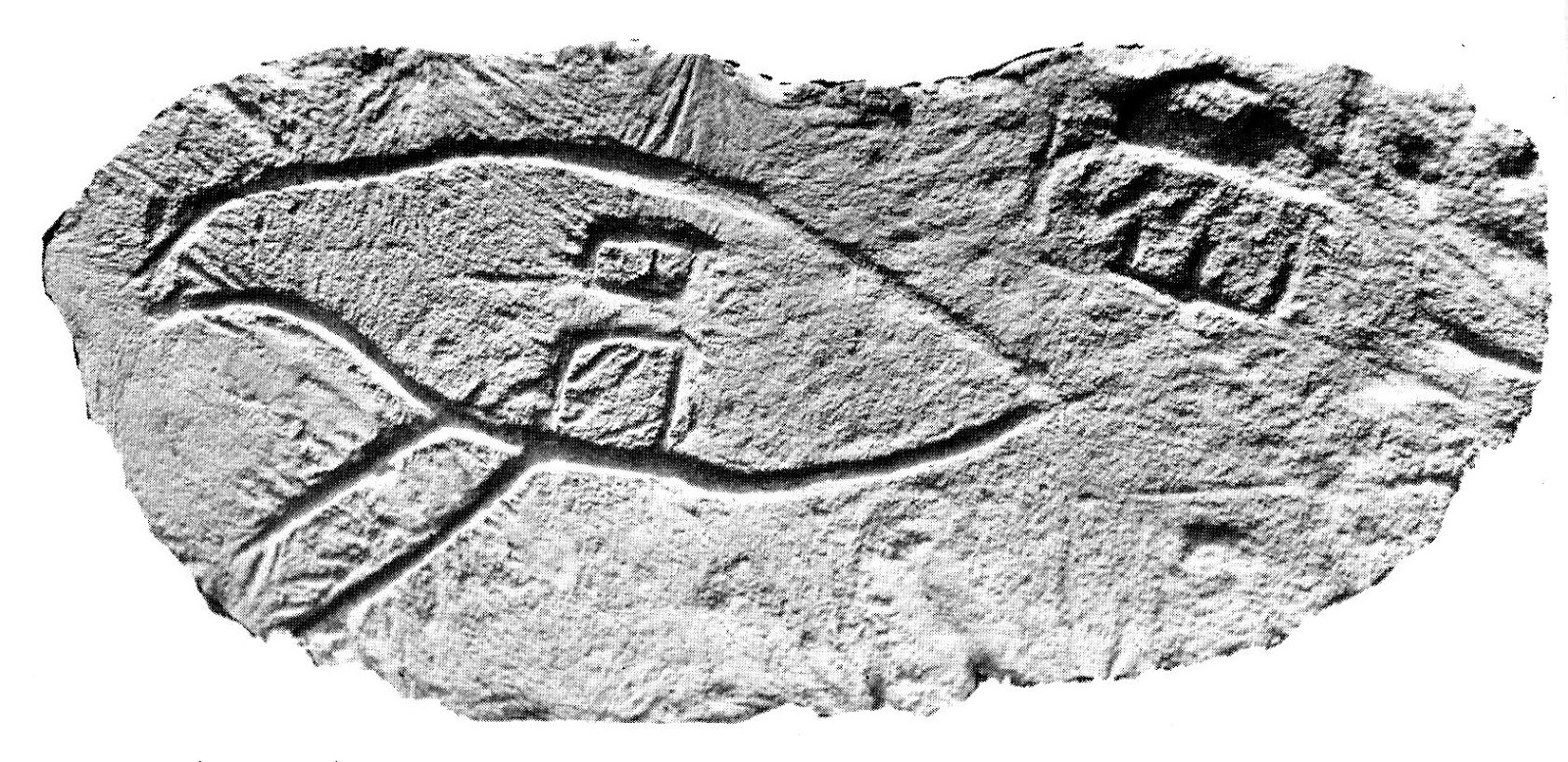
Cast by Gloria Farley, in America B.C.
Barry Fell, Demeter Press, 1976, p.182.

In 1986 I spent some time in Picture Canyon, in Baca County, southeastern Colorado. There I visited the petroglyph that Barry Fell had translated, and explained as follows, based upon a casting from a mold made by Gloria Farley: “Chief Ras left this bilingual autograph to record his exploration of the Cimarron River in Oklahoma, probably around 500 B.C. Gloria Farley obtained this latex impression under a rock overhand on the river cliffs. Above right the Egyptian hieratic letters T-P (Chief). The eye symbol itself is the Egyptian hieratic word R-S (“Watchful”). The two Libyan letters cut into the eye sign, also spell R-S. Bilingual Egypto-Libyan inscriptions in North America probably reflect the lasting influence of the Libyan pharaohs upon the Egyptian navy. In later centuries when the Greek Ptolemies ruled Egypt, their Libyan queens continued to promote the interest of the navy, still manned largely by Libyan mariners. Malcolm D. Pearson” (Fell 1976:182)

First, the image is not on the cliffs of the Cimarron River, this symbol is actually in Picture Canyon, in Baca County, Colorado, and it is found a number of miles from the Cimarron River cliffs in New Mexico. Second, the actual image is somewhat different than the supposed casting which one would expect to be an exact replica of the original. Notice that the right end of the image is flattened, not sharply pointed as in the “casting”, also, please note that the actual shapes of Fells’  “two Libyan letters cut into the eye sign”, which ”also spell R-S” are not the same in the photograph as on the “impression”. There are also a number of other markings on the panel, including a group of pits within the right side of the “eye” that do not appear to be on Gloria’s “impression” at all.

Additionally, the lines of the “eye” and the “Libyan letters” in the casting are much sharper edged than the lines of the original, all of which suggests to me that the so-called “impression” has been worked over with tools to achieve the end they desired. Finally, we can see that the background surface of the “impression” that was supposedly made with latex directly from the surface of the rock does not match the actual background surface of the rock face itself. In any scientific context that I know of that is called falsification of data and is considered to be a fraudulent practice at the very least. So, back in the beginning – this is where Barry Fell. I will continue this exploration in the future.

Note: I wish I could claim to be clever enough to have originated the title “Where Barry Fell” for myself, but I cannot. This title came from a slide program debunking some of Fells' claims that was assembled by Bill McGlone back in the early 1990s, in cooperation with Phil Leonard.

REFERENCES:

Fell, Barry
1976    America B.C., Demeter Press, New York.