Showing posts with label Venezuela. Show all posts

Saturday, February 8, 2025

ANCIENT VENEZUELAN ROCK ART FROM AN UNKNOWN CULTURE?

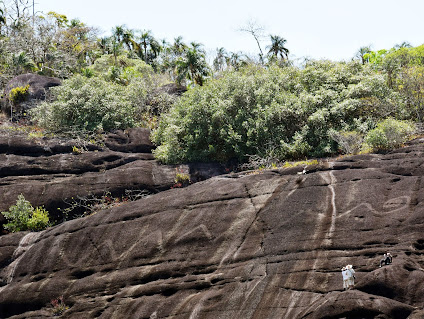
Arauák River valley with the Upuigma Tepui at the back,
and the savanna where the boulder is located. All images ©José
Miguel Perez-Gomez unless indicated otherwise. Figure 2, page 132.

A number of new rock art sites have been discovered in southern Venezuela in Canaima National Park. These newly discovered rock art sites in Venezuela can be stated to exist in a truly magnificent landscape.

Main panel showing digitally traced motifs obtained by using Photoshop. Image from Josẻ Miguel Pẻrez-Gỏmez and Roger Swidorowicz, 2023, Figure 7, page 134. Area of red square shown in next image.

“The Guiana Highlands region of southeastern Venezuela is characterized by flat-topped mountains, or tepuis, rising thousands of metres into the clouds while remaining geographically inseparable from the rainforest and savannahs below. The remarkable geographical characteristics of these mountains are likely to have had a significant phenomenological impact on the cultural perception and environmental interpretation of the nearby human groups. Rock art found in these magnificent landscapes can be appreciated on isolated rocks in river valleys as well as on large boulders strewn across the savannas.” (Pẻrez-Gỏmez and Swidorowicz 2023) While the magnificence of the landscape was undoubtedly appreciated by the original inhabitants, I can see no influence of that in the illustrations that I have seen of the rock art they left. This sort of poetic rhapsody really has no place in a paper intended to be scientific.

Main panel detail selected from Fig. 7. Image from Josẻ Miguel Pẻrez-Gỏmez and Roger Swidorowicz, 2023, Figure 8, page 135.

“At around 20 different sites, carved and painted in caves and on boulders archaeologists have discovered glyphs, pictograms, and other symbols left behind thousands of years ago. It’s the first rock art of any kind discovered in southern Venezuela, and while there are similarities to rock art in Brazil, it’s unclear whose hands left behind the mysterious motifs.” (Starr 2024) In other words, not enough archaeology has been done in the region to begin to pin down the local archaic indigenous cultures.

Image from Josẻ Miguel Pẻrez-Gỏmez and Roger Swidorowicz, 2023.

In a very positive development researchers have begun to study the rock art of southern Venezuela. “Josẻ Miguel Pẻrez-Gỏmez, a researcher from Simỏn Bolivar University in Caracas, Venezuela, has documented previously unrecorded rock art with the Indigenous Pemỏn community. This artwork represents a largely undisclosed cultural tradition. Pẻrez-Gỏmez recently presented evidence and findings about these remote sites at a rock art conference in Italy. The conference served as a forum for disseminating information about this significant archaeological discovery to the international scientific community. This research contributes to understanding the region’s Indigenous art and cultural practices, potentially offering new insights into historical and anthropological studies.” (Bartek 2024) As I said above, not enough archaeology has been done in the region to begin to pin down the local indigenous cultures. Apparently the historical and anthropological studies have not yet been done. Without further hard evidence (archeology) the claims for the important influence of this rock art are basically empty.

Surprisingly the local inhabitants claim to have possessed no knowledge about the rock art in their area. Pẻrez-Gỏmez summed up their report with these recommendations. “Subsequent inquiries with people in various local communities confirmed their lack of awareness about these sites. In light of this, we propose introducing these rock art manifestations to the local communities through a community engagement project that includes establishing a local museum. This initiative would not only raise awareness about these significant archaeological sites but also contribute to their protection as valuable heritage sites. Furthermore, it would have the added benefit of stimulating the indigenous local economy.” (Pẻrez-Gỏmez and Swidorowicz 2023) This last bit sounds like archaeological tourism. In many instances such stimulation ends up creating more problems for local societies than it solves. It certainly prompts development which can, in the end, begin to cause environmental impacts such as pollution, paving, and infrastructure, which can destroy the local culture in the end.

Image from Josẻ Miguel Pẻrez-Gỏmez and Roger Swidorowicz, 2023.

 “Although it is not known precisely how old rock art is, similar rock art in Brazil has been dated to about 4,000 years ago, but Perez-Gomez believes the examples in Venezuela may be older. The park might have been the original place where this unknown culture first developed, Perez-Gomez told Live Science, adding that they may have later dispersed to places as far away as the Amazon River, the Guianas, and even southern Colombia, which all feature rock art akin to the newly found sites in Venezuela.” (Archaeology World 2024) What can I say about this quote – so much is so wrong. First, Petez-Gomez says “it is not known precisely how old rock art is”, but he knows his is older than the others. Second, similar rock art is found around the world. These symbols would generally be called ‘abstract style’ and I can point to some in southeastern Colorado like them, but I am pretty sure that the local cultures here were not originally dispersed from Venezuela.

NOTE: Some images in this posting were retrieved from the internet with a search for public domain photographs. If any of these images are not intended to be public domain, I apologize, and will happily provide the picture credits if the owner will contact me with them. For further information on these reports you should read the original reports at the sites listed below.

REFERENCES:

Archaeology World Team, 2024, 4,000-Year-Old Rock Art From a Previously Unknown Ancient Culture Uncovered in Venezuela, 4 July 2024, Archaeology World Online, https://archaeology-world.com. Accessed online 23 November 2024.

Bartek, Jan, 2024, Mysterious Rock Art By Unknown Ancient Culture Found In Venezuela, 5 July 2024, Ancient Pages, https://www.ancientpages.com. Accessed online 7 July 2024.

Josẻ Miguel Pẻrez-Gỏmez and Roger Swidorowicz, 2023, New Rock Art Site Complex in the Arauk River Valley, Southeastern Venezuela, Rock Art Research 2023, Volume 40, No. 2, pp. 131-144. Accessed online 23 November 2024.

Starr, Michelle, 2024, Mysterious Symbols on 4,000-year-old Rock Art Hint at an Unknown Culture, 6 July 2024, https://www.sciencealert.com. Accessed online 23 November 2024.


Saturday, August 3, 2024

PETROGLYPH BOUNDARY MARKERS?

One question frequently heard in rock art studies is “are these border markers?” Rock art is often proposed to have been placed in a certain location as a sign post to other people than the area’s inhabitants.

Serpent petroglyph at Raudal Palomazón, illustration from Riris et al., 2024, fig. 4.

I remember that back in the 1980s many of my co-enthusiasts placed a great deal of significance in the location of rock art, and they were probably correct in doing so. If rock art was near signs of habitation it was supposedly placed there like a public sign, perhaps for educational purposes. If it was sort of hidden away in an alcove or something it was thought to have been placed there for secret rites and ceremonies. But, if it was in a location that is easy to see, and without any nearby signs of occupation, it was thought to possibly be some sort of boundary marker. 

Study area, illustration from Riris et al., 2024.

This theory has again come up along the Orinoco River in Columbia and Venezuela, images of gigantic snakes assumed to represent border markers, or warnings – sort of a NO TRESSPASSING sign. “Our results demonstrate the profound influence of artistic practices on pre-Columbian cultural landscapes. Even considering the exceptional diversity and size of many northern South American rock art sites. Middle Orinoco monumental engravings represent a unique tradition of large-scale artistic production. Ethnohistorical and archaeological data illustrate the multi-ethnic character of Indigenous societies in the region with recent work showing how symbolic material culture was key to negotiating identities in an environment of sustained cultural interaction. The potential associations of these sites with Indigenous myths today underscore the central role of rock art in the appropriation of contested landscapes. With reference to the perilous connotations of gigantic snakes emphasized in, for example, Piaroa and Warekena (Arawak) myths alike, we suggest that pre-Columbian people perceived the gigantic snakes as an ever-present reminder of ancient conflicts and negotiations between supernatural beings and humans. As cultural agents, these motifs would need to be related to accordingly. - Our analysis of monumental rock art suggests that panels likely acted as markers on the edges of group boundaries, and as a protective agent within domestic spaces. The visibility and prominence of gigantic snake outcrops from the river and riverbanks emphasizes this notion.” (Riris et al. 2024) It has been suggested that some of these snakes are the largest petroglyphs ever recorded. I couldn’t speak to that except to remind readers that there are some pretty big examples of rock art all over the world. These, however, were apparently placed where they were purposely to be seen, and great size enhances that emphasis.

Serpent petroglyph from Orinoco River, illustration from Riris et al., 2024.

“During the 18th century C.E. voyagers roving (?) the Orinoco River—a vast watery highway stretching across the northeastern corner of South America—reported dozens of mysterious rock engravings of snakes crowning the rocky hilltops. The engravings have remained mysterious over the centuries, their whereabouts in today’s Colombia and Venezuela largely passed down by local word of mouth. Now, in the first systematic study by modern archaeologists, researchers have mapped 13 sites bearing gigantic pre-Hispanic artwork—mostly of serpents—confirming both local stories and explorers’ accounts.” (Rubiano A. 2024) Sparsely occupied and remote areas will obviously be explored later, and science gets to them last.

Serpent petroglyph from Orinoco River, illustration from Riris et al., 2024. Note human figures in lower right for scale.

Serpent petroglyph from Orinoco River, illustration from Riris et al., 2024. Detail of coiled tail at right side.

“Depictions of anacondas, centipedes, human figures and giant rodents are among the engravings which may hark back to myths told for more than 2,000 years. Now the first scientific documentation of this art finds that some of these engravings are among the largest in the world. Their size makes them visible from a distance, suggesting they were used as ancient signposts that told travelers along the prehistoric trade route whose territory they were entering and leaving.” (Pappas 2024) Remember, the serpent as a theme is common in rock art throughout North and Central America, so this extends that theme farther south into South America. They do not all mean the same thing, but whatever their local meaning they are common.

Serpent petroglyph from Cerro Dagua, Orinoco River, illustration from Riris et al., 2024, fig. 6. For scale, the span of the bat-like creature in lower right is approx. 4 meters.

“Separately, we have carried out excavations, material culture analyses and chronometric dating on pre-Columbian settlement sites in and around the Atures Rapids. This work has documented a succession of cultural complexes that span two main periods: an early occupation period ranging from 100 BC–AD 620 (Saladoid-Barrancoid and Cedeñoid ceramics, Early Picure complex) and a late occupation period from AD 1030–1480 (Arauquinoid, Valloid and Nericagua ceramics; Late Picure/Late Rabo de Cochino complexes). Following ephemeral initial occupations, settlements grew over time, culminating in the establishment of several multi-ethnic communities before the Conquest (AD 1500). Although not directly dated, a small number of petroglyph motifs are paralleled in archaeological ceramic decoration.” (Riris et al. 2024) Which may help in the dating, common themes may have common meaning and indicate a common time frame. The idea being that as a culture evolves and its beliefs are altered by time, the symbols and visual icons to represent them will also evolve.

Serpent petroglyph from Casuarito Norte, Orinoco River, illustration from Riris et al., 2024, fig. 5. 

“Starting at least 9200 years ago, several Indigenous groups inhabited the Orinoco region. Distinct styles of quartz tools, clay pots, and other objects suggest these groups used the river as a highway to trade objects, techniques, and materials. By the time the first Spanish missionaries arrived in the 14th century, at least seven different groups were trading, marrying, allying, and fighting with one another in a complex political network. Some contemporary Indigenous groups, including the Arawaks and Piaroa, descend from these ancient societies. When the researchers behind the new study first arrived in the region in 2015, they were stunned by the engravings made by the ancient Indigenous people. “The first time I saw one of them, it was from the window of a moving vehicle, [seeing a] hill like any other hill, but all of a sudden, [the snake] appeared,” recalls Philip Riris, an archaeologist at Bournemouth University and lead author of the study.” (Rubiano 2024)

“Though area residents have long been aware of the rock art, the archeology of the Middle to Upper Orinoco had been little studied by outsiders, says paper co-author Jose R. Oliver, a reader in Latin American archeology at University College London. He and his co-authors, Philip Riris of Bournemouth University in England and Natalia Lozada Mendieta of the University of the Andes in Columbia, wanted to document these sites both for scientific and conservation reasons. They surveyed a region centered around the Atures Rapids in the Middle Orinoco, a place where the river becomes impassible by canoe and travelers have to portage over land. ‘Everything we knew about the archeology of the region suggested that it was this meeting point where different cultures came together and actively traded and, in some cases, probably intermarried,’ Riris says.” (Pappas 2024) Another example perhaps of the local people always knowing about it but when a visitor from outside first sees it, it is “discovered.”

So to reiterate - if rock art was near habitation sites it was supposedly placed there like a public sign for our own people, perhaps for educational purposes. If it was sort of hidden away in an alcove or something it was thought to have been placed there for secret rites and ceremonies. But, if it was in a location that is easy to see, and without any nearby signs of occupation, it was thought to possibly be some sort of boundary marker, a signboard or announcement to others. The idea was that the location of a petroglyph or pictograph will help deduce its possible meaning. Nowadays that idea goes under the more picturesque designation of ‘Rock Art’s Placement in the Landscape’ but the basic theories have changed very little.

NOTE: Some images in this posting were retrieved from the internet with a search for public domain photographs. If any of these images are not intended to be public domain, I apologize, and will happily provide the picture credits if the owner will contact me with them. For further information on these reports you should read the original reports at the sites listed below.

REFERENCES:

Pappas, Stephanie, 2024, Ancient Snake and Centipede Carvings Are Among World’s Largest Rock Engravings, 3 June 2024, https://www.scientificamerican.com. Accessed online 4 June 2024.

Riris, Philip, Jose Ramon Oliver, Natalia Lozada Mendieta, 2024, Monumental Snake Engravings of the Orinoco River, 4 June 2024, Published online by Cambridge University Press, 4 June 2024, pp. 724-742, Accessed online 4 June 2024.

Rubiano A., Maria Paula, 2024, Gigantic snake carvings may have been ancient ‘road signs,’ 3 June 2024, https://www.science.org. Accessed online 4 June 2024


Saturday, April 21, 2018

DRONES ARE PROVIDING A USEFUL TOOL FOR RECORDING ROCK ART AND ARCHAEOLOGICAL FEATURES:


Newly discovered Paracas
geoglyphs, ancient-origins.com.
Public domain.

Exciting new discoveries in archaeological survey, and rock art recording, are being made possible by the development of video and photographic drones. Recent online articles in Live Science and National Geographic News have documented the use of drone photography to record inaccessible rock art panels and geoglyphs. In the coastal Peruvian desert near the Nazca lines a number of new geoglyphs have been discovered with drone imaging, and an enormous rock art panel in Venezuela was recorded by drone as well.


Newly discovered Paracas
geoglyphs, ancient-origins.com.
Public domain.

The story of the newly discovered geoglyphs in the Palpa province of Peru began in December 2014 "when the environmental organization Greenpeace placed a huge sign calling for renewable energy next to the Nazca hummingbird design National Geographic reported. Greenpeace didn't have permission to enter the World Heritage Site and ended up damaging it." (Geggel 2018)

"Following the incident (for which Greenpeace later apologized), Peru received a grant from the United States to help restore its archaeology by hiring Peruvian archaeologist Johny Isla, the Nazca Line's chief restorer and protector, National Geographic said. Given that not all of Peru's archaeological sites have been mapped from the air, Isla and Peruvian archaeologist Luis Jaime Castillo Butters, of the Pontifical Catholic University of Peru, who co-discovered the new glyphs, partnered with Sarah Parcak, a space archaeologist and founder of the Laboratory for Global Observation at the University of Alabama at Birmingham, to do so." (Geggel 2018)

"After winning the TED Prize in 2016, Parcak founded the GlobalXplorer initiative, which trains citizen scientists to analyze satellite imagery for archaeological sites and signs of looting. The platform's first project invited volunteers to look at satellite photos of Peru." (Greshko 2018)


Newly discovered Paracas
geoglyphs, Public domain.

"Parcak uses aerial photography from drones and satellites to discover and examine archaeological sites. In Peru, Parcak's team used drones, which took images in 2017 that helped the archaeologists discover the new lines." (Geggel 2018) This innovative project used drone photography to make new discoveries in areas that were suspected of holding geoglyphs, in Venezuela drones were used to record rock art that was previously known, but was hard to reach or inaccessible.


Venezuelan mountainside petroglyphs
(computer enhanced),
nationalgeographic.com,
Public domain.

"Ancient rock art isn't always easy to reach, but a researcher in Venezuela has solved this challenge with a bit of modern technology. A camera - equipped drone that zipped across a rocky, watery landscape to photograph ancient artwork depicting people, cultural rituals and animals, a new study reports." (Geggel 2017)


Venezuelan petroglyphs
(computer enhanced),
www.ucl.ac.uk,
Public domain.

"The drone-recorded engravings, in addition to more accessible rock art along the Orinoco River in western Venezuela, are some of the largest rock engravings found anywhere in the world, the researcher said. One panel is more than 3,200 square feet (304 square meters) and has 93 engravings. Another engraving portrays a 98-foot-long (30 m) horned snake." (Geggel 2017)

"The engravings appear to date to pre-Columbian (before 1492) and colonial times (1492 to the 19th century), said the study's author Philip Riris, an archaeologist at University College London in the United Kingdom. Some may be up to 2,000 years old, he noted." (Geggel 2017)

So modern drone technology not only proved useful in discovering rock art, but also in photographing and recording it. Not bad.

NOTE: Some images in this posting were retrieved from the internet with a search for public domain photographs. If any of these images are not intended to be public domain, I apologize, and will happily provide the picture credits if the owner will contact me with them. For further information on these reports you should read the originals at the sites listed below.

REFERENCES:

Geggel, Laura,
2017 Ancient Rock Art Mapped in Amazing Detail, Revealing 100-Foot Snake, Live Science, December 11, 2017, https://www.livescience.com/61155-drone-maps-ancient-rock-art-venezuala.html

Geggel, Laura,
2018 Sprawling, 2,000-Year-Old Desert Carvings Show Up in Drone Photos,
Live Science, April 6, 2018, https://www.livescience.com/62238-new-nazca-lines-discovered.html

Greshko, Michael
2018 Exclusive: Massive Ancient Drawings Found in Peruvian Desert,National Geographic News, April 5, 2018, https://news.nationalgeographic.com/2018/04/new-nasca-nazca-lines-discovery-peru-archaeology/

nationalgeographic.com

www.ancient-origins.com.

www.ucl.ac.uk