Showing posts with label horses. Show all posts

Saturday, March 21, 2020

CAVE ART ACCURACY OF DETAIL IN ANIMAL DEPICTIONS IS BETTER THAN IN HISTORIC ART:


Aurochs, Lascaux Cave, France.
Internet photo, Public domain.

I have recently written about the question of identifying varieties of deer in cave paintings from their antler shapes, and also about cave artists learning to portray perspective in aurochs horns over time. Joseph Stromberg wrote a piece about cave pictures of animals in December 2012 with the title " Cavemen Were Much Better At Illustrating Animals Than Artists Today." His article was a synopsis of a much longer study by Horvath et. al. from Plosone, "Cavemen Were Better at Depicting Quadruped Walking than Modern Artists: Erroneous Walking Illustrations in the Fine Arts from Prehistory to Today," which focused on the portrayal of the gaits of the animals pictured on cave walls.


Diagram of gait of Lascaux aurochs,
From Horvath et. al. 
(I have no idea why they reversed it)

"The leg attitudes of walking quadrupeds, especially horses, are also frequently erroneously illustrated in the works of fine arts. These artistic representations of walking quadrupeds have not been systematically studied from a biomechanical point of view. To fill this gap, we have collected 1000 different fine art quadruped walking illustrations from the Internet and other sources. We analysed them to decide whether they are correct or not in respect to the relative limb positions with the assumption that the other aspects of statues, paintings, drawings and reliefs used to determine animal gait are depicted correctly. As a result we have determined the rate r of erroneous artistic quadruped walking depictions. We obtained the error rates of artistic quadruped walking illustrations for the prehistoric period, for the pre-Muybridge time (after prehistory but prior to 1887) and for the post-Muybridge period (after 1887). We have also calculated the error rate for three-dimensional (cavalry statues) and two-dimensional (paintings, graphic art, reliefs) artistic quadruped walking depictions." (Horvath et. al. 2012)


Photo study of horse gaits,
Edward Muybridge, public domain.

In this study the works of Paleolithic cave artists (particularly in Lascaux cave in France) were compared to animal portrayals by artists from the Renaissance until today. "The researchers evaluated the prehistoric artists on the basis of the landmark 1880s finding by British photographer Eadweard Maybridge that horses (and, it was later discovered, most four-legged animals) move their legs in a particular sequence as they walk. The "foot-fall formula," as it's called goes LH-LF-RH-RF, where H means 'hind,' F means 'fore,' and L and R mean 'left' and 'right,' respectively. At the time of Muybridge, this was thought to be an entirely novel discovery." (Stromberg 2012)


Horse drawings, Lascaux Cave, France.
Internet photos, Public domain.

But, as the researchers discovered, the Paleolithic artists apparently had learned it too. "Of the 39 ancient cave paintings depicting the motion of four-legged animals that were considered in the study, 21 nailed the sequence correctly, a success rate of 53.8%. Due to the number of combinations of how a four-legged animal's gait can be depicted, the researchers state that mere chance would lead to a 26.7% rate of getting it right. Cavemen artists knew what they were doing." (Stromberg 2012)


Cavallo della Sforza, designed by
Leonardo da Vinci. Statue by
Nina Akamu, 1999,
Internet photo, Public domain.

"When the researchers looked at 272 paintings and statues of four-legged animals made during modern times but before Muybridge's finding in the 1880s, such as a famous horse sketch by Leonardo da Vinci, it turned out that these more recent artists were much worse: They only got the sequence right 16.5% of the time. Remarkably, even the 686 paintings and statues studied that were made more recently than 1887, after scientists knew for sure how four-legged animals walked, still got it right just 42.1% of the time." (Stromberg 2012)


Design for Cavallo della Sforza,
Leonardo da Vinci, 1482.
Internet photo, Public domain.
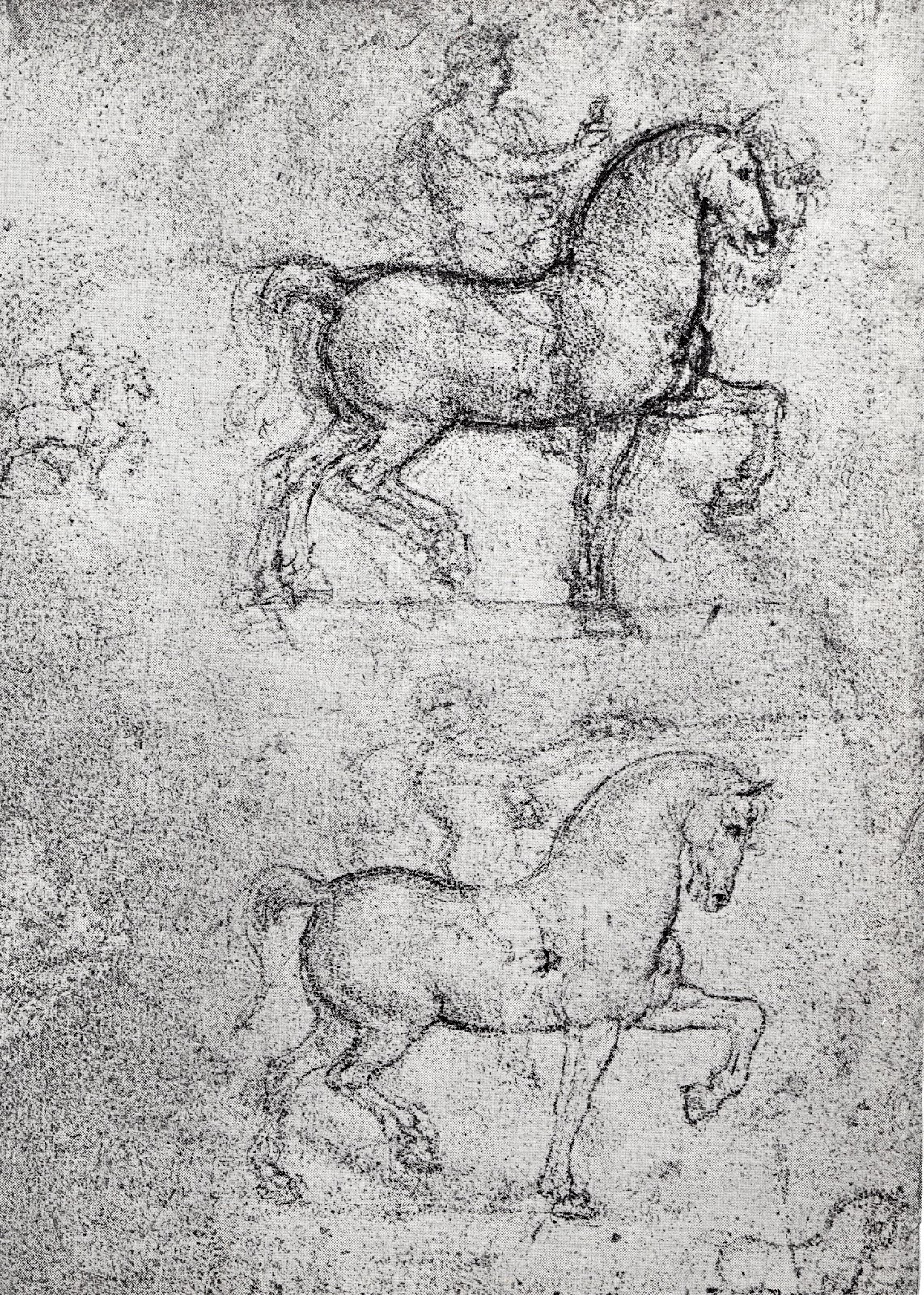

Drawings of prancing horses,
Leonardo da Vinci, 1482.
Internet photo, Public domain.


Leonardo left many drawings of horses and designs for equestrian statues in his notebooks and if they were shown as walking they illustrated the horse's gait incorrectly. Since the cave paintings as well as Leonardo's sketches do not generally include a ground line, the researchers had to estimate that to complete their analysis, but, if more than one foot of the animal is raised there is no way to draw a ground line that contacts three feet. Cave artists - 53.8% to Post-Muybridge modern artists - 42.1%, and we call them "Primitive" artists.

Now it is important to again clarify that this only applies to walking gaits by these large quadrupeds. Other gaits; trot, gallop, run, leaping, etc., can have different characteristics including more than one foot off the ground at one time.

NOTE:  On August 25, 2019, I published "On Endless Motion - Depiction of Movement in Upper Coa Valley Rock Art" on RockArtBlog. This discussed a 2009 paper by L. Luis and A. P. B. Fernandes "On endless motion: depiction of movement in the Upper Palaeolithic Côa Valley rock art (Portugal)" in which they discussed animal portrayals in terms of implied animation. The walking gait that Horvath et. al. are examining was classified in this study as "Symmetrical animation."

Some images in this posting were retrieved from the internet with a search for public domain photographs. If any of these images are not intended to be public domain, I apologize, and will happily provide the picture credits if the owner will contact me with them. For further information on these reports you should read the original reports at the sites listed below.

REFERENCES:

Faris, Peter
2019 On Endless Motion - Depiction of Movement in Upper Côa Valley Rock Art, Portugal, August 25, 2019, https://rockartblog.blogspot.com/search/label/Coa%20Valley

Horvath, Gabor, Etelka Farkas, Ildiko Boncz, Miklos Blaho, and Gyorgy Kriska,
2012 Cavemen Were Better at Depicting Quadruped Walking than Modern Artists: Erroneous Walking Illustrations in the Fine Arts from Prehistory to Today, December 5, 2012, https://doi.org/10.1371/journal.pone.0049786

https://journals.plos.org/plosone/article/figure?id=10.1371/journal.pone.0049786.g003

Luis, L., & Fernandes, A. P. B.
2009 On endless motion: depiction of movement in the Upper Palaeolithic Côa Valley rock art (Portugal), In Congresso International da IFRAO 2009, Piauỉ, Brasil, IFRAO, p. 1304-1318

Stromberg, Joseph
2012 Cavemen Were Much Better At Illustrating Animals Than Artists Today, December 5, 2012, https://www.smithsonianmag.com

Saturday, March 7, 2020

GENETIC MARKERS FOUND FOR THE COLORATION OF HORSES PAINTED IN EUROPEAN CAVES:


Horses, Lascaux, France.
Internet photo, Public domain.

Students of rock art have learned to always be on the lookout for representations of rare or extinct animals as a guide to their actual appearance. This is a case of a cave painting of animals that were for some time thought to be imaginary or symbolic, and now have been proven to be real. On January 18, 2020, I revisited the question of the authenticity of the spotted horses of Pech-Merle Cave in France. Genetic analysis of ancient horse fossils has provided markers that can be used to identify the color of the animal when it was alive. Not only has the existence of spotted horses been proven by genetic analysis, but genetic studies have also given us information on the color and confirmation of other Paleolithic wild horses - Equus ferus ferus.


Horse, Lascaux, France.
Internet photo, Public domain.

"Prehistoric representations of animals have the potential to provide first-hand insights into the physical environment that humans encountered thousands of years ago and the phenotypic appearance of the animals depicted. However, the motivation behind, and therefore the degree of realism in, these depictions is hotly debated and it has yet to be shown to what extent they have been executed in a naturalistic manner.
Neuropsychological explanations include 'hyperimagery,' in which an internally generated image is perceived in external space, whereas others have argued for shamanistic significance or simply art for art's sake. Some paleontologists argue that cave paintings are a reflection of the natural environment of humans at the time, but not all researchers agree with this opinion." (Pruvost et.al. 2011:1)


Horses, Chauvet Cave, France. www.bradshawfoundation.com

In a nutshell, the argument has been whether the animal depictions represent the appearance of real animals, or whether they represent "spirit animals" of some sort. As "spirit animals" their overall appearance (shape, coat color, conformation, etc.) need not be considered as representative of a real horse.


Prewalski horses from
Chauvette Cave, France.
www.haut-thorenc.com

"Where animal species can be confidently identified, horses are depicted at the majority of these sites. With more than 1,250 documented depictions (~30% of all animal illustrations) ranging from the Early Aurignacien of Chauvet to the Late Magdalenian (several post-12-kyBP sites in France and Spain), and from the Iberian Peninsula to the Ural mountains, horses are the most frequent of the more than 30 mammal species depicted in European Upper Paleolithic cave art. Depictions are commonly in a caricature form that slightly exaggerates the most typical 'horsey' features.
Although taken as a whole, images of horses are often quite rudimentary in their execution, some detailed representations, from both Western Europe and the Ural mountains, are realistic enough to at least potentially represent the actual appearance of the animals when alive. In these cases, attributes of coat color may also have been depicted with deliberate naturalism, emphasizing colors and patterns that characterized contemporary horses. For example, the brown and black horses dominant at Lascaux and Chauvet, France, phenotypically match the extant coat colors bay and black. (Pruvost et.al. 2011:2-3)


Przewalskis horse, 
Wikipedia.

"In a 2009 analysis of DNA from the bones of nearly 90 ancient horses dated from about 12,000 to 1000 years ago, researchers found genetic evidence for bay and black horse colors." (Balter 2011)


Wild horse reconstructions.
Wikipedia

"The researchers, led by geneticists Arne Ludwig of the Leibniz Institute for Zoo and Wildlife Research in Berlin and Michael Hofreiter of the University of York in the United Kingdom, analyzed DNA from an older sample of 31 prehistoric horses from Siberia as well as Eastern and Western Europe ranging from about 20,000 to 2200 years ago. They found that 18 of the horses were bay, seven were black, but six had a genetic variant - called LP - that corresponds to leopardlike spotting in modern horses. Moreover, out of 10 Western European horses estimated to be about 14,000 years old, four had the LP genetic marker, suggesting that spotted horses were not uncommon during the heyday of cave painting." (Balter 2011)

So, genetic confirmation of not only bay coloration, but black horses as well was found, as well as the final proof of spotted horses in the Paleolithic era, reinforcing the idea that cave art can indeed give us valuable insights into the extant animal life of prehistoric times.

NOTE: Some images in this posting were retrieved from the internet with a search for public domain photographs. If any of these images are not intended to be public domain, I apologize, and will happily provide the picture credits if the owner will contact me with them. For further information on these reports you should read the original reports at the sites listed below.

REFERENCES:

Balter, Michael,
2011 Was the Spotted Horse an Imaginary Creature?, November 7, 2011, Science Magazine, https://www.sciencemag.org/news/2011/11/was-spotted-horse-imaginary-creature

Pruvost, Melanie, Rebecca Bellone, Norbert Benecke, Edson Sandoval-Castellanos, Michael Cieslak, Tatyana Kuznetsove, Arturo Morales-Muniz, Terry O'Connor, Monica Reissmann, Machael Hofreiter, and Arne Ludwig,
2011 Genotypes of Predomestic Horses Match Phenotypes Painted in Paleolithic Works of Cave Art, Proceedings of the National Academy of Sciences of the United States, Nov. 15, 2011

Saturday, January 18, 2020

ANIMALS IN ROCK ART: PALEOLITHIC SPOTTED HORSES - REAL OR FANCIFUL?


       Spotted horses, Pech-Merle
Cave, France.
   Internet photo - Public domain.

Students of rock art have learned to always be on the lookout for representations of rare or extinct animals as a guide to their actual appearance. This is a case of a cave painting of animals that were for some time thought to be imaginary or symbolic, and now have been proven to be real.

"Prehistoric representations of animals have the potential to provide first-hand insights into the physical environment that humans encountered thousands of years ago and the phenotypic appearance of the animals depicted. However, the motivation behind, and therefore the degree of realism in, these depictions is hotly debated and it has yet to be shown to what extent they have been executed in a naturalistic manner. Neuropsychological explanations include 'hyperimagery,' in which an internally generated image is perceived in external space, whereas others have argued for shamanistic significance or simply art for art's sake. Some paleontologists argue that cave paintings are a reflection of the natural environment of humans at the time, but not all researchers agree with this opinion." (Pruvost et.al. 2011:1)

In a nutshell, the argument has been whether the animal depictions represent the appearance of real animals, or whether they represent "spirit animals" of some sort. As "spirit animals" their overall appearance (shape, coat color, conformation, etc.) need not be considered as representative of a real horse.

One animal where these questions have been raised is the horse, specifically the depictions of spotted horses.

Coat colors and patterns
of Paleolithic horses.
Internet photo - Public Domain.


Bay and Black horses,
Chauvet Cave, France.
Internet photo - Public Domain.

"Where animal species can be confidently identified, horses are depicted at the majority of these sites. With more than 1,250 documented depictions (~30% of all animal illustrations) ranging from the Early Aurignacien of Chauvet to the Late Magdalenian (several post-12-kyBP sites in France and Spain), and from the Iberian Peninsula to the Ural mountains, horses are the most frequent of the more than 30 mammal species depicted in European Upper Paleolithic cave art. Depictions are commonly in a caricature form that slightly exaggerates the most typical 'horsey' features.
Although taken as a whole, images of horses are often quite rudimentary in their execution, some detailed representations, from both Western Europe and the Ural mountains, are realistic enough to at least potentially represent the actual appearance of the animals when alive. In these cases, attributes of coat color may also have been depicted with deliberate naturalism, emphasizing colors and patterns that characterized contemporary horses. For example, the brown and black horses dominant at Lascaux and Chauvet, France, phenotypically match the extant coat colors bay and black. However, the depictions in the cave of Pech-Merle, France, dated to 24.7 kyBP, featuring spotted horses in a frieze that includes hand outlines and abstract patterns of spots, have led prehistorians to argue for more complex explanation for several reasons. First, the juxtaposition of elements in this depiction raises the question of whether the spotted pattern is in some way symbolic or abstract, and second, a spotted coat phenotype is, at least by many researchers, considered unlikely for Paleolithic horses." (Pruvost et.al. 2011:2-3)


 Spotted horses, Pech-Merle
Cave, France.
   Internet photo - Public domain.

Most researchers before now had considered a horse with a spotted coat to have been improbable before domestication. Indeed, most non-domesticated wild animals have coats that are relatively solid in color, often darker above and lighter below. Now, a new genetic study has indicated that there was a strong genetic possibility of spotted horses back in the Paleolithic period.

"Now, a new study of prehistoric horse DNA concludes that spotted horses did indeed roam ancient Europe, suggesting that early artists may have been reproducing what they saw rather than creating imaginary creatures." (Balter 2011)


Bay horses, Lascaux Cave, France.
Internet photo - Public Domain.


Close-up of bay horse,
Lascaux Cave, France.
Internet photo - Public Domain.


Close-up of bay dun horse,
Lascaux Cave, France.
Internet photo - Public Domain.


"In a 2009 analysis of DNA from the bones of nearly 90 ancient horses dated from about 12,000 to 1000 years ago, researchers found genetic evidence for bay and black horse colors but not sign of the spotted variety." (Balter 2011) This led researchers to suggest that the spotted horses had been imaginary, spiritual beings.

"But in a new paper published online in the Proceedings of the National Academy of Sciences, the same team reports finding that spotted horses did indeed exist around the time that cave artists were doing their best work. The researchers, led by geneticists Arne Ludwig of the Leibniz Institute for Zoo and Wildlife Research in Berlin and Michael Hofreiter of the University of York in the United Kingdom, analyzed DNA from an older sample of 31 prehistoric horses from Siberia as well as Eastern and Western Europe ranging from about 20,000 to 2200 years ago. They found that 18 of the horses were bay, seven were black, but six had a genetic variant - called LP - that corresponds to leopardlike spotting in modern horses. Moreover, out of 10 Western European horses estimated to be about 14,000 years old, four had the LP genetic marker, suggesting that spotted horses were not uncommon during the heyday of cave painting." (Balter 2011)

This is not proof that the Pech Merle spotted horses were painted after real models, but it is proof that they could have been.

NOTE: Some images in this posting were retrieved from the internet with a search for public domain photographs. If any of these images are not intended to be public domain, I apologize, and will happily provide the picture credits if the owner will contact me with them. For further information on these reports you should read the original reports at the sites listed below.

REFERENCES:

Balter, Michael
2011 Was the Spotted Horse an Imaginary Creature?, November 7, 2011, Science Magazine, https://www.sciencemag.org/news/2011/11/was-spotted-horse-imaginary-creature

Pruvost, Melanie, Rebecca Bellone, Norbert Benecke, Edson Sandoval-Castellanos, Michael Cieslak, Tatyana Kuznetsove, Arturo Morales-Muniz, Terry O'Connor, Monica Reissmann, Machael Hofreiter, and Arne Ludwig,
2011 Genotypes of Predomestic Horses Match Phenotypes Painted in Paleolithic Works of Cave Art, Proceedings of the National Academy of Sciences of the United States, Nov. 15, 2011.

Sunday, November 3, 2013

HORSE DECORATION IN ROCK ART – PAINT:


Warriors of the Plains horse tribes painted their horses for special occasions. These painted markings and symbols were not so much an identifier in the nature of the Angle horse brand as they were an enhancement, visual or spiritual, of the horse’s and the rider’s presence. Some of the symbols represented specific accomplishments and so could be read like a biography of the warrior. Other symbols conferred spiritual powers and abilities that had been shown to the warrior on a vision quest. Some examples of painted horses can be seen in rock art and other Native American art forms, and some of these messages can still be read in the painted markings.

Symbols from painted horses, Thomas E. Mails, 
Mystic Warriors of the Plains, 1991, p.220.

Thomas Mails illustrated a number of commonly seen marks in his book Mystic Warriors of the Plains (Mails 1991:220) and examples (including variations) of some of these symbols can be seen in examples of Native American art. “Painted exploit symbols used on horses. a, war party leader. b, enemy killed in hand combat. c, owner fought from behind breastworks. d, hail. e, coup marks. f, horse raids or number of horses stolen. g, mourning marks. h, medicine symbol.” (Mails 1972: 220)


Picture Canyon, Baca County. Photograph: Peter Faris.


Close-up of symbol on the horse from Picture
 Canyon, Baca County, Colorado.

In Picture Canyon, Baca County, Colorado, a horse figure that is faintly drawn in black and also lightly incised into the cliff face has markings carved into his front shoulder that might represent a variation of Mail’s marks for coup counts. An extremely faded rider can be made out and the shapes of tipis in the background are now almost invisible.


A coup count, Dog Soldier Ledger, pl. 91, p. 189.


Detail, A coup count, Dog Soldier Ledger, pl. 91, p. 189.

Coup count symbols can be seen on the horse illustrated in one of the plates in the Dog Soldier Ledger (p. 91, p. 189) in which an unidentified warrior has dismounted to count coup with a strike of his bow on a wounded soldier.


Keyser, James D. and Michael A. Klassen,
2001, Plains Indian Rock Art,p. 237.

An incised panel from Joliet, Montana, is illustrated in James Keyser’s and Michael Klassen’s 2001 book Plains Indian Rock Art (p. 237). The large horse in the center of the illustration carries an “H” on his hip which might represent an Anglo brand, but the horse also shows a open-bottom rounded symbol on his front shoulder which is quite possibly Mail’s symbol for horse raids and/or horses stolen, a could possibly actually refer to the capture of the horse illustrated by its rider.


White Bird lancing a soldier, a circle is painted
on the hip of his horse. Dog Soldier Ledger,
plate 100, p. 203. 

Another illustration from the Dog Soldier Ledger (p. 100, p. 203) shows White Bird lancing a white man. White Bird’s horse is painted with a circle identified by Mails as signifying fighting from behind breastworks or from some sort of defensive position. Additional illustrations of White Bird in the same publication show the same symbol on his horse.

“A warrior often painted his favorite war horse with the same pattern and colors he used for his own face and body. And when he was preparing for ceremonial events or for journeys into enemy territory, he painted his horse at the same time as he painted himself. – The main thing to bear in mind is that the painted horse always carried a message about his owner, hence sometimes the quality of the horse bearing the marks – although the painted horse might not always be the one the owner had ridden on the raids described.” (Mails 1991:219)

The value and importance of the horse painting is illustrated by George P. Horse Capture and Emil Her Many Horses in their 2006 book “Song for the Horse Nation”. “Siya’ka said that on one occasion when he was hard pressed on the warpath, he dismounted, and, standing in front of his horse, spoke to him saying: “We are in danger. Obey me promptly that we may conquer. If you have to run for your life and mine, do your best, and if we reach home, I will give you the best eagle feather I can get – and you shall be painted with the best paint.”” (Horse Capture and Her Many Horses 2006:41)  “The best paint” presumably is paint made with the rarest, or hardest to acquire, pigments, the value being due to the effort or expense of acquisition.

A range of motives and reasons led to painting of their horses by Native American Plains warriors, and many of these motives and reasons were of such importance that the same symbols were occasionally portrayed on rock art of horses. Indeed, many of these symbols can often be found independantly painted or pecked into the rock as well, but that is a subject for a later posting.

REFERENCES:

Afton, Jean, David Fridtjof Halaas, and Andrew E. Masich
1997    Cheyenne Dog Soldiers: A Ledgerbook History of Coups and Combat, Colorado Historical Society and University Press of Colorado, Denver.

Horse Capture, George P., and Emil Her Many Horses
2006    A Song For the Horse Nation: Horses in Native American Cultures, National Museum of the American Indian, Smithsonian Institution, Washington D.C., and Fulcrum Press, Golden, Colorado.

Keyser, James D. and Michael A. Klassen
2001    Plains Indian Rock Art, University of Washington Press, Seattle.

Mails, Thomas E.

1991    Mystic Warriors of the Plains, Barnes and Noble Books, New York

Sunday, December 18, 2011

SPOTTED HORSES IN CAVE ART:


Spotted horses, cave of Pech-Merle, France.

The panel of painted horses from the cave of Pech-Merle in France has caused considerable speculation as to its accuracy and intention. The approximately 25,000-year-old painting of The Dappled Horses of Pech-Merle depicts spotted horses on the walls of a cave in France remarkably similar to a pattern of overall spot markings known as "leopard" in modern horses such as Appaloosas.

An article in LiveScience.com by Charles Choi, and dated Tuesday, 8 November 2011, reported the discovery of genetic evidence that the Paleolithic horses of Europe had the potentiality of overall “leopard” spotting indeed. “Scientists investigated the differences in genes for coat color of 31 ancient horse fossils from Siberia, Eastern and Western Europe and the Iberian Peninsula.” To study the genetics of equine coat color, the international research team analyzed DNA from fossilized bones and teeth from 31 prehistoric horses representing over a dozen different archaeological sites.

Genetic analysis indicated that eighteen of the horses had been brown and seven were black. In six of the horses researchers found the LP genetic variant that corresponds to leopard like spotting in the coats of modern horses. Additionally, among ten 14,000 year old Western European horses, four had the LP genetic marker. These results suggest that at the time of the creation of the ancient cave paintings spotted horses could well have been observed in nature and copied in the cave paintings.


Contemporary spotted horses - Appaloosas.

In the past some researchers have found the spotting of the Pech-Merle horses to be perhaps unrealistic and have suggested that these horses represented fantastic imagined horses or spiritual creatures rather than realistic animals. This genetic study proves that the beautiful spotted horses of Pech-Merle could indeed have been painted from life.

REFERENCES:

Charles Choi,  LiveScience.com.  Tue, Nov 8, 2011.

Thursday, August 20, 2009

ARMORED HORSE PETROGLYPHS:

Some of the early rock art representations of horses equipped with tack or gear illustrate it with the body covered by a tent-like hanging covering. These represent horses that are covered with rawhide horse armor. John Ewers related an early report of this which was found in Lewis and Clark’s 1805 description of the Lemhi Shoshoni. “They have a kind of armor like a coat of mail, which is formed of a great many folds of dressed antelope-skins, united by means of a mixture of glue and sand. With this they cover their own bodies and those of their horses, and find it impervious to arrows”.
Citing a number of early sources Ewers continued:
“The earliest known description of the use of armor by any Plains Indian tribe refers to both body and horse types. In 1690, Tonty found the Caddo on Red River wore “body-coverings of several skins, one over the other, as a protection from arrows. They arm the breasts of their horses with the same material, a proof that they are not very far from the Spaniards.” The French explorers Du Tisne and La Harpe found the Wichita and their neighbors on the Arkansas wore hide body armor and decked their horses with breastplates of tanned hide in 1719. Five years later Bourgmont remarked that the Paduca (Apache) went to war dressed in “specially tanned buffalo skins with which they protect themselves. They also hang them around their horses to protect them against arrows” A Ponca tradition refers to their fights with mounted Comanche, before the Ponca themselves obtained horses, in which the Comanche employed horse armor “of thick rawhide cut in round pieces and made to overlap like the scales of a fish. Over the surface was sand held on by glue”.
Armored horse petroglyph, Farrington
Springs, Colorado. Photo: Peter Faris.

Imagery of armored horses has been discovered at the monumental rock art site of Farrington Springs, in southeastern Colorado, by Mark Mitchell.

Rock Art Depicting Commanches, Horses Clad In Leather Armor Discovered In Colorado, ScienceDaily, April 1, 2004 — Several new rock art discoveries by a University of Colorado at Boulder researcher depict mounted warriors, likely Comanche, astride horses clad in leather armor and created around 1700 to 1750, the first such petroglyphs found in the state. CU-Boulder anthropology doctoral student Mark Mitchell, who identified the art, said Plains Indians like the Comanche probably acquired horses from the Spanish in northern New Mexico beginning about 1650 through raiding or trading. The idea of leather-armored horses and riders to deflect spears and arrows probably came from American Indians seeing armored Spanish horse soldiers in the Southwest or Mexico.
"This art tells us about Comanche history through archaeology," Mitchell said. "There is some recorded history but virtually no archaeology of the Comanche, which makes these rock art depictions very valuable. They should point us to additional places to look for Comanche sites containing artifacts associated with horses."


Armored horse petroglyph, Farrington
Springs, CO, photo: Peter Faris

The new finds by Mitchell include three in Colorado and one in central Kansas. He identified two separate rock art depictions of armored horses on the Purgatoire River in southeast Colorado, both showing the horses' armor as rough trapezoids of leather on each side with straight to slightly flaring front and back margins and curved at the top and bottom. "Both also clearly show an armored collar from which horses' heads protrude," said Mitchell.
Page 34, Rock Art of Western North Dakota and the Southern
Black Hills, James D. Keyser and Linea Sundstrom, South
Dakota Archaeological Society, No. 9, 1984.

In order to pick out the image of the armored horse in the first photo from Farrington Springs, Colorado, you need to first see the fairly large, tent-like shape in the middle of the picture. That represents the body of the horse draped in a cover of leather armor. Protruding from the right side of that shape is a parallelogram representing the cylindrical neck covering of the armor. The horse’s head protrudes from the right side of that cylindrical neck armor with a pointed ear, and is almost ludicrously small in comparison with the size of the neck and body. This is much like the larger of the two armored horses in James Keyser’s illustration from Rock Art of Western South Dakota, the North Cave Hills, and the Southern Black Hills (South Dakota Archaeological Society, Number 9, Special Publication) as seen above.

Mark Mitchell’s exciting discovery adds important new evidence for interpreting the prehistoric/historic transitional period in the American west. It also illustrates beautifully one of the most important axioms in rock art research. We really do tend to see what we look for. This site has been visited by hundreds of visitors over the years, including yours truly, and as far as I know not one of us recognized the important image of the armored horse. We certainly saw it, but it did not register. Then Mark Mitchell stood in front of the panel in the same place that so many of us had stood in before, and he realized what it was he was seeing. Congratulations Mark, on your important contribution.