Showing posts with label game board. Show all posts

Saturday, March 7, 2026

A ROMAN STONE GAME BOARD:


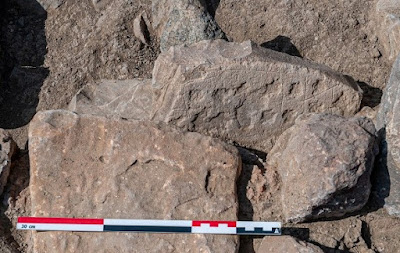
Roman stone game board. Internet photograph, public domain.

I have published a number of columns in the past on RockArtBlog about game boards in rock art (see the cloud index at the bottom). This one is about an example attributed to the Romans from between seventeen and fifteen hundred years ago that was found in the Netherlands.

“A limestone object recovered from the Roman settlement of Coriovallum, now Heerlen in the Netherlands, has provided rare evidence for how people played board games during the Roman period. The object, preserved in Het Romeins Museum, carries a pattern of incised lines on a flattened surface. Archeologists long suspected a link to play, yet no known Roman or earlier European game matches the design.” (Radley 2026) This presented researchers with a fascinating mystery. Can they find out what game was played on an unfamiliar board from that long ago? “Researchers used AI to reconstruct the rules of a board game carved into a stone found in the Dutch city of Heerlen. The team concludes that this type of game was played several centuries earlier than previously assumed.” (Phys.org 2026)

“Coriovallum was a Roman town in the province of Germania Inferior founded under the reign of emperor Augustus (27 BC–AD 14) and inhabited until the fall of the Western Roman Empire in AD 476. The remains of Coriovallum lie beneath present day Heerlen.” (Crist 2026:112)

The game board with pieces in place. Photograph from Universiteit Leiden. 

Although the artifact’s provenance, the details of its discovery have been lost it is believed to have been excavated in Heerlen during the late 19th or early 20th centuries. “Contextual dating, based on the typical archeological strata of Heerlen, places the creation and used of this board between 1,700 and 1,500 years ago.” (Carvajal 2026)

The flattened stone board has a pattern of lines engraved into the upper surface. “The engraving consists of a rectangle defined by a perimeter groove within which four diagonal lines intersect to form a kind of X shape, accompanied by a single straight horizontal line at one end of the rectangle, and apparently simple but enigmatic configuration.” (Carvajal 2026) This is really not how I would describe the design of the lines on the surface, but interestingly, instead of a series of similar boxes, pits or outlines the design essentially consists of a large rectangle divided up into differing sized rectangular and triangular spaces. The design is symmetrical with both ends the same.

Roman game pieces from Coriovallum. Image from Het Romeins Museum.

These questions particularly interested an archeologist named Walter Crist. “Archeologist Walter Crist encountered the stone in 2020 in the collection of the Thermenmuseum – which has since been renamed the Roman Museum. The worked limestone slab, measuring 21 by 14.5 centimeters, was found in the ground in Heerlen in the late 19th or early 20th century. Heerlen was once the important Roman settlement of Coriovallum. Crist specializes in ancient games and was immediately intrigued.” (Phys.org 2026)

Crist assumed that playing a game on this board would leave microscopic wear marks that might point to directions of movement of pieces. “Crist examined the stone under a microscope. ‘Wear was visible on the lines of the stone, exactly at the places where you would slide your playing piece.’ He enlisted the help of researchers from Heerlen and Maastricht. Restaura restoration studio from Heerlen produced highly detailed 3D scans.” (Phys.org 2026) They found the traces they were looking for suggesting possible patterns on the stone surface.

The wear patterns that were detected apparently followed along the diagonal lines on the stone. “To test whether play could explain the wear, researchers combined archeological observation with artificial intelligence-driven simulations. The team used the Ludii system, a platform designed to model historical board games. Two automated players competed against each other on a digital version of the stone board. The simulations drew from many rule systems recorded for small Northern European games, including examples from Scandinavia and Italy. The results showed strong agreement between the observed wear and simulations based on blocking games. In this type of game players aim to restrict an opponent’s movement rather than capture pieces. The simulated play repeatedly concentrated movement along the same lines seen on the stone surface.” (Radley 2026) While the results of the artificial intelligence analysis seem to confirm gameplay, they could not actually replicate for sure the actual game, which Crist (2026:1) refers to as Ludus Coriovalli.

Possible placement of pieces for the game as determined by AI. Image from Crist et al.

“The use wear on the stone was plausibly created through gameplay, moving playing pieces of a size and material composition consistent with examples common at Roman sites, including Coriovallum. - The fact that the observed wear pattern is only apparent in parallel with the incised lines suggests that those lines were meaningful for the action that produced abraded wear along them.” (Crist 2026:121) Although the wear on the stone surface was not as serious as the wear on the Monopoly board I played as a kid, it could be detected with microscopy. And the wear patterns suggested the possible movements of the pieces.

NOTE: Some images in this column were retrieved from the internet with a search for public domain photographs. If any of these images are not intended to be public domain, I apologize, and will happily provide the picture credits if the owner will contact me with them. For further information on these reports you should read the original reports at the sites listed below.


REFERENCES:

Carvajal, Guiellermo, 2026, A Roman Board Game Found in Ancient Coriovallum Rewrites the History of Strategy Games, 10 February 2026, https://www.labrujulaverde.com/en/2026/02/a-roman-board-game-found-in-ancient-coriovallum-rewrites-the-history-of-strategy-games/. Accessed online 10 February 2026.

Crist, Walter et al., 2026, Ludus Coriovalli: using artificial intelligence-driven simulations to identify rules for an ancient board game, Antiquity, Vol. 100 (409), 111-126. Accessed online 11 February 2026.

Phys.org, 2026, Rules of unknown board game from the Roman period revealed, 10 February 2026, Leiden University. Accessed online 10 February 2026.

Radley, Dario, 2026,  AI simulations reveal a Roman era board game in the Netherlands, pushing Europe’s blocking games back centuries, 10 February 2026, https://archaeologymag.com/2026/02/roman-era-board-game-in-the-netherlands/. Accessed online 10 Feb. 2026.


Saturday, July 15, 2023

A SMALL STONE CARVED WITH A VIKING SHIP MAY BE THE OLDEST PICTURE IN ICELAND

Carved sandstone showing Viking ship in full sail, from Stöð, Iceland. Credit, The Landnámsskáli group in Stöð.

Iceland had no native indigenous population before European discovery and settlement by the Norse in the second half of the 9th century, approximately 874 CE. Now archaeologists have found a small round piece of sandstone carved with a picture of a Viking ship. “The stone was found at the archaeological site of Stöð in East Iceland in a longhouse that is believed to predate the permanent settlement of the island.” (Ciric 2023) This means, of course, that there should be no prehistoric rock art.

Viking longhouse excavation, Stöð, Iceland. Photograph Bjarni Einarsson.

“The first exploratory digs at Stöð were made in 2015 and archaeologists have returned every summer since to continue excavating the site, where they first focused their efforts on a settlement-era longhouse. ‘The longhouse is among the largest found in Iceland, 31.4m [103 ft] long. In Scandinavia, only chieftains’ farms had longhouses larger than 28m [92 ft]. It is also the richest longhouse ever excavated in Iceland. We have found 92 beads and 29 silver objects, including Roman and Middle Eastern coins,’ Bjarni F. Einarsson told Iceland Review for a 2020 article on the archaeological site.” (Ciric 2023) This provides a striking illustration as to how cosmopolitan the Vikings really were. Even in this out-of-the-way place there were artifacts from varying cultures throughout much of the known world.

 One of the longhouses excavated at the site, Stöð, Iceland. Photograph Bjarni Einarsson.

“What makes the site still more significant is that archaeologists discovered an even older longhouse underneath the settlement-era longhouse, estimated to date back to around 800 AD, some 75 years before permanent settlement of Iceland. The most striking feature of the older structure is the conspicuous absence of the bones of domesticated animals. ‘My theory is that the older longhouse was a seasonal hunting camp, operated by a Norwegian chief who outfitted voyages to Iceland to gather valuables and bring them back across the sea to Norway,’ Bjarni told Iceland Review. One of these valuables may have been walrus ivory: in 2019 DNA analyses and radiocarbon dating confirmed that Iceland was previously inhabited by a North Atlantic subspecies of walrus, now extinct.” (Ciric 2023)

Much of the ivory used in Medieval Europe was walrus ivory supplied through trade with the Vikings. “New finds of walrus bone and ivory in early Viking Age contexts in Iceland suggest exploitation of nearby walrus for meat, hide and ivory that appears to have driven local Icelandic walrus populations to extinction.

Current evidence suggests that walrus hunting and ivory extraction was a significant activity for early settlers in Iceland, and was probably not limited only to the best-known areas of the south-west coast.

The new excavations and zooarchaeological work appear to support the notion of an initial settlement of at least parts of Iceland driven and ‘financed’ by walrus hunting and connections to Viking Age exchange networks.

As a preliminary conclusion it seems that we can now refine the ‘trading hypothesis’ by verifying or disproving that walrus ivory in north-west European exchange networks may be Icelandic c. 850–1000 CE, but increasingly Greenlandic from 1000 CE onwards.” (Frei et al. 2015)

So Ciric (2023) is proposing that this earlier pre-colonization  longhouse/hunting camp may have existed to hunt walrus ivory before the Iceland walrus was driven to extinction by overhunting.

But the subject of this column is the small engraved piece of sandstone found in the walls of the older longhouse.

“The small but remarkable sandstone featuring a Viking ship with its sails unfurled was found in the walls of the older longhouse, Bjarni told reporters. Such carvings of ships, made in bone, wood, and stone, are fairly common artefacts in the Nordic countries, he stated, but this is the first ever found in Iceland and is likely the oldest picture of any kind ever found on the island.


Trade beads, Stöð, Iceland. Photograph Bjarni Einarsson.

This spring, archaeologists used survey equipment to scan a larger area around Stöð and found indications of still more structures and boat burial sites. While there is much that is unknown about the early settlement of Iceland, the amount of beads, coins, and silver found at Stöð certainly suggests significant wealth and trade.” (Ciric 2023)

Hnefaltafl game board and pieces, Online image, public domain.

Wherever they roamed, whether for trade, colonization, or raiding, Vikings carried with them an important element of their culture, the board game known as hnefaltafl.

Carved stone hnefaltafl game board, Online image, public domain.

"Over the past 150 years, excavators have unearthed large quantities of gaming material from Viking boat burials. Dating from the 7th to the 11th centuries, most of it consists of checker-like pieces constructed from glass, whale bone, or amber. These pieces range from ordinary discs to ornate figurines and are usually uniform in shape and size, save for one prominent king piece, known as the hnefi. The archaeologist Mark Hall recently chronicled the contents of 36 burials containing such pieces in a 2016 article for the European Journal of Archaeology. This material, he says, indicates the game was much more than a frivilous way to kill time between raids. 'Its presence in these burials suggests it was an aspect of everyday life that was desirable to see continued,' he says, as well as 'a significant element that helped define the status of the deceased." (Crown 2018) In other words hnefaltafl seems to have had a ritual or ceremonial element as well as just recreational. Between its recreational popularity, and its ritual/ceremonial importance it seems to have been ubiquitous in the Viking world.

"That archaeologists and game historians can confidently make such claims is a testimony to more than 100 years of painstaking research. Indeed, until the early 20th century, few scholars differentiated hnefatafl from other contemporary board games. Early published editions of the Sagas relied upon wildly disparate translations of medieval Iclandic texts,, with also confused the matter. Because the oldest extant copies of these documents often refer to the gam as 'Tafl' - a Germanic word denoting 'board' or table'  - translators regularly mistook references to it for generic allusions to chess." (Crown 2018)

Carved sandstone showing Viking ship in full sail, from Stöð, Iceland. Credit, The Landnámsskáli group in Stöð.

Early assumptions that hnefatafl somehow developed from contact with cultures that played chess have been proven wrong, indeed, some claim that the Viking game preceded chess. In any case, their origins are hard to pin down and they were played side-by-side in some cultures.

"Tafl games (pronounced [tavl], also known as hnefatafl games) are a family of ancient Northern European strategy board games played on a checkered or latticed gameboard with two armies of uneven numbers. Most probably they are based upon the Roman game Ludus latrunculorum." (Wikipedia)

So, we have a very early Viking residence in Icelend, apparently there some time before the actual period of settlement by Europeans, and in excavating it a small piece of sandstone was found hiddenn in the wall as it it were important enough to keep concealed. It is my suggestion that perhaps the small piece is a prized game piecer, and logically the game would have been hnefaltafl, the Viking board game. Now, being made from sandstone it would not have been valued so much for its material, but Vikings were very superstitious by today's standards. Maybe this piece was prized for the number of games it won, much like a boy playing marbles today prizes his winning shooter almost superstitiously.


NOTE: Some images in this posting were retrieved from the internet with a search for public domain photographs. If any of these images are not intended to be public domain, I apologize, and will happily provide the picture credits if the owner will contact me with them. For further information on these reports you should read the original reports at the sites listed below.


REFERENCES:

Ciric, Jelena, 2023, Stone Carved With Viking Ship May Be Oldest Picture Ever Found in Iceland, 15 June 2023, https://www.icelandreview.com. Accessed online 17 June 2023.

Crown, Daniel, 2018, The Board Game at the Heart of Viking Culture, 26 June 2018, https://atlasobscura.com. Accessed online 24 June 2023.

Frei, Karin M. et al., 2015, Was it for walrus? Viking Age settlement and medieval walrus ivory trade in Iceland and Greenland, Taylor & Francis, ISSN 0043-8243. Accessed online 24 June 2023.

Wikipedia, Tafl Games, https://en.wikipedia.org. Accessed online 25 June 2023.

Saturday, March 5, 2022

ANOTHER GAME BOARD PETROGLYPH:


Omani game board, Qumayrah Valley, Oman. Photograph J. Sliwa, Polish Centre of Mediterranean Archaeology, University of Warsaw, Poland.

I have, in the past, written a few columns about petroglyphs that seem to be intended as game boards. There is now a new report about another one found in Oman by a joint project between the University of Warsaw and the Omani Ministry of Heritage and Tourism.

“The work is carried out by an Omani-Polish project ‘The development of settlement in the mountains of northern Oman in the Bronze and Iron Ages’ headed jointly by Prof. Piotr Bielinski from the Polish Centre of Mediterranean Archaeology, University of Warsaw (PCMA UW) and Dr. Sultan al-Bakri, Director General of Antiquities at the Ministry of Heritage and Tourism (MHT) of the Sultanate of Oman.” (ASZY 2022)

Oman is located on the southeast tip of the Arabian Peninsula adjacent to the Indian Ocean and the ruins are near the village of Ayn Bani Saidah in the Qumayrah Valley in the north of the Sultanate of Oman. (ASZY)

“In the latest study, the researchers identified an ancient settlement from the Umm al-Nar period (2500-2000 BC), where they unearthed the remains of several large circular towers and Bronze Age buildings.” (HeritageDaily 2022)


Closeup of Omani game board, Qumayrah Valley, Oman. Photograph J. Sliwa, Polish Centre of Mediterranean Archaeology, University of Warsaw, Poland.

“In one of the rooms we’ve found…a game-board – beams the project director. The board is made of stone and has marked fields and cup-holes. Games based on similar principles were played during the Bronze Age in man economic and cultural centers of that age. Such finds are rare, but several examples are known from India, Mesopotamia and even the Eastern Mediterranean basin.” (ASZY 2022) Unfortunately, none of the references identified which of the co-directors of the project this quotation should be attributed to.


10th century ivory board from Muslim Spain, Museum of Burgos, photograph Wikipedia.

The board appears to have 14 holes carved into what looks in the photos to be a block of limestone. It seems to be intended for use in a variant of the family of games known as Mancala in which seeds or stones are moved from pit to pit to either capture an opponent’s pieces, or to bank the most pieces for yourself. (Wikipedia)

“Researchers also found evidence of processing copper at the site, as well as several copper objects, suggesting that the settlement participated in this lucrative trade for which Oman was famous at that time, with mentions of Omani copper present in the cuneiform texts from Mesopotamia.” (HeritageDaily 2022)

I think that we can assume that any group of people who have the leisure time to play board games are, if not prosperous, at least secure in their environment, and emotionally relaxed enough to enjoy themselves, and this game board would seem to prove this. I can picture prosperous copper merchants relaxing with a game of mancali. There is, however, another possibility, that this is a counting board. These work on the same principle as an abacus with each hole in each marked off sector having a value. The operator can essentially do fairly complicated mathematical operations by placing, moving, or removing counters between the various valued holes. If this were the case we need to picture the prosperous copper merchants calculating their profits. Remembering, however, that the board appears to have 14 holes I know of no mathematical system that would require 14 holes to work.

NOTE: Some images in this posting were retrieved from the internet with a search for public domain photographs. If any of these images are not intended to be public domain, I apologize, and will happily provide the picture credits if the owner will contact me with them. For further information on these reports you should read the original reports at the sites listed below.

REFERENCES:

ASZY, 2022, Qumayrah Valley in Oman: ancient towers, copper trade and games, 4 January 2022, Polish Centre of Mediterranean Archaeology, University of Warsaw, accessed 8 January 2022

HeritageDaily, 2022, Archaeologists discover 4,000-year-old stone board game, https://www.heritagedaily.com, accessed 7 January 2022.

Wikipedia, Mancala, https://en.wikipedia.org/wiki/Mancala, accessed 9 January 2022

Saturday, December 15, 2018

GAMES IN ROCK ART - 58-HOLES, OR HOUNDS AND JACKALS:


58 Holes game board pecked
in Azerbaijan rock shelter,
Photograph W. Crist, courtesy
of the director of the
Gobustan State Historical
and Cultural Preserve.

Back in 2013 I posted a number of columns about game boards carved into rock. Now a new example has been reported from Azerbaijan, an ancient Near Eastern game called 58 Holes, or Hounds and Jackals (the name Hounds and Jackals was bestowed by Howard Carter to describe an example he found in King Tutankhamen's tomb). (Gurevich 2017)


Egyptian 58 Holes game board,
metmuseum.org - public domain.

Apparently originating in Egypt at around 2000 BCE, 58 Holes spread throughout the Near East quickly. "At least 68 gameboards of 58 Holes have been found archaeologically, including examples from Iraq (Ur, Uruk, Sippar, Nippur, Nineveh, Ashur, Babylon, Nuzi), Syria (Ras el-Ain, Tell Ajlun, Khafaje), Iran (Tappeh Sialk, Susa, Luristan), Israel (Tel Beth Shean, Megiddo, Gezer), Turkey (Boghazkoy, Kultepe, Karalhuyuk, Acemhuyuk), and Egypt (Buhen, Thebes, El-Lahun, Sedment)." (Hirst 2017)


This newly discovered example was pecked into stone in a rock shelter in Azerbaijan, some 1000 to 2000 km. from the Near East. Archaeologist Walter Crist of the American Museum of Natural History in New York City saw a photograph of the pattern online and recognized it as a board for 58 Holes. Crist contacted a colleague in Azerbaijan who helped him arrange a site visit in April 2018. "Once there, Crist found that the site he saw online had been bulldozed for a housing development. But a scientific official in Azerbaijan told him of another rock-shelter with the same dot pattern. Crist, who has studied Near Eastern versions of 58 holes, recognized the two-person game when he reached that site." (Bower 2018)

Hopefully the knowledge and recognition of this will protect this site from the bulldozer. In any event RockArtBlog is grateful for the situation that put Walter Crist in place to save it.

NOTE: Images in this posting were retrieved from the internet with a search for public domain photographs. If any of these images are not intended to be public domain, I apologize, and will happily provide the picture credits if the owner will contact me with them. For further information on these reports you should read the originals at the sites listed below.


REFERENCES:

Bower, Bruce
2018 A Bronze Age Game Called 58 Holes Was Found Chiseled Into Stone in Azerbaijan, November 16, 2018, https://www.sciencenews.org/article/bronze-age-game-found-chiseled-stone-azerbaijan

Gurevich, Eli
2017 Hounds and Jackals, October 14, 2017, http://www.ancientgames.org/hounds-and-jackals/

Hirst, Kris
2017 58 Holes: Ancient Egyptian Board Game of Hounds and Jackals, November 12, 2017, https://www.thoughtco.com/50-holes-game-169581

Friday, March 22, 2013

GAME BOARDS IN ROCK ART, REVISITED – MU TORERE:


Petroglyph, Pu'uLoa, Hawaii, Photo Joe Belef, 2007.

On 2/1/13, referring to a photograph taken by Joe Belef used in my posting GAME BOARDS, CONTINUED, on 12/29/12,  Anonymous sent the following comment: “The 8 hole pattern around a central hole looks exactly like a game board for Mu Torere.This game was played by the Maori people of New Zealand.The Maori were Polynesians as were the original Hawaiians.The conclusion is inescapable;this is a board for the same game.” 

That promising information required some checking out so I have been looking into this. I think that Anonymous may well be right. With two different, but related cultures (they both have Polynesian origins) as well as the possibility of prehistoric contact through long-distance sailing voyages, it seems eminently reasonable for us to assume this possibility.

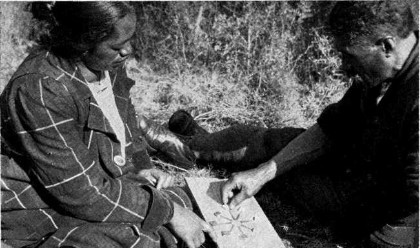
Maoris playing Mu Torere, Dominion Museum Photo,
“MuTorere is one of two games that are known to have been played before they were absorbed into the British Empire (Wikipedia), and it is played on a board with a central hole, called the petahi, and eight or more holes around it called, kewai.” (www.gamesoftheworld.com).


Mu Torere board diagram.
httpwww.boardgamesoftheworld.commutorere.html

And from http://nzetc.victoria.ac.nz/tm/scholarly/tei-BesGame-t1-body-d5-d1-d2.html we are told  “this game, known as torere and mu torere, is one of the most interesting items we have to discuss, on account of its resemblance to our game of draughts, and the existence of a doubt as to whether or not it was a pre-European diversion. The board or diagram used is utterly different in form to that employed by us, there is no crowning of kings, and old natives have stated that, so far as they knew, it was an old Maori game.
Mohi Turei, a well informed and very old man of the Ngati-Porou tribe informs us (1912) that mu torere was the old name for the game, and, in this connection, he quotes an old saying:—"E mu torere mai ana ranei ko utou ki au, e hoa ma !" used in the sense of—"Are you striving against me, or, are you looking for trouble?" Tuta Nihoniho, of the same tribe, stated that the European game of draughts was introduced into that district in the time of his grandfather, probably by sailors, or early traders, or missionaries. In the far off Hawaiian Isles, a game resembling draughts was played, and known by two names, mu and konane.” 
According to available references mu torere boards could be painted or carved on wood as we can see from the illustration that shows the game being played , or just scratched out in the sand. This photgraph also illustrated a board with eight peripheral holes (the kewai), and one central hole (the petahi), exactly the same layout as the Hawaiian petroglyph. This is really exciting to me. Through discussion about our shared interest we have added a small, but real, item of knowledge to the encyclopedia of rock art. Thank you Anonymous! 

REFERENCES:

Wikipedia

Sunday, December 23, 2012

PIKO STONES, OR GAME BOARDS?


PuuLoa, Hawaii, Photograph Joe Belef, 2007. 


PuuLoa, Hawaii, Photograph Joe Belef, 2007.

On November 17, 2012, I put up a posting about Hawaiian Piko stones. These are stones with holes pecked into them that serve as receptacles for the umbilical cords of newborn infants, the belief being that spiritual benefits will accrue to the newborn because of this. Rock surfaces with pecked holes can be found worldwide, and, because of the recorded Hawaiian purpose for such holes they are often, and usually incorrectly, also interpreted as umbilical cord receptacles, Piko stones around the world. As I have stated before we just cannot take a piece of data from one culture and simply apply it to another culture without considerable supporting evidence. We cannot even assume that similar items from within the same culture all have similar uses.


Pohaku Ka Luahine, Moanalua valley, Honolulu.
Photograph Peter Faris,10-23-2010.


Pohaku Ka Luahine, Moanalua valley, Honolulu.
Photograph Peter Faris,10-23-2010.

Field sketch of Pohaku Ka Luahine, Moanalua Valley,
Oahu, Ancient Sites of Oahu, Van James
Bishop Museum Press,  p. 50.

On Dec. 1, 2010, I had posted a column about a rock art site on the Hawaiian island of Oahu that has a grouping of pits in its upper surface that are considered to be a game board, not a piko stone. This site, named Pohaku Ka Luahine, is found in Moanalua valley and consists of a large round boulder. It is densly pecked with lines and figures as well as the game board. I could not really distinguish the grid of pits of the konane game board on the top of the boulder. This is a checkers-like game played with black and white pebbles by Hawaiians and examples have reportedly been found with one hundred or more pits pecked into boulders. This particular boulder is quite eroded and given the dim light under the jungle canopy there were few options for visual clues from side lighting.If there was any patina on the boulder surface it was the same color and value as the rock itself because there was virtually no color difference to go by. Details were hard to see and really did not come through well in the photos at all. I have illustrated it with an obviously incomplete field sketch from the Bishop Museum which does not include many of the lines and images visible in the photograph of the boulder. This is, however, an instance of an attributed game board in rock art.

So, what are the examples in the photographs by Joe Belef, Piko stones, game boards, or something else? Notice that on the game board boulder the pits are arranged in rows in a grid pattern. Also, there are many other petroglyphs of figures, etc., on the Pohaku Ka Luahine. Examples of actual attributed Piko stones that I have seen did not have the pits arranged in a grid, and they had no other figures on them. By comparison, these examples then have to be classified as either, or both, or something else entirely, because they have additional figures but are not arranged in grid patterns. Interesting? 

REFERENCE:
James, Van
2010    Ancient Sites of O’ahu, Bishop Museum Press, Honolulu, p.50