Showing posts with label shield. Show all posts

Saturday, January 20, 2024

BASKETRY SHIELDS IN SOUTHWESTERN ROCK ART?

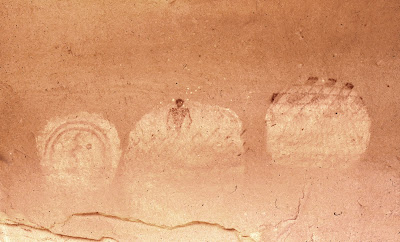
Three shields, Westwater Creek, Grand County, Utah. Photograph Peter Faris, September, 1981.

An important component of the rock art in the American Southwest represents images of shields and/or shield bearing warriors, but shields, as archeological artifacts from prehistoric times are very rare.

“Shields from across the Americas, whether of animal hide or basketry, as objects made from perishable organic materials, are inherently disadvantaged in terms of their archaeological visibility when compared with more durable lithic, ceramic, and bone products.” (Jolie 2022:3) Most shields in collections reflect the contact and historic periods where collectors have been able to acquire them for collections.

Overview of Mummy Cave coiled basketry shield showing a frog like anthropomorphic design.  Frontispiece from Culin’s (1907) “Games of the North American Indians, showing a colorized chromolithograph with an artistically rendered version of the convex surface of the basketry shield from Mummy Cave, Arizona, with froglike design. Illustration from Jolie, 2022, page 7.

In 1978 Barton Wright wrote “Prehistoric shields have been excavated from burials at Mesa Verde, Aztec, and Mummy Cave in Canyon del Muerto. All of these shields are basketry. The coil of the basket is a bundle of three willow rods laced together with yucca in a simple, non-interlocking stitch to form a circular plaque roughly three feet in diameter. The center is bowed outward slightly to leave room for the hand behind a hardwood grip. The shield is supported by this short hand grip, lashed with yucca across the inner convexity. These wooden handles were recovered intact on the Mummy Cave and Aztec specimens which is an extremely rare occurrence. The Mummy Cave shield showed that the positioning of the handle had been changed at least once, possibly for better balance.” (Wright 1976:4)

A few discoveries of shields made by basketry techniques have turned up in excavations in the American southwest. The techniques used in basketry weaving in the Southwest are plaited and coiled basketry. Plaiting is the criss-cross intertwining of the material used for things like mats. Coiled basketry uses rods sewn together with a material. “All of the shields are essentially large shallow trays or plaques made in close coiling by sewing non-interlocking stitches over a three whole rod bunched foundation. Formal variability largely exists in terms of their degree of concavity and overall diameter which, in most cases, due to the presence of a rim or coil curvature, can be estimated with a high level of certainty. Extant basketry shields range from about 50 to 88 cm in diameter.  These measurements likely give us a rough indication of the size of basketry or hide walking shields as being, on average, closer to 70+ cm. As noted above, iconographic depictions of shields are known to be up to 90 cm in diameter, but there is no reason to assume that any or all such depictions were executed to scale. Work direction is uniformly right-to-left (leftward) and work direction is always concave, resulting in the painted, decorated surface being the convex surface. In general, all of the shields reflect a technology and style wholly at home in the northern southwest during the AD 1100s and 1200s, but for which thicker foundation rods and stitching material (all likely Rhus sp.) were employed to create a thicker, denser-walled basket compared to similar contemporaneous coiled baskets of identical structure from the Southwest.” (Jolie 2022:13-14))

Center of coiled basketry shield from Aztec West Ruin, Room 95, showing adhering red pigment. Note remains of hide thong at top piercing the fabric. Photograph by Edward A. Jolie, courtesy of the American Museum of Natural History.


Artistic reconstruction of the fragmentary coiled basketry shield from Aztec Ruin West, New Mexico, Room 95, according to the two largest fragments. Illustration by Will G. Russell, based on the author’s data. Jolie, Figure 9, page 18, 2022.
Note the resemblence to the shield on the right of my opening illustration from Westwater Creek, Utah.

Gary David reported on the discovery of a basketry shield during excavations at Aztec Ruin. “In one of the rooms the bones of an obviously high-status man nicknamed “the Warrior” was found. Wrapped in a turkey-feather blanket, his skeleton measured 6’2” tall, making him at least a foot taller than the average height of males at that time. On top of his body was found a large woven-basketry shield measuring three feet in diameter. Placed on this warrior shield were several curved sticks (boomerangs).” (David:20) These were, of course, either rabbit sticks or fending sticks.

Overview of the Cliff Palace coiled basketry shield (O.574). Scale is 10 cm. Photograph by Edward A. Jolie, courtesy of the History Colorado Center. Image from Jolie, 2022, Figure 15, page 24.

“The outer surface of the Aztec shield has been painted. The central portion is blue-green with a thin rim of red. The outer margin of the shield was covered with pitch and sprinkled with powdered selenite for sparkle. The Mummy Cave shield is also decorated. The central part is covered by a frog-like figure with an orange spot on its back and the rim is painted with a divided border of yellow and blue-grey. This is the same design that occurs on the canyon wall at Betatakin. The Mesa Verde shield was badly deteriorated and no longer retained a trace of its decoration; however, it had been constructed in the same fashion as the other two examples. These shields are from the Pueblo III period of the Anasazi people dating from A.D. 1100-1300.”  (Wright 1976:4-6)

“Surprisingly, there are, in fact, a few traces of basketry shields being used in the historic period. A single extant Tohono O’odham basketry shield collected in 1884, some 49 cm in diameter, is fabricated in 3/3 twill strips of unidentified material with a burlap-like cloth covering painted black with a white floral-looking design surrounding a black center. A basketry shield is also reported for the San Juan Southern Paiute, and this is all the more noteworthy because of their residence in southern Utah/northern Arizona and the inferred influence of ancient Pueblo basketweaving traditions on their own.” (Jolie 2022:6)

Barton Wright (1976) did not believe that basketry shields would have had small efficacy once the bow and arrow were adopted. “It is extremely unlikely that these basketry shields would have deflected or stopped an arrow or lance. Since lances have never been found in archaeological context in the Southwest, they were probably not a factor in the use of a basketry shield. Native archers, on the other hand, who had little difficulty in penetrating the chain mail of the Spanish or the padded fiber armor of their mestizo warriors, would have had no difficulty in penetrating the half inch willow rods. Judd believed on the basis of his excavations that arrows, clubs and thrown rocks were the most common implements of warfare in the Southwest. It seems logical to assume that basketry shields were used for cushioning the fracturing blows of clubs or thrown rocks rather than defense against arrows.” (Wright 1976:6) As it turns out, however, basketry shields have been seen to be quite capable of stopping arrows. I suggest that Wright had forgotten that the flexibility (or “cushioning”) he writes about is an effective way of absorbing the energy of the arrow’s impact as Jolie’s discovery teaches us.

Forton disagreed with Wright, in his 2019 doctorial thesis he wrote: “Pueblo III shields were essentially coiled baskets worn on the arm and were crafted as a deterrent to the bow and arrow, which had made fending sticks obsolete. Imagery is confidently identified as depicting shields, based on physical examples excavated from Mesa Verde, Aztec Ruins, and Canyon del Muerto. The shield from Mesa Verde was too deteriorated to ascertain any designs it may have born, but the shield from the Aztec West great house was painted in concentric bands of green blue, while the Canyon del Muerto shield was painted with a froglike figure. Shields in Southwest rock art are frequently decorated with concentric circles and the Canyon del Muerto shield is similar in form to a striking shield pictograph at Betatakin.” (Forton 2019)

Closeup view of one of the two wooden projectile tips embedded in the convex surface of the White House basketry shield. Photograph by Edward A. Jolie, courtesy of the American Museum of Natural History. Jolie, 2022, Figure 12, page 21.

One basketry shield from White House in Canyon del Muerto calls into question Wright’s assertions of their ineffectiveness against the bow and arrow and confirms Forton’s statement. “Though missing its center, it is mostly complete and was at least about 74 cm in diameter originally. The convex surface exhibits a painted design in the form of a black and red checkerboard band some 20–25 cm wide that divides the basket in half. The convex surface exhibits multiple holes, some with penetrating remnants of hide thongs that suggest former pendant items and, most notably, the tips of two wooden projectiles embedded in its coils. A direct AMS radiocarbon determination on stitching fiber yielded a date of 817+/-35 rcy BP.” (Jolie 2022:17) In other words Jolie (2022) found the remains of a basketry shield with the tips of two arrows stuck in it. These are self arrows with pointed wooden tips and lacking arrowheads but, it is possible that given their smaller diameter they may have had a greater chance of penetration than a stone arrowhead.

“Sometime prior to AD 1200, coiled basketry shields may have supplanted fending sticks in response to bow and arrow use, and the newly available chronometrics on basketry shields reviewed here suggest the existence of conflict in the northern Southwest before the widely accepted social unrest of the AD 1200s. The possibility also remains that basketry shield production persisted at a low level into the historic era among some Southwestern groups. Accepting that shield imagery remains mute on construction technique, it seems prudent not to assume that all shields depicted are automatically hide.” (Jolie 2022:27) I am here suggesting that Jolie’s statement that “shield imagery remains mute on construction technique” is too negative, I believe that the many rock art images of anthropomorphs holding a spiral may be, in fact, representations of figures with basketry shields.

“Thus, visibility again looms large as a key dimension for understanding and evaluating the multiple roles of shields and shield imagery in the prehispanic Southwest. The basketry shields described above inhere with strong visual qualities that were arguably designed to impact viewers’ perception across multiple contexts. Although suffering from imperfect preservation that contributes to their archaeological invisibility, the very fact that three of the five known basketry shields originate from areas largely devoid of shield bearing imagery invites a renewed look at shield imagery and its distribution.” (Jolie 2022:27)

3-Kings panel, McConkey Ranch, Vernal, Utah. Photograph by Bill McGlone.

Closeup of the 3-Kings panel, McConkey Ranch, Vernal, Utah, showing three spirals representing possible basketry shields. Photograph by Peter Faris.

Closeup of the 3-Kings panel, McConkey Ranch, Vernal, Utah, showing three spirals representing possible basketry shields. Photograph by Peter Faris.

The famous 3-Kings panel at McConkey Ranch ouside of Vernal Utah shows a group of fremont figures, some of which are obviously armed warriors, with three spirals in the composition. One is in the lower right of the picture, one is next to the waist on the right side of the central figure, and the third is just above the shield being held by that central figure.

Joli wrote (2022): “Perhaps the most famous rock imagery (paintings, petroglyphs, and pictographs) shield depictions in the Southwest are those from Tsegi phase sites in the Kayenta region of southern Utah and northern Arizona dating between about AD 1250 and 1300. Numerous large-scale shields, some up to 90 cm in diameter, are executed in white, tan, purple, and pink clay mixtures and are found in or near alcoves and defensible cliff dwellings. Various interpretations of these and later shield images see them as symbolizing socioreligious or clan affiliations, community identity, or perhaps even marking the locations of particular clan or residence groups. Shield petroglyph images from Hopi have also been stated to be records of successful battles with adjacent groups (Wright 1976)." (Joli 2022:9-10) The opening line of this paragraph, of course, would only be true if the spirals associated with warriors in famous Fremont portrayals like the 3-Kings panel at McConkey Ranch, Vernal, Utah, are not meant to be examples of basketry shields.

Fremont warrior with coiled basketry shield. Glade Park, Mesa County, Colorado. Photograph Peter Faris, October 1989.

The AD 1100s and 1200s time period cited by Jolie (2022: 13-14) also falls well within the dates (AD 1 to 1301) of the Fremont Culture which resided a little farther North centered on Utah and western Colorado. (Wikipedia) Fremont basketry is a distinctive one-rod-and-bundle technique that is “so unique that it has led some to suggest that the Fremont culture can be defined on the basis of this single artifact category alone.” (Madsen 1989:9) As Wright (1976:4) stated above “All of the shields are essentially large shallow trays or plaques made in close coiling by sewing non-interlocking stitches over a three whole rod bunched foundation.” This suggests that we have no extant examples of basketry shields by Fremont peoples, however the Fremont culture area also boasts extensive shield bearing warrior imagery. Interestingly, the Fremont region also boasts many petroglyphs of warriors holding spirals, which I am suggesting may represent basketry shields. Fremont artists also left numerous images of spirals by themselves which could represent shields as well.

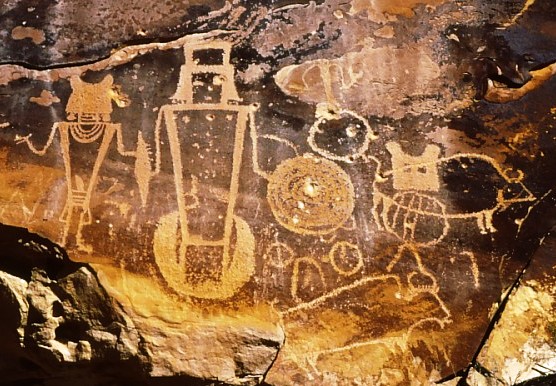
Fremont warrior, McKee Springs, Dinosaur National Monument, Utah. Photograph Peter Faris.

Fremont warrior, McKee Springs, Dinosaur National Monument, Utah. Photograph Peter Faris.

Basketry shields, like most baskets in the American Southwest, were created by coiling where the weft of the basket is started in the center and coils horizontally, continuously being sewn to the previously completed element inside the coil. Given this coiled construction I suggest that many shield figures holding a coil (spiral) are meant to represent figures with basketry shields, not hide shields with spiral decoration. Instead of “ceremonial objects,” or hide shields painted with spiral decoration, or figures connected to the Sun, or water, or so many of the other explanations put forward over the years, I am suggesting that many of them are warriors holding basketry shields. Sometimes things actually are what they look like they are.

NOTE: Some images in this posting were retrieved from the internet with a search for public domain photographs. If any of these images are not intended to be public domain, I apologize, and will happily provide the picture credits if the owner will contact me with them. For further information on these reports you should read the original reports at the sites listed below.

REFERENCES:

David, Gary A., Giants, Kachinas, and Cannibals, https://www.academia.edu.

Forton, Maxwell M., 2019, Shields of the Tsegi: Pueblo III Social Affiliation as Seen in Spatial Patterning of Shield Iconography, PhD thesis, Dept. of Anthropology, Binghamton University, Academia. Accessed 29 October 2023.

Jolie, Edward, 2022, Basketry Shields of the Prehispanic Southwest, The Heard Museum, June 2022, KIVA, DOI:1080/00121940.2022.2086400.

Madsen, David B., 1989, Exploring the Fremont, Utah Museum of Natural History, University of Utah, Salt Lake City.

Wikipedia, Fremont Culture, https://en.wikipedia.org/wiki/Fremont_culture. Accessed online 9 September 2023.

Wright, Barton, 1976, Pueblo Shields From the Fred Harvey Fine Arts Collection, Northland Press, Flagstaff, AZ, © The Heard Museum, Phoenix, Arizona.

Saturday, October 2, 2021

TURTLES IN ROCK ART – THE HORNED TURTLE:


Horned Turtle petroglyph, Jeffers Petroglyph site, Minnesota. Photograph Peter Faris, 1993.

In Native American mythology the turtle plays many roles. Because of the protection afforded by the shell of the turtle he is often associated with warfare. Turtle was also seen as a source of warrior power since he carries his shield with him everywhere he goes.


Horned Turtle petroglyph, Jeffers Petroglyph site, Minnesota. Internet photograph, public domain.

At the Jeffers Petroglyph Site in Minnesota there is a very interesting image of a turtle with bison-like horns. In prehistoric vertebrate fossils a distinctly horned giant turtle was found in Australia. This creature was named Meiolaniidae and dated from the Pleistocene. Also, a South American horned turtle named Niolamia dates from the Cretaceous and Eocene; and Crossochelys was found in the South American Eocene. Unfortunately I could find no North American examples of horned turtles so the inspiration for this petroglyph is very unlikely to have been fossil remains.  

Horned turtle shield, provenance unknown. Photograph Housatonic Trading Company.


Horned turtle shield, p. 83, Afton, Jean, David Fridtjof, and Andrew E. Masich,1997, Cheyenne Dog Soldiers, Colorado Historical Society, Denver, Colorado.

At this time I have also been unable to locate references in Native American mythology to a horned turtle. I believe, however, that we can assume that if nothing else the addition of bison-like horns indicates a spiritual significance for the recipient. This assumption is backed up by images that I have located of three shields (one Arapaho and two possibly Cheyenne or Lakota) decorated with horned turtle subjects.


Arapaho horned turtle shield cover, 1850, Feder, American Indian Art, 1982, Harry N. Abrans, New York.

As we know that the decoration of a shield is generally spiritually significant, and is intended to lend the power of this spiritually significant subject to the warrior who possesses the shield, these suggest to me that the horned turtle does indeed have spiritual significance. Among Plains tribes the umbilical cord of a boy was often retained in a small turtle shaped amulet decoratively painted or beaded. Thomas Mails (1991) stated “Buffalo headdresses often had turtle designs painted on them or had small beaded turtle effigies appended to them.” (Mails 1991: 292)


Buffalo horned headdress with turtle amulet on top. Mails, Thomas E., 1991, Mystic Warriors of the Plains, copyright Thomas Mails, Barnes and Noble Books, New York.

This turtle effigy was indeed the umbilical cord amulet according to Mails. “When the child began to walk, the amulet was attached to his clothing to serve as a constant reminder of its purpose. Therefore, a child of five or six was known as a ‘carry your navel’. Sometimes the turtle was put away later on and other times it was kept by the mother. A boy often tied it to the left shoulder of his shirt, and then transferred ti to his buffalo-horned headdress if he became a renowned warrior.” (Mails 1991: 512) This suggests a connection between the turtle and buffalo horns for a “renowned warrior”. Given the examples of horned turtles on the Plains shields also providing a warfare context for the theme, I assume that the petroglyph of the horned turtle at the Jeffers Petroglyph Site has a martial implication, possibly the signature (in the form of a name glyph) of some renowned warrior.

 NOTE: Some images in this posting were retrieved from the internet with a search for public domain photographs. If any of these images are not intended to be public domain, I apologize, and will happily provide the picture credits if the owner will contact me with them. For further information on these reports you should read the original reports at the sites listed below.

REFERENCES:

Afton, Jean, David Fridtjof, and Andrew E. Masich,1997, Cheyenne Dog Soldiers, Colorado Historical Society, Denver, Colorado

Mails, Thomas E., 1991, Mystic Warriors of the Plains, copyright Thomas Mails, Barnes and Noble Books, New York.

Thursday, May 9, 2019

ORIGINS OF THE OUTLINED CROSS VENUS SYMBOL:


Four-armed outlined cross Venus
symbol. Redrocks, AZ.
Photo Paul and Joy Foster.

The 4-armed symbol representing the planet Venus seems to have been ubiquitous prehistorically among cultures in Mexico and much of Central America. This, to such an extent that when we find it in contiguous areas like the American Southwest we also tend to apply that meaning to it. But how did that symbol, the outlined 4-armed cross or star, get to be associated with the planet Venus. In order to approach that question I had to look into the background of the subject.

In 1996, John B. Carlson wrote a paper titled "Transformations of the Mesoamerican Turtle Carapace War Shield, A Study in Ethnoastronomy", that looked at war shields from Mesoamerica and the American Southwest. He found that a common subject for the decoration of these symbols of conflict was the crucifix representing the planet Venus.

"It is now well understood that, at least from Late Formative times in Mesoamerica (around the beginning of the Common Era and probably much earlier), the planet Venus was viewed as a powerful male god of warfare and sacrifice. The evidence for this cult of Venus-regulated warfare and sacrifice comes from various archaeological sources, including inscriptions and iconography, from Spanish chronicles and ethnohistorical sources, and from Pre-Columbian codices." (Carlson 1996:100) Additionally, Carlson noted a frequent portrayal among Mayan (and Aztec) stela and other carvings, of a turtle carapace used by a god or important person as a shield (below).

One of the attributes of the turtle in Native American belief, and I assume Mesoamerican as well, is protection, because the turtle is protected by his shell. The step from that observation to the use of a large tortoise carapace as a shield is an obvious one. And, if Carlson, and others, are right about the connection between Venus and warfare, then the connection of the turtle to Venus is implied as well. But where did that symbol of the outlined 4-armed cross come from?


Carved shell turtle pendant,
Mayan, Tikal, 700-900 C.E.
John B. Carlson.

Carlson opened his paper with an illustration of a "Late Classic Maya carved shell pendant with the image of the eighth Maya day-sign Lamat, the symbol for the Great Star or Venus, represented on the carapace of a turtle. It was excavated in a Late Classic Period (ca. 700-900 C.E.; Imix ceramic phase) burial PNT-009 in structure 5C-49 in the Mundo Perdido group of Tikal by Juan Pedro Laporte." (Carlson 1996:1) This sign generally consists of an outlined cross with a circle in each quadrant.

Mayan glyph of the day sign
for Lamat, the eighth day.
The symbol for Venus.

This certainly establishes that there is a relationship, but not why a turtle is associated with Venus and warfare. He does go on "In Mesoamerican (and most Native American) iconography, turtles appear in a diversity of ritual and ceremonial contexts." (Carlson 1996: 106)


Mayan merchant warrior "Four Dog",
from Templo Rojo, Cacaxtla.
Turtle shell shield in lower right of picture.

Carlson lists a number of these, among the the following statement: "Turtle shells, usually from large marine turtles but also from those of smaller freshwater species, were used as shields in Mesoamerica, as demonstrated in iconographic and archaeological record and in the codices. . . . A beautiful example of such a sea turtle carapace war shield is the one carried by a historical character, the armed merchant warrior named "Four Dog," shown in a portrait as an impersonator of the Maya Merchant God L in the Templo Rojo of Cacaxtla. It is stowed on the lower back of the "cacaxtli" merchant's packframe which, in turn, is propped up by his lance. This Epiclassic mural likely dates from the 8th or perhaps 9th century C.E., placing it in the same general period as the Tikal shell." (Carlson 1996:107) He goes on to give many more examples of turtle/Venus/shield combinations but I think that this is satisfactory for our purposes.


Ecuadorian snapping turtle plastron.
Internet - Public Domain.

At this point I asked myself which turtle has such a symbol naturally on its upper shell (carapace), in other words what turtle is the actual model for the Venus symbol. That proved a little more difficult and a few hours of searching the internet failed to provide me with an actual model. At this point I realized that there are, in effect, two portions to a turtle's shell, the upper part known as the carapace, and the lower or under part, the plastron. Searching images of turtle plastrons fairly quickly provided the image I was looking for. The plastron of the snapping turtle has the basic shape of the Venus symbol with the four legs representing the circles in the four quadrants. Matching species of snapping turtles to the territory of the Maya the two likely candidates are the Common Snapping Turtle and the Ecuadorian Snapping Turtle, both of which have ranges that include some or all of the Mayan territory. And, it strikes me, if you want to use a turtle as a symbol of war, the turtle who can take off your finger or toe is certainly a good model to go by.


Personified star with eagle attributes,
Petroglyph Park, Albuquerque, NM.
Photo Peter Faris, 1988.

Carlson continues in his paper showing examples of the outlined cross, with or without the dots or circles in the four quadrants, as examples of Mesoamerican cultural influence on the Native peoples of North America. Some of that might indeed be true although I may not take it quite as far as he has. Where I part company with him, however, is his attribution of this Venus image to the personified star image of the Northern Rio Grande pueblo peoples. On August 11, 2012, I posted a column titled HALLEY'S COMET AND THE ORIGIN OF THE STAR KACHINA in which I suggested the possibility of Halley's Comet as the inspiration for that personified star symbol. I see the star with a tail as more probably a comet (a planet with a tail) than as the planet Venus. Ancillary subjects would also include turtle images in rock art. But,all in all the paper by John B. Carlson is an enjoyably impressive piece of scholarship, and I highly recommend it.

NOTE: Some images in this posting were retrieved from the internet with a search for public domain photographs. If any of these images are not intended to be public domain, I apologize, and will happily provide the picture credits if the owner will contact me with them. For further information on this report you should read the original report at the site listed below.

REFERENCE:

Carlson, John B.
1996 Transformations of the Mesoamerican Turtle Carapace War Shield, A Study in Ethnoastronomy, p. 99-122, Archaeoastronomy, Volumes XII-XIII, Songs From the Sky: Indigenous Astronomical and Cosmological Traditions of the World, Von Del Chamberlain, John B. Carlson, M. Jane Young, editors, Center for Archaeoastronomy, College Park, MD, USA.

Saturday, November 15, 2014

SHIELDS AND SHIELD FIGURES IN ROCK ART:


All-American Man, Salt Creek, Canyonlands, UT.
Photograph: 1983, Don I. Campbell.

One fascinating class of imagery in rock art is the well-known shield figures of the American West. Although seen in a number of variations the shield figure is basically a shield (usually the larger sized shield carried by a pedestrian warrior) with portions of the anatomy of the figure carrying it seen protruding from the edges of the shield; legs at the bottom, head at the top, and with weapons or ceremonial items often portrayed as well. Shield figures have always fascinated me because they very often portray the sorts of details of adornment, decoration, or accessories that allow us to assume that the representation is of a specific shield that would be the property of a specific, and recognizable, person – in other words a portrait.


All-American Man, Salt Creek, Canyonlands, UT.

Photograph: 1983, Don I. Campbell.

One of the most famous shield bearing figures is found in Utah, in Canyonlands National Park. The “All-American Man” figure is rounded and bears a brightly decorated shield. He is seen in front view with straight legs and feet angled down slightly to his left. His face and head are seen straight on and we can discern facial features as well as some form of neck band as well as two antenna-like projections from his head, perhaps feathers in a headdress. His name refers to his decoration in red, white, and a bluish paint and references indicate that he has a radiocarbon date of A.D. 1295. 


Close-up of shield figures, Werstwater canyon, UT.
Photograph:  Oct. 8, 2001, Peter Faris.

With his rounded contours All-American Man resembles the shield bearing warriors from Westwater Creek, Utah, much more than the shield bearing warriors from McConkey Ranch, near Vernal, Utah.


Shields, Castle Gardens, Fremont County, WY.
Photograph: Peter Faris, Sept. 1992.

Dr. Lawrence Loendorf has written some insightful comments about shield figures: “The oldest shields or shield warriors found in the Montana and Wyoming region are in the Castle Garden Shield Style. - - Castle Garden Shield Style figures are made in a unique way. Before making these pictographs, the artist prepared the rock surface by abrading it to remove undulations or protuberances and produce a flat, smooth palette. This surface preparation removed the less-consolidated outer layer of surface sandstone to reveal a harder, inner layer for painting."


 Shields, Castle Gardens, Fremont County, WY.
 Photograph: Peter Faris, Sept. 1992.

           "Once smoothed, the artist incised a pattern of the shield or shield warrior on the rock palette. - - Paint colors include two shades of red (one more purple than the other), two shades of orange (one more yellow than the other), black, white, and green. Polychrome paintings are rare in Wyoming and Montana and this is one of the criteria by which the Castle Garden Style shields and shield warriors can be identified. Use of green paint is also an important criterion because it is rare in the region.
            In an excavation in the Valley of the Shields, I recovered two sandstone-abrading tools used to smooth the surface in preparation for the paintings (Loendorf 1990). One of these had paint adhering to it as though the artist picked it up to do some additional smoothing while in the process of applying paint. The tools were found in direct association with the remains of a hearth, and it was possible to obtain standard radiocarbon dates on the charcoal. Two dates with overlapping sigma were obtained using the correction tables it is clear the Castle Garden Shield Style pictographs were made at the Valley of the Shields ca. A.D. 1100.” (Loendorf 1990:49) Great information Larry, as always.

Shields and shield figures are so fascinating to me because they offer entry points into a whole range of questions in rock art: portraiture, the pedestrian-to-equestrian warrior transition (and thus the societal changes cause by the adoption of the horse), heraldry, and even inter- and intra-tribal interaction and communication.

REFERENCE:

Loendorf, Lawrence
2004   Shields and Shield Warrior Pictographs and Petroglyphs in the Intermountain West, pages 103-117, in New Dimensions in Rock Art Studies, edited by Ray T. Matheny, Museum of Peoples and Cultures Occasional Papers No. 9, Brigham Young University, Provo.

Saturday, November 16, 2013

HORSE DECORATION IN ROCK ART – FEATHERS:


Biographic panel from Joliet, Montana. Keyser and 
Klassen, 2001, Plains Indian Rock Art, p. 237.

On any important occasion a Native American wanted to be as memorable as possible. Part of the preparation for that was to dress oneself up in finery, and that went for their horse as well. Not only for ceremonial occasions, but often for combat, a warrior’s horse would have been painted with symbols carrying spiritual protection, and announcing the warriors strength and prowess. Another essential part of the decoration of any Native American’s horse is eagle feathers.


Mail's illustration of a decorated horse. Thomas Mails,
Mystic Warriors of the Plains, p. 222.

Thomas Mails explained this as follows: “Golden eagle tail feathers were often tied to the mane and/or tail of the war horse when the owner was about to go on a mounted war party. A common Plains custom was that of tying up the horse’s tail when preparing for battle. The Indians believed it sensible to get the long tails out of the horse’s way. Sometimes the tail itself was simply tied in a knot. Other times it was folded and bound with buckskin strips, or in trade days with red blanket cloth. Feathers and fringes were often added to the ties for more spectacular effect.” (Mails 1991:223)


Detail, Biographic panel from Joliet, Montana. Keyser and 
Klassen, 2001, Plains Indian Rock Art, p. 237.

The rock art image from Keyser and Klassen Plains Indian Rock Art (2001:237) located at Joliet, Montana, shows horses and riders in a battle. The detail illustrates a feather decorated horse carrying two riders, the rear rider turned and firing his rifle at an enemy. The image of a horse carrying two riders is usually an illustration recording the heroic rescue of a downed comrade in a battle. The horse that the two warriors are riding has an eagle feather attached to its forelock and also appears to have three feathers hanging from its tied-up tail. This horse was carefully decorated for war so I assume that it represents the aggressors, the defenders presumably would have been caught by surprise and not had enough time to make such careful preparations.


Horse petroglyph, Writing-on-stone Provincial Park,
Alberta, Canada. Three lines from the back of the
horse's head represent feathers, or possibly two
ears and one feather.

“Siya’ka said that on one occasion when he was hard pressed on the warpath, he dismounted, and, standing in front of his horse, spoke to him saying: “We are in danger. Obey me promptly that we may conquer. If you have to run for your life and mine, do your best, and if we reach home, I will give you the best eagle feather I can get – and you shall be painted with the best paint.”” (Horse Capture and Her Many Horses 2006:41)

Horse images with decorative feathers attached are found in many media utilized by Native American artists. Some examples are shown and listed below.


Bone quirt handle. George Horse Capture and Emil Her
Many Horses, 2006, A Song For The Horse Nation,
Horses in Native American Cultures, p. 38.

Bone quirt handle showing a feather tied to the tail of the horse – “1870s, By identifying stylistic motifs, scholars can often determine which groups created the drawings, and occasionally, a match can be found by comparing figures in rock art to those items made by contemporary tribes, confirming that some ancient art styles reach across the centuries. A wedge-shaped anthropomorphic figure carved into a stone wall in southern Alberta, Canada, is similar to the one incised into the handle of this quirt, collected in the early twentieth century.” (Horse Capture and Her Many Horses 2006:38)

Portrait of High Wolf. George Horse Capture and Emil Her
Many Horses, 2006, A Song For The Horse Nation, Horses
in Native American Cultures, p. 40.

Ledger painting, horse with feathers both on his tail and forelock – “Yellow Nose (Ute raised as Cheyenne), Portrait of High Wolf, circa 1880. This drawing shows high wolf counting coup with a riding quirt against a Nez Perce. The imitation scalp under the horses chin indicates the accomplishments of both horse and rider.” (Horse Capture and Her Many Horses 2006:40)


Shield cover. George Horse Capture. and Emil Her
Many Horses, 2006, A Song For The Horse Nation,
Horses in Native American Cultures, p. 70.

Shield cover, horse with feathers tied to his tail - “Cheyenne River Sioux painted hide shield cover, circa 1880s – This shield cover records a battle scene between the Lakota and some of their enemies, possibly Crow or Pawnee, who are recognized by the topknot hairstyle that was popular with both tribes. The hero/owner of this shield, wearing a split horn war bonnet, is at the center, moving left.” (Horse Capture and Her Many Horses 2006:70)


Portrait of Few Tails by Red Dog, ca. 1884. George Horse Capture 
and Emil Her Many Horses, 2006, A Song For The Horse Nation,
Horses in Native American Cultures, p. 87.

Ledger portrait, the horse has a feather fan tied to his tail – “Red Dog (Lakota), Portrait of Few Tails, circa 1884. Fully decked out in warrior society accoutrements, Few Tails appears to be dressed for battle. Most portraits, like this one, incorporate stylized faces. Because each Plains warrior’s shield was decorated differently, individuals or tribes were identified in artwork by their shield designs and clothing styles.” (Horse Capture and Her Many Horses 2006:87)

As Jim Keyser has demonstrated in his many analytic rock art publications, much can be learned from careful attention to the details in rock art, and by comparison with other art forms which display the same sort of imagery. In the case of horses decorated with feathers it can represent a warrior prepared for war, or for a ceremonial occasion.

 REFERENCES:

Afton, Jean, David Fridtjof Halaas, and Andrew E. Masich
1997    Cheyenne Dog Soldiers: A Ledgerbook History of Coups and Combat, Colorado Historical Society and University Press of Colorado, Denver.

Horse Capture, George P. and Emil Her Many Horses
2006    A Song For The Horse Nation, Horses in Native American Cultures, National Museum of the American Indian, Smithsonian Institution, Washington D.C., and Fulcrum Press, Golden, CO.

Keyser, James D.
2012    “My Name Was Made High:” A Crow War Record at 48HO9, The Wyoming Archaeologist, Vo. 55, Spring 2011 (pub. Oct. 2012).

Keyser, James D. and Michael A. Klassen,
2001    Plains Indian Rock Art, University of Washington Press, Seattle.

Mails, Thomas E.
1991    Mystic Warriors of the Plains, Barnes and Noble Books, New York.