Showing posts with label Cub Creek. Show all posts

Saturday, April 16, 2016

CUB CREEK - ORIGINALITY, OR WHIMSY, OR BOTH:


Post-classic Vernal Abstract figures, Cub
Creek, Dinosaur National Monument, Utah.
Photograph Peter Faris, June 1984. 

In the collection of Cub Creek anthropomorphic figures from the Uintah Fremont people of Dinosaur National Monument in Utah, there is a sequence of figures undergoing varying stages of successive abstraction from Representative Realism to a highly abstracted stage. Included in these figures are a few with a visual treatment that I have wondered at since I first saw them about 30-some years ago. While most of the abstracted figures at Cub Creek use basic line or dot patterns to indicate the details of jewelry and torso/clothing, these figures use other symbols for that purpose.
                                                             

Cub Creek figure, Dinosaur National
Monument, Utah. (Faris 1987:34)
                                
As a starting point, this illustration shows the basic method of indicating a simplified figure at this site. Dots are used as facial details and jewelry (necklaces, ear bobs) and large pectoral pendants are portrayed. Body details are either composed of linear markings or lines of dots, and once the viewer is aware of the pattern it is easy to find a large number of these figures at Cub Creek which fall into the pattern although they all have individual differences.


Cub Creek, Dinosaur National Monument,
Utah. Photograph Peter Faris, 1984.

There are a few, however, which have details that differ noticeably from the expected pattern. A couple of them are illustrated here where one figure has torso details indicated with a couple of rows of connected triangles with the points up. There are four triangles across the upper part of the torso or chest area, and a pair of triangles in approximately the location of the waist.


Cub Creek figures, Dinosaur National
Monument, Utah. (Faris 1987:36)

Next to that figure is another one with the design located in the torso of two simple interlocked spirals, sort of a variation on the Na'kwach (brotherhood) symbol illustrated by Frank Waters in his Book Of The Hopi (1963:63). Waters claimed that it represents priests clasping hands in that manner during the dances of the Wuwuchim ceremony.


Cub Creek, Dinosaur National Monument,
Utah. Photograph Peter Faris, 1984.

To me, however, the one that is most interesting is a figure, also from Cub Creek, which has a torso and shoulders consisting of pretty much what I would expect a drawing of a Greek column and capitol of the Ionic order would be. 


Ionic column capitol, Wikipedia.

Note also that the line above the facial area is painted with a dark red ochre, and there seem to be visible traces of paint in other spots as well.


Cub Creek figure, Dinosaur National
Monument, Utah. (Faris 1987:35)

Now were these done in a joyful exploration into the possibilities of depicting the visual image in original and creative ways (i.e. artistic variation), or were they done with a sense of humor, illustrating the human image with a whimsical purpose and style, or are they accurate records of details of clothing and adornment that were themselves unique and creative? I do not know, but whichever is the case I very much like the implications for the mindset of the prehistoric Fremont artist(s) who created these images. It allows me to see them with an increased sense of common humanity, and I very much like what I see.


REFERENCE:

Faris, Peter
1987    Post-Classic Vernal Abstraction: The Evolution of a Unique Style in Late Fremont Rock Art in Dinosaur National Monument, Utah, pages 28-40, Southwestern Lore, Vol. 53, No. 1, Colorado Archaeological Society. 

Waters, Frank
1963    Book of the Hopi, Ballantine Books, New York.

Wikipedia

Saturday, April 9, 2016

STYLISTIC EVOLUTION - FROM REALISM TO ABSTRACTION IN FREMONT ANTHROPOMORPHS - PART 2:


FIGURE 3, 3-Princesses, Cub Creek, 
Dinosaur Nat. Mon., Uintah County, UT.
Photograph Peter Faris, September 1989.

In my first column on this site, (March 26, 2015) I suggested that the next stage in this process could be seen in the 3-Princesses, a group of figures from near the Cub Creek site (FIGURES 3, 3A, 3B, FIGURE 4, and FIGURE 5). They have been simplified another step by losing their extremities although they still possess their decorative adornment. The first princess even wears facial markings that may represent face paint.


Figure 6A, Cub Creek, Dinosaur National 
Monument, Utah. Photograph Peter Faris,
June 1984.

Figure 6B, Cub Creek, Dinosaur National
Monument, Utah. Peter Faris, 1984,
page 32.


From this point on even the torso of the figure has disappeared, and we see figures that are represented by their jewelry and costume with a few facial features thrown in. FIGURE 6A is still roughly on par with the first princess for amount of detail. FIGURE 6A shows a hairdo or headdress, facial features, wears a pectoral and possible earbobs, and a kilt is seen where the bottom of the torso should fall. This figure also wears a belt line which will be seen as well as subsequent figures (an ink drawing of this figure is seen as FIGURE 6B).


Figure 7, Cub Creek, Dinosaur National
Monument, Peter Faris, 1987, page 34.

Figure 7 lacks the body outline, but the torso is composed of dots, it still has the pectoral, facial features, and ear bobs, as well as a necklace and headdress.
                                                                                                                                 
Figure 8, Cub Creek, Dinosaur National
Monument, Peter Faris, 1987, page 33.

Figure 8 also lacks the body outline. The torso is composed of six rows of dots, it still has the pectoral, facial features, and ear bobs, as well as a necklace, headdress, and belt. The emphasis on these figures is less the details of the human body being portrayed than it is on the items of decorative adornment. In a culture in which all of these items are handmade, and thus unique, such a focus on details of adornment seem to me to betray a concern for the identity of who wore these particular items, in other words it functions as a portrait.


Figure 9, Cub Creek, Dinosaur National
Monument, Utah. Photograph
John Faris, 1989.


Figure 10, Cub Creek, Dinosaur National
Monument, Peter Faris, 1987, page 38.

Figures 9 and 10 show another step in simplification with the presence of the torso almost ignored, its existence is implied by the positions of the pectoral, shirt or vest front seam, and the belt line. Facial details and ear bobs are also still found, but this figure, with such a degree  of simplification, is hard to label as realism.


Figure 11, Cub Creek, Dinosaur National Monument,
Utah. Photograph Peter Faris, 1984.

Figure 12, Cub Creek, Dinosaur National
Monument, Peter Faris, 1987, page 39.

These steps in the sequence have further eliminated details until at the end of the whole sequence we have the trio of figures in FIGURES 11 and 12 which would never be recognizable as portrayals of humans if we had not had the rest of the sequence to follow step by step. At this point in the whole history I tend to see that last Fremont artist at Cub Creek put down his hammer stone and step back, then turn and walk away (hopelessly romantic, I admit it).

Perhaps the figures were originally more complete than now, with elements and detailed added by paint, and, given that the great figure from the 3-Kings panel, with which I started my sequence, was both painted and pecked, this is a definite possibility. During my visits there however, I could see no trace of paint remaining on any of the Cub Creek anthropomorphs. Even had they been painted, the changes that we see in the remaining petroglyph elements indicate that the style of humanoid representation was changing, so the possibility of paint does not invalidate my conclusions. However we assume it played out, it is still the visual record of a remarkable cultural transition, from Classic Vernal Style, through Post-Classic Vernal Abstraction, to whatever came next, which before long, were the Ute/Shoshone peoples of the same area.

In 1987, I concluded my study of these images with the following paragraph:
"At this location, sometime around ca. A.D. 1200, the last inheritor of the artistic tradition of creative abstraction left the trio of figures carved into the cliff at Cub Creek. We probably can never know whether his or her people migrated out of the area or stayed in the area maintaining the hunter/gatherer lifestyle but having reached a point of deculturation that the continued  creation of these abstracted figures was no longer relevant to their way of life and their beliefs. Whichever the case, it was the end of a unique art form, a style based on simplification and abstraction but, most of all, on creative variation in anthropomorphic figure portrayal." (Faris 1987:40)


REFERENCE:

Faris, Peter
1987    Post-Classic Vernal Abstraction: The Evolution of a Unique Style in Late Fremont Rock Art in Dinosaur National Monument, Utah, pages 28-40, Southwestern Lore, Vol. 53, No. 1, Colorado Archaeological Society.

Schaafsma, Polly
1980    Indian Rock Art of the Southwest, School of American Research, Santa Fe, and University of New Mexico Press, Albuquerque.

Saturday, March 26, 2016

STYLISTIC EVOLUTION - FROM REALISM TO ABSTRACTION IN FREMONT ANTHROPOMORPHS - PART 1:


Figure 1. 3-Kings Panel, Classic
Vernal Fremont Style, McConkey
Ranch, Utah. Photograph Peter Faris,
September 1994.

The subject of Style in rock art has perhaps engendered more arguments than any other facet of this field of study. So many people throw the word style around loosely without actually understanding the definition of that word. In art studies, style is that suite of defining characteristics which encompass a group of related works, and separate it from another group. For instance, Impressionism, as compared to Classicism. But when we look at Impressionist works by a number of different artists we see a broad range of appearances between them, so where does style come in? The term Style actually applies more to the intentions of the artist than it does to the end result of that artist's creation, but, to the general public, the term becomes applied to what they see in common from one work to another. That is the basic meaning of the term Style as it is generally applied in rock art studies.

The rock art in the example of Stylistic Evolution that I am presenting here began as Fremont Classic Vernal Style figurative imagery as defined by Polly Schaafsma (1980), and evolved or morphed into what I have called Post-Classic Vernal Abstraction (Faris 1987:29). Starting with highly naturalistic examples, why would imagery devolve into increasing abstract forms over time. My answer is that we have numerous examples from the history of art in which exactly that has occurred, and I suspect a psychological effect like "Mere Exposure" is behind it. The basic premise is that people get used to what they see most often as the way something should be seen - as the "right way" to portray it.

“THE MORE YOU SEE IT THE MORE YOU LIKE IT, (Familiarity) Robert Zajonc (1923-2008) –
Zajonc’s groundbreaking paper, Attitudinal Effects of Mere Exposure, was published in The Journal of Personality and Social Psychology in 1968. Zajonc’s paper describes a series of experiments in which he showed participants a sequence of random images – geometric shapes, Chinese symbols, paintings, and pictures of faces – that were flashed in from of them so rapidly that they were unable to discern which were shown repeatedly. When subjects were later asked which images they preferred, they consistently chose the ones to which they had been most frequently exposed, although they were not consciously aware of the fact. What Zajonc seemed to have discovered was that familiarity brings about an attitude change, breeding affection or some form of preference for the familiar stimulus. This increases with exposure: the greater your number of exposures to something, the more affection you will feel toward it. To put it simply, 'the more you see it, the more you like it.'” (Collin, et al 2012:233)

How would that also lead to the evolution (or perhaps devolution) from realistic to abstracted images? Well, along with the Mere Exposure effect we humans tend to overlook details, so as we are viewing these images we are also making subconscious decisions as to which parts of it are more important than others, and in the future the less important portions of the image can get overlooked, while the elements we consider to be of greater importance will remain and perhaps become emphasized.

The Classic Vernal Style of Polly Schaafsma includes figures with attention to realistic details of texture, contour, and accessories, the best example of which is the main figure from the 3-Kings panel at McConkey Ranch, North of Vernal, Utah (FIGURE 1). This ultimate expression of Classic Vernal Style shows anatomic details, clothing and accessory details, and was created in multi-media, painted as well as pecked. Other figures from this stylistic classification are less grand and ornate, but most seem to share this intention toward realism.

This is exactly what I saw in the progression of images from Cub Creek, Dinosaur National Monument, Utah, a step by step simplification and abstraction from the Classic Vernal Realism starting point to a final set of petroglyphs that would not be identified as anthropomorphs if we did not have the intervening steps to refer to.

Figure 2. Classic Vernal Fremont
Style, McConkey Ranch, Utah. 
Peter Faris, 1987.

From the Classic Vernal Style beginning we see a first step in the evolution of the figure is essentially a simplification. Details of adornment, headdress, jewelry (pectorals, ear bobs), clothing, etc., are still present but the figure itself is not realistically proportioned, it reminds one of a cookie cutter gingerbread man. This example (FIGURE 2), also from McConkey Ranch in the Dry Fork Valley, near Vernal, Utah, is obviously related to the 3-Kings panel, but not as naturalistically detailed. In effect, the interest is more in the decorative detail than in the realism of the figure. This focus on decorative detail will be seen to be a constant throughout the sequence.


Figure 3. Three-Princesses panel at Cub
Creek, Dinosaur National Monument,
Utah. Photograph Peter Faris,
Sept. 1989.


Figure 3A. Close-up of first princess
at Cub Creek, Dinosaur National
Monument, Utah. Photograph
Peter Faris, Sept. 1989.


Figure 3B. Close-up of second and
third princesses at Cub Creek,
Dinosaur National Monument, Utah.
Photograph Peter Faris, Sept. 1989.

As I envisioned it back in 1987, the 3-Kings panel was most likely created during a cultural peak of the local Fremont culture, after which the culture slowly changed (or declined), and the rock art changed with it. I illustrate this with a sequence of anthropomorphs from the great cliff face site of Cub Creek in Dinosaur National Monument. From the Classic Vernal Style beginning, the first step in the evolution of the figure is essentially a simplification. I illustrate this with figures from very near the Cub Creek cliff face known as the 3-Princesses. the figures now are merely symbolic shapes instead of realistically proportioned torsos, or even the cookie cutter figure. FIGURES 3, 3A, and 3B show the 3-princesses panel complete and then close up, and FIGURES 4 and 5 are drawings of these figures.
Figure 4. First princess at Cub Creek,
Dinosaur National Monument, Utah.
Peter Faris, 1987, page 32.

Figure 5. Second and third princesses
at Cub Creek, Dinosaur National
Monument, Utah. Peter Faris,
1987, page 31.

These figures are stylistically related to the Cub Creek panels and the location is certainly close enough to be considered as the same location, and as they are all in the same basic location they were likely to have been created by one group of people (the local residents) over time, and thus their changes illustrate perfectly the evolution that I have discussed above.

This sequence will wait for part 2 of this essay. 


REFERENCE:

Collin, Catherine, Nigel Benson, Joannah Ginsburg, Voula Grand, Merrin Lazyan, and Marcus Weeks,
2012    The Psychology Book, DK Books, London and New York.

Faris, Peter
1987    Post-Classic Vernal Abstraction: The Evolution of a Unique Style in Late Fremont Rock Art in Dinosaur National Monument, Utah, pages 28-40, Southwestern Lore, Vol. 53, No. 1, Colorado Archaeological Society.

Schaafsma, Polly
1980    Indian Rock Art of the Southwest, School of American Research, Santa Fe, and University of New Mexico Press, Albuquerque.

Saturday, June 29, 2013

THE MOST NORTHERN KOKOPELLI:

The figure that we call Kokopelli has been adapted from the beliefs of the Pueblo peoples of the American southwest. This character often has a humped or rounded back and something like a flute held to, or projecting from, his mouth. In Pueblo beliefs he is sometimes also called the Robber Fly or Assassin Fly kachina because that insect is humpbacked and has long flute-like mouthparts. He frequently appears with a Flute Kachina and sometimes carries no flute until he borrows the flute from the Flute Kachina. When that occurs the Assassin Fly Kachina becomes Kokopelli, the hump-backed flute player. This character that we identify as Kokopelli is commonly found throughout the four corners region (Arizona, Colorado, New Mexico, Utah) of the American southwest, and has been identified with prehistoric cultures from that area.


McConkey Ranch, Vernal, Uintah County, UT.
Photograph: John Faris, Sept. 1989.

McConkey Ranch,  Vernal, UT. From
Slifer and Duffield, fig. 169, p. 102.

I have often wondered exactly how far north these flute-player images extend. Last week I illustrated a kokopelli pictograph from Canyon Pintado, south of Rangely in western Colorado. In their 1994 book Kokopelli: Flute Player Images in Rock Art, Dennis Slifer  and James Duffield show examples located up in the Vernal, Utah, area and in Dinosaur National Monument. I have seen a couple of these northern flute-players. One is located at the marvelous McConkey Ranch petroglyph site near Vernal, Utah. He is found lying on his back beneath the central figure of a group of figures done by a Fremont culture artist. This figure is hard to see because he is pecked into an area denuded of the desert varnish that sets the other figures off so clearly. I have also included a site drawing of that panel from the Slifer and Duffield (1994:102) book "Kokopelli: Flute Player Images in Rock Art",  which shows the recumbent flute-player much more clearly. 


Cub Creek, Dinosaur Nat. Mon., Uintah county, UT.
Photograph: John and Esther Faris, Sept. 1989.

The other northern flute-player I have seen is from the wonderful Cub Creek site in Dinosaur National Monument (this site also contains the giant lizard petroglyphs on the masthead of this blog). Slifer and Duffield also list a handful of other examples from the Vernal/Dinosaur National Monument area.

So, as I asked above, I wonder how far north the flute-player image actually extends? This area does roughly approximate the northern boundary of the cultures who commonly portray the flute-player in rock art. Other Native American cultures, however, had the flutes and whistles that these figures are thought to represent. Are there examples to be found farther north than this?

REFERENCE:

Slifer, Dennis, and James Duffield,
1994    Kokopelli: Flute Player Images in Rock Art, Ancient City Press, Santa Fe.

Saturday, May 19, 2012

WHERE DID THEY PRACTICE? - OR BODIES OF WORK:

In looking at rock art we tend to approach the images as single, unitary works. Even in the case of exceptional images that must be classified as high quality visual portrayal we do not usually ask the obvious question; “where are his practice images?” No artist just springs up full blown onto the scene producing works of high quality. Such end results demand many years of practice to achieve.


3-Princesses, near Cub Creek, Dinosaur National
Monument, UT. Photo: Peter Faris.

In some instances we can identify multiple images created by the same hand, adding up to a body of work, something expected of a professional artist. One good example is the panel known as the 3-Princesses near Cub Creek in Dinosaur National Monument, Utah. These three Fremont anthropomorphs exhibit every indication in style and technique of having been produced by the same hand.


Three abstracted Fremont figures, Cub Creek, 
Dinosaur Nat. Mon., UT. Photo: Peter Faris.

Nearby the 3-Princesses, on the cliff face at the Cub Creek site, are a few other instances of multiple images that give every indication of having been produced by the same artist.


Fremont, McConkie Ranch,
UT. Photo: Peter Faris.

What this implies is that the artist that produced the high-quality panel that we admire must have produced many lower quality images while working up to that level of ability. So instead of a large number of creators producing the large number of images at Cub Creek, there may have actually been relatively few artists, each producing a range of images from poor to high quality while practicing their art. This question does have serious implications in the study of rock art as it goes directly to the question of who created it. Was it a large number of people, each making one, or at most a few images, or was it a small number of people, each creating a larger number of images while perfecting their art?  

Wednesday, February 9, 2011

DINOSAUR FOOTPRINTS AND THE GIANT LIZARD PETROGLYPHS AT CUB CREEK, DINOSAUR NATIONAL MONUMENT:

Close-up of giant lizard panel, Cub
Creek, Dinosaur National Monument,
Utah. Photo: Peter Faris, 2005.

One location in Utah where extensive rock art is associated with abundant fossil remains is found at Dinosaur National Monument in northeastern Utah and northwestern Colorado. Fossil dinosaur bones there first appear in our history with the 1909 discovery of what is now called the Douglass or Carnegie Quarry by Earl Douglass. From 1909 to 1924 thousands of fossil bones were removed for museum collections. It does not seem likely that such deposits of fossil bone would have been overlooked by Native Peoples who lived there before the arrival of Euro-American explorers and exploiters. A large number of rock art sites are also found in what is now named Dinosaur National Monument. A few miles from the Douglass/Carnegie Quarry is an extensive collection of Fremont petroglyphs at the location named Cub Creek.


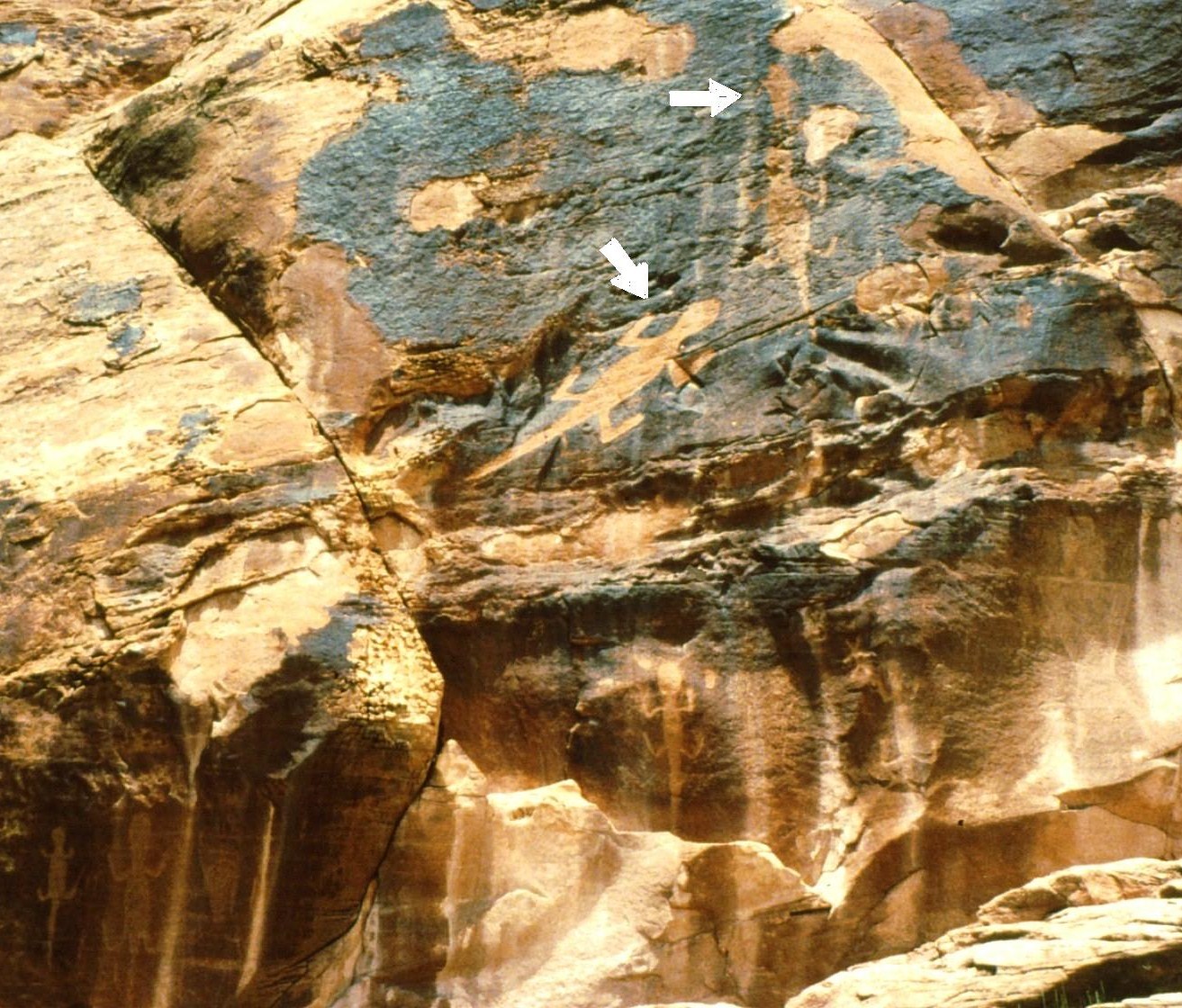
Giant Lizard panel, Cub Creek, Dinosaur National
Monument, Utah. The top arrow points to the small Fremont
figure and the lower arrow points to the six foot lizard.
Photo: Peter Faris, 2005.

The Fremont people were proto-agriculturalists who lived on the northern and western peripheries of the Ancestral Pueblo peoples planting some maize and hunting and gathering to make up the balance of the year’s food needs (sort of like the country cousins of the Ancestral Pueblo peoples of the Colorado Plateau). The Fremont culture may have developed from the Desert Archaic Culture by AD 500 in eastern Utah and western Colorado. Abandonment of the region by Fremont people falls at ca. AD 1300. They manufactured some ceramic vessels and built permanent dwellings in villages. The Fremont group occupying the area of Dinosaur National Monument has been designated Uintah Fremont. They created the marvelous rock art of the area which has been designated the Classic Vernal Style by Polly Schaafsma. The dates of Classic Vernal Style rock art has been estimated as between AD 600 and AD 1000 by Sally Cole.

A large concentration of Classic Vernal Style anthropomorphs are found on the cliff along a trail up the mesa at Cub Creek in Dinosaur National Monument, a few miles from the location of the Douglass/Carnegie quarry. In this case however, the images of interest are a group of solidly pecked petroglyphs of very large lizards (eight in total) seemingly focused on a small human figure (arrow). The human figure measures perhaps 12”, the largest lizard is about six feet long, and some of the lizards are very obviously focused on the anthropomorph. Other lizards at the site are not focused on the human figure but seem associated with the ones that are in the main group. Given a reasonable estimate of the minimum height of a Fremont male at just a little over five feet the creator of this petroglyph panel was picturing lizards that would approach thirty feet in length correspondingly. Such a juxtaposition of small human and large reptiles is, of course, tremendously suggestive. The most common form of animal life seen there today (other than tourists, of course) are small lizards and, since the climate in that region was similar in the time of the Fremonts to that of today there is no reason to assume that lizards were any less common then.

Therapod dinosaur track, Cub Creek dinosaur track site.
Photo: John Mayers, BLM, Vernal, UT, 2005.

One hundred and eleven Chinle formation dinosaur track sites in and around the Dinosaur National Monument have been recorded to date. One of these is located at Cub Creek, approximately 2.5 km. from the Cub Creek lizard petroglyphs. “It has produced the trackways of more than fifty individual vertebrates from five stratigraphic levels.”(Lockley 1995:97) The track site is up the watershed of Cub Creek itself from the petroglyph panel which was the natural thoroughfare for native peoples who would have followed the water course. The tracks are located in a rock shelter which is found over a saddle from Cub Creek above an adjoining drainage, but again in the reasonable route for passing from the Cub Creek drainage to the next canyon. Most of the visible tracks are casts in the ceiling of the rock shelter but one fallen boulder has many tracks on its face. This location suggests that the dinosaur tracks are certainly within a reasonable distance and position for influencing the creation of the petroglyphs.

The Navajo people of northern Arizona and northwestern New Mexico reportedly recognize petrified dinosaur tracks as the tracks of monsters described in their creation story. An article in the Arizona Republic newspaper stated that “Navajos call the fossilized footprints ”Naasho’illbahitsho Biikee’,” which means “big lizard tracks.” (Anonymous 2004) This article cited 16-year old Stephanie Haskie who works part-time as a tourist guide to show people the trackways near Tuba City. “Fifty years ago, Haskie’s grandparent, while herding sheep home, stumbled across the tracks. They believed that the tracks must have been made by the monsters described in the Navaho creation story. All of the details fit – the muddy imprints, the three toes of a lizardlike animal.” This is tangible evidence that fossil dinosaur footprints were believed by Native American peoples to have been made by giant lizards.

People who had witnessed the gigantic bones of animals weathering from the rocks around them needed to explain their presence and, in this instance, I assume that explanation included mythological accounts of gigantic creatures. The presence of nearby lizard-like footprints measuring eight inches in length would certainly reinforce such an interpretation and would have also suggested that the creatures were giant lizards. Unfortunately this assumption cannot at present be tested because anthropologists are still uncertain of the fate of the Uintah Fremont people. They may have eventually migrated away to become one of the historic period groups of the southwest, or they may have stayed in place and evolved into the Ute and Paiute peoples of the proto-historic period. Indeed it may be possible to throw some light on the question of the eventual fate of the Uintah Fremont people by looking for mythologies of giant lizards among the extant peoples of the southwest.
Until such a time we can only assume such a connection based upon available evidence, but I suggest that the evidence available may well be strong enough to warrant such an assumption.


REFERENCES:
Lockley, Martin, and Adrienne P. Hunt
1995      Dinosaur Tracks and Other Fossils of the Western United States, Columbia University
              Press, New York.


Wednesday, August 26, 2009

NATIVE AMERICAN PALEONTOLOGY – FOSSIL KNOWLEDGE OF THE FIRST AMERICANS:

Carnegie Quarry, Dinosaur National
Monument, UT. Photo: Peter Faris.

I became interested in the relationship of Native American fossil knowledge and how it is portrayed in their art and rock art back in the early 1980s. One evening, teaching a class on rock art for the University of Colorado extension program, I was lecturing on the marvelous rock art of Dinosaur National Monument in Utah and Colorado, and a member of the class asked me what the Native Americans who lived there thought about the dinosaur bones. I was embarrassed to admit that I had not thought of it but that they would have certainly been aware of the bones, these people knew the land like we know our own homes. The Native Americans were also animal anatomists depending upon hunting for their survival, they would recognize the bones they saw and must have been impressed by their size, and the fact that they were part of the solid rock.

Returning home that evening I went to my file cabinet and wrote “Fossils” on a blank file folder. I began to file notes, clippings, and references that had any mention of Native Americans and fossils. I was soon surprised at the amount of material I was collecting on a subject that had been ignored by researchers as far as I could see. This search has given me a great deal of satisfaction, and I have experienced the joy of discovery. Along the way I was lucky enough to make the friendship of Adrienne Mayor whose books on the fossil knowledge of early cultures have broken new ground in the understanding of mythology and ethnographic records (I keep waiting to hear about Adrienne receiving a MacArthur grant but so far they do not seem to have noticed yet).


Dinosaur bone in rock matrix, Dinosaur
Ridge, Denver, CO. Photo: Peter Faris.

A society does not leave questions unexplained. They would have seen the fossils around them and must inevitably have had stories and explanations for their presence, what they were, what caused them, and what they meant to the people. Over the intervening years I have found a wealth of knowledge on the subject. I will be revisiting this subject in the future, but this is how and where it started.

Fremont style petroglyphs, Cub Creek,
Dinosaur National Monument, UT.
Photo: Peter Faris.

The rock art of Dinosaur National Monument is not found in direct association with the fossilized remains that made it famous, but there is certainly a large quantity of it in that area. I cannot imagine that there not a connection. Rock art portrays the beliefs and events of a society, and in an area with both fossilized dinosaur remains and world class rock art the creators of the rock art must have been aware of the amazing bones.

Giant lizard petroglyphs, Cub Creek, Dinosaur
National Monument, UT. Photo: Peter Faris.
Notice petroglyphs across bottom of frame
include four more reptiles.

As I said above, this has been a sub-theme of my personal interest for a long time. Indeed, the photo of giant lizard petroglyphs in my page heading comes from Cub Creek in Dinosaur National Monument, and I have since associated them with a dinosaur fossilized track site nearby, but that is for future postings.