Showing posts with label Utah. Show all posts

Saturday, February 21, 2026

VISUAL ESCAPEMENTS IN ROCK ART:

Back in 1979 I described what I call Visual Escapements to describe the clues that artists use to give the illusion of depth in paintings. As we know much of human creative history was accomplished before the creation of perspective in Renaissance Europe, and a whole lot of other creativity ignores the rules of perspective. One example would be the observation that things that are farther away look smaller than things that are closer. That can be explained by the rules of perspective, but one did not have to understand perspective to be aware of this phenomenon.

My phrase, visual escapements, was chosen on the similarity of the visual indications of distance provided by artists in paintings to the escapement mechanism in a mechanical clock  that divides up the time into segments of equal duration.

Ginevra de’ Benci by Leonardo da Vinci, 1474-1478. Internet image, public domain.

In Leonardo da Vinci’s Ginevra de’Benci these steps are comprised of various elements including the landscape behind her. First, her figure establishes the picture plane. The next is the tree behind her head and the left side of the picture. These are followed by hills with trees in intermediate and far ground, culminating in distant mountains blued by atmospheric distance. Each of these steps is definable as a visual escapement.

The Assumption of the Virgin or The Frari Assumption by Tiziano Vecelli (also known by Titian), 1516-1518. Internet image, public domain.

One can do the same sort of analysis for Titian’s Assumption of the Virgin, with figures in the foreground backed up by landscape features into the distance.


Both differentiation in size, and in vertical placement according to distance would be examples of my idea of Visual Escapements which I posited in 1979.

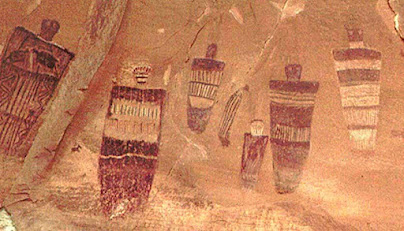
"Holy Ghost Panel," Horseshoe Canyon, Utah. Photograph by Peter Faris.

In 2019, Dr. James Farmer presented a webinar for the Colorado Rock Art Association in which he stated that he believes that the Holy Ghost panel in Horseshoe Canyon shows purposeful perspective with the smaller figures receding into the distance. I do not believe that the artists of Barrier Canyon Style panels knew the rules of single point visual perspective, but they would have observed that that are farther away look smaller than things that are closer. But, I would not call their use of this technique perspective, I would call the various sizes of figures apparently receding into the distance as an example of my concept of Visual Escapements. Another example, also illustrated in the Holy Ghost panel is that smaller figures are higher up than the bottoms of the larger figures. If the different figures are purposely sized in relation to the other figures in the panel, then one might indeed infer perspective and the use of visual escapements in the composition.

Horseshoe Canyon, Utah. Photograph by Don I. Campbell, May 16, 1984. 

On the other hand, if the figures were independently created and just scattered over the surface without relation to each other than this analysis may not be accurate. Did the artists know what they were doing, and were they doing it on purpose? And can we even know this?


NOTE: Some images in this posting were retrieved from the internet with a search for public domain photographs. If any of these images are not intended to be public domain, I apologize, and will happily provide the picture credits if the owner will contact me with them. For further information on these reports you should read the original reports at the sites listed below.


REFERENCE:


Farmer, James, Dr., 2019, Southwestern Rock Art and the Mesoamerican Connection, 18 April 2019, Colorado Rock Art Association online webinar.

Saturday, June 7, 2025

WAS HACHURE SEEN AS THE COLOR BLUE IN THE AMERICAN SOUTHWEST?


Ancestral Pueblo olla with hachure infill in the design. Internet image, public domain.

The origin of the idea that hachure, closely spaced, parallel thin lines, used to fill a space might be intended to symbolize the color blue was credited to J. J. Brody by Stephen Plog (2003). “One of the common design characteristics on black-on-white pottery from the eleventh and twelfth centuries in the northern American Southwest is the use of thin, parallel lines (hachure) to fill the interior of bands, triangles, This essay explores a proposal offered by Jerry Brody that hachure was a symbol for the color blue-is examined by exploring colors and color patterns used to decorate nonceramic material from the of northwestern New Mexico. His proposal is supported and the implications of this conclusion for future studies of this nature are discussed.” (Plog 2003:1) This suggestion, originally applied to the decoration of pottery, was because while the indigenous potters had a full range of black, white, reds and yellow based upon natural pigments, there was no technology at that time that could give them blue or green colors on finished pots. But Plog had also compared the use of hachure on pottery to other, non-pottery, painted artifacts and decided that hachure was used on pottery designs in the same manner that blue paint was used on other media.

Ancestral Pueblo olla with hachure infill in the design. Internet image, public domain.

Sarah Klassen and Will Russel, in 2019, explained it in a paper on color usage in Mimbres pottery. “In the 1970s, American art historian Jerry “J.J.” Brody speculated that 11th- and 12th-century potters in the Chaco region of what is today New Mexico used black hachure—closely spaced, parallel lines—on a white background as a proxy for the color blue-green. The Chaco culture was centered on Chaco Canyon, but it spanned the Four Corners area of Utah, Colorado, Arizona, and New Mexico. Brody had noticed some striking similarities between black-on-white designs on pottery and more colorful designs in other media, such as stone mosaics and painted boards, where color was easier to apply and longer-lasting. The designs were similar, but where the mosaics had turquoise, the pottery had hachure. In 2003, archaeologist Stephen Plog of the University of Virginia tested this idea, comparing the use of hachure on pots to the use of blue-green on more than 50 objects featuring color. His findings supported Brody’s idea: Hachure seemed to represent turquoise.” (Klassen and Russell 2019:3)

Interestingly, Will G. Russell, Sarah Klassen and Katherine Salazar, having done their own comparative study, had written in 2017 that “Our observations do not support the hypothesis that Mimbres hachure acted as a proxy for blue-green. If such an association did exist, it would make little sense for potters to use hachure interchangeably with any color other than blue-green. That is, if hachure did represent blue-green, it follows that it would either stand alone, or be stylistically interchangeable with blue-green. Although blue-green pigment would not have stayed blue-green after firing, it could have been added as fugitive paint. Thus, if our comparison suggests any correlation between Mimbres hachure and a particular color, that color is either brown (objective) or yellow (subjective).” (Russell, Klassen and Salazar 2017:115) So, their interpretation, although their conclusions differ from Brody and Plog, also find hachure to represent a color.

Barrier Canyon Style anthropomorph, Harvest Scene, Maze Overlook, Canyonlands, San Juan County, Utah. Photograph by Don I. Campbell, 1 May 1983.

We also need to keep in mind that what may have applied to art produced by the Mimbres Culture would not necessarily apply to the other prehistoric cultures of the American Southwest. As we have seen, however, Brody and Plog had come to the conclusion that for prehistoric Puebloan (Anasazi) peoples the use of hachure, in Chaco Canyon and elsewhere, stood for the color blue. Indeed, Plog had focused his study on Chacoan pottery.

Barrier Canyon Style anthropomorph, Horseshoe Canyon, Canyonlands, Wayne County, Utah Photograph Don I. Campbell, 16 May 1984.

So what does all this talk about pottery have to do with rock art? Well, we find some examples of hachure or hachure-like texturing in rock art. Also we need to remember that colors pretty much always had major spiritual significance to indigenous peoples.


Barrier Canyon Style anthropomorphs, Photograph by Colin D. Young.  

“Most of the Pueblos associate north with yellow, west with blue, south with red, and east with white. Below, or the underworld is generally associated with black or dark, while the zenith, or the world above, is variably represented by black, brown, yellow or multiple colors.” (Munson 2020:13) So, the colors on a pot, or the color of the paint used to make a pictograph may have carried extra meaning associated with the spiritual implications of the color. Based on the seeming ubiquity of these color codes in the American Southwest, I am going to assume that the peoples on the northern periphery, first Barrier Canyon and later Fremont, also gave colors of paint a spiritual content, I just have no way of knowing for sure what those meanings would be.


Barrier Canyon Style anthropomorph, Horseshoe Canyon, Canyonlands, Wayne County, Utah Photograph James Q. Jacobs.

Most painted rock art is in various shades of natural ochers although there are rare examples of blue and green. In Barrier Canyon Style (BCS) figures (and presumably Fremont Culture figures as well) Dr. James Farmer (2019) associated vertical hachure within the silhouette of the figure as representing rain. One of the elements of his “BCS ‘Thunderstorm’ Iconographic Complex” is falling rain shown on an anthropomorph as closely spaced vertical lines – hachure? Although painted with red paint, he says they represent falling rain, and rain is water and water is associated with blue. What if those hachure rain lines in Barrier Canyon anthropomorphs represent blue rain? What if the artists who painted the figures used closely spaced red lines (hachure) to represent the color blue on the figures?


I don’t think I could prove this even if I wanted to, and I am not convinced even now, but isn’t it an interesting possibility?


NOTE: Some images in this posting were retrieved from the internet with a search for public domain photographs. If any of these images are not intended to be public domain, I apologize, and will happily provide the picture credits if the owner will contact me with them. For further information on these reports you should read the original reports at the sites listed below.


PRIMARY REFERENCES:


Farmer, James, Dr., 2019, Southwestern Rock Art and the Mesoamerican Connection, 18 April 2019, Colorado Rock Art Association online webinar.


Klassen, Sarah, and Will Russell, 2019, The Hidden Color Code in Mimbres Pottery, 14 November 2019, https://www.sapiens.org/archaeology/mimbres-pottery-color/.

Accessed online 6 March 2025.


Munson, Marit K., and Kelley Hays-Gilpin, editors, 2020, Color in the Ancestral Pueblo Southwest, University of Utah Press, Salt Lake City, UT.


Plog, Stephen, 2003, Exploring the Ubiquitous Through the Unusual: Color Symbolism in Pueblo Black on White Pottery, October 2003, American Antiquity, Volume 68 (4), pp. 665-695. Accessed online at JSTOR, 7 March 2025.


Russell, Will G., Sarah Klassen and Katherine Salazar, 2017, Lines of Communication: Mimbres Hachure and Concepts of Color, American Antiquity 83 (1), 2018, pp. 109-127. Accessed online at Researchgate, 7 March 2025.


SECONDARY REFERENCE:


Brody, J. J., 1991, Anasazi and Pueblo Painting, A School of American Research Book, University of New Mexico Press, Albuquerque, New Mexico.

Saturday, April 26, 2025

A BLANKET STRIP IN ROCK ART:

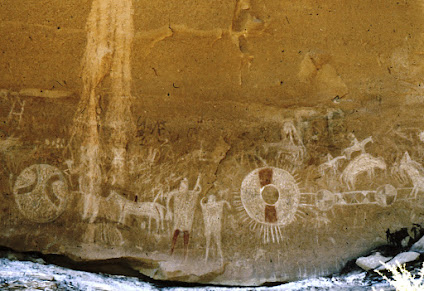
Pictograph panel, Sego Canyon (Thompson Wash), Grand County, UT. Photograph Peter Faris, August 1993.

Back in 1981, I ran across this representation of a blanket strip in Sego Canyon, also known as Thompson Wash, in Grand County, Utah. Someone obviously has gone to a great deal of work to leave an image of something that we normally think of as merely decorative, although decorative can be pretty special too if well done.

Mails, Thomas E., 1995, from Mystic Warriors of the Plains, Barnes & Noble Books, New York, figure 4, page 291.

In the years since then I have tried to find a motive for the creation of this image. My search in ethnographic examples for some special significance of blanket strips has so far been unsuccessful. For instance, Thomas Mails, in Mystic Warriors of the Plains (1995), discussed bead work on page 290, and illustrated blanket strips on page 291, but made no reference to their significance in his text.

I did find a couple of mentions online. In one, The Wandering Bull LLC, the anonymous writer stated “The Native Americans of the Northern Plains created beaded Blanket Strips in the mid 19th century. Blanket Strips originated as a means to cover the seam where two brain-tanned buffalo hides were sown together to create one large robe. Eventually, Native American crafters began to use wool Trade Blankets for robes. They added their beaded strips to them in a purely decorative manner.” While I suppose that this is a possible explanation, the idea of two whole buffalo robes joined together for wearing strikes me as improbably large and heavy.

Blanket strip,Buffalo hide , beads, 1870, American Indian Art Magazine, Spring 2014, p.7.

In 2015, Benson Lanford described a 44 inch long blanket strip created by a Plateau tribe or Crow beader. “In the mid-19th century, blanket strips became a salient decorative object type among the Plains, Plateau and some High Desert American Indian tribes. The concept of the blanket strip has origins in a relatively short, narrow band composed primarily of porcupine quillwork that covered the seam after excising the bulging hump area of a tanned buffalo hide -- excised for the purpose of flattening the hide. This decorative band of quillwork (or beadwork) was applied directly to the hide and extended for more than a third of the hide's length, from just behind the neck, down the back toward the tail. The later blanket strips, composed of tanned hide (or even canvas) were decorated and then applied to the hide robe or wool blanket. Usually, to permit ease in handling while being quilled and / or beaded, the hide strips were worked in sections--rectangles and rosettes, then sewn together once finished.” This is, to me, a somewhat more believable story for the use of a blanket strip on a single hide robe but it still provides no information of any symbolic meaning or significance.

McCoy, Ron, 2013, I Was Taught That the Sun Was a Great Mystery, The Sky in Lakota Art and Lore, American Indian Art Mag., Spring 2013, Vol. 38 (2), page 45.

In the Spring 2013 issue of American Indian Art magazine, Ron McCoy illustrated a Lakota blanket strip from the 19th century with the rondelles divided into quarters by slender Maltese Cross shapes which he defines as the symbol for stars. So, in that instance, the blanket strip refers to the night sky. This cannot be considered universal, however, as there are many examples of blanket strips on the internet that do not show crosses on their rondelles.

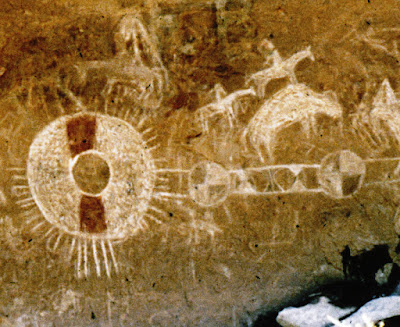
The Sego Canyon, Utah, pictograph has a large circular element on the left, surrounded by fringe, with a large, red stripe vertically through it broken by an empty circle in the center, and with each side painted a solid white. Connected to that circle on the side to our right is a sequence of a band, a rondelle, another band and a final rondelle. The rondelles are divided into painted and plain quarters, and the band between the right and center rondelles has two sets of opposed triangles painted in white. The whole is one portion of a large, complicated scene amassing horses, equestrian figures, a bison, standing humans, and a large shield on the left side of the panel. The panel sports red paint, white paint, and apparently a little black or dark for some details.

Closeup of panel, Sego Canyon (Thompson Wash), Grand County, UT. Photograph Peter Faris, August 1993.

While the Sego Canyon blanket strip rondelles are divided into quarters, those quarters are not separated by a star shape so I don’t know that we can define them as referencing stars. I have come up with one possible overall implication for what a blanket strip might stand for. Based upon the definition by Benson Lawford (above) that it is used to cover the place where the robe has had a portion cut out, it might be thought to imply union, or bringing together, and thus a reference to the strength of the tribe, clan or family. Possibly, the pattern is only decorative, or the patterns may symbolize anything the artist wants it to, and the overall significance of the blanket strip is based on its very existence.

NOTE: Some images in this posting were retrieved from the internet with a search for public domain photographs. If any of these images are not intended to be public domain, I apologize, and will happily provide the picture credits if the owner will contact me with them. For further information on these reports you should read the original reports at the sites listed below.


REFERENCES:

Lanford, Benson, 2015, A Crow or Plateau Quilled and Beaded Buffalo Hide Blanket Strip, c. 1860, March 2015, https://fineart.ha.com. Accessed online 12 April 2025.

Mails, Thomas E., 1995, Mystic Warriors of the Plains, Barnes & Noble Books, New York.

McCoy, Ron, 2013, I Was Taught That the Sun Was a Great Mystery, The Sky in Lakota Art and Lore, American Indian Art Mag., Spring 2013, Vol. 38 (2), p.46-53.

The Wandering Bull LLC, https://wanderingbull.com/shop/collectibles/vintage/blanket-strip-beaded-sioux-style/. Accessed online 12 April 2025.

Monday, March 31, 2025

A PETROGLYPH OF BIGHORN SHEEP PLAYING PATTICAKE AT NINE-MILE CANYON:

 Column for 1 April, 2025.

Rocky Mountain Bighorn Sheep, lambs playing. Internet image, public domain.


We have all seen photographs of lambs playing, we have probably all seen photographs of bighorn sheep lambs playing at head-butting. Now, from Nine-Mile Canyon in Utah we have photographic proof of adult bighorn sheep playing, not head-butting, but patticake.


Petroglyph panel, Nine-Mile Canyon, Utah. Photograph Peter Faris, 1993.

I took the photograph in 1993, of the entire panel in question in Nine-Mile Canyon, Utah.


Close-up of bighorn sheep playing patticake, petroglyph panel, Nine-Mile Canyon, Utah. Photograph Peter Faris, 1993.

In this close-up you can see it more clearly. Now, I know this seems a little far-fetched, but the only other possible explanation is that they are Siamese Twins with two grown sheep sharing the same hoofs, and that seems really a bridge too far.


So, now I find it encouraging that with the state of the world as it is we can still learn something new about the animals that share the planet with us – at least on April First.

Saturday, November 5, 2022

CHRIS MARKES ROCK ART PHOTOGRAPHY - AN EXAMPLE OF REAL ART:

Birthing Rock, Moab, Utah. Photograph Chris Markes.

From time to time I receive communications from readers of RockArtBlog who share their work and studies with me. I have even published some of these on this blog. I have recently had the pleasure of receiving the pictures below from Chris Markes of Moab, Utah. Instead of recording rock art as an archaeological/anthropological or scientific endeavor, Chris is pointing at the artistic qualities of rock art panels, enhancing their mood with night time long-exposure shots. The sheer beauty of these pictures immediately grabbed me and I want to share this with all of you. As you view these pictures try to temporarily shut off the rock art studies or recording frame of mind and approach them as if they are still life or trompe l’oeil works of art. I like to imagine a bright moonlit night, one of those that is almost bright enough to read a newspaper by, with the beautiful universe behind and above the rock art panel.

Birthing Rock, Moab, Utah. Photograph Chris Markes.

In describing his approach to these beautiful time lapse photographs he said; “I go for around 2600-2800 kelvin for lighting in order to get that nice warm vs. cool look between the night sky and the art!  I moved to using a small RGB LED panel, so the light is constant.”  Chris added that his illumination level setting is “at 1% of 100% and on these, they’re actually bouncing light from the ground, then back up to the art.” I find the result to be quite striking and unforgettable.

Birthing Rock, Moab, Utah. Photograph Chris Markes.

In Chris’ words “Visiting the panels is a rather transformative experience in a present time where existential nihilism is the pill of the day – the panels to me serve as a reminder about imagining a time where meaning, purpose and survival were brought into the present moment. While many of us, due to modern conveniences, presently watch/observe life, the idea of truly living life – taking it in, and experiencing it, serves as a profound reminder that our time here is transient, limited, and important.” Well said Chris.

Arches National Park, Moab, Utah. Photograph Chris Markes.

Additionally, Chris sent me a time-lapse video compilation at Arches National Park. (Cut and paste into your browser https://www.youtube.com/watch?v=KwF8Q6WhkjQ). If you look closely, at 2.18 of the video you can see a satellite crossing the sky over Arches (music by Vangelis).

Arches National Park, Moab, Utah. Photograph Chris Markes.

While Chris is not the only person doing this sort of photography his work is a really excellent example of using photography to focus on the mood of a rock art panel instead of merely recording the reality of its presence. He is literally establishing its beauty and presence in the universe. As a student of rock art since 1979 from a background of Art History instead of Archaeology I appreciate the beauty of Chris’s presentations. Thank you Chris for sharing and I look forward to seeing more of your work.


Saturday, March 19, 2022

ANOTHER EXAMPLE OF PERSPECTIVE ANAMORPHOSIS IN ROCK ART – THE LASCAUX RED BULL:


Three Kings panel, McConkey Ranch, Vernal, Utah. Photograph Peter Faris, September 1990.

I have discussed the subject of anamorphosis previously on RockArtBlog. According to Wikipedia “Anamorphosis is a distorted projection requiring the view(er) to occupy a specific vantage point - to view a recognizable image. - The word is derived from the Greek prefix ana-, meaning ‘back’ or ‘again’, and the word morphe, meaning ‘shape’ or ‘form’.” (Wikipedia)


Proportions of central figure of Three Kings panel showing that it is eight heads in height (normal proportion should be six-and-a-half to seven). Peter Faris.

On 23 April 2009, in “Portraiture in Rock Art”, I wrote about the central figure in the Three-Kings panel, McConkey Ranch, north of Vernal, Utah, This figure also displays another interesting detail. When seen from the ground below the figure appears in normal proportion. When observed from a vantage point near its height the figure is seen to be vertically elongated out of proportion (as seen in the photo above). I enjoy imagining a Fremont Indian artist and his young apprentice creating the portrait of an important man of the band or tribe. The young apprentice forced to climb the rocky crag with his tools and materials where he took direction from the master who stayed down on the ground below shouting to him to "make that line higher, no, a little down from there." The result appears in realistic proportion from below on the ground, but is elongated vertically when viewed from a raised viewpoint.” (Faris 2009)

I revisited this subject in “Perspective Anamorphosis – An Example In Rock Art,” on 22 June 2013, where I again included the above quote.


The red aurochs in the Megaloceros Room, Lascaux cave, France. Photograph by Norbert Aujoulat, from donsmaps.com.

Apparently the artists of the painted caves in Europe had discovered the optical distortions of angle and distance on an image and also used anamaphosis to counter them. “When our ancestors painted beautiful works of art, were they intending them to be viewed by others, or did they just paint for their own pleasure? The Lascaux caves in the Dordogne region of France, may have the answer. There you can see a painting of a red cow with a black head high on one of the walls. Up close the cow appears to be stretched from head to toe, but when viewed from the ground the cow regains normal proportions. This technique, known as anamorphosis, is highly advanced and suggests the painter was considering his audience as he painted the cow.” (Ravilious 2010)


Closeup of the red aurochs in the Megaloceros Room, Lascaux cave, France. Internet photo, public domain.

This could, in fact, be true, the painter may have been aware of the distortion effects of angle and adjusted the image to appear correct from the floor of the cave. But, it is also possible that the anamorphosis appeared accidentally as I described above for the McConkey Ranch Three-Kings panel. An elderly master painter may have been directing a young apprentice high up on a scaffold painting the cow. With the master giving directions from ground level when he told the apprentice where to place the lines of the back and belly of the cow because they looked correct to the master on the ground, the anamorphosis would be automatically built in to the image. Either way, images high on cave walls (with the Lascaux red cow as our particular example) can be found which display perspective anamaphorsis, which makes the cave artists either technically highly sophisticated or the lucky recipients of a happy accident – either way with interesting results.


Lascaux replica, France, another red Aurochs. Internet photograph, public domain.


Lascaux replica, France, brown Aurochs. Photograph, Ministere de la culture, Norvert Aujoulat.

There is, however, another possibility that we have to visit. This thick bodied bovine image may be merely a stylistic choice. Indeed, other painted aurochs from Lascaux show the same features of a small head and an abnormally thick torso. But, as I said above, whatever the truth, the question is fascinating.

NOTE: Some images in this posting were retrieved from the internet with a search for public domain photographs. If any of these images are not intended to be public domain, I apologize, and will happily provide the picture credits if the owner will contact me with them. For further information on these reports you should read the original reports at the sites listed below.

REFERENCES:

Ravilious, Kate, 2010, The Writing on the Cave Wall, New Scientist, 17 February 2010, https://www.sott.net/article/203166-The-writing-on-the-cave-wall

Wikipedia, Anamorphosis, https://en.wikipedia.org/wiki/Anamorphosis, accessed on 27 February 2022

Saturday, December 4, 2021

700-YEAR-OLD PETROGLYPHS VANDALIZED NEAR MOAB, UTAH:


"Birthing Rock" site near Moab, Utah. Online photograph, public domain.

Writing for KSL.com, Carter Williams has had the sad duty of describing the vandalism of two petroglyph panels this year near Moab, Utah.


The so-called "birthing panel" near Moab, Utah. Photograph Peter Faris, 3 August 2000.

Birthing Rock Vandalism: I have never been able to see the petroglyph that this site was named for as an instance of giving birth. If anything, it looks to me like a case of medical prolapse, but whatever it is, it is an example of rock art and now this site has been vandalized. “Birthing Rock includes birthing images drawn on the rock by Native American groups at least as far back as the Ancestral Puebloan Culture, a couple of thousand years ago. More petroglyphs were added through the years. Judging from photos, Elizabeth Hora, and archaeologist for the Utah State Historic Preservation Office, said it appeared most of the damage was to petroglyphs left by people from the Fremont Culture. The Fremont in that area stretched from 500 A.D. to about 1300 A.D.” (Williams, April 2021)


Vandalized panel at "Birthing Rock" site near Moab, Utah. Online photograph, public domain.

A party, or parties, unknown wrote “White Power” across a portion of the petroglyph panel. This makes very little sense as Moab, Utah, is a bastion of white power if ever there was one. According to figures from the 2019 Census, white alone (not Hispanic or Latino) population is 73.6%, the Hispanic or Latino proportion of the population is 16.6%, with American Indian and Alaskan Native at 4.9%, and Black or African American coming in at 0.6% (U. S. Census 2019). This strikes me as sort of like praying for rain in the middle of a flood.


Vandalized Mill Creek Canyon site, Moab, Utah. Photograph ksl.com.

Mill Creek Canyon Vandalism: And in another unbelievably stupid act - “Pictures of the vandalism show the unknown vandal or vandals wrote ‘Petroglyphs’ and what appears to be the names ‘Taylor’, ‘Tray’, ‘Wes’ and ‘Travis’ plus the date of Aug. 3.” (Williams 2021)  This destruction was apparently done with a motive of photographing for social media. “The vandalism was discovered by someone visiting Mill Creek Canyon, southeast of Moab, on Aug. 10, according to Rachel Wootton, a public affairs specialist for the Bureau of Land Management. She said the petroglyph is believed to have been drawn by northern San Juan members of the Ancestral Puebloan Culture likely between 350 B.C. and 1300 A.D.” (Williams, August 2021)

 Restorer treating the vandalism at the Mill Creek Canyon site, Moab, Utah. Photograph ksl.com.

Moab has had an official policy of publicizing the locations of rock art for the purpose of attracting tourists. This has made it a popular destination for students of rock art, but apparently it also attracts more than its share of idiots and fringies.

You will notice I have not tried to be politically correct in my descriptions of the perpetrators of this vandalism. These morons need to be called out, arrested, and made examples of. If anyone knows anything about these crimes you should call the Police Department, Moab, Utah.

NOTE: Some images in this posting were retrieved from the internet with a search for public domain photographs. If any of these images are not intended to be public domain, I apologize, and will happily provide the picture credits if the owner will contact me with them. For further information on these reports you should read the original reports at the sites listed below.

REFERENCES:

U.S. Census Bureau Quick Facts, Moab, Utah, Population estimates, July 1, 2019, accessed 29 October 2021

Williams, Carter, 2021, 700-year-old petroglyph vandalized in southern Utah, 25 August, 2021, KSL.com

Williams, Carter, 2021, ‘This is not an accident’: $10K reward offered after well-known Moab petroglyph found vandalized, 27 April 2021, KSL.com

Saturday, April 24, 2021

THE ENIGMATIC FIGURE AT BALANCED ROCK, UTAH - BOLAS, JUGGLING OR RATTLES:


Balanced Rock, Nine-Mile Canyon, Utah. Internet photograph, Public Domain.

Most rock art researchers, at least those in the western United States, know of the rock art in Nine Mile Canyon, Utah. “Nine Mile Canyon is a canyon, approximately 40 miles (64 km) long, located in Carbon and Duchesne counties in eastern Utah, United States. Promoted as the ‘world’s longest art gallery’, the canyon is known for its extensive rock art, most of it created by the Fremont culture and the Ute people. The rock art, shelters, and granaries left behind by the Fremont make Nine Mile Canyon a destination for archaeologists and tourists alike.” (Wikipedia)


Fremont Petroglyph, Nine-Mile Canyon, Utah. Photograph Peter Faris, 1993.

One well-known panel in Nine Mile Canyon is found at the site known as Balanced Rock which includes this interesting figure. Sometimes called “the juggler” or “balloon man”, this figure has prompted a great deal of speculation. It has even been suggested that he might be about to throw a bola or boleadora, the lasso equivalent of the Gauchos, horsemen from Argentina. What connection could a Fremont rock art figure, possibly two thousand years old, have with modern Argentinian gauchos? The answer is round stone balls.


Argentinian boleadora. Photograph Wikipedia, Public Domain.

“Gauchos used boleadoras to capture running cattle or game. Depending on the exact design, the thrower grasps the beleadora by one of the weights or by the nexus of the cords. The thrower gives the balls momentum by swinging them and then releases the boleadora. The weapon is usually used to entangle the animals legs. - There is no uniform design; most bolas have two or three balls, but there are versions of up to eight or nine.” (Wikipedia)

I believe that the actual structure of a boleadora is well known. A weight (like a stone ball) is enclosed in a leather or net pouch and attached by a long cord to other weights at a central point where the cords are all tied together. Well it so happens that round stone balls are an earmark of Fremont occupation sites.


Fremont culture round stone balls. Photograph http:www.natgeocreative.com, Public Domain.

“A number of other material items, such as stone balls, basin-shaped metates with small secondary grinding surfaces, and elongated, corner-notched arrow points are characteristic of the Fremont - .” (Madsen 1989:9) And “for a long time stone balls commonly found at Fremont village sites were thought to be part of a game but recent work suggests they may have been used with metates.” (Madsen 1989:33) And finally, “Some stone balls, such as this highly polished specimen from the Old Woman site, suggest a use other than as a grinding tool.” (Madsen 1989:66) So, did the Fremont use boleadoras to catch game? None have ever been found so, apart from this enigmatic Fremont petroglyh, we have no actual evidence that they did.

The actual panel this figure is part of includes a couple of desert bighorn sheep and some armed human figures including on with a bow and arrow appearing to aim at one of the sheep. So, in a hunting context, a boleadora might make sense, but this is certainly not conclusive.

The other commonly suggested interpretations, or designations, of this figure are “balloon man” and “the juggler”. We can do away with the name “the juggler” because the circles are all connected to each other by lines. This is no way to juggle. And “balloon man”? What balloons? They could be sheep or deer bladders full of water tied together for carrying, but I fear we may never know about this.

I even found one suggestion that the figure represents Spider Woman or Spider Grandmother, the mythical southwestern figure involved in creation and man’s presence on this earth. I suppose that whoever made this suggestion was basing it on some perceived resemblance between the object(s) the figure is carrying and a spider web, but I just cannot accept that similarity.

So, if the object(s) in the figure’s hand is not a boleadora, what could it be? It just might be a ceremonial rattle/tinkler.


Rattle of Arizona walnut shells from Antelope House, Canyon de Chelly National Monument. Collection of the Western Archeological and Conservation Center. photo Emily Brown.

A discovery at Antelope House in Canyon de Chelly provides another real possibility. A rattle or tinkler made of walnut shells on yucca twine could provide the model for the item possessed by the figure in the Balanced Rock panel. “An examination of this walnut rattle reveals the ingenuity of its maker. Each yucca cord was carefully twined, then threaded through a native Arizona walnut shell. The ends were then bound together in such a way as to make a handle. There are many rattles made by suspending hoofs or other objects in a similar way, but Brown found only two walnut rattles in the collections she researched. Both came from Canyon de Chelly.” (Hoover 2005:14)

Modern reproduction chestnut shell shaker. Internet photograph, Public Domain.

This is a variation on the more common deer or antelope hoof rattle. “The deer hoof rattle usually requires the use of twenty-four or thirty-two hoofs. Since deer are split-hoofed, hooves from three or four deer are needed to make this type of rattle. The hooves are boiled for a period of time so that the bone and cartilage can be removed and then shaped and dried to harden. The handles used for this type of rattle are a combination of leather and fiber cordage. The leather strips are used to attach the hooves to the fiber bundle that serves as the handle. The handle is held in the palm of the hand and the rattle is played by dangling the hooves toward)s the ground and moving the hand in sharp, downward motions.” (Pechanga Band of Luiseno Indians)

Although called a rattle in both of these quotes this object is more properly designated as a form of tinkler or shaker, rattles consist of a closed container of some sort with smaller objects inside that rattle when it is shaken. A tinkler is a group of hard objects suspended in such a way that they make a sound when they contact each other while undergoing agitation or shaking. Other tinklers are commonly made of seashells, other types of nut shell, or during the historic period metal cones. And while Antelope House in Canyon de Chelley is a long way from Nine-Mile Canyon in Utah, aspects of the cultures are not so far apart. I assume that the Fremont people of Nine-Mile Canyon used rattles or tinklers like the Ancestral Puebloans of Canyon de Chelley. Therefor I submit that the enigmatic figure of balanced rock is a musician, shaking his tinkler, whether deer or antelope hoof, or walnut shell, we cannot know at this remove in time.


Nine-Mile Canyon, Utah. Photograph Paul and Joy Foster.

Nine-Mile Canyon, Utah. From Polly Schaafsma, The Rock Art of Utah, fig.33, p. 35.

Other petroglyphs in Nine-Mile Canyon, Utah, embody the same general shape and layout, although not shown as being held by an anthropomorph.


Three Rivers, Otero County, New Mexico. Photograph Peter Faris, January 1998.

Another petroglyph, this one an image from Three-Rivers site in New Mexico, just might represent another example of this form of rattle or tinkler as well.


NOTE: Some images in this posting were retrieved from the internet with a search for public domain photographs. If any of these images are not intended to be public domain, I apologize, and will happily provide the picture credits if the owner will contact me with them. For further information on these reports you should read the original reports at the sites listed below.

REFERENCES:

Hoover, Joanne Sheehy2005 Making Prehistoric Music, American Archaeology, Winter 2004-5, Vol. 8, No. 4, pp 12 - 21

Madsen, David B.1989 Exploring the Fremont, Utah Museum of Natural History and University of Utah, Salt Lake City

Pechanga Band of Luiseno IndiansRattlemaking: Rattle Types, Temecula, California, https://www.pechanga-nsn.gov

Schaafsma, Polly, 2002, The Rock Art of Utah, University of Utah Press, Salt Lake City.

Wikipedia, https://en.wikipedia.org/wiki/Bolas

Wikipedia,https://en.wikipedia.org/wiki/Ninemile_Canyon_(Utah)