Showing posts with label Christogram. Show all posts

Saturday, September 17, 2016

CARIBBEAN ROCK ART - PUERTO RICO:


Cave with wall markings (inset).
Mona Island, Puerto Rico.
www.livescience.com.

Writing for LiveScience on July 20, 2016, Megan Gannon introduced the petroglyphs of Mona  Island, Puerto Rico. Citing an article in the July 19, 2016 journal Antiquity, she presented both prehistoric and Spanish settler images. This considerably expands the knowledge of rock art in the Caribbean.


Cave markings. Mona
Island, Puerto Rico.
www.livescience.com.

This collection of rock art is found in caves on Mona Island, and many of the markings were made by dragging fingers or a tool through a soft surface layer on the limestone walls of the caves. Researchers reportedly found markings in thirty of seventy caves they explored, and date the oldest back to 500 years B.P.


Historic cave inscription.
Mona Island, Puerto Rico.
www.livescience.com.

In one cave they found a mix of prehistoric and historic imagery. "Alongside the indigenous artwork there are names, dates, and Christian symbols like crosses and Christograms (a symbol of Christ usually consisting of letters) from the 16th century. There are also some Christian phrases and Bible verses, in Spanish and Latin, such as "dios te perdone" (may God forgive you") and "verbum caro factum est" ("and the Word was made flesh")." (Gannon 2016)
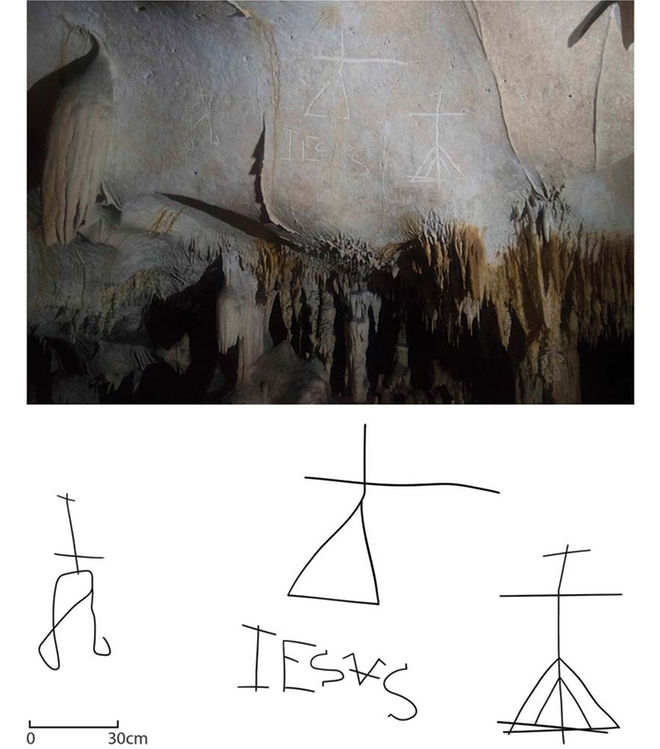
Christograms on cave wall.
Mona Island, Puerto Rico.
www.livescience.com.

"In one case, a name scribbled graffiti-style on a cave wall could be tied to a real person. Francisco Alegre, who came to the Caribbean from Spain with his father in the 1530s and became a royal official in Puerto Rico." (Gannon 2016)

So much more rock art is there to be discovered, if only we look.

REFERENCE:                       

Gannon, Megan,
2016      http://www.livescience.com/55467-pre-columbian-cave-art-discovered.html

Saturday, August 6, 2016

CHRISTOGRAMS:


Symbols consisting of variations on
the cross, Mesa Prieta, New Mexico.
Photograph Peter Faris.


In the portions of the New World that were settled by the Spanish a symbol commonly found in historic rock art is the Christogram. "A Christogram (from Greek Khristos, Christ + -gramma, letter or piece of writing is a monogram or combination of letters that forms an abbreviation for the name of Jesus Christ, traditionally used as a Christian symbol. Different types of Chrostograms are associated with the various traditions of Christianity, e.g. the IHS (also JHS, IHC, or IHΣ) monogram representing the Holy Name of Jesus or ICXC representing "Jesus Christ". Since early Christianit, the related term Chrismon (from Greek Khristos, Christ + -mon, one or single, from Late Latin monogramma, monogram) has traditionally referred to any symbol or figure reminiscent of the name of Christ, by contrast with the basic Christogram consisting of plain letters typically implying the presence of some kind of calligraphic ornamentation." (Wikipedia)

 
Chi-Rho Christogram,
public domain.


"One of the oldest Christograms is the Chi-Rho or Labarum. It consists of the superimposed Greek letters chi (X) and rhoh (P), which are the first two letters of Christ in Greek." (Wikipedia)

The most commonly encountered Christogram in English-speaking countries in modern times is the letter X (or more accurately, the Greek letter chi), representing the first letter of the word Christ, in such abbreviations as Xmas (for "Christmas) and Xian or Xtian (for "Christian")." (Wikipedia)


Monogram for the name of Jesus based
on the Cross, Public Domain.

Many of the known Christograms include representations of the Cross, symbolizing the crucifix and the crucifixion of Christ. This leads to the distinct possibility that elaborated crosses found in historic rock art of the American southwest were intended as Christograms. Even if the person who produced the image did not know the concept of Christograms their intention to produce a reference to the church of Jesus Christ allows us to classify these as probable Christograms.


Purgatoire Canyon, Bent County, CO.
Photograph Peter Faris, June 1991.

A concentration of these symbols is found in the northern New Mexico, southern Colorado area historically inhabited by the Penitente Brotherhood, and are assumed to have probably been their creations. Others can perhaps  be credited to sheepherders or Hispanic cowboys. In some instances they demonstrably mark a shrine, while in other instances they are just found on a rock surface with no other cultural remains to be seen. In any case they represent a message of someone's strong devotion to their Christian religion and should be viewed with the respect due a sacred symbol.

REFERENCES:

Blaine, Dean
2015    Mysteries of the Brotherhood, Archaeology, May/June 2015, Vol. 68, No. 3, p. 42-7.

Faris, Peter
2015     Penitente Rock Art, http://rockartblog.blogspot.com

Wikipedia