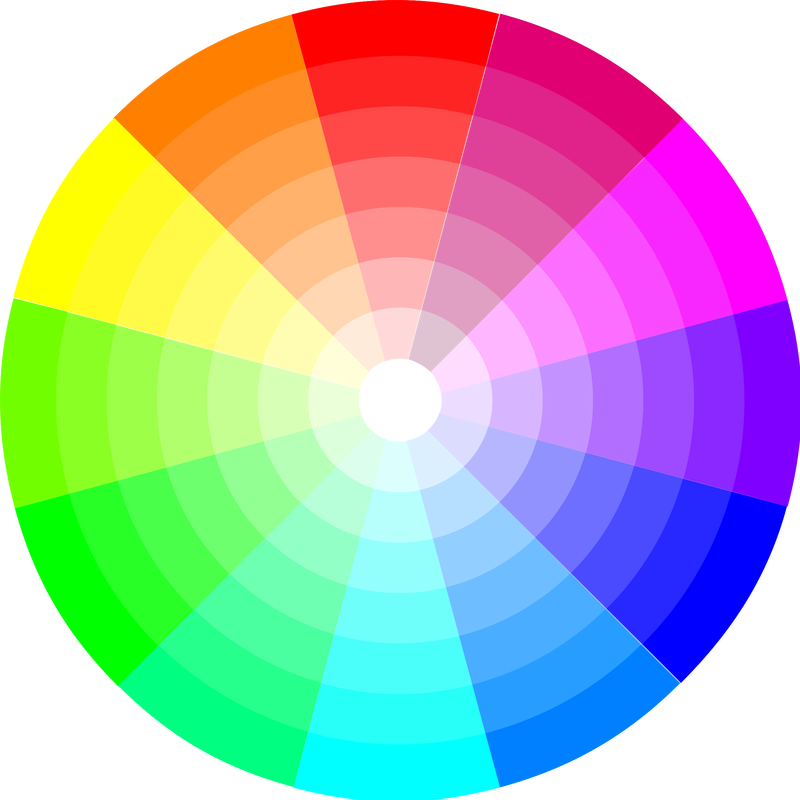
What follows is my take on a philosophical question – “did ancient people see colors the same way we do?” This one is just for fun, please don’t take it too seriously – I do not.
I
have recently run across a very strange line of inquiry (or speculation anyway)
that investigates whether or not ancient people could
see/discriminate/comprehend all of the colors that we see. This became a
fascinating mental exercise for me. Such a question would perhaps be pertinent
to us as to whether or not the Paleolithic cave-artists saw the same colors we
see, and did that reflect in their paintings? Before beginning I have to
confess that in extensive searches of cave paintings in Europe, both on the
internet and in printed books, I have failed to find an example painted in
blue.

One
strong possibility is that while they certainly saw the colors, meaning that
their eyes picked up on all the same wavelengths of light that we do, they may
not have comprehended what they were seeing. Based upon the old truism that you
cannot actually comprehend something that you do not have a name for, until the
name for the color blue was invented (in whatever language they spoke) they just
were not as aware of it as they would have been shades of red. Remember, there
seems to have been a historic fascination with red ocher.

One
of the first examples scholars noticed was in the writings of the Greek poet
Homer. Christopher Hall (2018) has studied this subject extensively and
explains that “Then Achilles, in tears, moved far away from
his companions, and sat down on the shore, and gazed out over the wine-dark
sea. (Iliad,
1. 351-353, trans. Stephen Mitchell) What
color is the sea? Perhaps a silver-pewter at dawn, or a deep blue, or a warm
green-blue, depending on the particular day, depth, and geographic location
—but have you ever described the sea as being the color of claret? One of the
characteristics of Homer’s writing is his use of epithets: rosy-fingered dawn, swift-footed Achilles. Arguably the most famous of these is his oinops pontos, his wine-dark sea; it appears over a dozen times in the Iliad and the Odyssey, companion books chronicling the Greek siege of Troy, the Trojan War,
and then the difficult journey undertaken by Odysseus after the war as he
attempts to find his way home back to Ithaca. Wine-dark sea has been the subject of much
speculation over the past couple hundred years. Shouldn’t the sea be blue?
Strangely, nowhere in Homer’s epic poetry is the color blue ever mentioned.
Water, water everywhere, but not a hint of blue.” (Hall 2018) I love the
humor in Hall’s use of Coleridge’s “Rime of the Ancient Mariner” (way back when
I read this in High School English it was spelled “Rhyme of the Ancient
Mariner). He is pointing out the omission of any reference to the color blue,
and some of Homer’s substitute phrases for it.
To begin with I need to add another disclaimer – an online search
for “ancient Greek blue pigments” will yield many sites that do claim that the
ancient Greeks had a word for blue. But
again I have to confess that in extensive searches of images of Greek art, both
on the internet and in printed books, I have failed to find an example painted
in blue.
Hall continues “One of the
first people to seriously study Homer’s use of color was the 19th-century
classics scholar and British Prime Minister William Gladstone. In 1858,
Gladstone published a seminal 1,700-page study of Homer’s epic poetry, which
included a 30-page statistical analysis of Homer’s use of color. Gladstone
notes that, compared to modern writers, Homer rarely mentions color, and what
is mentioned is mostly limited to shades of black and white, with red, yellow,
and green making only occasional appearances. Black is mentioned almost 200
times, white about 100. Red is mentioned fewer than 15 times, and yellow and
green fewer than 10. Moreover, Homer’s descriptions of color can be, at times,
completely bizarre: skies the color of bronze, stars are an iron or copper hue,
sheep wool and ox skin appear purple, horses and lions are red, and honey glows
green. Most conspicuous, however, Gladstone noted the complete absence of the
color blue. Nothing is ever described as ‘blue.” (Hall 2018) Might it just
have been that Homer was color blind? This turned out to be Gladstone’s
explanation.

But then the question is was it just Homer who was color blind or
were all ancient Greeks color blind? “But
Homer’s blindness could not be an explanation for the strange use of color in
the Iliad and Odyssey. The existing texts record stories from a longstanding oral tradition.
Moreover, once Gladstone sifted through Homer’s texts, he also analyzed the
descriptions in other ancient Greek texts and found they too had a conspicuous
lack of color terms, limited to mostly shades of black and white—and again, a
total absence of the color “blue.” The word didn’t even exist. Did the Homeric
Greeks have defective color vision? Was there something physically different
about their eyes? Indeed, that was Gladstone’s conclusion: “[The] organ of
colour and its impressions were but partially developed among the Greeks of the
heroic age.” The ancient Greeks, according to him, were color blind.” (Hall
2018) In other words, it was not just Homer, it apparently was his whole
culture.

Since then, many other theories have been posited for the lack of
the word blue in Homer’s writings. “All
of these potential explanations fail to account for one very important thing,
however: the absence of the word “blue” in ancient Greek literature. The Greek
islands are practically surrounded by the color blue: blue sky, blue sea—and
yet the word for “blue” is conspicuously absent. Gladstone was on to something
with his statistical compilation of color use in ancient Greek literature, but
as it turns out, his study was a bit narrow: the ancient Greeks were not alone
in their limited color descriptions, nor in the conspicuous absence of the
color “blue.” Expanding upon Gladstone’s research, philosopher and philologist
Lazarus Geiger found the same phenomenon in ancient Hebrew literature, Assyrian
texts, Icelandic sagas, the Koran, ancient Chinese stories, Hindu Vedic hymns
and Indian epics such as the Mahabharata. It is as though the entire ancient world
were living in murky world of black and white, basking under heavy, brazen
bronze skies, interrupted on rare occasion by flashes of red or yellow. The
only ancient culture to have a word for blue was the Egyptians, as they
developed the first synthetic pigment, Egyptian blue (the secret of its
manufacture was lost in Roman times, but is thought to have been derived from
heating together a quartz sand, a copper compound, calcium carbonate, and a
small amount of alkali).” (Hall 2018) This resulted in a coarse blue sandy,
partially vitrified product (somewhat similar to faience blue glaze) that was
then ground fine enough to be used as the pigment. Egyptian blue was possibly
the first artificially produced pigment.

“In the annals of
history, ancient Egyptian society emerges as the trailblazer in embracing a
distinct term for the color blue, owing to its pioneering development of blue
dyes. This innovation found its vibrant expression in the renowned hue known as
Egyptian blue. This stunning color featured in artworks such as the tombs of
Mereruka from the Old Kingdom (2600 to
2100 BC).” (Cowie 2024)
Then the question became whether the lack of blue was actually
based on a physical difference, or was perhaps a cultural or linguistic
question.
NOTE 1: The second part of this column will be posted next week.
NOTE 2: Some images in this posting were retrieved from the internet with a search for public domain photographs. If any of these images are not intended to be public domain, I apologize, and will happily provide the picture credits if the owner will contact me with them. For further information on these reports you should read the original reports at the sites listed below.
REFERENCES:
Cowie, Ashley, 2024, Hidden Hue: Why Ancient Civilizations Failed to See the Color Blue? 18
June 2024, Ancient Origins, https://www.ancientorginsunleashed.com.
Accessed online 19 February 2025.
Hall, Christopher, 2018, Blue is the Rarest Color: Language and Visual Perception, 30 August
2018, Burnaway digital magazine online, https://burnaway.org/magazine/blue-language-visual-perception.
Accessed online 19 February 2025.




 Posts

