On November 6, 2011,
I reviewed a paper by Ekkehart Malotki and Henry D. Wallace about the discovery
of a possible petroglyph of a mammoth along the San Juan River, near Bluff,
Utah. (Malotki and Wallace, 2011: 143)
In the article by Agenbroad and Wallace (2004) cited below the
authors argue that the belief that Paleo-hunters did not live on the Colorado
Plateau because the megafauna that they depended upon were absent is just a
myth. They point to fossil remains located throughout the area in question, as
well as rock art that they identify as the megafauna in question, as proof that
both the animals and the hunters occupied the Colorado Plateau from 12,000 to
6,000 BP. (Agenbroad and Hesse 2004:189-195)

If this is indeed the case, then the rock art that they show
as evidence toward their claims must be illustrations of the extinct megafauna
species (mammoth and bison) that existed during that period. The actual existence of rock art illustrating mammoths is somewhat problematical although opinion is not as closed against it as before.
The Clovis culture is a prehistoric Paleoindian
culture, named after distinct stone tools found at Clovis, New Mexico, in the
1920s and 1930s. The Clovis culture appeared around 13,200 - 12,900
years before present, at the end of the last glacial period. Clovis is
characterized by the manufacture of Clovis points and distinctive bone and
ivory tools. Clovis peoples are considered to be the ancestors of most
of the indigenous cultures of the Americas. (Wikipedia)
Some instances of mammoth remains with evidence of
intentional butchering have been recorded and Clovis artifacts are often found
with mammoth remains in archaeological contexts pointing to the Clovis culture
as mammoth hunters.
"The distribution
of 35 Clovis localities, most of which are surface finds, closely resembles the
reported mammoth distribution. In other words, mammoth hunters were where the
mammoths were." (Agenbroad and
Hesse 2004:194)
"Only 14 of the
42 documented mammoth sites (33 percent) have been radiocarbon dated. These
dates range from 30,800 to 10,350 B.P., with no major temporal absence. The
weighted average of the four youngest radiocarbon dates for mammoths is 11,270
± 65 B.P. , which approximates the time
of mammoth extinction on the Colorado Plateau (Agenbroad and Mead 1989)."
(Agenbroad and Hesse 2004:195)

"Figure 16.6
shows the known rock-art localities that depict mammoth and bison on the
Colorado Plateau. Some of the mammoth petroglyphs are in the same canyons that
contain mammoth skeletal and fecal remains. Figure 16.7 provides examples of
mammoth rock art on the Plateau." (Agenbroad and Hesse 2004:195)


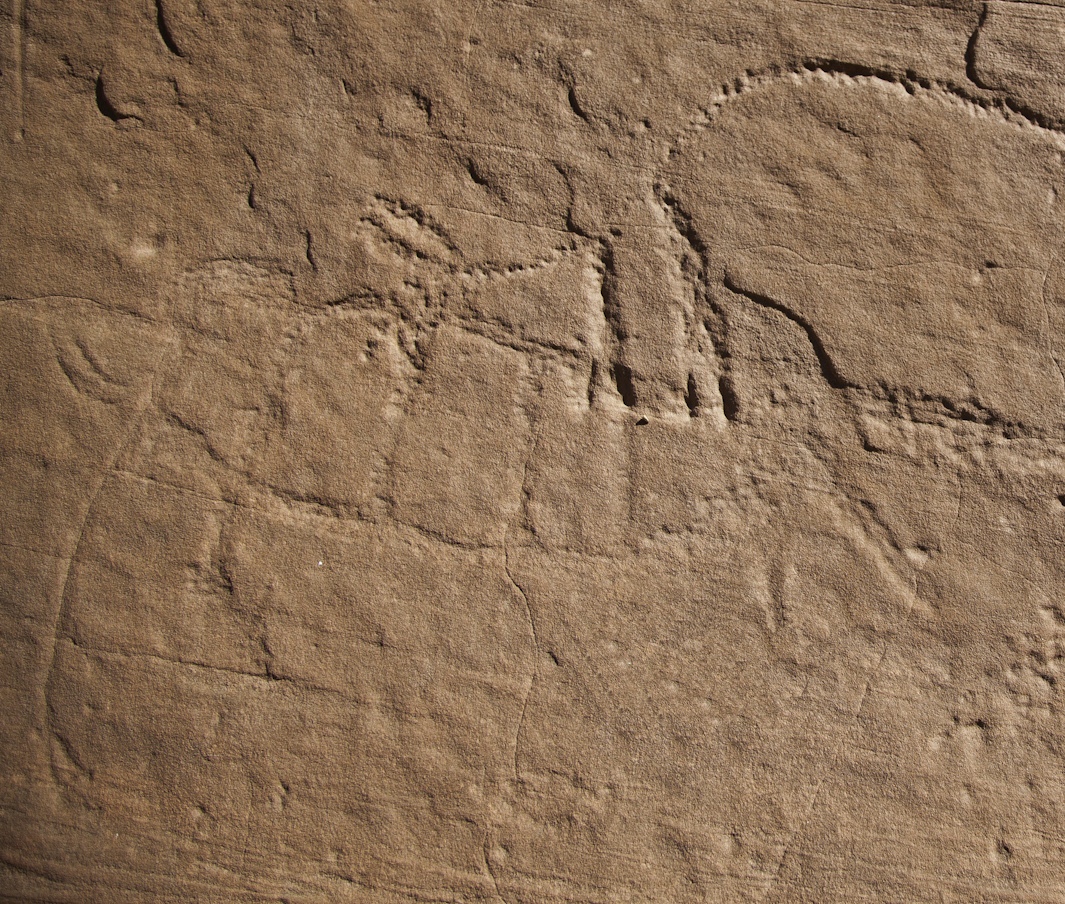
Proposed San Juan river mammoth
and bison petroglyph. Ekkehart Malotki
and Henry D. Wallace, 2011.
While I am certainly open to the possibility of some rock
art in North America portraying mammoths, I am skeptical about many of the
claimed examples. I have previously argued against the authenticity of the
so-called "Moab mastodon", and I have guardedly accepted the
identification of a petroglyph along the San Juan river near Bluff, Utah, as a
Columbian mammoth by Malotki and Wallace (2011). In Agenbroad and Hesse's
figure 16.7, however, I fear a number of the illustrated examples do not strike
me as convincing.


One image that I personally do find very convincing was discovered in 2002 by Mike
Maselli on an outlying boulder at the Farrington Springs site in southeastern
Colorado. In this instance Larry Agenbroad disagreed, stating he did not
believe that the image represented any type of pachyderm (personal
communication). On the question of mammoths in rock art, I fear the votes are
not yet in, and we will have to wait a while for further data before we can
state conclusively yes or no.
REFERENCES:
Agenbroad, Larry D., and India S. Hesse,
2004 Megafauna,
Paleoindians, Petroglyphs, and Pictographs of the Colorado Plateau, in The Settlement of the American Continent: A
Multidisciplinary Approach to Human Biogeography, edited by C. Michael
Barton, Geoffrey A. Clark, David R. Yesner, and Georges A. Pearson, University
of Arizona Press, Tucson.
Malotki, Ekkehart, and Henry D. Wallace
2011 Columbian
Mammoth Petroglyphs From The San Juan River Near Bluff, Utah, United States, in
Rock Art Research 2011, vol.28,
number 2, pages 143-152, Australian Rock Art Research Association, Caulfield
South, Victoria, Australia.
Wikipedia






 Posts
Posts

