Showing posts with label Caribbean. Show all posts

Saturday, December 16, 2017

MORE ROCK ART FROM MONA ISLAND, PUERTO RICO:


Image made with finger markings.
Mona Island, Puerto Rico.
Photo: static.independent.co.uk,
 Public Domain.

On September 17, 2016, I posted a column about Taino rock art discoveries on Mona Island, Puerto Rico titled Caribbean Rock Art - Puerto Rico. Now, an article in Live Science by Dan Robitzki on November 6, 2017, outlines discoveries of further rock art on Mona Island. In his article "On An Uninhabited Caribbean Island, A Trove Of Pre-Columbian Art", Robitzki wrote "to analyze the cave drawings, the archaeologists took x-rays and used (radio) carbon dating. They were surprised to find that all of the artwork discovered in about 70 winding caves predated Christopher Columbus arriving in the Americas."(Robitzki 2017)


Mona Island, Puerto Rico.
Photo: www.archaeology.org,
 Public Domain.

The newly discovered petroglyphs include a large percentage of anthropomorphs. "Many of the drawings on the cave walls, some of which depict religious and ceremonial symbols - animals, faces wearing headdresses, and various designs dotted the cave wall - were made using simple techniques, such as rubbing or scraping into the rock walls. Because the cave walls were coated with a softer surface, rubbing or scraping at the surface revealed a different-colored mineral beneath." (Robitzki 2017)

"Other images in the caves were made with advanced paints that varied based on the unique components of each cave, according to the research. These paints contained varied levels of charcoal, bat droppings, plant gums, different minerals like iron and plant material from native trees like Bursera simaruba, also known as the turpentine tree. The researchers concluded that the paintings were likely prepared in advance, and then charcoal from torches were likely added to the artwork afterward." (Robitzki 2017) I fear that I draw a different conclusion here. It sounds to me as if the ingredients are highly random and depended upon whatever the painter could pick up in the location.


Mona Island, Puerto Rico.
Photo: ancientorigins.net,
 Public Domain.

""Most of the pre-colonial pictographs are in very narrow spaces deep in the caves, some are very hard to access, you have to crawl to get to them, they are very extensive and humidity is very high but it is extremely rewarding," Victor Serrano, an archaeology doctoral candidate from the University of Leicester who worked on the research, said in a statement. "Because the indigenous people of Mona Island were wiped out by European invaders, physical and cultural analysis of the new cave paintings are one way people can learn about what they were like and how they lived. Because the art found in the Mona caves are so well preserved, researchers may glean new insight into the lifestyle of a lost culture."" (Robitzki 2017) In other words, the people are long gone, but we might be able to understand a little of their culture by studying the rock art.


Mona Island, Puerto Rico.
Photo: static.independent.co.uk,
 Public Domain.


Close-up,
Mona Island, Puerto Rico.
Photo: www.archaeology.org,
 Public Domain.

The Taino people barely survived Spanish civilizing. "The Taino became nearly extinct as a culture following settlement by Spanish colonists, primarily due to infectious diseases. The first recorded smallpox outbreak in Hispaniola was either in December 1518 or January 1519. This smallpox epidemic killed almost 90% of the Native Americans who had not already perished. Warfare and harsh enslavement by the colonists also caused many deaths. By 1548, the Taino population had declined to fewer than 500. Starting in about 1840 there have been attempts to create a quasi-indigenous Taino identity in rural areas of Cuba, the Dominican Republic, and Puerto Rico. This trend accelerated among the Puerto Rican community in the mainland United States in the 1960s. At the 2010 U.S. census, 1,098 people in Puerto Rico identified themselves as Puerto Rican Indian, 1,410 identified as Spanish American Indian, and 9,399 identified as Taino. In total, 35,856 Puerto Ricans considered themselves Native American." (Wikipedia)

NOTE: Images in this posting were retrieved from the internet in a search for public domain photographs. If any of these images are not intended to be public domain, I apologize, and will happily provide the picture credits if the owner will contact me with them. For further information on this report you should read the original at the site listed below.


REFERENCE:

https://en.wikipedia.org/wiki/Ta%C3%ADno

Robitzki, Dan
2017    On An Uninhabited Caribbean Island, A Trove Of Pre-Columbian Art, November 6, 2017, Live Science, https://www.livescience.com/60850-photos-mona-island-cave-art.html

www.ancientorigins.net

www.archaeology.org

www.static.independent.co.uk 

Saturday, September 17, 2016

CARIBBEAN ROCK ART - PUERTO RICO:


Cave with wall markings (inset).
Mona Island, Puerto Rico.
www.livescience.com.

Writing for LiveScience on July 20, 2016, Megan Gannon introduced the petroglyphs of Mona  Island, Puerto Rico. Citing an article in the July 19, 2016 journal Antiquity, she presented both prehistoric and Spanish settler images. This considerably expands the knowledge of rock art in the Caribbean.


Cave markings. Mona
Island, Puerto Rico.
www.livescience.com.

This collection of rock art is found in caves on Mona Island, and many of the markings were made by dragging fingers or a tool through a soft surface layer on the limestone walls of the caves. Researchers reportedly found markings in thirty of seventy caves they explored, and date the oldest back to 500 years B.P.


Historic cave inscription.
Mona Island, Puerto Rico.
www.livescience.com.

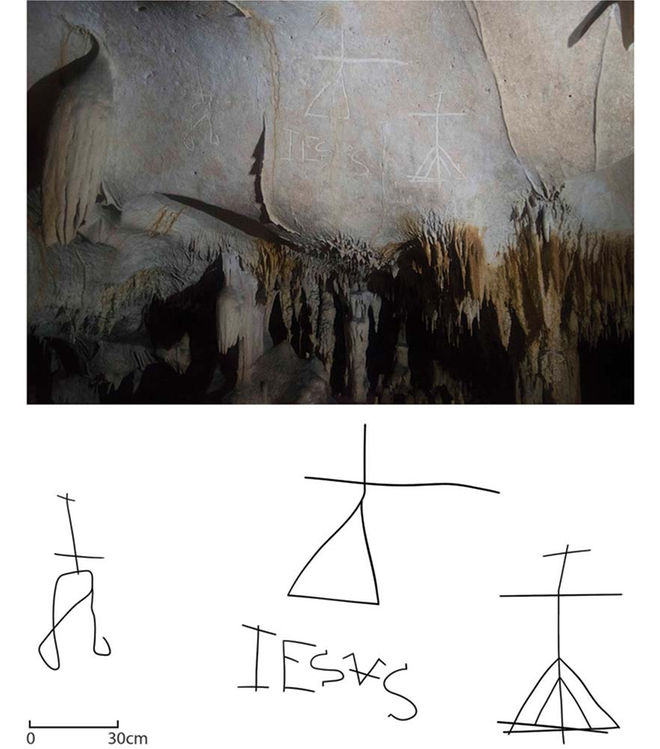
In one cave they found a mix of prehistoric and historic imagery. "Alongside the indigenous artwork there are names, dates, and Christian symbols like crosses and Christograms (a symbol of Christ usually consisting of letters) from the 16th century. There are also some Christian phrases and Bible verses, in Spanish and Latin, such as "dios te perdone" (may God forgive you") and "verbum caro factum est" ("and the Word was made flesh")." (Gannon 2016)

Christograms on cave wall.
Mona Island, Puerto Rico.
www.livescience.com.

"In one case, a name scribbled graffiti-style on a cave wall could be tied to a real person. Francisco Alegre, who came to the Caribbean from Spain with his father in the 1530s and became a royal official in Puerto Rico." (Gannon 2016)

So much more rock art is there to be discovered, if only we look.

REFERENCE:                       

Gannon, Megan,
2016      http://www.livescience.com/55467-pre-columbian-cave-art-discovered.html

Saturday, June 20, 2015

ROCK ART IN JAMAICA:

 
As I explain below, I wanted this to be a first-hand report of wonderful rock art that I hoped to see in Jamaica. It did not turn out that way. So this is now a review of publications by Lesley-Gail Atkinson (listed below in References) on the rock art of Jamaica. 
 
 
Jamaian petroglyphs, pulseamerica.co.uk.
 
Years ago we took a cruise up the Alaskan Inside Passage on a smaller ship. During that trip the Purser's office on the ship would go to great lengths to help us make plans for our visits ashore with helpful information like the directions to Wrangell's Petroglyph Beach. They were friendly and hospitable and went out of their way to help. Well, now we have just completed a Western Caribbean cruise on the Serenade of the Seas/Royal Caribbean, and it was a completely different experience.


Leslie-Gail Atkinson, Rock Art of the Caribbean,
Fig. 4.3, p. 52, Bird pictographs at Mountain
River Cave, Photograph: Evelyn Thompson.

I had confirmed that Jamaica (which was a scheduled stop) has numerous rock art sites so I took my packet of information including locations and even some pictures to the Shore Excursion desk to ask for help in arranging visits to one or more sites. Now this is the desk of which the cruise line's promotional material says "let our helpful Shore Excursion staff customize your shore excursion for your most memorable cruising experience."  The result was certainly memorable, but in a very negative way - they refused to lift a finger or make a phone call to try to find directions, or a guide, or even where I could look for postcards of the Jamaican rock art. In other words they totally blew me off, essentially asking me to go away and quit bothering them. There may actually still be cruises out there that will help you try to do what you want to do, but Royal Caribbean is certainly not one of them.
 
 
Leslie-Gail Atkinson, Rock Art of the Caribbean,
Fig. 4.2, p. 51, Birdmen pictographs at Mountain
River Cave, Photograph: Evelyn Thompson.

It turns out that with some online searching and a few books I can find out a little about rock art in Jamaica to pass on to you, but not with any help from Royal Caribbean.


Leslie-Gail Atkinson, Rock Art of the Caribbean,
Fig. 4.1, p. 50.

Most of the rock art on Jamaica was created by the early Taino inhabitants of the island. Sources agree that caves were of great significance to the Taino, serving as receptacles for the creation and nurturing of life and as its entry point into the world. Some myths suggest that caves were the place of origin for not only humans, but the sun and moon as well. Apparently caves were also used by the Taino for burials and sanctuaries, and as places for shrines where their Shaman could work to keep balance. Much of the rock art on Jamaica is also found in caves. Most of this seems to consist of petroglyphs of faces, although Mountain River cave reportedly has a large number of painted images.


Leslie-Gail Atkinson, Jamaica: The Earliest Inhabitants,
Fig. 13.5, p. 181, Petroglyphs at Canoe Valley.

Two of the books I found are listed below in references. These writings by Leslie-Gail Atkinson were the most valuable. I have copied illustrations from these so you can indeed see what is to be found. Also, a little internet searching will give you an idea of the rock art to be found in Jamaica. In particular, the book Rock Art of the Caribbean provides a good overview and some helpful analysis. I got my access to this through interlibrary loan, but if you are into building your rock art library I would recommend this one. A number of papers by varying authors in this volume cover a broad spectrum and offer a great beginning to understanding the rock art of Jamaica, and elsewhere.

 So, based upon what I can find, Jamaica does not have any really world class art on its rocks, but remember it is all rock art, and is all valid. I am sorry that I could not present this report based on first hand data, but don't blame me - blame Royal Caribbean Cruises.

 
REFERENCES:
 
Atkinson, Lesley-Gail
2006    Jamaica: The Earliest Inhabitants: The Dynamics of the Jamaican Taino, University of West Indies Press, Jamaica

Atkinson, Lesley-Gail
2009    Sacred Landscapes: Imagery, Iconogaphy, and Ideology in Jamaican Rock Art, p. 41-57, in Rock Art of the Caribbean, edited by Michele H. Hayward, Lesley-Gail Atkinson, and Michael A. Cinquino, University of Alabama Press, Tuscaloosa.