NOTE: The illustrations labelled public domain were retrieved from the internet with a search that included the phrase public domain. If any of these are not intended to be public domain I apologize. Please inform me and I will give proper credit or take them down.
Showing posts with label counting. Show all posts
Saturday, May 27, 2017
HANDPRINTS MAY RECORD TALLIES OR COUNTS - CONTINUED:
Hand stencil, Maltravieso Cave,
Caceres, Spain, little finger
deliberately painted out,
Paleolithic. Public Domain.
Handprints are a common image in rock art from time immemorial. One interesting phenomenon in handprints in European Palaeolithic cave art is the image of a handprint with one or more fingers only partially represented, or missing altogether. Whereas this used to be interpreted as missing fingers due to Ice Age frostbite, or cultural practice such as chopping off a finger as a mourning ritual, recent authors have suggested that this represents counting systems or tallies.
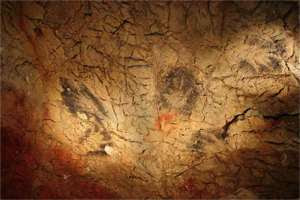
Handprints, Gargas Cave, France,
Paleolithic. Public domain.
It is
relatively easy to see how handprints with one to five fingers fully extended
or folded/missing could be intended as a count of one to five (https://rockartblog.blogspot.com, May 6, 2017). But what about
handprints with one or more fingers only partially represented? We have five fingers
on each hand so for counting with a base ten (a decimal system) our hands are
ideal, but what about other systems of enumeration such as counting to a base
twelve? Many human cultures have used base twelve numeration (duodecimal)
systems throughout history. Their influences have given us dozen count
quantities, 12 and 24 hour clocks, 12 inches in a foot, 12 signs in the zodiac
and 12 months in a year. (Wikipedia)
Duodecimal hand counting
diagram, from Everett, 2017.
Hand-counting
in a duodecimal system is facilitated by the fact that the four fingers have
three finger bones each (phalanges) and these can be counted with the thumb of
each hand. With this system you can designate a quantity of twelve on each
hand, or up to twenty-four total with both hands. This leads to the proposition that the paleolithic handprints with missing portions of fingers represent numbers in a duodecimal (base twelve) counting system.
In his fascinating book Numbers and the Making of Us: Counting and the Course of Human Cultures, Caleb Everett (2017) explains this, and more in detail, how counting led to civilization and vice versa. So, is this the explanation for the handprints with missing fingers? I do not know but it is possible, what do you think?
NOTE: The illustrations labelled public domain were retrieved from the internet with a search that included the phrase public domain. If any of these are not intended to be public domain I apologize. Please inform me and I will give proper credit or take them down.
REFERENCES:
Everett,
Caleb,
2017 Numbers
and the Making of Us: Counting and the Course of Human Cultures, Harvard
University Press, Cambridge, Mass.
Wikipedia
Labels:
cave art,
counting,
duodecimal,
hand print,
Maltravieso Cave,
paleolithic,
rock art,
Spain,
tally
Saturday, May 13, 2017
INCOMPLETE HAND PRINTS MAY RECORD TALLIES OR COUNTS:
Count or tally of four? Hand
Print with missing little finger.
Maltravieso Cave, Spain.
Public Domain.
For quite
some time there has been discussion on the question of handprints in
Palaeolithic cave art with missing digits. Originally proposed as evidence of
Ice Age artists losing digits to frostbite or accidents, or alternatively
digits that were cut off as sacrifices in a ceremonial context, they have been
more recently been proposed as evidence of tallies, or numerical records.
Count or tally of four? Hand
Print with missing little finger.
Maltravieso Cave, Spain.
Public Domain.
"Perhaps the most mysterious aspect of Palaeolithic hand stencils
is that on many examples one or more fingers are missing. Early theories saw
this as reflecting fingers that really were missing from their subject’s hands,
either through frostbite, accidents during flintkapping, or through ritual
mutilation. The former have been rejected: these societies were certainly
tailoring sophisticated clothing in order to survive the harsh Ice Age climate
and mittens would not be beyond their technological ken, and no flintkapper,
however unskilled, would sever an entire finger. Deliberate mutilation, perhaps
as part of the rituals that accompanied a rite of passage or as punishment,
remains a possibility. In many cases, however, two, three or four fingers are
missing from stencils, and the deliberate removal of this number – which would
render the hand useless – would be suicidal to small-scale hunter societies in
such hostile environments. It seems far more probable that such stencils with
attenuated fingers resulted from the deliberate bending back of fingers, which
have been created experimentally. In some cases too, little fingers seem to
have been deliberately painted over, adding strength to this observation. In
such cases unskilled work results in the blurring of finger outlines, although
most Palaeolithic examples are sharp, suggesting perhaps a degree of artistic
familiarity and resulting skill." (Pike, date unknown)
Hand with extended digits
representing a count of five.
publicdomainpictures.net.
Four in a decimal
counting system.
counting system.
It is relatively easy to see how hand prints with one to five fingers fully extended or folded/missing could be intended as a count of one to five. Examples of this are found in the Paleolithic cave art of Europe (as seen in the examples illustrated). But, what about hand prints that illustrate partial fingers, say three and a half fingers plus the thumb. If we say that the fingers portray a count or tally, does the half finger portray a fraction? While I cannot know for certain, I must confess that I do not feel wholly comfortable stating that the Paleolithic artist/mathematician is portraying a fraction. If I am to take this proposition seriously I need another explanation for the partial finger. Luckily there is another possibility that answers this question without the need to propose fractions - a duodecimal counting system (base 12). I will write about this possibility next week.
NOTE: Illustrations used in this posting were obtained from an internet search for public domain pictures. If any of these pictures are not public domain and were used mistakenly please inform me and I will give proper photo credit of remove the photo.
REFERENCES:
Everett,
Caleb,
2017 Numbers
and the Making of Us: Counting and the Course of Human Cultures, Harvard
University Press, Cambridge, Mass.
Pike, A.W. G., et al,
Date unknown, Stencils in Upper Palaeolithic Cave Art, Dept. of Archaeology, Durham University, Durham, UK, https://www.dur.ac.uk/archaeology/research/projects/all/?mode=project&id=640
Labels:
cave art,
counting,
hand print,
Maltravieso Cave,
paleolithic,
rock art,
Spain,
tally
Subscribe to:
Posts (Atom)