Showing posts with label reindeer. Show all posts

Saturday, August 5, 2023

REINDEER HERD MIGRATION PORTRAYED IN NORWEGIAN ROCK ART:

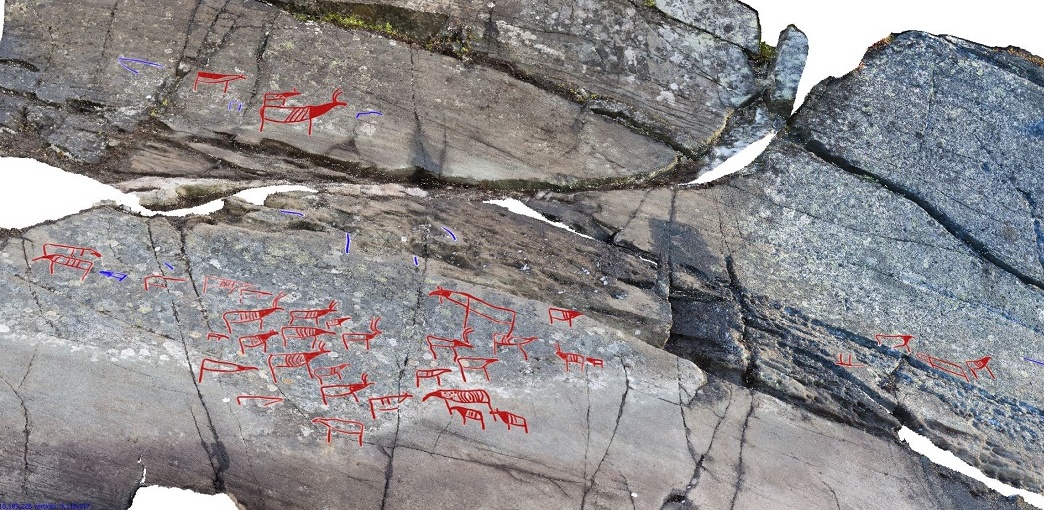
Migrating reindeer closeup, Gamnes, Norway. Photograph Jan Magne Gjerde, Tromsø Museum - The University Museum.

A report about a rock art site in Norway caught my attention recently. It is a petroglyph of a herd of reindeer. Now there is nothing unusual about a bundh of reindeer in petroglyphs in Scandinavia, this is a common theme, but they are usually portrayed with a number of other subjects as well. This panel shows a number of reindeer with a few moose as well. The unique thing about them is that they are almost all facing the same way as if the herd is on the move.

Migrating reindeer panel, Gamnes, Norway. Photograph Erik Kjellman, Tromsø Museum - The University Museum. 

Central portion of the panel enlarged. Photograph Erik Kjellman, Tromsø Museum - The University Museum. 

“Six to seven thousand years ago, the road system in Norway was essentially non-existent. That meant Stone Age residents mainly used waterways as they moved from place to place, especially on the hunt.

One area called Gamnes, located between the outlet of a river and the mouth of a fjord that opens onto the Barents Sea, is particularly rich with rock art. There are petroglyphs of reindeer and moose, in herds and alone, with and without young animals.” (Kvittingen 2016)


“In general, animals depicted in rock carvings are shown moving in all different directions. But in Gamnes, most of the reindeer have been drawn with their muzzles pointed in the same way. ‘The reindeer are following the fjord inland. This may mean that the artist was trying to depict a migration route,’ says Anja Roth Niemi, who is project manager for archaeological excavations for the University Museum in Tromsø, UiT – The Arctic University of Norway.” (Kvittingen 2016)

The map shows an estimate of where the sea level was when the petroglyphs were carved about 7,000 years ago. Under this scenario, the petroglyphs were right at sea level and were easily visible to those who paddled past. Image by Erik Kjellman, Tromsø Museum - The University Museum. The red dot at waterline shows the position of the petroglyph panel.

“These rock carvings are the only ones of their kind from the Stone Age in East Finnmark. The drawings were found last summer, and probably date from 5200-4200 BC. So far, scientists have tallied 48 figures, some of them incomplete, but they expect even more will become apparent when the lichen that covers the rock is removed.” (Kvittingen 2016)

Swimming reindeer crossing a river in Siberia. Internet photograph, public domain.

”The selection of subjects is not that varied, which is unusual. Petroglyphs from the same period in Alta, also in northern Norway, depict boats, bear, fish and hunting scenes. Here there are only reindeer and moose. Why would Stone Age people draw only these animals here?” (Kvittingen 2016)

One possibility is that the images represent a group of reindeer that have just emerged from the water. Reindeer are accomplished swimmers who cross bodies of water routinely. I would suggest that since this location is essentially surrounded on three sides by water it is likely that the reindeer shown all facing the same way are indeed migrating, but that they have just left the water and are heading inland. BTW – moose are good swimmers too.

NOTE: Some images in this posting were retrieved from the internet with a search for public domain photographs. If any of these images are not intended to be public domain, I apologize, and will happily provide the picture credits if the owner will contact me with them. For further information on these reports you should read the original report at the site listed below.

REFERENCE:

Kvittingen, Ida, translated by Nancy Bazilchuk, 2016, Stone Age artists used rock art as a billboard, 16 April 2016, https://sciencenorway.no/. Accessed online 5 July 2023.

Saturday, April 25, 2020

ANTLERS IN CAVE ART - MEGALOCEROS OR REINDEER:


Caribou, Wikipedia.
Public domain.

Large numbers of cave images in the painted caves of France show hoofed animals with antlers, and a large number of these are identified as European reindeer (Rangifer tarandus) or caribou (the North American version of the species). These Reindeer and caribou are of the same species, but their subspecies have slightly different characteristics, and these subspecies tend to be found in different geographical locations. Examining a number of pictures of reindeer and caribou we can see differences in the antlers. North American caribou often have palmate antlers while reindeer tend to have antlers with tines along the main beam. I believe that it is this difference that has led to mislabeling of some of the creatures illustrated in European cave art.


Megaloceros, Internet photo.
Public domain.

"Megaloceros is an extinct genus of deer whose members lived throughout Eurasia from the early Pleistocene to the beginnings of the Holocene and were important herbivores during the Ice Ages. The largest species, Megaloceros giganteus, vernacularly known as the "Irish elk" or "Giant elk" is also the best known. Most members of the genus were extremely large animals that favoured meadows or open woodlands. they are the most cursorial deer known, with most species averaging slightly below 2 metres (6ft 7in) at the withers. Despite its name, the Irish elk was neither restricted to Ireland now closely related to either species commonly referred to as elk (Alces alces in British English and other European languages; Cervus canadensis in north American English) but instead is closely related to the fallow deer genus Dama." (Wikipedia)


Megaloceros, Chauvet
Cave, France. Internet
photos. Public domain.

"Cave art from early humans depicts Megaloceros as having a dark coat of fur with a white underside, quite similar to other deer today. The art also shows Megaloceros to have had a small hump above its shoulders which has been interpreted as being for the storage of body fat for survival in lean times. The presence of a hump is supported by observation of the forward dorsal vertebrae on Megaloceros which have enlarged neural spines (bony projections that point up from the vertebrae) that would have granted structured support for a hump."  (prehistoric-wildlife.com)
Megaloceros, Grotte de la Greze, France.
Internet photo, Public domain.


Megaloceros, Cougnac, France.
The Neanderthal Museum,
Mettman, Germany.
(Note the hump on left animal
and antlers on the right animal.)

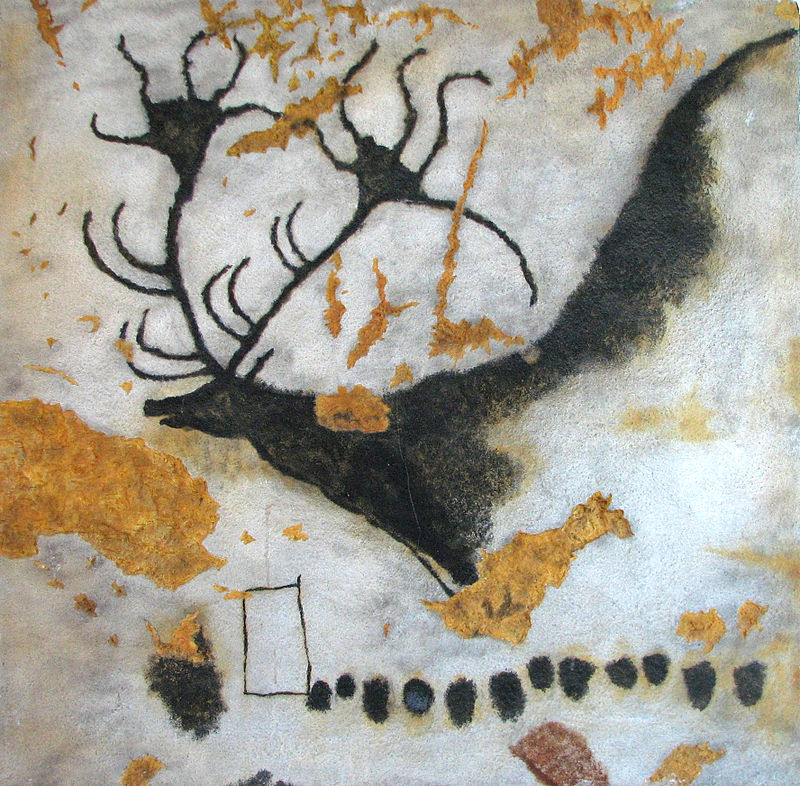
Curiously enough, most Paleolithic parietal portrayals of Megaloceros, while readily identifiable by this hump, seem to lack the gigantic antlers of the adult male. This suggests that they are either meant to picture female animals or males during the season when the antlers have dropped off and not yet re-grown. Modern deer shed their antlers in the first quarter of the year, between January and April, so if these images are meant to picture Megaloceros males it may indicate that time of year. When the antlers of a Megaloceros are pictured they are large palmate antlers reminiscent of the antlers of our North American moose.


Reindeer, Chauvet Cave, France.


Reindeer, Chauvet Cave, France.

Reindeer, on the other hand, are frequently pictured in cave art, perhaps because in many instances they were the most important food animal for the people who lived there. Their remains are often the most common bones found in excavations in those locales.


Reindeer, Lascaux Cave, France.
Internet photo, Public domain.


Reindeer, Lascaux Cave, France.
Internet photo, Public domain.

Reindeer (Rangifer tarandus) are European members of the caribou deer family. "In the largest subspecies, the antlers of large males can range up to 100 cm. (39 in) in width and 135 cm (53 in) in beam length. They have the largest antlers relative to body size among living deer species. The prominent, palmate brow tines extend forward, over the face. The antlers typically have two separate groups of points, lower and upper." (Wikipedia) As to whether reindeer antlers are palmate or not there is considerable variation, but, in general, reindeer seem to lack this trait (except for the brow tines) while caribou antlers can be quite palmate. A black painting of a reindeer in Lascaux Cave shows the upper antlers to be slightly palmate, but certainly not to the extent of a Megaloceros, while a red reindeer from Lascaux lacks that trait. Reindeer images from Chauvet Cave, however, seem to lack the palmate antlers altogether.

So, with careful attention to the presence or absence of a hump, the presence or absence of a brow tine on antlers, and the degree to which the antlers are shown as palmate, we should be able to confidently identify which members of the deer species are being depicted, the Megaloceros (Megaloceros giganteus), or the Reindeer (Rangifer tarandus).

NOTE: Some images in this posting were retrieved from the internet with a search for public domain photographs. If any of these images are not intended to be public domain, I apologize, and will happily provide the picture credits if the owner will contact me with them. For further information on these reports you should read the original reports at the sites listed below.

REFERENCES:

http://www.prehistoric-wildlife.com/species/m/megaloceros.html

https://en.wikipedia.org/wiki/Megaloceros

https://en.wikipedia.org/wiki/Reindeer

Saturday, September 8, 2018

THE DRINKING REINDEER OF LES COMBARELLES:


View of Drinking Reindeer in Les Combarelles,
donsmaps.com, public domain.

I LOVE this one. Carved into the grotto of Les Combarelles, in Les Eyzies de Tayac, Dordogne, France. It was officially discovered by pre-historians Denis Peyrony, Abbe Breull, and Louis Capitan in September, 1901 (although it had been used as a stable by local peasants for years).(Wikipedia) The engraved "Drinking Reindeer" reaches and delicately extends his tongue to lap at water that once seeped from a crack in the wall of the cave.

Drawing of Drinking Reindeer,
Les Combarelles. Peter Faris.

"The long corridor of Les Combarelles extends for 240 m (790 ft) into the heart of the rock - with most of the art only appearing more than 160 m (525 ft) from the entrance - and 14,000 to 12,000 years ago during the late Magdalenian times much of it would have been accessed on hands and knees, or lying flat along the narrowest sections (today the floor level has been deepened, enlarging the height from floor to ceiling to allow easier access for tourists). Although some of the artworks can be clearly seen, such as the reindeer with lowered head drinking water that once emanated from a crack in the rock, the only way of finding much of the more than 600 artworks would have been to carefully look on the walls, oil lamp in hand, one person at a time and face almost pressed against the rock in the narrow space." (David 2017: 181-2)


Drinking Reindeer in Les Combarelles
donsmaps.com, public domain.

Students of rock art love to identify examples of incorporation of natural features into the images, has another example of incorporation ever been so beautifully done? If the measure of art is the emotional response it elicits from the viewer, this is great art - primitive man, who's kidding who?

NOTE: Some images in this posting were retrieved from the internet with a search for public domain photographs. If any of these images are not intended to be public domain, I apologize, and will happily provide the picture credits if the owner will contact me with them. For further information on these reports you should read the originals at the sites listed below.


REFERENCE:

David, Bruno
2017 Cave Art, Thames and Hudson, London.

Hitchcock, Don
2015 Combarelles, http://www.donsmaps.com/combarelles.html

Wikipedia

Saturday, March 15, 2014

ACCURACY IN RECORDING DETAILS IN ROCK ART


Reindeer in Lascaux.

It has long been held that in prehistoric rock art there is no “art for art’s sake,” meaning that art was created for a reason other than purely decorative or aesthetic. Whether or not that is always true is a subject for another time, but there is one implication of this that I want to discuss. It is that if the art is for another reason than “art’s sake” it is probably not done subject to the same motives that drive a modern artist, particularly a desire to maximize the impact of the image by adjusting elements to attract attention and focus. In other words I, as the artist, attempt to control my image to elicit the most emotional effect from the viewer. This does not always provide an entirely realistic record as I make adjustments to the reality that I see to create the effects I desire. If this is not the motive of the prehistoric artist then we might suspect that in many ways their imagery is actually more realistic or accurate in detail than my modern counterpart would be.


Aurochs from Lascaux with raised right front foot.

This was indeed the conclusion found in a 2009 study by Gabor Horvath, a researcher from Eotvos University in Hungary, reported on LiveScience by Stephanie Pappas. They found that "cavemen, or people living during the upper Paleolithic period between 10,000 and 50,000 years ago, were more accurate in their depictions of four-legged animals walking than artists are today. While modern artists portray these animals walking incorrectly 57.9 percent of the time, prehistoric cave painters only made mistakes 46.2 percent of the time.” (Pappas 2012)

“Observing carefully, scientists found that “four-legged animals walk by moving their legs in the same sequence. First, the left-hind foot hits the ground, then the left-front foot, followed by the right hind-foot and finally the right front-foot. Only the speed at which four-legged animals complete this sequence differs. But this simple gait often escapes the notice of artists.” (Pappas 2012)

Gabor and his researchers, “found that 63.6 percent of the animals depicted in anatomy textbooks were drawn in impossible gaits. Half of toy horses, lions, tigers, and other quadrupeds were also wrong. Even depictions in natural history museums failed much of the time: Just over 41 percent of those showed errors.” (Pappas 2012)

Then, “Horvath and his colleagues wanted to look at the same question over the history of art. In the 1880s, photographer Edward Muybridge used motion pictures to show how horses and other quadrupeds really walked. This knowledge spread, so Horvath and his colleagues split their analysis into three time periods: prehistoric art, historical art made before Muybridge's work, and art made after 1887, when Muybridge's work would have been public.” (Pappas 2012)


A. Horse by Leonardo da Vinci, B. Outline of Leonardo's horse,
C. One option for correcting Leonardo's horse, D. Another 
option for correcting Leonardo's horse.

“The researchers plucked 1,000 examples of art from online collections, fine art books and Hungarian museums as well as on stamps and coins. Chance alone would dictate that artists mess up depictions of four-legged gait 73.3 percent of the time, researchers calculated. But art produced after prehistory but before Muybridge showed more errors than chance would allow. In fact, 83.5 percent of depictions from this time period were wrong. The erroneous drawings even included one sketch of a horse by Leonardo da Vinci, known for his anatomical sketches. In the sketch, the horse has its right-hind foot and left-front foot down with its other two feet lifted, and in an unstable position. In fact, four-legged animals keep three legs on the ground at any given time. It’s possible that the high level of pre-Muybridge errors may reflect artists mimicking their peers un-anatomical work, the researchers wrote. But Paleolithic man seems to have been a keen observer of four-footed fauna. Cave art got its depictions right about 54 percent of the time, far better than chance.” (Pappas 2012)

In other words, according to Horvath, in Leonardo’s drawing (A) only one foot should be lifted from the ground. Either the left-hind foot (C) or the right-front foot (D), not both (B). Now we have to be careful to point out that these facts refer to walking animals; trotting, galloping, or running is a different situation entirely, but we can generally tell from a depiction whether the animal pictured is meant to be walking or running. These situations can be illustrated with any of a number of animal paintings from Lascaux cave in France.


Lascaux horse showing foreshortening
in the positions of the feet.

There is, however, another factor which Horvath apparently overlooked (or at least I did not find it addressed in the reports about his study) - foreshortening. Because of perspective if we look at an animal standing on its four legs and our eye level is above the ground, the two farther legs appear to end higher up than the nearer ones, in other words an object farther away will simply look smaller. This is foreshortening. In many of the Lascaux painted animals illustrated we can imagine a ground plane in which a foot that is drawn higher on the rock would actually be portraying a situation where the foot is solidly implanted on the ground but demonstrating foreshortening. This can be seen as a possibility in many of the animals portrayed in Lascaux and other caves, as well as in more recent examples of art, and if Horvath and his team did not take it into account their results could be incomplete. In other words, more of the animals in Paleolithic cave paintings would be standing in correct stances than Horvath recorded.

Otherwise, the art done by artists in our western cultural heritage is often wrong in anatomical details that Paleolithic artist more often got correct. This analysis can be seen as backing up the supposition that there is no “art for art’s sake” in rock art as they were supposedly not making alterations to enhance the drama or beauty of their images.

REFERENCES:

Pappas, Stephanie, Senior writer,
2012    Cavemen Trump Modern Artists at Drawing Animals,
           LiveScience12/5/2012.