Showing posts with label Sulawesi. Show all posts

Saturday, February 14, 2026

A NEW CANDIDATE FOR THE OLDEST ROCK ART - A 67,000+ YEAR OLD HANDPRINT:


Researcher Maxime Aubert  in a limestone cave called Liang Metanduno on Muna. Photograph Ahdi Agus Oktaviana, 21 January 2026.

Almost a year ago I published a column on RockArtBlog on what was claimed to be the oldest rock art discovered so far, a 66,000+ year old hand print in Maltrivieso Cave in Spain (Faris 2025). Now, a new candidate has emerged from a cave on the Indonesian island of Muna, a handprint dated at 67,800+ years of age.

The islands in the Indonesian archipelago were on the transit route for the early humans who ended up in Australia. Some of these people would have settled locally in their tropical paradise, and this was very early indeed in the chronicles of human migration. “In an Indonesian cave system known for its prehistoric art, the oldest cave art yet found was hiding in plain sight. In a cave full of paintings that were well studied over the years, a faint hand stencil on the ceiling had been overlooked. – A nearby stencil dated to about 60,900 years ago.” (Callaway 2026)

Overlooked because of its location and being faded. It will be very interesting to see what future results of these studies will produce. There may be much more to learn there.

The faint handprint between two other images. Image from Griffith University.

Having found this overlooked handprint, their next step was to date it. “The oldest minimum-age constraint we obtained is for a hand stencil (sample LMET2) from Liang Metanduno in Muna Island. This motif is partly covered by ancient coralloid speleothems. This stencil is in a poor state of preservation, comprising only a 14×10cm patch of faded pigment bearing a portion of the fingers and the adjoining palm area. The tip of one finger appears to have been artificially narrowed, either through the additional application of pigment or by moving the hand during pigment application, a distinct type of hand stencil art thus far identified only in Sulawesi. Dating results show that this stencil was produced at least 67.8 thousand years ago (ka) (71.6±3.8ka).” (Oktavian et al. 2026) This dating was apparently made with uranium/thorium dating of rock deposited over the surface of the handprint. This means that the higher figure of 71.6 thousand years could, in fact, be close to the accurate date.

Close-up of the handprint. Image from Griffith University.

In ages of lowered sea levels the Indonesian archipelago could have been transited on foot, and at times of higher sea level early rafts or boats would suffice for population movement. “It’s not yet clear whose hands made the prints. They could be from an ancient human group called Denisomans who lived in the area and may have interacted with our Homo sapiens ancestors before eventually going extinct. Or they may belong to modern humans venturing away from Africa, who could have wandered through the Middle East and Australia around this time. Fine details on the cave art, including the intentionally modified fingertips, point to a human hand.” (Ramakrishnan 2026) While we are pretty sure that early humans were here because of their early arrival in Australia, we cannot know for certain that Homo sapiens made these prints. As Ramakrishnan states it is possible that Denisovans also could have been in that area although there is not yet any corroborating data for that. We must remember that “absence of evidence is not evidence of absence” (although this quote is usually attributed to Carl Sagan its first uses can be traced back to the 1890s).

Additional examples of handprints with narrowed fingers. Image by Maxime Aubert.

This narrowing of the fingertip is very interesting. “Consistent with a style that has, so far, only been found on Sulawesi, the hand is depicted with pointy, clawlike fingers. Researchers believe the style might serve to emphasize the close connection between humans and animals, which is “something we already seem to see in the very early painted art of Sulawesi, with at least one instance of a scene portraying figures that we interpret as representations of part-human, part-animal beings,’ said study co-author Adam Brumm of Griffith University in a statement.” (Callaway 2026) I am assuming that this part-human, part-animal interpretation is seeing the narrowed fingertips as portrayals of hands with claws. This is something that I have to take with a grain of salt. While therianthropic figures mixing human and animal traits are common in rock art the world over a picture of a handprint with narrow fingers does not strike me as related.


REFERENCES:

Callaway, K.R., 2026, Oldest cave art ever found discovered in Indonesia, www.scientificamerican.com. Accessed online 21 January 2026.

Faris, Peter, 2025, A newer candidate for the oldest rock art – a 66,000+ year old hand print, 18 January 2025, RockArtBlog, https://www.blogger.com/blog/post/edit/7760124847746733855/3761715241354171606

Oktavian ,Adhi Agus et al., 2026, Rock art from at least 67,800 years ago in Sulawesi, Nature online, https://doi.org/10.1038/s41586-025-09968-y.

Ramakrishnan, Adithi, 2026, Indonesian handprints are the oldest cave art found yet, 21 January 2026, Associated Press. Accessed online 2 February 2026.

Saturday, October 9, 2021

SULAWESI'S BADA VALLEY MEGALITHS:


Lore Linda megaliths, Bada Valley, Sulawesi, Indonesia. Online photograph, public domain.


Lore Linda megaliths, Bada Valley, Sulawesi, Indonesia. Online photograph, public domain.

Earlier this year I posted two columns on the rock art of the island of Sulawesi (Faris 2021), one of the islands of Indonesia. One pictograph in a cave on Sulawesi is currently the oldest dated painted zoomorph known, dated to 45,500 BCE. Less widely advertised is a large collection of megalithic stone carvings in Lore Lindu National Park, a 2,180 km2 reserve in the province of Central Sulawesi. “There are over 400 granite megaliths in the area, of which about 30 represent human forms. They vary in size from a few centimeters to 4.5 meters. The original purpose of the megaliths is unknown. Other megaliths are in form of large pots (Kalamba) and stone plates (Tutu’na). Various archaeological studies have dated the carvings from between 3000 BC to 1300 AD.” (Indonesia-tourism.com)


Lore Linda megaliths, Bada Valley, Sulawesi, Indonesia. Online photograph, public domain.

Sulawesi, also known as Celebes, is one of the four Greater Sunda islands and was first inhabited during prehistory when the island almost certainly formed part of the land bridge used for the settlement of Australia and New Guinea by at least 40,000 BC. A majority of the present-day inhabitants descend from the Buginese or Bugis people, which are an ethnic group that migrated around 2000 BC to the area around Lake Tempe, and Lake Sidenreng, in the Walannae Depression in the southwest peninsula of Sulawesi.” (Heritage Daily 2021)


Lore Linda megaliths, Bada Valley, Sulawesi, Indonesia. Online photograph, public domain.
 
Varying styles in the presentation of the anthropomorphs and in details of their carving attest to more than one episode of carving.

“According to an inventory conducted by megalith enthusiasts of the Sagarmatha Faculty of Agriculture in 1994, there are over 300 (over 400 are now known) megalithic sites around the Lore Lindu National Park. Objects exist in the form of statues, large pots or vats, and stone mortars. Unfortunately, many of these ancient relics have been smuggled out of the area, sold and traded.” (Rosario 2020)

As is so common to we humans many of the carvings have been given names by the people.


Palindo megalith, Bada Valley, Sulawesi, Indonesia. Online photograph, public domain.


Palindo megalith in 1930s with Dutch tourists, Bada Valley, Sulawesi, Indonesia. Online photograph, public domain.

Palindo (The Entertainer) – “This (is) the largest statue in the area standing 440 cm from the ground. It is suggested that the Palindo is related to death, because his round face and large eyes face west. According to Toraja culture, a region in south Sulawesi, west is the direction of death. This theory holds some credibility based on the fact that the Toraja and Bada people share linguistic and cultural similarities. For example, both the Bada and Taraja sacrifice a buffalo for the deceased during funeral ceremonies. Another local legend talls of an ancient King of Luwu, who in order to prove his dominance, once ordered 1,800 of his subjects to move the statue from its location in the village of Sepe to Palopo, a long way south. The efforts failed, but as an insult to the abusive king, the people turned the once south-facing statue to the west. When the king’s followers tried to turn it back, it fell to its side, where it rests till today.” (Rosario 2020)


Maturu megalith, Bada Valley, Sulawesi, Indonesia. Online photograph, public domain.

Maturu (Sleeper) – “Measuring 3.8 meters, Maturu looks very much like a horizontal Palindo, but with very faded features. It was referred to by explorers from the early 1900s as ‘the statue that lies on its back.’” (Rosario 2020)


Kalamba megalith, Bada Valley, Sulawesi, Indonesia. Online photograph, public domain.

Kalamba (Large pots) – “Just up the path from Maturu, are vast stone cisterns, which are dotted across the valley. The Kalamba may have been used as baths or burial chambers for nobles and those of high status.” (Rosario 2020)


Oba megalith, Bada Valley, Sulawesi, Indonesia. Online photograph, public domain.

Oba (Monkey) – “This small fellow sits in the midst of a paddy field. It is a small statue, just barely over 40 cm from the ground. As its name suggests, this figure has amusingly monkey-like features.” (Rosario 2020)

All in all Sulawesi presents us with a number of new chinks in the armor of the old Euro-centric colonial assumptions on the development and advancement of human culture and force a serious and comprehensive re-appraisal of the role of Southeast Asia.

NOTE: Some images in this posting were retrieved from the internet with a search for public domain photographs. If any of these images are not intended to be public domain, I apologize, and will happily provide the picture credits if the owner will contact me with them. For further information on these reports you should read the original reports at the sites listed below.

REFERENCES:       

Central Sulawesi, indonesia-tourism.com, accessed in September 2021.

Faris, Peter, 2021, The Effects of Climate Change on the Pleistocene Rock Art of Sulawesi, 5 June 2021, https://rockartblog.blogspot.com

Faris, Peter, 2021, A New Candidate for the Oldest Pictograph – the Sulawesi Pig, 13, February 2021, https://rockartblog.blogspot.com

Heritage Daily, 2021, The Lore Lindu Megaliths, https://www.heritagedaily.com.

Rosario, Flame, 2020, Lore Lindu & the Mystifying Megaliths of Bada Valley, https://www.cryptoanthropologist.com

Saturday, June 5, 2021

THE EFFECTS OF CLIMATE CHANGE ON THE PLEISTOCENE ROCK ART OF SULAWESI:


Warty pig pictograph, 45,000 year old painting, Leang-Tedongnge cave, Sulawesi, Indonesia. Internet photo, public domain.

It has only been a few months since the reports of the oldest known pictographs were reported in Sulawesi. As I wrote in my February 13 posting of this year (see below) “Rock art researchers in Indonesia have announced the discovery of another candidate for the oldest representative rock art image, a picture of a Sulawesi Warty Pig found in a cave on the island of Sulawesi. ‘The warty pig from Leang Tedongnge cave dates to at least 45,599 years ago, making it the earliest known representational work of art in the world. (Sci-News 2021) Leang Tedongnge cave: The cave is located at the foot of a limestone karst hill. – (The) rock art panel is located on a ledge toward the rear of the cave and features at least three large figurative paintings of pigs.’” (Faris 2021)

Here, we have hardly had time to appreciate the extreme estimated age of these wonderful images, when we are told that they are deteriorating, threatened by climate change. A new report from Sulawesi by Huntley, J., Aubert, M., Oktaviana, A.A. et al. explains that – “The equatorial tropics house some of the earliest rock art yet known, and it is weathering at an alarming rate. Here we present evidence for haloclasty (salt crystallization) from Pleistocene-aged rock art panels at 11 sites in the Maros-Pangkep limestone karsts of southern Sulawesi. We show how quickly rock art panels have degraded in recent decades, contending that climate-catalysed salt efflorescence is responsible for increasing exfoliation of the limestone cave surfaces that house the ~ 45 to 20-thousand-year-old paintings. These artworks are located in the world’s most atmospherically dynamic region, the Australasian monsoon domain. The rising frequency of El NiƱo-induced droughts from anthropogenic climate change (that is, higher ambient temperatures and more consecutive dry days), combined with seasonal moisture injected via monsoonal rains retained as standing water in rice fields and aquaculture ponds of the region, increasingly provide ideal conditions for evaporation and haloclasty, accelerating rock art deterioration.” (Huntley, J., Aubert, M., Oktaviana, A.A. et al. 2021:1)

“In almost all sites containing early art, the hand stencils and figurative motifs are heavily affected by exfoliation of the limestone cave wall/ceiling surfaces that comprise the artists’ ‘canvas’. The deposition of solutes (chiefly irons, silicones, and calcium carbonates) from the bedrock and surrounding environment concentrate and oxidise at the limestone’s surface, blocking pores to form a mineralized rind – a process known as case-hardening. The case-hardened surfaces of the Maros-Pangkep caves, co-created by biofilms including plentiful microbial mats, regulate water penetration on limestone surfaces, preventing rapid moisture uptake. While case-hardening makes the surface layer more resistant to weathering, the sub-surface zone immediately underneath is weakened by loss of cement matrices, the void spaces becoming susceptible to the accumulation of evaporites such as geological salts, especially where the outer crust has been breached.” (Huntley, J., Aubert, M., Oktaviana, A.A. et al. 2021:2)


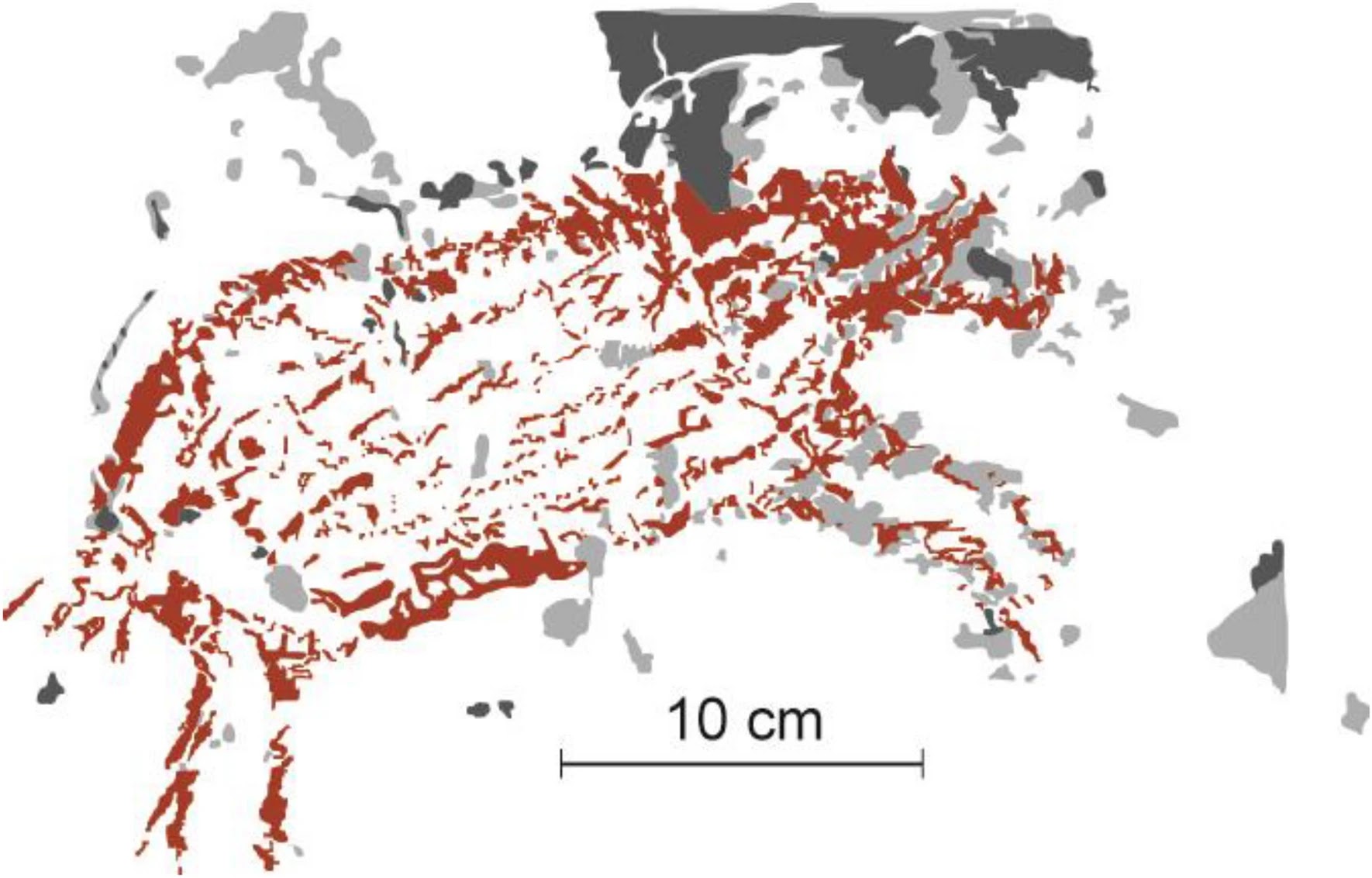
This illustration from the report shows the extent of the problem. “Rate of salt-induced exfoliation affecting a figurative painting of a suid. This rock art motif is located at Leang Pattae, a limestone cave open to the public at Taman Prasejarah Leang-Leang, Maros-Pangkep. The artwork is undated but it was executed in the same artistic style used to depict animals during the Late Pleistocene rock art phase. Dark grey shading highlights the exfoliated areas documented in 1950. The light grey highlights exfoliated areas documented in 2013.” (Huntley, J., Aubert, M., Oktaviana, A.A. et al. 2021:4)

Here, in the western United States, rock exfoliation caused by alkali salts is well known, but it is really a shame that the destruction of the oldest rock art currently known in the world is being degraded by a natural process, prompted by human-driven climate change.

NOTE: An image in this posting was retrieved from the internet with a search for public domain photographs. If this image is not intended to be public domain, I apologize, and will happily provide the picture credits if the owner will contact me with them. For further information on these reports you should read the original reports at the sites listed below.


REFERENCES:

Faris, Peter, 2021, A New Candidate for the Oldest Pictograph – The Sulawesi Pig, February 13, 2021, https://rockartblog.blogspot.com

Huntley, J., Aubert, M., Oktaviana, A.A. et al.2021, The Effects of Climate Change on the Pleistocene Rock Art of Sulawesi, Science Reports 11, 9833 (2021), https://doi.org/10.1038/s41598-921987923-3

Sci-News Staff, 2021, 45,000-Year-Old Sulawesi Warty Pig Painting Found in Indonesian Cave, January 14, 2021, http://www.sci-news.com/archaeology/sulawesi-warty-pig-paintings-09250.html


Saturday, February 13, 2021

A NEW CANDIDATE FOR THE OLDEST PICTOGRAPH - THE SULAWESI PIG:

45,500 year old pictograph of Sulawesi warty pig, Leang-Tedongnge Cave, Sulawesi, Indonesia. Internet photo, Public Domain.

Rock art researchers in Indonesia have announced the discovery of another candidate for the oldest representative rock art image, a picture of a Sulawesi Warty Pig found in a cave on the island of Sulawesi. “The warty pig from Leang Tedongnge cave dates to at least 45,500 years ago, making it the earliest known representational work of art in the world.” (Sci-News 2021)

“Leang Tedongnge cave: The cave is located at the foot of a limestone karst hill. - (The) rock art panel is located on a ledge toward the rear of the cave and features at least three large figurative paintings of pigs.” (Brumm 2021)


Sulawesi warty pig. Wikipedia.

“The Celebes warty pig (Sus celebensis), also called Sulawesi warty pig or Sulawesi pig, is a species in the pig genus (Sus) that lives on Sulawesi in Indonesia. It survives in most habitats and can live in altitudes of up to 2,500 m (8,000 ft). It has been domesticated and introduced to a number of other islands in Indonesia.

The Celebes warty pig is a medium-sized pig, and quite variable in size and appearance. It is the only pig species that has been domesticated apart from the wild boar; being semi-domesticated may have had an influence on the variability of its appearance. This pig has a head-and-body length of between 80 and 130 cm (30 and 50 in) and a long tail, with males generally being larger than the females. The back is rounded and the legs short. The colour is greyish-black, sometimes tinged with red or yellow on the flanks. There are three pairs of facial warts and a fringe of pale bristles on the snout and more bristles on the cheeks.” (Wikipedia)


     32,000 year old pictograph of Sulawesi warty pig, Leang-Balagajia 1 Cave, Sulawesi,           Indonesia. Photograph Sci-News.

Another large warty pig painting was found in the nearby cave of Leang Balagajia 1. “The result of Uranium-series dating provided respective minimum ages of 45,500 and 32,000 years for the Sulawesi warty pig images at Leang Tedongnge and Leang Balagajia 1.” (Sci-News 2021)


40,000-year-old Banteng, Borneo. Internet photo, Public Domain.

A previous candidate for oldest representative pictograph was from the island of Borneo. The island of Borneo is separated from Sulawesi by a little over 100 miles of water in the Makassar Strait. A limestone cave in eastern Borneo contained a red painted figure of a wild cow known as a Banteng (Bos javanicus) that was dated by uranium-thorium dating of a calcium carbonate layer at 40,000 ybp. This displaced another figure from Sulawesi as the oldest previously known representative pictograph. “Previously, the oldest known animal painting in the world was an approximately 35,400-year-old babirusa, or ‘pig-deer,’ on the Indonesian island of Sulawesi.” (Faris 2018)

Then we were notified of another find on Sulawesi in a cave named Liang Bulu’Sipong 4.


43,900 year old Anoa pictograph, Sulawesi, Indonesia. Photograph arstechnica.com.

“Across a 4.5 meter (14.8 foot) section of rock wall, 3 meters (9.8 feet) above the floor of a hard-to-reach upper chamber of a site called Liang Bulu’Sipong4, wild pigs and dwarf buffalo called anoa face off against a group of strangely tiny hunters in monochrome dark red. A dark red hand stencil adorns the left end of the mural, almost like an ancient artist’s signature.

Lieng Bulu’Sipong 4 is a living cave, still being reshaped by flowing water, and layers of rock have begun to grow over the painting in spots. The minerals that form those layers included small traces of uranium, which over time decays into thorium-230. Unlike the uranium, the thorium isn’t water-soluble and can only get into the rock via decay. By measuring the ratio of uranium-234  to thorium-230 in the rock, archaeologists can tell how recently the rock layer formed.

The deposits have been slowly growing over the hunting mural for at least 43,900 years, which means the painting itself my be even older than that.” (Smith 2019)

So, we have a range of painted animals from roughly the same region with a date spread of from 32,000 to 45,500 BP giving us new candidates for the oldest representative images now known. The discovery of this cluster of very old rock art from the same region in the last few years suggests that there is a vast amount left to learn about prehistory in southeast Asia and the islands which might require serious reappraisal of our preconceptions about prehistory and the rise of humanity.

NOTE: Some images in this posting were retrieved from the internet with a search for public domain photographs. If any of these images are not intended to be public domain, I apologize, and will happily provide the picture credits if the owner will contact me with them. For further information on these reports you should read the original reports at the sites listed below.

REFERENCES:

Brumm, Adam, et al., 2021 Oldest Cave Art Found in Sulawesi, 13 January 2021, Science Advances, Vol.7, No. 3, https://advances.sciencemag.org/content/7/3/eabd4648

Faris, Peter, 2018 Borneo Cave Art Claimed World’s Oldest Animal Image, 14 November, 2018, https://rockartblog.blogspot.com

Sci-News Staff, 2021 45,000-Year-Old Sulawesi Warty Pig Painting Found in Indonesian Cave, January 14, 2021, http://www.sci-news.com/archaeology/sulawesi-warty-pig-paintings-09250.html

Smith, Kiona N., 2019 A 43,000-Year-Old Cave Painting Is The Oldest Story Ever Recorded, December 15, 2019, https://arstechnica.com/science.

Wikipedia, Celebese Warty Pig, https://en.wikipedia.orb/wiki/Celebes_warty_pig