Showing posts with label Neandertal. Show all posts

Saturday, May 16, 2026

NEANDERTHAL FINGER FLUTINGS, EUROPE’S OLDEST INTENTIONAL MARKS?

La Roche-Cotard manor house, France. Internet image, public domain.

In the ever proceeding scramble to identify the earliest, or oldest, rock art, we have another claim, this time from Europe. In the category of finger marks may I have the envelope please? And our winner is - - finger fluting on the cave walls of La Roche-Cotard left there by Neanderthals.

La Roche-Cotard finger fluting. Image from sci.news.

“The oldest known engravings in Europe, discovered in a French cave sealed up for tens of thousands of years, likely weren’t crafted by modern humans but rather Neanderthals, a new study finds. Within the cave of La Roche-Cotard 150 miles (240 kilometers) southwest of Paris, the researchers analyzed a series of non-figurative markings thought to be made by ancient human fingers, according to a study published – in the journal PLOS One. The cave had been sealed up by sediments until the late 19th century. Modern excavations at the site have yielded numerous stone tools whose style is associated with the Neanderthals, suggesting that they created the art.” (Killgrove 2023) In addition to the style of stone tools the investigators used hard dating to infer the age of the marks.

The finger marks themselves were not dated, but optical stimulated luminescence dating told the investigators when the cave became inaccessible due to sedimentation. “OSL dating indicates that the sediment deposition closed the cave > 51 ka (95% confidence) ago, or at 57 ± 3 ka (68% confidence interval). This age makes access to the cave interior by anatomically modern humans (AMH) highly unlikely, as we believe that evidence for their arrival in Western Europe prior to 45 ka - is not yet demonstrated. The non-figurative engraved marks at La Roche-Cotard are necessarily older than 57 ± 3 ka, and can be, therefore, confidently stated to be of Neanderthal origin.” (Marquet, Jean-Claude et al., 2023) This adds even more proof of the cognitive sophistication of our hominin relatives.

La Roche-Cotard finger fluting. Image from sci.news.

While the term ‘graphic productions’ may be a little overly optimistic for the collections of markings left on the cave wall, they marks were made intentionally and apparently by hominins, not cave bears or other fauna.“The graphic productions identified on the walls of La Roche-Cotard demonstrate a deliberate creative process visible in the spatial arrangement of the engraved marks on the cave wall. This is perhaps one of the most remarkable aspects evidenced by the creative ensemble at La Roche-Cotard. As discussed above, there is little graphic evidence associated with Neanderthals, and that is mainly on mobile objects (pebbles, slabs, bones…), rather than walls. In contrast, the walls of La Roche-Cotard testify to something different: the frequent repetition of thoughtful gestures, organized in space both on the wall surfaces and with respect to the cave as a whole.” (Marquet, Jean-Claude et al., 2023) I cannot go quite as far as Marquet’s last sentence in describing the marks, but I applaud his enthusiasm.

La Roche-Cotard finger fluting. Image from sci.news.

Now, of course, we have to address the question of whether finger-fluting is art and deserves to be lumped in with rock art. In the case of RockArtBlog I say yes. It is intentional modification to the cave wall in the same way that a magnificent painted animal on a cave wall is and that is the definition I am using.


NOTE: Some images in this column were retrieved from the internet with a search for public domain photographs. If any of these images are not intended to be public domain, I apologize, and will happily provide the picture credits if the owner will contact me with them. For further information on these reports you should read the original reports at the sites listed below.


REFERENCES:

Killgrove, Kristina, 2023, Neanderthals created Europe’s oldest ‘intentional’ engravings up to 75,000 years ago, study suggests, 21 June 2023, LiveScience.com. Accessed online 10 September 2025.

Marquet, Jean-Claude et al., 2023, The earliest unambiguous Neanderthal engravings on cave walls: La Roche-Cotard, Loire Valley, France, 21 June 2023, PLOS One, https://doi.org/10.1371/journal.pone.0286568. Accessed online 8 September 2025.


Saturday, August 16, 2025

EARLY EUROPEAN ART IN GROTTE FUMANE, ITALY:

Fumane Cave (Grotte Fumani), Italy. Internet image, public domain.

According to Rebecca Sykes (2020) Fumani Cave in north-west Italy has Neandertal deposits dating back to between 47.5 and 45 ka. In an area just about the size of a school classroom it contained some 50 hearths and lithic scatters, as well as over 100,000 pieces of bone. Sykes, however, did not attribute any cave art to the Neandertal occupation(s).


Painted plaque, Fumane Cave (Grotte Fumani), Italy. Internet image, public domain.

“Discovered in 1964 by archaeologist Giovanni Solinas, the Fumane Cave sits in the Lessini Hills about 15 km northwest of Verona. Although it was examined immediately by the Natural History Museum of Verona, it was only in 1988 that a proper excavation took place. This excavation uncovered a sequence of human occupation of the cave spanning the Mousterian, Aurignacian and Gravettian cultures of the Middle and Upper Paleolithic. Neanderthals occupied the cave from 60,000 to about 38,000 BC, during the Mousterian and early Aurignacian periods.” (Artslookup) This is a very long period of occupation and began during Neandertal periods and probably ended with occupation by Homo sapiens.

Possible weasel, Painted plaque, Fumane Cave (Grotte Fumani), Italy. Internet image, public domain.

Writing about the painted rock finds in Fumane Cave, Elvira Visciola (undated) stated “rock finds found in different points of the Fumane Cave, in the Aurignacian levels, with dimensions between 10 and 30 centimeters, with red ocher representations, some representing schematic motifs, other naturalistic motifs including animals, plants and a very particular anthropomorphic figure. The rocks are all fractured in places that interrupt the figures and were all found upside down at the base of the archaeological level; these tests made it possible to ascertain that the fragments certainly detached cue to cryoclastic effect during the Aurignacian occupation of the site from the vaults or walls of the cavity which were therefore decorated. Inside the cave, the use of ocher is attested in several places, with the discovery of about 50 blocks of red and yellow ocher, as well as two areas whose surface was entirely covered by it, one in the internal part and the other in the entrance, corresponding to a dating of about 41,000 years ago; subsequent investigations made it possible to ascertain that the ocher was recovered from quarries located at a distance between 5 and 29 kilometers from the cave. It is very probably that the age of the rock decorations is contemporary with the ocher deposits found, so that Fumane’s paintings can be considered the most ancient form of European wall art.” (Visciola) Cryoclasty is fracturing by means of freezing, so the assumption is that the paintings were originally parts of the cave wall but that freeze/thaw cycles eventually broke them loose – spalls. Given the fact that all of the painted slabs were found turned over with the painted side down we can probably assume that they were placed that way purposely, it is highly unlikely that they would all fall face down naturally. Perhaps the goal was to conceal or protect them somehow.

Painted plaque, Fumane Cave (Grotte Fumani), Italy. Internet image, public domain.

The painted stone slabs did turn out to be quite old and were not in great condition. “Stone slabs bearing images of a four-legged animal and a half-human, half-animal figure were discovered during the excavation of the cave. Three more figures could be seen on the slabs, but couldn’t be identified due to their bad preservation. As they were embedded in the sediment, they could be dated to between 32 and 36,500 BP, which would make them contemporary to the Chauvet Cave paintings” (Wikipedia) These dates were on the sediment that the rock slabs were embedded in.

Shaman?, Painted plaque, Fumane Cave (Grotte Fumani), Italy. Internet image, public domain.

“In 1999, following a series of excavations, beginning in 1988, researchers came across numerous examples of cave painting buried under layers of debris. The pictures were painted on slabs that had broken off the cave ceiling. Measuring about 30-70cm in length, they include an image of a creature with an elongated neck (perhaps a weasel, as in the Niaux Cave), a strange five-legged animal, and a figure of a man – thought to be a shaman  - wearing a mask with horns. The man's arms are spread, while in his right hand he holds what may be a ritual object which hangs downwards.” (Artslookup) So, we are dragging out the S-word again. Unless you were there 35,000 years ago and could observe the culture I think that designating an extremely crude apparently anthropomorphic figure as a shaman is quite a stretch.

NOTE: Some images in this posting were retrieved from the internet with a search for public domain photographs. If any of these images are not intended to be public domain, I apologize, and will happily provide the picture credits if the owner will contact me with them. For further information on these reports you should read the original reports at the sites listed below.

REFERENCES:

Artslookup, Fumane Cave Paintings, https://artslookup.com/prehistoric/fumane-cave-paintings.htmlAccessed online 27 July 2024.

Sykes, Rebecca Wragg, 2020, Kindred: Neanderthal Life, Love, Death and Art, Bloomsbury Sigma, London.

Visciola, Elvira (ed.), Painted stones from Grotta Fumane (VR), https://www.preistoriainitalia.it/en/scheda/pietre-dipinte-da-grotta-fumane-vr/. Accessed online 27 July 2024.

Wikipedia, Fumane Cave, http://en.wikipedia.org/wiki/Fumane_Cave. Accessed online 27 July 2024.

Saturday, June 28, 2025

PALEO-FORENSICS IN ROCK ART: IDENTIFYING A 43,000-YEAR-OLD NEANDERTAL FINGERPRINT:

San Lazaro rock shelter, Spain. Photograph from Alvarez-Alonso et al., 2025, Figure 3A.

Although the term forensic is generally used in the context of gathering evidence for a police investigation, or presenting that evidence in a court of law, I am using the term forensic here because of the detection, determination, and analysis of a fingerprint, much like we would see done in a criminal investigation.
San Lazaro rock shelter excavation units, Spain. Photograph from Alvarez-Alonso et al., 2025, Figure 3B.

Archeological investigations at San Lazaro rock shelter near Segovia in central Spain turned up a number of pebbles (rounded river rocks) that showed signs of percussion, they had been used as hammerstones.

The stone in situ.  Photograph from Alvarez-Alonso et al., 2025, Figure 6.

Among them was a somewhat larger piece of rock that had no evidence of being used as a hammerstone, but had a small, round red dot of ocher paint on it. “Twenty-three pebbles of leucogranite and gneiss have been found in level H, most of them used as hammerstones, showing extensive evidence of percussion marks. These pebbles have been analyzed for comparison with the leucogranite pebble studied in this paper. All pebbles with traces of use as hammerstones are predominantly sub-rounded or small oval shapes, with none exceeding 11 cm in their longest axis. No other pebble displays traces or remains of ocher, nor do they have natural concavities or cupules.” (Alvarez-Alonso et al. 2025: 9)

Photograph from Alvarez-Alonso et al., 2025, Figure 1B.

The red dot in the center of one face of the rock was midway between two indentations at one end and a single indentation at the other end. If one were to think of these indentations as eyes and a mouth then the red dot is precisely placed to mark the position of a nose.

Assuming that the red dot had been applied with a fingertip, the team (Alvarez-Alonso et al. 2025) arranged for a police forensic lab to examine it. “Determined to test their conviction that the red mark was a human fingerprint placed deliberately between the indentations that could have been the eyes and mouth of a face, the team enlisted the help of other experts. Further investigations confirmed that the pigment, which contained iron oxides and clay minerals, was not found elsewhere in or around the cave. ‘We then got in touch with the scientific police to determine whether we were right that the dot had been applied using a fingertip,’ said Alvarez Alonso. ‘They confirmed that it had.’ The print, they concluded, was human and could be that of an adult male.” (Jones 2025) I assume that the phrase ‘scientific police’ in the preceding paragraph refers to a police forensic laboratory.

“The object to be analyzed in detail is a quartz-rich granite pebble, with a sub-ellipsoidal-planar morphology (21.4 × 11.3 × 7.6 cm). On one of its faces, the pebble has three small cupules and at the center of these, positioned centrally relative to the three marks, a sub-circular red dot is visible on its surface.” (Alvarez-Alonso et al. 2025:6)

The red dot. Photograph from Alvarez-Alonso et al., 2025, Figure 9.

So the question then became ‘why was such a fingerprint so carefully been placed on this stone? “Once we had that and all the other pieces, context and information, we advanced the theory that this could be a pareidolia [catching sight of a face in an ordinary, inanimate object] which then led to a human intervention in the form of the red dot,’ said the archaeologist. ‘Without that red dot, you can’t make any claims about the object.’” (Jones 2025)

Multispectral analysis of the fingerprint. Photograph from Alvarez-Alonso et al., 2025, Figure 11.

It was discovered that the particular layer that this was excavated from had to be Neandertal in age. “Several 14C-AMS dates have been obtained to contextualize the find chronologically, both for Level H itself and for one of the upper archeological strata, Level D. The results range from 43 ky cal BP for Level H to 42.5–42.1 ky cal BP for Level D, on samples of horse teeth.” (Alvarez-Alonso et al. 2025: 6)


So we have the intentional application of paint to a rock – rock art! This is my excuse for writing this, but I am also excited about it being a genuine Neandertal fingerprint.

The first Neandertal fingerprint on a piece of birch gum. Internet photograph, public domain.

However, this is not the first Neandertal fingerprint discovered. And as impressive as a date of 43ka is, the first one found was much older. “Even more complex demonstrations of Neanderthal hafting technology. In the 1970s archaeologists excavating another German brown coal mine at Konigsaue found two small black lumps from a lakeside excavation, dating around 85 to 74 ka. One had certainly been part of a composite tool: three surfaces bore imprints of a lithic tool, a wooden surface and the unmistakable whorls from a partial Neanderthal fingerprint. It was only in 2001 that chemical analysis identified unique biomarkers from birch trees: specifically, tar derived by cooking the bark in low-oxygen conditions.” (Sykes 126) This technology has since been replicated numerous times through experimental archaeology.


So, two Neandertal fingerprints, this is something that could not have even been imagined when I was in school – amazing.


NOTE: Some images in this posting were retrieved from the internet with a search for public domain photographs. If any of these images are not intended to be public domain, I apologize, and will happily provide the picture credits if the owner will contact me with them. For further information on these reports you should read the original reports at the sites listed below.

REFERENCES:

Alvarez-Alonso, David et al., 2025, More than a fingerprint on a pebble: A pigment-marked object from San Lazaro rock shelter in the context of Neanderthal symbolic behavior, 5 May 2025, Archaeological and Anthropological Sciences (2025) 17:131. Accessed online 28 May 2025.

Jones, Sam, 2025, World’s oldest fingerprint may be a clue that Neanderthals created art, 26 May 2025, The Guardian online, https://www.theguardian.com. Accessed online 28 May 2025.

Sykes, Rebecca Wragg, 2020, Kindred: Neanderthal Life, Love, Death and Art, Bloomsbury Sigma, London.


V

Saturday, January 18, 2025

A NEWER CANDIDATE FOR THE OLDEST ROCK ART – 66,000+ YEAR-OLD HAND PRINT:


Maltravieso Cave entrance. Photograph from httpwww.turismoextremadura.com.

Every so often I get to write another column for RockArtBlog about a newly announced date breaking the record for the oldest rock art. You will find links to a number of them in the cloud index at the bottom of this blog. My column of 13 February 2021 concerned a pictographic image on the Indonesian island of Sulawesi that has been dated to at least 45,599 years ago. “Rock art researchers in Indonesia have announced the discovery of another candidate for the oldest representative rock art image, a picture of a Sulawesi Warty Pig found in a cave on the island of Sulawesi. The warty pig from Leang Tedongnge cave dates to at least 45,599 years ago, making it the earliest known representational work of art in the world (Sci-News 2021). Leang Tedongnge cave: the cave is located at the foot of a limestone karst hill. – (The) rock art panel is located on a ledge toward the rear of the cave and features at least three large figurative paintings of pigs.” (Faris 2021) Note that the researchers have limited their claim to “representative rock art” images, but not specifically defined what they intend that to mean. While we can all agree that a painting of a Warty Pig would be representative, one wonders what they would think of ancient hand prints. They cannot be called geometric or abstract so are they representative, or another special category?

Maltravieso Cave handprint (center of picture). Image from atlasobscura.com.

“Stencils and prints of the human hand are some of the earliest forms of deliberately created visual artwork preserved in the archaeological record. Maltravieso Cave houses more than 60 red hand stencils, but their precise ages have remained a mystery.” (Jackson 2024) This has now been corrected as a new paper describes the retrieval of Uranium-Thorium dates from carbonate crusts that have formed over a number of the handprints.

Photograph of Maltravieso Cave handprints above, and D-Stretch version below. Image from Standish et al., 2024, figure 6, page 6.

“U-Th dating of associated carbonate crusts has been applied to date parietal art in Maltravieso cave, Extremadura, Spain. Known for its large collection of red hand stencils (60), one example previously dated to >66.7 ka was taken to suggest Neandertal authorship. Here we present a more detailed U-series study of hand stencils within the cave, and place the results in the context of the chronology of these motifs worldwide. Twenty-two carbonate samples overlying pigment of hand stencils were dated from the caves Sala de las Pinturas and the Galería de la Serpiente. Minimum ages for the art range from the Holocene to the Middle Palaeolithic. Alongside published dating results from other sites, this demonstrates that Neandertals as well as modern humans could create these motifs.” (Standish et al. 2024:1)  These dates taken by Uranium-Thorium dating represent minimum ages because they are taken from material on top of the original hand print. This means that the actual hand prints must be even older. This minimum dating is pre-homo sapiens in this area so the hand prints must be Neanderthal.


Photograph of Maltravieso Cave handprints above, and D-Stretch version below. Image from Standish et al., 2024, figure 5, page 5.

Christopher Standish et al. (2024) re-stated this in their conclusions. “U-Th dating of carbonate crusts overlying painted rock art in Maltravieso cave indicates that the tradition of making hand stencils in Europe began prior to the Aurignacian; a conclusion that is consistent with wider chronological information for examples elsewhere. In Maltravieso, two samples from one stencil, including one sequence of four sub-samples that demonstrates closed-system behaviour of the carbonate and therefore reliability of the dates, gave minimum ages well within the range of the Middle Palaeolithic and long before the Initial Upper Palaeolithic; the oldest of these being 66.7 ka. Together with published dating evidence from sites elsewhere in the world, this suggests that Neandertals as well as modern humans created these enigmatic motifs.” (Standish et al. 2024:9) And as I said above “These dates taken by Uranium-Thorium dating represent minimum ages because they are taken from material on top of the original hand print. This means that the actual hand prints must be even older. This minimum dating is pre-homo sapiens in this area so the hand prints must be Neanderthal.”

In other words, the handprint was made considerably earlier than the arrival of modern humans in the area – thus, Neanderthal.

NOTE: Some images in this posting were retrieved from the internet with a search for public domain photographs. If any of these images are not intended to be public domain, I apologize, and will happily provide the picture credits if the owner will contact me with them. For further information on these reports you should read the original reports at the sites listed below.

REFERENCES:

Faris, Peter, 2021, A New Candidate for the Oldest Pictograph – The Sulawesi Pig, 13 February 2021. https://rockartblog.blogspot.com.

Jackson, Justin, 2024, Neanderthals were making hand stencil rock art more than 66,000 years ago, U-series dating suggests, 4 December 2024, Phys.org (online). Accessed online 4 December 2024.

Standish, Christopher D. et al., 2024, The age of hand stencils in Maltravieso cave (Extremadura, Spain) established by U-Th dating, and its implications for the early development of art, 19 November 2024, Journal of Archaeological Science: Reports 61, www.elsevier.com/locate/jasrep. Accessed online 3 December 2024.

Saturday, August 12, 2023

57,000 YEAR OLD NEANDERTHAL CAVE MARKINGS IN LA ROCHE-COTARD:

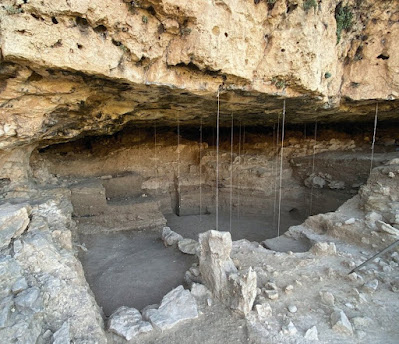
Cave of La Roche-Cotard, France. Online image, public domain.

On 19 November 2022 I posted a column titled "A Neanderthal Mystery – The Mask of La Roche-Cotard." This discussed a mysterious artifact from that cave, attributed to Neanderthal occupation comprising a flake of flint shaped like a face with a piece of bone shoved through a natural hole looking somewhat like eyes (Faris 2022). In this column I am presenting a study (Marquet et al. 2023) that discusses finger flutings and other marks made in La Roche-Cotard by Neanderthals dated to approximately 57,000 BCE.

Pillar chamber, cave of La Roche-Cotard, France. Photogrammetry by Y. Egels, journal.pone.

“Today, the cave of La Roche-Cotard comprises four main chambers extending ESE-WNW for 33 m: the Mousterian Gallery, the Lemmings Chamber, the Pillar Chamber and the Hyena Chamber. In the back of the Hyena Chamber, collapse of the ceiling prevents the determination of the exact extent of the ancient cavity.” (Marquet et al. 2023) And now we have to wonder what might be behind the collapsed ceiling.

Circular panel, La Roche-Cotard, France. Image from journal.pone.

“The site of La Roche-Cotard is in Indre-et-Loire, in the commune of Langeais, France. Discovered in January 1912, the cave is on the south-facing slope on the right bank of the Loire. The entrance is at the back of a small rocky cirque, only a few meters above the top of the river’s modern embankment. The cave comprises a narrow gallery, a tunnel some 10 m (33 feet) long and three wider chambers, extending around 40 m (131 feet) in all.” (De Lazaro 2023)


Dotted panel, La Roche-Cotard, France. Image from journal.pone.

“Following human occupation, the cave was completely sealed by cold-period sediments, which prevented access until its discovery in the 19th century and first excavation in the early 20th century. - In 1846, La Roche-Cotard cave entrance was exposed during quarrying and in 1912, the site owner François d’Achon excavated almost all the inner sedimentary deposits. Only Mousterian lithic artefacts were discovered within the cave; no later-period material was found. Subsequent excavation, in the 1970s and from 2008 onwards, identified three additional loci close to the cave.” (Marquet et al. 2023) In Europe, the Mousterian industry is associated with Neanderthal occupation.

Cave of La Roche-Cotard, France. Online image, public domain.

“The team first dated samples of cave sediment using a technique called optically stimulated luminescence (OSL) dating, which determines the time since sedimentary grains were last exposed to daylight. They concluded that the cave had been sealed off by sediment brought in by the flooding of the Loire around 57,000 years ago, well before Homo sapiens made their way into the region. Stratigraphic dating yielded an earlier date of around 75,000 years ago, which would make this "the oldest decorated cave in France, if not Europe," the authors wrote. Since the only stone tools found in the cave over the last century are those associated with Neanderthals, that provides two lines of evidence in support of the hypothesis that Neanderthals created the finger flutings.” (Ouellette 2023) In other words, if the only evidence of occupation of this cave is Neanderthals, then the wall markings must be Neanderthal as well.

Undulated panel, La Roche-Cotard, France. Image from journal.pone.

“Marquet et al. also modeled the entire cave with photogrammetry to more precisely locate the engravings and to carefully distinguish between the different kinds of traces. They focused on the suspected finger flutings for further analysis, then drew reproductions of the panels and carefully noted their detailed observations. The team concluded that the marks were deliberate, organized, and intentional shapes—arch-shaped tracings, for example, or two contiguous tracings forming sinuous lines.” (Ouellette 2023) Organized and intentional shapes created before anatomically Human entrance into Europe would only be attributed to Hominin presence, in other words, Neanderthal.

Triangular panel, La Roche-Cotard, France. Image from journal.pone.

“The numerous marks on the soft surface layers of the walls of have been categorized according to origin: those made by humans must be distinguished from those made by animals, as well as those arising from local geochemical alteration (surface dissolution, disintegration, dehydration), and minor chemical deposits (concretions). Animal claw marks, attributable to Ursus sp.Meles sp. and other species, can be identified by their characteristic spacing and incision angle. But alongside these numerous, randomly distributed animal scratch marks, there are also a number of elongated or dotted, spatially organized marks. These organized marks are found only on the 13 m long north-east wall of the pillar chamber (shown with a blue line in. They have distinct geometric shapes and are often grouped into panels separated by groups of smaller marks. Analysis based on the width, incision angle and depth of 116 marks revealed two statistically distinct groups: 32 with features consistent with claw marks, and 84 most likely of anthropogenic origin. Those identified as claw marks are thinner, deeper and have a V-shaped cross-section, whereas the presumed ancient spatially organized marks are mostly wider, shallower, and U-shaped, consistent with the morphology of a fingertip or similarly shaped tool. However, the rectangular panel is clearly separated, first from the two panels made with fingers and secondly separated from the claw marks.” (Marquet et al. 2023) Not only do we have the marks left by Neanderthals, we have marks left by bears and badgers – bear and badger rock art?

Cave bear (Ursus speleus). Image by Patrick Burgler.

European badger (Meles meles). Online image, public domain.

“The attribution to Neanderthal of the graphic productions at La Roche-Cotard pays tribute to this lost humanity, whose role in the biological and cultural evolution of humans is undergoing profound revision. In terms of culture, we now have a better understanding of the plurality of Neanderthal activities, attesting to elaborate and organized social behaviours that show no obvious differences from those of their contemporaries, Anatomically Modern Humans, south of the Mediterranean.” (Marquet et al 2023)

Note the last line of that quote “organized social behaviours that show no obvious differences from those of their contemporaries, Anatomically Modern Humans, south of the Mediterranean.” I am personally uncomfortable with the part about “no obvious differences” because I believe there are many obvious differences. From their tools, to their social interactions and personal adornment, we find traces of differences, but they are cultural differences. Notice I said cultural – because I do not think that any of them indicate differences in potential from those contemporaries. I believe that the Neanderthals had localized cultures in just the same way modern Human societies do. In other locations we have found Neanderthals using paint in caves, or incising petroglyphs into the rock with stone tools. In La Roche-Cotard their creative expression was to leave finger fluting.

NOTE: Some images in this posting were retrieved from the internet with a search for public domain photographs. If any of these images are not intended to be public domain, I apologize, and will happily provide the picture credits if the owner will contact me with them. For further information on these reports you should read the original reports at the sites listed below.

REFERENCES:

De Lazaro, Enrico, 2023, 57,000-Year-Old Neanderthal Engravings Discovered in France, 22 June 2023, https://sci.news. Accessed online 22 June 2023.

Faris, Peter, 2022, A Neandertal Mystery – The Mask of La Roche-Cotard, 19 November 2022, RockArtBlog, https://www.blogger.com.

Marquet, Jean-Claude et al., 2023, The earliest unambiguous Neanderthal engravings on cave walls: La Roche-Cotard, Loire Valley, France, 21 June 2023, https:journals.plos.org/plosone/. Accessed online 22 June 2023.

Ouellette, Jennifer, 2023, Could these marks on a cave wall be oldest-known Neanderthal ‘finger paintings’?, 21 June 2023, https://arstechnica.com. Accessed online 22 June 2023.


Saturday, July 22, 2023

57,000 YEAR OLD NEANDERTHAL CAVE MARKINGS IN LA ROCHE-COTARD:

Entrance to La Roche-Cotard Cave, France. Photograph from ancientorigins.net.

The mask of La Roche-Cotard. Image courtesy Wikipedia.

On 19 November 2022 I posted a column titled A Neanderthal Mystery – The Mask of La Roche-Cotard. This discussed a mysterious artifact from that cave, attributed to Neanderthal occupation comprising a flake of flint shaped like a face with a piece of bone shoved through a natural hole looking somewhat like eyes (Faris 2022). In this column I am presenting a study (Marquet et al. 2023) that discusses finger flutings and other marks made in La Roche-Cotard by Neanderthals dated to approximately 57,000 BCE.

The Pillar Chamber, La Roche-Cotard, France. From Marquet et al., 2023, Photogrammetry by Y Egals, journal.pone.

“Today, the cave of La Roche-Cotard comprises four main chambers extending ESE-WNW for 33 m: the Mousterian Gallery, the Lemmings Chamber, the Pillar Chamber and the Hyena Chamber. In the back of the Hyena Chamber, collapse of the ceiling prevents the determination of the exact extent of the ancient cavity.” (Marquet et al. 2023) And now we have to wonder what might be behind the collapsed ceiling.

“The site of La Roche-Cotard is in Indre-et-Loire, in the commune of Langeais, France. Discovered in January 1912, the cave is on the south-facing slope on the right bank of the Loire. The entrance is at the back of a small rocky cirque, only a few meters above the top of the river’s modern embankment. The cave comprises a narrow gallery, a tunnel some 10 m (33 feet) long and three wider chambers, extending around 40 m (131 feet) in all.” (De Lazaro 2023)


Circular panel, La Roche-Cotard. Image from journal.pone.

“Following human occupation, the cave was completely sealed by cold-period sediments, which prevented access until its discovery in the 19th century and first excavation in the early 20th century. - In 1846, La Roche-Cotard cave entrance was exposed during quarrying and in 1912, the site owner François d’Achon excavated almost all the inner sedimentary deposits. Only Mousterian lithic artefacts were discovered within the cave; no later-period material was found. Subsequent excavation, in the 1970s and from 2008 onwards, identified three additional loci close to the cave.” (Marquet et al. 2023) In Europe, the Mousterian industry is associated with Neanderthal occupation.

Dotted panel, La Roche-Cotard. Image from journal.pone.

“The team first dated samples of cave sediment using a technique called optically stimulated luminescence (OSL) dating, which determines the time since sedimentary grains were last exposed to daylight. They concluded that the cave had been sealed off by sediment brought in by the flooding of the Loire around 57,000 years ago, well before Homo sapiens made their way into the region. Stratigraphic dating yielded an earlier date of around 75,000 years ago, which would make this "the oldest decorated cave in France, if not Europe," the authors wrote. Since the only stone tools found in the cave over the last century are those associated with Neanderthals, that provides two lines of evidence in support of the hypothesis that Neanderthals created the finger flutings.” (Ouellette 2023) In other words, if the only evidence of occupation of this cave is Neanderthals, then the wall markings must be Neanderthal as well.

Triangular panel, La Roche-Cotard. Image from journal.pone.

“Marquet et al. also modeled the entire cave with photogrammetry to more precisely locate the engravings and to carefully distinguish between the different kinds of traces. They focused on the suspected finger flutings for further analysis, then drew reproductions of the panels and carefully noted their detailed observations. The team concluded that the marks were deliberate, organized, and intentional shapes—arch-shaped tracings, for example, or two contiguous tracings forming sinuous lines.” (Ouellette 2023) Organized and intentional shapes created before anatomically Human entrance into Europe would only be attributed to Hominin presence, in other words, Neanderthal.

Cave bear (Ursos spelaeus). Image by Patrick Burgler.

Eurasian badger (Meles meles). Internet image, public domain.

“The numerous marks on the soft surface layers of the walls of have been categorized according to origin: those made by humans must be distinguished from those made by animals, as well as those arising from local geochemical alteration (surface dissolution, disintegration, dehydration), and minor chemical deposits (concretions). Animal claw marks, attributable to Ursus sp.Meles sp. and other species, can be identified by their characteristic spacing and incision angle. But alongside these numerous, randomly distributed animal scratch marks, there are also a number of elongated or dotted, spatially organized marks. These organized marks are found only on the 13 m long north-east wall of the pillar chamber (shown with a blue line in. They have distinct geometric shapes and are often grouped into panels separated by groups of smaller marks. Analysis based on the width, incision angle and depth of 116 marks revealed two statistically distinct groups: 32 with features consistent with claw marks, and 84 most likely of anthropogenic origin. Those identified as claw marks are thinner, deeper and have a V-shaped cross-section, whereas the presumed ancient spatially organized marks are mostly wider, shallower, and U-shaped, consistent with the morphology of a fingertip or similarly shaped tool. However, the rectangular panel is clearly separated, first from the two panels made with fingers and secondly separated from the claw marks.” (Marquet et al. 2023) Not only do we have the marks left by Neanderthals, we have marks left by bears and badgers – bear and badger rock art?

Linear panel, La Roche-Cotard. Image from journal.pone.

“The attribution to Neanderthal of the graphic productions at La Roche-Cotard pays tribute to this lost humanity, whose role in the biological and cultural evolution of humans is undergoing profound revision. In terms of culture, we now have a better understanding of the plurality of Neanderthal activities, attesting to elaborate and organized social behaviours that show no obvious differences from those of their contemporaries, Anatomically Modern Humans, south of the Mediterranean.” (Marquet et al 2023)


Undulated panel, La Roche-Cotard. Image from journal.pone.

Note the last line of that quote “organized social behaviours that show no obvious differences from those of their contemporaries, Anatomically Modern Humans, south of the Mediterranean.” I am personally uncomfortable with the part about “no obvious differences” because I believe there are many obvious differences. From their tools, to their social interactions and personal adornment, we find traces of differences, but they are cultural differences. Notice I said cultural – because I do not think that any of them indicate differences in potential from those contemporaries. I believe that the Neanderthals had localized cultures in just the same way modern Human societies do. In other locations we have found Neanderthals using paint in caves, or incising petroglyphs into the rock with stone tools. In La Roche-Cotard their creative expression was to leave finger fluting.

NOTE: Some images in this posting were retrieved from the internet with a search for public domain photographs. If any of these images are not intended to be public domain, I apologize, and will happily provide the picture credits if the owner will contact me with them. For further information on these reports you should read the original reports at the sites listed below.

REFERENCES:

De Lazaro, Enrico, 2023, 57,000-Year-Old Neanderthal Engravings Discovered in France, 22 June 2023, https://sci.news. Accessed online 22 June 2023.

Faris, Peter, 2022, A Neandertal Mystery – The Mask of La Roche-Cotard, 19 November 2022, RockArtBlog, https://www.blogger.com.

Marquet, Jean-Claude et al., 2023, The earliest unambiguous Neanderthal engravings on cave walls: La Roche-Cotard, Loire Valley, France, 21 June 2023, https:journals.plos.org/plosone/. Accessed online 22 June 2023.

Saturday, August 6, 2022

PREHISTORIC COLLECTING:


One aspect of art that I have not seen discussed in relation to rock art is collecting. The whole point of having something as non-utilitarian as art is its possession, or collecting it. In this paper I am using the term “collection,” not as the gathering or acquiring of material for utilitarian purposes, but in the sense of keeping it in one’s possession for non-utilitarian purposes (as in a modern stamp collection). Many, although not all, of these collected items were also purposely modified to some extent making them also Paleoart.

“Paleoart of the Lower Paleolithic period seems to have been found for well over 150 years but it has remained largely ignored, misinterpreted, or its existence was fundamentally denied. Most archaeologists and paleoanthropologists of recent decades attempt to refute anthropogenically modified objects located in Lower and Middle Paleolithic contexts as being taphonomic accidents or ‘natural’ in origin. Their presumption is that all Lower and Middle Paleolithic humans (including Homo habilis, H. rudolfensis, H. ergaster, H. georgicus, H. erectus, H. heidelbergensis, and H. sapiens neanderthalensis) were cognitively incapable of expressing themselves through ‘art’ or exograms. They ‘know’ these hominins were cognitively incapable of expression because they were not modern humans; they have been convicted of mental deficiency by negative evidence (Speth 2004). This is despite the clear evidence that these hominins have engaged in maritime colonization since approximately a million years ago, and have crossed sea barriers of up to 189 km to reach over twenty islands and one continent prior to having ‘Upper Paleolithic’ technology (Bednarik 1999).” (Bednarik 2015:1)

So, with the existence of items that have been gathered and modified, or not, to have in the possession of these early humans, we find the earliest known instances of collecting.

Australopithecus:

Makapansget Cobble: South Africa, north of Mokopane, found in 1925.

Makapansget cobble, north of MokopaneSouth Africa, found in 1925. Illustration www.donsmaps.com.

 “Collection of fossils and ‘curious’ or unusual objects, which were transported to the inhabited areas and probably became the object of interest and observation, if not invested with other value and meaning – certainly difficult to define – by the archaic human forms and then they were apparently abandoned on the paleosols that constitute the same archaeological deposits and which are distributed over a long chronological arch, from about 3.0 Ma BP to the entire middle Paleolithic. It should be noted that in some cases these objects were transported several kilometers away from their place of collection. As an example, we can mention the diasprite pebble from the cave of Makapansget (South Africa), probably collected by an Australopithecus africanus between 2.95 and 2.6 Ma BP (Bednarik 2013:8-9, Harrod 2014:136-137, 142).” (Mussi and Rossi 2018:313) Presumably, and austrealopithecene recognized the resemblance to a face in the rock and picked it up and carried it for curiosities sake.

Homo erectus:

Tan-Tan Figurine: Morocco, discovered in 1999.

Tan-Tan figurine, Morocco, discovered in 1999. Internet photograph, public domain.

“The object, which is around six centimeters in length, is shaped like a human figure, with grooves that suggest a neck, arms and legs. On its surface are flakes of a red substance that could be remnants of paint.

The object was found 15 metres below the eroded surface of a terrace on the north bank of the River Draa near the town of Tan-Tan. It was reportedly lying just a few centimeters away from stone handaxes in ground layers dating to the Middle Acheulian period, which lasted from 500,000 to 300,000 years ago.” (Rincon 2003) So this object resembling a human figure was definitely from the time of Homo erectus. It was undoubtedly ‘collected’ because of its resemblance to the finder and was then apparently modified somewhat to improve the illusion.

“The object, including its ‘arms’ and ‘legs’, was created by natural geological processes. The horizontal grooves on both sides of the object seem to be formed partly naturally partly artificially (by percussion). The object also contains traces of pigment, which seems to be iron and manganese according to preliminary study.” (Wikipedia)

Berekhat-Ram Figurine: Found at Berekhat-Ram on the Golan Heights, 1981.


Berekhat-Ram figurine, Golan Heights, Israil, 1981. Internet photograph, public domain.


Berekhat-Ram figurine, Golan Heights, Israil, 1981. Internet photograph, public domain.

Excavated and first described by Naama Goren-Inbar from the Institute of Archaeology, The Hebrew University of Jerusalem. The artifact is a scoria pebble, 35mm long, 25mm wide, and 21mm thick. – It was excavated in 1981 at the Acheulian site of Berekhat Ram, Golan Heights. The object is dated 280,000 – 250,000 BP. Goren-Inbar reported several artificial grooves on the object: one is a transversal groove in the upper third, others are longitudinal grooves on the sides below the transversal groove.

Goren-Inbar and Marshak suggested that the object resembled a female body and was artificially modified by hominids to emphasize its anthropomorphic features.” (Wikipedia)

The Erfoud Manuport: Eastern Morocco, 1984.

The Erfoud Manuport, Eastern Morocco, found in 1984. Photograph from Bednarik, 2002.

“The object in question is from Site No. A-84-2, a surface cluster of Acheulian tools in the vicinity of the townships Erfoud and Rissani, eastern Morocco. – The region is essentially a desert of small pebbles and sand, and the site consists of a dense cluster of numerous late Acheulian stone tools measuring about six-metres across. It includes the apparent remains of a dwelling consisting of a pile of stones forming and enclosed space of a few square metres, adjacent to a rock outcrop. – Within what appears to be the foundation of an Acheulian dwelling at Site A-84-2, Professor Lutz Fiedler from Marburg University collected in 1984 and object called here the Erfoud manuport. The manuport consists of a silicified fragment of a cuttlefish fossil cast dating from the Devonian or Carboniferous period (Orthoceras sp.). Such fossils are very common in other parts of Morocco, but they do not occur naturally in the region of the find site. – The object’s surface condition suggests that it was deposited in the same period as the stone tools found with it. An explanation is required for why it became a manuport, having been brought from some distance, and considering its apparently unworked, non-artefact status. This is readily found in its shape, being that of a perfectly naturalistic and life-size, non-erect human penis. The only realistic explanation for the curation of this object is that this clear similarity was perceived by a hominid.” (Bednarik 2002:138-9)

Neandertal: I have previously written about a number of instances of Neandertal produced art (available through the index at the bottom of the page) dating back to 65,000 years BP, but producing art is not collecting. If, however, we have some sort of accumulation of images in a location that can be thought of as a collection.

Neandertal manuport, patterned limestone, found in Croatia. Photograph Smithsonian magazine, Daley, 2017.

There is also a manuport, found in Neandertal context in a cave in Krapina, Croatia. “According to a press release, a group of international researchers re-examining material excavated from a cave where archaeologists found 900 Neandertal bones between 1899 and 1905, came across an unusual split limestone rock. It stood out from the other 1,000 pieces of stone collected because of its composition and the interesting black lines spidering across its face. – The researchers believe that the Neandertals brought the rock to their home cave simply because they thought it was interesting. In other words, whoever picked it up was rock collecting.” (Daley 2017)

So here we have a number of instances of pre-modern hominids who have been demonstrated to have acquired something for the purpose of collecting, keeping it in their possession for intellectual pleasure, not for utilitarian use. This is an immensely human trait that we can all identify with, and should give us a new perspective on pre-modern humans. I believe that it was just this sort of impulse which eventually gave rise to the creation of art and the magnificent palimpsests in the painted Stone Age caves, and thus, to the study of Art History and Rock Art which fascinates us all.

NOTE: Some images in this posting were retrieved from the internet with a search for public domain photographs. If any of these images are not intended to be public domain, I apologize, and will happily provide the picture credits if the owner will contact me with them. For further information on these reports you should read the original reports at the sites listed below.

REFERENCES:

Bednarik, Robert G., 2002, An Acheulian palaeoart manuport from Morocco, Rock Art Research Vol. 19, number 2, pp. 137-139.

Bednarik, Robert G., 2013, Pleistocene Palaeoart of Africa, Arts, 2, 6-34.

Bednarik, Robert G., 2015, Paleoart of the Lower Paleolithic, January 2015, ResearchGate, accessed on 17 April 2022.

Daley, Jason, 2017, Did Neanderthals Like Pretty Rocks?, 23 January 2017, Smithsonian.com, http://www.smithsonianmag.com/smart-news-did-neanderthals-pretty-rocks-180961865/#IJCeswdiLPg3FICF.99

Goren-Inbar, Naama, 1986, A figuring from the Acheulian site of Berekhat RamJanuary 1986, Mitekufat Haeven:Journal of the Israel Prehistoric Society, reprinted by Jstor, https://www.jstor.orb/stable/23373142, accessed 12 January 2022.

Harrod, James, 2014, Palaeoart at Two Million Years Ago? A Review of the Evidence, Arts, 3, 135-155.

Mussi, Piero and Pietro Rossi, 2018, You Snooze, you win: Perception, dream and symbolization in pre-sapiens Evolution, NeanderART 2018 (proceedings), pp. 311 – 349.

Rincon, Paul, 2003, ‘Oldest sculpture’ found in Morocco, 23 May 2003, BBC Science, http://news.bbc.co.uk/2/hi/science/nature/3047383, accessed 17 May 2022.

Wikipedia, Venus of Berekhat-Ram, https://wikipedia.org/wiki/Venus_of_Berekhat_Ram, accessed on 10 June 2022.

Wikipedia, Venus of Tan-Tan, https://en.wikipedia.org/wiki/Venus_of_Tan_Tan, accessed on 10 June 2022.

SECONDARY REFERENCES:

Bednarik, Robert G., 1999, Maritime navigation in the Lower and Middle Palaeolithic, Comptes Rendus de l’Academie des Sciences Paris, Volume 328, pp. 559-563.

Speth, J. D., 2004, Newsflash: negative evidence convicts Neanderthals of gross mental incompetence, World Archaeology, Volume, 36, No. 4, pp. 519-526.