Among the categories of historic rock art that we find are, of course, the many historic inscriptions that can be found along trail routes of the old west, and images left by the people who worked out in the environment, rock art created by cowboys and sheepherders.

Cowboy rock art, Trinchera Pass, CO.
Photo: 2010, Peter Faris.
Dennis McCown, a college instructor in Austin, Texas, and a part-time cowpoke himself, was interested in tracing the historic route of cattle drives from Texas to the mining districts of central Colorado. McCown particularly wanted to track the route used by the Eddy Brothers who had an enormous cattle ranch in southeastern New Mexico. There were no good routes to drive cattle from Colorado’s eastern Plains across the Front Range to the mining regions of the Colorado mountains, however, herds driven up from the south along the Arkansas River into South Park could summer on the rich mountain grasses and be sold at high prices.

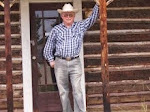
Dennis McCown and cowboy rock art, Trinchera
Pass, CO. Photo: Dennis McCown.
The Eddys intended their cattle for the mostly unexploited market in the mining districts of central Colorado. At first, the Eddys followed the Goodnight-Loving Trail from today's Carlsbad, N.M., to Raton, N.M., and through Raton Pass but “Uncle” Dick Wooten’s ranch blocked that pass and his toll road across the pass charged tolls that the cattlemen considered exorbitant. To this end, cattlemen had scouted for a more easterly route. Before long, they selected a passable route branching off from the Goodnight Trail. Called the "Eddy Diversion" in later years, the new route passed near today's Folsom in northeastern New Mexico. From the Folsom area, the diversion passed through Trinchera Pass on the New Mexico-Colorado border, then headed northwest to a crossing of the "Picketwire," the Purgatoire River, near today's Highway 160 in southern Colorado. From there, the trail crossed today's Comanche National Grassland to the Arkansas River. It's unknown how many cattle were driven up this trail, but perhaps as many as 10 or 12 herds a year--each numbering 1,500 to 2,500 cattle--went through Trinchera Pass in the years 1884-1904.
A geological feature called "the Wall" appeared as the trail broke into more open country at the mouth of Trinchera Pass. A relic of a basaltic dike, the Wall is composed of angular basaltic columns laid on their sides, as if stacked to make a wall. In places, the Wall is at least 15 feet high and 10 feet wide. Some sections are overgrown with juniper and scrub. Long-ago Indians had used the dark basalt on the south side of the “Wall” to make pictographs of animals, insects and symbols. Perhaps 200 Indian pictographs remain, most quite clear to this day. Seeing these, the drovers, cowboys and wranglers were inspired. In a short period of perhaps just 20 years, they left a pictorial legacy of cowboy life unequaled anywhere. They were not artists, they were cowboys. Their drawings are little more than stick figures, but they reveal a charming sense of humor and an eloquent grasp of history. The cowboys themselves knew what made them memorable. Prominent in their drawings are high-heeled boots, 10-gallon hats and six-shooters. One cowboy, perhaps in recognition of the Indian artists who had preceded him, represented himself shooting a bow and arrow. Another overlooks a trail and waves hello to a visitor.
Dennis McCown is a college instructor in Austin, Texas, and a part-time cowpoke on his father-in-law's ranch. His article on the Cowboy Rock Art of Trinchera Pass can be found at p. 56-60, Wild West Magazine, April, 2008. I wish to thank him for helping me make the contact that led to my visit to this site in May 2010.



 Posts
Posts

