Showing posts with label Canyonlands. Show all posts

Saturday, June 7, 2025

WAS HACHURE SEEN AS THE COLOR BLUE IN THE AMERICAN SOUTHWEST?


Ancestral Pueblo olla with hachure infill in the design. Internet image, public domain.

The origin of the idea that hachure, closely spaced, parallel thin lines, used to fill a space might be intended to symbolize the color blue was credited to J. J. Brody by Stephen Plog (2003). “One of the common design characteristics on black-on-white pottery from the eleventh and twelfth centuries in the northern American Southwest is the use of thin, parallel lines (hachure) to fill the interior of bands, triangles, This essay explores a proposal offered by Jerry Brody that hachure was a symbol for the color blue-is examined by exploring colors and color patterns used to decorate nonceramic material from the of northwestern New Mexico. His proposal is supported and the implications of this conclusion for future studies of this nature are discussed.” (Plog 2003:1) This suggestion, originally applied to the decoration of pottery, was because while the indigenous potters had a full range of black, white, reds and yellow based upon natural pigments, there was no technology at that time that could give them blue or green colors on finished pots. But Plog had also compared the use of hachure on pottery to other, non-pottery, painted artifacts and decided that hachure was used on pottery designs in the same manner that blue paint was used on other media.

Ancestral Pueblo olla with hachure infill in the design. Internet image, public domain.

Sarah Klassen and Will Russel, in 2019, explained it in a paper on color usage in Mimbres pottery. “In the 1970s, American art historian Jerry “J.J.” Brody speculated that 11th- and 12th-century potters in the Chaco region of what is today New Mexico used black hachure—closely spaced, parallel lines—on a white background as a proxy for the color blue-green. The Chaco culture was centered on Chaco Canyon, but it spanned the Four Corners area of Utah, Colorado, Arizona, and New Mexico. Brody had noticed some striking similarities between black-on-white designs on pottery and more colorful designs in other media, such as stone mosaics and painted boards, where color was easier to apply and longer-lasting. The designs were similar, but where the mosaics had turquoise, the pottery had hachure. In 2003, archaeologist Stephen Plog of the University of Virginia tested this idea, comparing the use of hachure on pots to the use of blue-green on more than 50 objects featuring color. His findings supported Brody’s idea: Hachure seemed to represent turquoise.” (Klassen and Russell 2019:3)

Interestingly, Will G. Russell, Sarah Klassen and Katherine Salazar, having done their own comparative study, had written in 2017 that “Our observations do not support the hypothesis that Mimbres hachure acted as a proxy for blue-green. If such an association did exist, it would make little sense for potters to use hachure interchangeably with any color other than blue-green. That is, if hachure did represent blue-green, it follows that it would either stand alone, or be stylistically interchangeable with blue-green. Although blue-green pigment would not have stayed blue-green after firing, it could have been added as fugitive paint. Thus, if our comparison suggests any correlation between Mimbres hachure and a particular color, that color is either brown (objective) or yellow (subjective).” (Russell, Klassen and Salazar 2017:115) So, their interpretation, although their conclusions differ from Brody and Plog, also find hachure to represent a color.

Barrier Canyon Style anthropomorph, Harvest Scene, Maze Overlook, Canyonlands, San Juan County, Utah. Photograph by Don I. Campbell, 1 May 1983.

We also need to keep in mind that what may have applied to art produced by the Mimbres Culture would not necessarily apply to the other prehistoric cultures of the American Southwest. As we have seen, however, Brody and Plog had come to the conclusion that for prehistoric Puebloan (Anasazi) peoples the use of hachure, in Chaco Canyon and elsewhere, stood for the color blue. Indeed, Plog had focused his study on Chacoan pottery.

Barrier Canyon Style anthropomorph, Horseshoe Canyon, Canyonlands, Wayne County, Utah Photograph Don I. Campbell, 16 May 1984.

So what does all this talk about pottery have to do with rock art? Well, we find some examples of hachure or hachure-like texturing in rock art. Also we need to remember that colors pretty much always had major spiritual significance to indigenous peoples.


Barrier Canyon Style anthropomorphs, Photograph by Colin D. Young.  

“Most of the Pueblos associate north with yellow, west with blue, south with red, and east with white. Below, or the underworld is generally associated with black or dark, while the zenith, or the world above, is variably represented by black, brown, yellow or multiple colors.” (Munson 2020:13) So, the colors on a pot, or the color of the paint used to make a pictograph may have carried extra meaning associated with the spiritual implications of the color. Based on the seeming ubiquity of these color codes in the American Southwest, I am going to assume that the peoples on the northern periphery, first Barrier Canyon and later Fremont, also gave colors of paint a spiritual content, I just have no way of knowing for sure what those meanings would be.
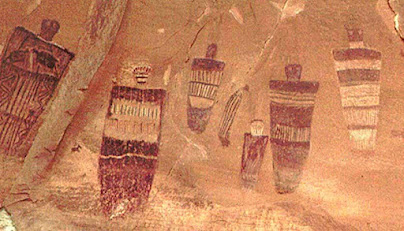
 

Barrier Canyon Style anthropomorph, Horseshoe Canyon, Canyonlands, Wayne County, Utah Photograph James Q. Jacobs.

Most painted rock art is in various shades of natural ochers although there are rare examples of blue and green. In Barrier Canyon Style (BCS) figures (and presumably Fremont Culture figures as well) Dr. James Farmer (2019) associated vertical hachure within the silhouette of the figure as representing rain. One of the elements of his “BCS ‘Thunderstorm’ Iconographic Complex” is falling rain shown on an anthropomorph as closely spaced vertical lines – hachure? Although painted with red paint, he says they represent falling rain, and rain is water and water is associated with blue. What if those hachure rain lines in Barrier Canyon anthropomorphs represent blue rain? What if the artists who painted the figures used closely spaced red lines (hachure) to represent the color blue on the figures?


I don’t think I could prove this even if I wanted to, and I am not convinced even now, but isn’t it an interesting possibility?


NOTE: Some images in this posting were retrieved from the internet with a search for public domain photographs. If any of these images are not intended to be public domain, I apologize, and will happily provide the picture credits if the owner will contact me with them. For further information on these reports you should read the original reports at the sites listed below.


PRIMARY REFERENCES:


Farmer, James, Dr., 2019, Southwestern Rock Art and the Mesoamerican Connection, 18 April 2019, Colorado Rock Art Association online webinar.


Klassen, Sarah, and Will Russell, 2019, The Hidden Color Code in Mimbres Pottery, 14 November 2019, https://www.sapiens.org/archaeology/mimbres-pottery-color/.

Accessed online 6 March 2025.


Munson, Marit K., and Kelley Hays-Gilpin, editors, 2020, Color in the Ancestral Pueblo Southwest, University of Utah Press, Salt Lake City, UT.


Plog, Stephen, 2003, Exploring the Ubiquitous Through the Unusual: Color Symbolism in Pueblo Black on White Pottery, October 2003, American Antiquity, Volume 68 (4), pp. 665-695. Accessed online at JSTOR, 7 March 2025.


Russell, Will G., Sarah Klassen and Katherine Salazar, 2017, Lines of Communication: Mimbres Hachure and Concepts of Color, American Antiquity 83 (1), 2018, pp. 109-127. Accessed online at Researchgate, 7 March 2025.


SECONDARY REFERENCE:


Brody, J. J., 1991, Anasazi and Pueblo Painting, A School of American Research Book, University of New Mexico Press, Albuquerque, New Mexico.

Saturday, November 15, 2014

SHIELDS AND SHIELD FIGURES IN ROCK ART:


All-American Man, Salt Creek, Canyonlands, UT.
Photograph: 1983, Don I. Campbell.

One fascinating class of imagery in rock art is the well-known shield figures of the American West. Although seen in a number of variations the shield figure is basically a shield (usually the larger sized shield carried by a pedestrian warrior) with portions of the anatomy of the figure carrying it seen protruding from the edges of the shield; legs at the bottom, head at the top, and with weapons or ceremonial items often portrayed as well. Shield figures have always fascinated me because they very often portray the sorts of details of adornment, decoration, or accessories that allow us to assume that the representation is of a specific shield that would be the property of a specific, and recognizable, person – in other words a portrait.


All-American Man, Salt Creek, Canyonlands, UT.

Photograph: 1983, Don I. Campbell.

One of the most famous shield bearing figures is found in Utah, in Canyonlands National Park. The “All-American Man” figure is rounded and bears a brightly decorated shield. He is seen in front view with straight legs and feet angled down slightly to his left. His face and head are seen straight on and we can discern facial features as well as some form of neck band as well as two antenna-like projections from his head, perhaps feathers in a headdress. His name refers to his decoration in red, white, and a bluish paint and references indicate that he has a radiocarbon date of A.D. 1295. 


Close-up of shield figures, Werstwater canyon, UT.
Photograph:  Oct. 8, 2001, Peter Faris.

With his rounded contours All-American Man resembles the shield bearing warriors from Westwater Creek, Utah, much more than the shield bearing warriors from McConkey Ranch, near Vernal, Utah.


Shields, Castle Gardens, Fremont County, WY.
Photograph: Peter Faris, Sept. 1992.

Dr. Lawrence Loendorf has written some insightful comments about shield figures: “The oldest shields or shield warriors found in the Montana and Wyoming region are in the Castle Garden Shield Style. - - Castle Garden Shield Style figures are made in a unique way. Before making these pictographs, the artist prepared the rock surface by abrading it to remove undulations or protuberances and produce a flat, smooth palette. This surface preparation removed the less-consolidated outer layer of surface sandstone to reveal a harder, inner layer for painting."


 Shields, Castle Gardens, Fremont County, WY.
 Photograph: Peter Faris, Sept. 1992.

           "Once smoothed, the artist incised a pattern of the shield or shield warrior on the rock palette. - - Paint colors include two shades of red (one more purple than the other), two shades of orange (one more yellow than the other), black, white, and green. Polychrome paintings are rare in Wyoming and Montana and this is one of the criteria by which the Castle Garden Style shields and shield warriors can be identified. Use of green paint is also an important criterion because it is rare in the region.
            In an excavation in the Valley of the Shields, I recovered two sandstone-abrading tools used to smooth the surface in preparation for the paintings (Loendorf 1990). One of these had paint adhering to it as though the artist picked it up to do some additional smoothing while in the process of applying paint. The tools were found in direct association with the remains of a hearth, and it was possible to obtain standard radiocarbon dates on the charcoal. Two dates with overlapping sigma were obtained using the correction tables it is clear the Castle Garden Shield Style pictographs were made at the Valley of the Shields ca. A.D. 1100.” (Loendorf 1990:49) Great information Larry, as always.

Shields and shield figures are so fascinating to me because they offer entry points into a whole range of questions in rock art: portraiture, the pedestrian-to-equestrian warrior transition (and thus the societal changes cause by the adoption of the horse), heraldry, and even inter- and intra-tribal interaction and communication.

REFERENCE:

Loendorf, Lawrence
2004   Shields and Shield Warrior Pictographs and Petroglyphs in the Intermountain West, pages 103-117, in New Dimensions in Rock Art Studies, edited by Ray T. Matheny, Museum of Peoples and Cultures Occasional Papers No. 9, Brigham Young University, Provo.

Sunday, April 15, 2012

DANCING FIGURES:


Vermillion Canyon, Brown's Park, Moffat
County, CO. Photo Peter Faris, 1995.

 We find in some locations images that are generally identified as groups of dancing figures. Some of these are lines of figures holding hands, or all facing the same way in a line, each with a hand on the shoulder of the person in front of them. Other variations of the theme are groups of figures, perhaps facing inward in a circle, or apparently in a line all moving together.


Vermillion Canyon, Brown's Park, Moffat
County, CO. Photo Peter Faris, 1975.
 
 
Inevitably we speculate on the meaning of these figures being some sort of celebration or ceremonial activity. In his 2002 book Landscape of the Spirits: Rock Art at South Mountain Park, Todd Bostwick discussed dancing scenes in rock art. “Characteristically, several anthropomorphs in a row will be holding hands and sometimes one or more hold a cane or staff”. He also mentioned examples of “figures in lively postures suggesting rhythmic movement”. Bostwick cited an Akimel O’odham informant, Archie Russell, who identified dancers in several rock art panels.


Salt Creek, Canyonlands, Utah.
Photo Don Campbell, 1985.

If we accept that much rock art has a spiritual significance and includes spiritual components, then we must also expect to find references to spiritual ceremonies and celebrations. As we know that many (perhaps most) spiritual ceremonies and celebrations of tribal peoples involve group dancing, we may justifiably guess that such scenes are illustrations of such ceremonies and celebrations.


Village of the Great Kivas, Zuni, New
Mexico. Photo Teresa Weedin.
 
 
“The most common event centered pictographs and petroglyphs at Zuni portray ritual dancers and dances. A number of Zunis told me that Figure 3.7 (the panel from the Village of the Great Kivas) represents a group of Zuni “clowns” dancing around a pole during the winter solstice ceremony. Although I have never witnessed this ceremony, I have often seen clowns during the summer rain dances move around the plaza with their arms on each other’s waists in a manner similar to that portrayed in this rock carving. Still, one could hardly refer to this as unambiguous evidence that this particular petroglyph actually depicts part of a specific ceremony. The figures are amorphous enough that one cannot say definitively that they form a distinctive clown group. Moreover, there are only ten clowns who participate in Zuni rituals, yet there are perhaps eleven or twelve in this petroglyph. Finally, the date of the carving is highly uncertain; it could have been carved before the formation of the Zuni tribe in the southwest. In fact, the extreme difficulty in dating rock art images renders most interpretations hypothetical at best.” (Young 2004: 93)

If we accept that much rock art has a spiritual significance and includes spiritual components, then we must also expect to find references to spiritual ceremonies and celebrations. As we know that many (perhaps most) spiritual ceremonies and celebrations of tribal peoples involve group dancing, we may justifiably argue that such scenes may be illustrations of such ceremonies and celebrations. Indeed, Colorado State Archaeologist Richard Wilshusen has argued that many of these portrayals are definitely processions to ceremonial events – enter dancing!

REFERENCES:

Patterson, Alex
1992    A Field Guide To Rock Art Symbols Of The Greater Southwest, Johnson Books, Boulder.

Young, M. Jane
2004    Ethnographic Analogies in Southwestern Rock Art, p. 80-102, in New Dimensions In Rock Art Studies, edited by Ray T. Matheny, Museum of Peoples and Cultures Occasional Papers No. 9, Brigham Young University, Provo.

Wednesday, November 18, 2009

I DIDN'T SEE THAT THERE!


Rock art researchers have for years read ethnographic reports about Native American beliefs that some rock art images appear overnight, and we have consistently dismissed this as superstitious mythology.

Ute Indians believed that rock art was created by little people who may live within the rock itself. The Piikani Blackfoot believed that rock art would appear overnight to predict upcoming events, and they would often consult rock art panels about enemy presence, and to divine the success of war parties. They also attributed the presence of rock art high on the rock face, above the reach of people to birds. As no one could obviously reach high enough to create these images, they were obviously created by bluebirds under the direction of Thunder. The upshot is that we, of course, know better with our scientific acumen, and that there is no basis for a belief as obviously wrong as that rock art can appear overnight.


Fig. 1, 5LA8464, Box Canyon Site,
Photo: Peter Faris, 1999.


It is interesting, however, that all rock art researchers that I know agree that they have had experiences where they have noticed rock art that they had not seen before in places where they have looked many times, which seems to have appeared overnight. We know that differing light conditions affect the visibility and under the right conditions a pictograph that has faded to illegibility can sometimes be seen more completely, and a petroglyph made with shallow scratches can literally snap into visibility. An excellent example of this is represented by the Box Canyon Site, 5LA8464, in the Picketwire Canyonlands in the Purgatoire River Canyon, illustrated in Figure 1.

The Box Canyon petroglyph scene is shallowly scratched onto the darkened surface of a fairly hard sandstone cliff, and had been missed by numerous people walking past it for years. Then, on the right day, under the right light conditions, it was clearly seen by a park ranger as he passed the cliff face. I believe that the ranger was Mark Mitchell whom I have mentioned before in my August 20, 2009, posting about Armored Horses.


Fig. 2, 5LA8464, Box Canyon Site tracing,
reproduced by Mark Mitchell.


The panel was recorded in August, 1999, under the direction of James Keyser. Because the images consist of essentially shallow scratches on the hard rock surface it was virtually impossible to properly photograph. The method adopted was to trace the images on transparent plastic sheeting with a permanent felt marker. The final image consists of photocopies of these transparent plastic tracings reduced to the same percentage in the photocopier, and the resulting reduced-scale photocopies were pieced together like a jigsaw puzzle, for further reduction through the same process. The final result can be seen in figure 2 as a whole scene in Plains Biographic style.
A group of Pawnee horsemen on the right have made a horse raid on a tipi village represented by the tipi on the left. Defending horsemen have taken at least one casualty represented by the mounted figure with an arrow in his chest in front of the tipi. The attackers, recognized as Pawnee by their distinctive moccasins with flaps at the ankles, and their hair in a queue at the back, are riding away with some dismounted horses representing the success of their raid. I have assumed that the victimized group are Cheyenne or Arapahoe because they inhabited the area in historic times.

As mentioned above, this complicated panel had been scratched onto the cliff face, probably between 150 – 250 years ago, but had not been noticed until the late 1990s. Why, one might almost imagine that it had appeared overnight!