Showing posts with label Chaco Canyon. Show all posts

Saturday, September 20, 2025

THE MILKY WAY IN ROCK ART:


The Milky Way. Vera Rubin Observatory photograph.

It is almost universally accepted that ancient cultures were very interested in the heavens, and we can assume that the prehistoric creators of petroglyphs and pictographs were also fascinated by questions of the universe. It could not have been possible to not be fascinated by the Milky Way.

Nut, Egyptian sky goddess. Internet image, public domain.

Among the most prominent features of the night sky is the side view of our galaxy that we call the Milky Way. Ancient cultures had to have an explanation for it that satisfied their world view and mythology. “The Egyptians, for examples, may not have been the only culture to link the Milky Way to a sky goddess who gives birth to other gods and, especially, other celestial objects.” (Graur 2024:37)

Citlalicue, sky-goddess. Internet image, public domain.

Peoples of the Americas had their own beliefs concerning the Milky Way. “Several of the pages in the Codex Borgia, a pre-Colombian pictorial manuscript composed by the Tlaxa-caltec people of the Puebla-Tlaxcala Valley in Mexico, include images of elongated beings covered with stars. These beings have been identified as the Milky Way as well as the goddess Citlalicue (Star Skirt), the “… goddess of the stars …”, and the mother of several gods, including the Venus god Quetzalcoatl. Quetzalcoatl is shown cutting his way out of the belly of Citlalicue; this and other, similar scenes in Co-dex Borgia 29-46 are interpreted as Venus crossing the Milky Way.” (Graur 2024:37)

Similar views of the Milky Way are found across Mesoamerica (Milbrath, 1999: 41). The dead of the Yucatec Maya travel along the Milky Way at night (Sosa, 1985: 432). The Quiché Maya see the Galaxy as two of four cosmic roads. Of these, the Black Road (Q’eqa b’e) or Road of Xibalba (Ri b’e xib’alb’a), which is identified with the dark band of the Milky Way’s Great Rift, leads to the underworld (Tedlock, 1985: 36, 337, 354). Similarly, the Lacandón call the Milky Way the “… white way of our true lord …”, Hachäkyum, the ruler of heaven populated by the dead.” (Graur 2024:39)

Mayan two-headed sky monster, from Clopan, altar 4,  Late Classic Period. Image from Mary Miller and Karl Taube,The Gods and Symbols of Ancient Mexico and the Maya, Thames and Hudson, London, 1993.

The ancient Maya saw the Milky Way as a serpentine monster with a head at each end. “Specifically, the two-headed monster known as the Celestial Monster or Cosmic Monster. This particular supernatural creature usually has either a crocodilian or sky band body, but in at least one example, cloud scrolls form the body. - - Most commonly, the Bicephalic Monster frames scenes of accession or rulership for the Maya, but its intrinsic meaning may be to represent the arc of the heavens, the front head being identified with Venus, pulling behind it the fleshless head of the Sun in the Underworld .” (Miller and Taube 1993:45) This is considerably more picturesque than many other beliefs, but then the Maya did have amazing imaginations and left us many images of them.

First Nations people in North America had a range of beliefs concerning the Milky Way. “Many Native American peoples across North America view the Milky Way as a road along which the spirits of the dead travel to the afterlife. The souls (tasoom) of the Cheyenne are said to travel toward the home of Hemmawihio (The Wise One Above), an all-knowing high god re-presented by the Sun, via the Milky Way, which is known as ekutsihimmiyo (Adamson Hoebel, 1960: 86–87). The Lakota name for the Milky Way is Wanáǧi Thacháŋku, the Spirits’ Road, which the Lakota follow to heaven when they die (Hollabaugh, 2017: 70–72). The Pawnee come to this life as the children of stars and, when they die, become stars once more. The stars of the Milky Way are the ancestors of the Pawnee moving from this world to the next (Pawnee Nation Tribal Historic Preservation Office, pers. comm., 2022)..” (Graur 2024:39) The idea that the Milky Way is a road or a path is a very common belief all around the world.

Chaco Canyon petroglyph panel. Photograph by Suzan Bradford.

Suzan Bradford's photograph overlaid against the Milky Way. Image by Robert Juhl.

Back in 2014 Robert A. Juhl sent me a PowerPoint presentation that he had created based upon a rock art photograph from Chaco Canyon that had been taken by Susan Bradford. In this presentation he likened the petroglyphs panel in the photograph to details of the Milky Way in the region of Scorpius in the night sky. When he superimposed the petroglyphs panel over this section of the Milky Way a crack across the panel seems to conform with the ‘Great Rift’ in the Milky Way, and he could match up a number of other details in the panel and the Milky Way. Additionally, although Juhl does not make this claim in his PowerPoint, the other features on the panel could represent constellations in that section of sky.

In the area of the American southwest tribes, the Milky Way is known as Ashes placed across the sky, or the Great Snowdrift in the sky by the Zuni people. (Miller 1997:183) In the design for a Navajo sand painting in the Shooting Chant Father Sky on the left side shows the Milky Way across his chest as a row of connected diamonds. (Miller 1997:187) But, most tribes in North and Central America connect the Milky Way with a path arcing across the night sky.


Rochester Creek petroglyph panel. Photograph Peter Faris, August 1993. Reminiscent of Nut arched across the sky, with a push me-pull you in the upper left corner to represent the Mayan two-headed monster?

With that definition in mind I will present as a possible representation of the Milky Way the great panel at Rochester Creek, near the junction with Muddy Creek near Emery, Utah. The arc in the panel might be seen as representing the Milky Way, and the creatures scattered around it might represent the constellations as identified by the people. As I said above, this is only a possibility, the arc in the panel is often presented as a rainbow as well, but the Milky Way and surrounding constellations might be a better explanation of the other figures on the panel. In any case, it is an interesting question and kind of fun to speculate on.

NOTE: Some images in this posting were retrieved from the internet with a search for public domain photographs. If any of these images are not intended to be public domain, I apologize, and will happily provide the picture credits if the owner will contact me with them. For further information on these reports you should read the original reports at the sites listed below.

REFERENCES:

Graur, Or, 2024, The Ancient Egyptian Personification of the Milky Way as the Sky-Goddess Nut: An Astronomical and Cross-Cultural Analysis, Journal of Astronomical History and Heritage, 27(1), 28-45.

Juhl, Robert A., 2013, The Milky Way in Chaco Rock Art, Version 18. PowerPoint presentation.

Miller, Dorcas S., 1997, Stars of the First People, Pruett Publishing Co., Boulder, Colorado.

Miller, Mary, and Karl Taube, 1993, The Gods and Symbols of Ancient Mexico and the Maya, Thames and Hudson, London.

SECONDARY REFERENCES:

Adamson Hoebel, E., 1960. The Cheyennes: Indians of the Great Plains. New York, Holt, Rinehart and Winston.

Milbrath, S., 1988. Birth images in Mixteca-Puebla art. In Miller, V.E. (ed.), The Role of Gender in Pre-Colombian Art and Architecture. Lanham, University Press of America. Pp. 153–178.

Milbrath, S., 1999. Star Gods of the Maya: Astronomy in Art, Folklore, and Calendars. Austin, University of Texas Press.


Tedlock, D., 1985. Popol Vuh: The Mayan Book of the Dawn of Life, Revised Edition. New York, Simon & Schuster.

Saturday, December 16, 2023

HALLEY'S COMET PICTURED IN CHACO CANYON – REVISITED:


Chaco Canyon, Penasco Blanco trail, San Juan county, New Mexico. Photograph Peter Faris, May 1994.

Back on 20 November 2010 I wrote a column about a pictograph along the Peñasco Blanco trail in Chaco Canyon. That trail boasts the panel which has been designated to represent the AD 1054 supernova that gave us the Crab Nebula. This particular panel consists of a red painted ten-pointed star, a crescent, and a hand print. I had visited Chaco a few times and was fascinated by the figure below the so-called Supernova panel. A white painted dot surrounded by two white concentric circles which I identify as a sun sign. This is nice enough by itself but no really big deal. In a 1997 visit I noticed what looked like very faint red paint to the right of that symbol looking somewhat like a large stylized flame. The column I wrote about that in 2010 is reprinted below.

“Archaeoastronomy is the study of the astronomical knowledge of ancient peoples. Students of archaeoastonomy have long been fascinated with the evidence for ancient astronomy found in Chaco Canyon consisting of the Fajada Butte sun calendar and the supposed supernova panel on Peñasco Blanco trail. High above Chaco Canyon’s Peñasco Blanco trail can be found a panel that has often been identified as the Supernova of AD 1054 that produced the Crab Nebula. This well known panel includes a crescent moon, a 10-pointed star which is believed to represent the supernova explosion, and a hand print.

What is not usually mentioned is that there is more rock art at that location. Right below the supposed supernova panel on the rock overhang, and painted in white on the face of the cliff is a large concentric circle symbol, often identified as an Ancestral Pueblo sun symbol. In this case, however, what appears to be a faded flame-like extension can be seen projecting to the right from the sun symbol. This extension, which also appears to be considerably obscured by dust, seems to combine with the sun symbol to represent a comet. Using the large sun symbol as the head of the comet certainly implies that it was large and bright.

Chaco Canyon was a major center of Ancestral Puebloan culture between AD 900 and AD 1150. During that period Halley’s Comet appeared in AD 912, AD 989, AD 1066, and AD 1145. Elsewhere in the world the AD 1066 appearance figured as an omen in the Norman conquest of England and, as such was also portrayed in the Bayeux Tapestry record of Duke William’s conquest. One old written reference in England mentions it as appearing four times as bright as Venus, and another likened its size and brightness to that of the moon.

I submit that the brightest and most impressive of these appearances would be the obvious candidate for reproduction above the Peñasco Blanco trail. From the information available that was probably the AD 1066 appearance of Halley’s. The proximity of that date to that of the supernova of AD 1054 also is suggestive of the AD 1066 appearance as we know that someone in that location had painted an astronomical event probably twelve years earlier. Certainly the people there at that time showed interest in the events seen in the heavens as is proved by the Fajada Butte Sun Calendar and the supernova panel. These clues suggest to me that the faded pictograph below the supernova panel is a record of the AD 1066 appearance of Halley’s Comet.” (Faris 2010)

Field sketch, Chaco Canyon, Penasco Blanco trail, San Juan county, New Mexico. Photograph Peter Faris, September 1997.

A bright heavenly object with a long flame behind it must be a comet, but which one. For the reasons outlined in the paragraphs quoted above from my 2010 column, I decided it was very likely the AD 1066 appearance of Halley’s Comet. I studied in intently and produced the field sketch illustrated above.

Chaco Canyon, Penasco Blanco trail, San Juan county, New Mexico. D-stretch by Michael Bradford, Photograph provided by Dr. Michael Fuller.

Chaco Canyon, Penasco Blanco trail, San Juan county, New Mexico. D-stretch by Meghan Murphy, Photograph provided by Dr. Michael Fuller.

Chaco Canyon, Penasco Blanco trail, San Juan county, New Mexico. D-stretch by Rob Pettengill, Photograph provided by Dr. Michael Fuller.

Since that time new developments have given us D-Stretch technology which can be used to enhance very faint traces of paint, and I recently received enhanced images of that design from Dr. Michael Fuller which confirm that the faint red field is a comet-like tail. I now have three examples produced by different people that clearly show the tail streaming behind the head of the comet. And, although my field sketch was inaccurate, especially along the top of the comet tail, I find it hugely gratifying to have been proven right in this instance.

REFERENCE:

Faris, Peter, 2010, Halley’s Comet Pictured in Chaco Canyon, 20 November 2010, https://www.blogger.com/blog/post/edit/7760124847746733855/3107711045319457496


Saturday, December 2, 2023

ARE THERE IMAGES OF SUPERNOVAS IN ROCK ART?


Chaco Canyon, Penasco Blanco trail, San Juan county, New Mexico. Photograph Peter Faris, May 1994.

Everyone who is interested in archeoastronomy knows about the proposed pictographic record of the supernova of A.D. 1054 in Chaco Canyon. The triad of the handprint, starburst, and what is assumed to be a crescent moon have become famous. These claims have even proliferated. A number of other combinations of crescents and what might represent stars in the American West have been declared to be records of that supernova.

Crescent and Sun, Arroyo del Parral, Crosby, Baja California. From The Cave Paintings of Baja California, Harry W. Crosby, 1984, p. 36, Copley Press, La Jolla, CA.

In 2015, astronomer E.C. Krupp wrote "Star and crescent combinations in rock art in the American Southwest were first interpreted in 1955 as eyewitness depictions of the 1054 AD Supernova explosion that produced the Crab nebula. While the Crab nebula is visible only telescopically, the event that generated it was brilliant, and for a time only the Sun and Moon were brighter. Additional Crab supernova candidates in California and Southwestern rock art were suggested 20 years later, and they included Chaco Canyon's Penasco Blanco pictograph panel, which became the poster child for Crab supernova rock art and is now called 'Supernova' on signage at the site. By 1979, a list of 21 Crab supernova rock art sites was assembled, and the inventory has continued to expand more slowly since then." (Krupp (A) 2015:167)

Possible representations of the AD 1054 supernova. Left to right: El Parral, Baja California; White Mesa, Arizona; Navajo Canyon, Arizona; Chaco Canyon, New Mexico; from "The Cave Paintings of Baja California", Harry W. Crosby, 1997, p. 227, Sunbelt Publications, San Diego, CA.

And in a second piece in 2015 Krupp wrote - “Astronomical studies of rock art began in the American Southwest, in 1955. William C. Miller, a staff member at Mount Wilson and Palomar observatories, initiated this research with a report on the pairing of a “star” symbol with a crescent at two different rock art sites in northern Arizona. He also suggested both panels might depict the Crab supernova of 1054 AD, a conspicuous event which was recorded at the time by official astronomers in China and Japan. Miller’s work was never forgotten by the astronomers, but astronomical interpretation of rock art went dormant until the 1970s, when additional examples of star/crescent combinations in California and Southwest rock art were noticed. In 1972, paintings of a “star” and crescent were reported from Fern Cave in Lava Beds National Monument, in northeast California, and a year later, the star and crescent on an overhang at Penasco Blanco in Chaco Canyon, New Mexico, captured attention. In June, 1973, at a conference in Mexico City, a group of eight investigators discussed five different supernova rock art sites and mentioned the possibility of two others in the first survey of supernova rock art. Two years later, astronomers John C. Brandt and Ray A. Williamson confirmed the two provisional sites and added six more. At the same symposium, Dorothy Mayer, a rock art researcher, discussed more than a dozen sites in California and Nevada and judged that four might represent the Crab supernova. By 1979, a new review listed 19 possible supernova depictions in rock art. By 2005, however, detailed, disciplined review demonstrated some of the classic examples could not possibly represent the Crab supernova. It was also clear no one knew the locations of the two original “supernova” sites and that no one had seen them since Miller described them. When the two sites were finally recovered and reappraised, it was evident the supernova interpretation at both sites is compromised, and ongoing scrutiny of the other canonical star/crescent rock art panels may now result in a complete reassessment of the supernova record in Southwest rock art.” (Krupp (B) 2015:594-5)

Navajo Canyon (actually Binne Etteni Canyon) Arizona. From Krupp (A), 2015, Figure 2.

It has gotten to the point where every crescent in rock art that is accompanied by another object is branded the A.D. 1054 supernova. Probably the most important question we have to ask is “what would a supernova look like to an ancient naked-eye observer, and how would they draw it?” I have never seen a supernova so I do not know what it would really look like.

White Mesa, Arizona. From Krupp (A), 2015, Figure 1.

Virtually all descriptions of the event go something like the following. “Chinese astronomers noticed the sudden appearance of a star blazing in the daytime sky on July 4, 1054 CE. It likely outshone the brightest planet, Venus, and was temporarily the 3rd-brightest object in the sky, after the sun and moon. This “guest star” – the exploding supernova – remained visible in daylight for some 23 days. At night it shone near Tianguan – a star we now call Zeta Tauri, in the constellation of the Taurus the Bull – for nearly two years. Then it faded from view.” (Sessions and Gonzaga 2023)
Supernova explosion. Internet image, public domain.

The speculation then continues, usually starting with the panel from the Penasco Blanco trail in Chaco Canyon. “The ancestral puebloan people in the American Southwest may have viewed the bright new star in 1054. Also, a crescent moon was in the sky near the new star on the morning of July 5, the day following the observations by the Chinese. So the pictograph below, from Chaco Canyon in New Mexico, may depict the event. And the multi-spiked star to the left represents the supernova near the crescent moon. Furthermore, the handprint above may signify the importance of the event or may be the artist’s ‘signature.’” (Sessions and Gonzaga 2023)

Petroglyph originally designated an eclipse. I suggest it as a much better candidate for the AD 1054 Supernova. Photograph High Altitude Observatory, public domain.

I would like to nominate another candidate for the supernova of A.D. 1054. Also found in Chaco Canyon, it has been designated as a solar eclipse in the past, but, as I have written before, a total solar eclipse should not have the center pecked out like this, it should be a ring of light showing prominences. This petroglyph seems to me to be a much better candidate for early stages of an exploding supernova. There are any number of public domain photographs on the internet of supernovas in their various stages, and some of them look very much like the Chaco Canyon petroglyph in question. Can I prove any of this? No, I cannot – but I submit it makes a certain amount of sense.


NOTES: Some images in this posting were retrieved from the internet with a search for public domain photographs. If any of these images are not intended to be public domain, I apologize, and will happily provide the picture credits if the owner will contact me with them. For further information on these claims you should read the Krupp’s excellent reports listed below.

REFERENCES:

Krupp, Edwin C. (A), 2015, Crab Supernova Rock Art: A Comprehensive, Critical, and Definitive Review, August 2015, Journal of Skyscape Archeology 1(2), 167-197. DOI:10.1558/jsa.v1i2.28255.

Krupp, Edwin C. (B), 2015, Rock Art of the Greater Southwest, pp. 593-606, in Handbook of Archaeoastronomy and Ethnoastronomy, edited by Ruggles, Clive L. N., Springer Company, New York

Sessions, Larry, and Shireen Gonzaga, 2023, Meet the Crab Nebula, remnant of an exploding star, 15 January 2023, https://earthsky.org. Accessed online 21 October 2023.


Saturday, November 12, 2022

CACAO IN THE AMERICAN SOUTHWEST AND ROCK ART:


One minor, but enjoyable, facet of the study of rock art in the American Southwest is the search for Mesoamerican influences in the imagery. Many examples of large-eyed anthropomorphs, for instance, have been labeled (whether righly or wrongly) as Tlaloc, the Aztec rain god. I have previously written about so-called abstract examples of rock art that resemble glyphs in Mayan or Aztec writing. On 30 October 2021 I published “Symbols for Geologic Phenomena in Rock Art – Earthquakes Revisited” (Faris 2021) in which I showed a symbol in New Mexico that resembled the Aztec glyph representing earthquakes. On 15 August 2015, I published “Wind Symbols in Rock Art of Chaco Canyon” showing a petroglyph in Chaco Canyon that appears identical to Mesoamerican breath/speech/wind scrolls. (Faris 2015) I make no claims to being a Mayanist, linguist, or epigrapher, so these comparisons may be on shaky ground, but it is an interesting question. Now, I am presenting another Mayan symbol that has possible relatives in the American Southwest – the glyph for cacao.

Rio Azul cocoa pot, Mayan, Guatemala. Illustration from atlasobscura.com.

Cacao, the flavoring ingredient of our modern chocolate was of huge  importance to the Maya. “During the Classical Period of the Maya, from approximately 250 – 900 A.D., chocolate was a cornerstone of daily life. It was currency, a ritual ingredient, and a pleasurable drink. But until recently, the details of Maya life were fairly opaque, largely due to the destruction wrought by the conquering Spanish. In the 1980s, after intense effort by Mayanist scholars, there was breakthrough after breakthrough in deciphering Maya glyphs, the written symbols that survived in codices, stone carvings, and pottery. One milestone was the examination of a remarkable ancient vessel, which was found by an unlikely party, to contain chocolate.” (Ewbank 2019)

Of these glyphs on the vessel, drawn by Stuart, the two on the right of the top two lines read cacao. Drawing by David Stuart.

This vessel was found in an untouched Mayan tomb. “In 1984, archaeologists discovered a pristine Maya tomb in the Rio Azul region of Guatemala. Among the royal offerings, they found an exquisite pot. Topped with a twist-top and a handle painted like jaguar skin, it contained an intriguing residue.” (Ewbank 2019:1)

“The archaeologists and anthropologists working on the Rio Azul project mused over whom to send the residue to for analysis. ‘Okay, well, who knows the chemistry of chocolate really well?’ Stuart says with a chuckle. So, they called the number on the back of a Hershey’s bar and got in touch with W. Jeffrey Hurst, an analytical chemist at the Hershey Food Corporation Technical Center. The chocolate company had labs full of PhDs, where Hurst and chemist colleague Stanley M. Tarka tested the residue. Sure enough, says Stuart, ‘they ran the chemical signatures, and they were spot on.’ Hershey chemists found caffeine and theobromine in the residue. ‘The only plant or organic material in all of ancient America that can produce those two chemical signatures together are cacao.” (Ewbank 2019:2)
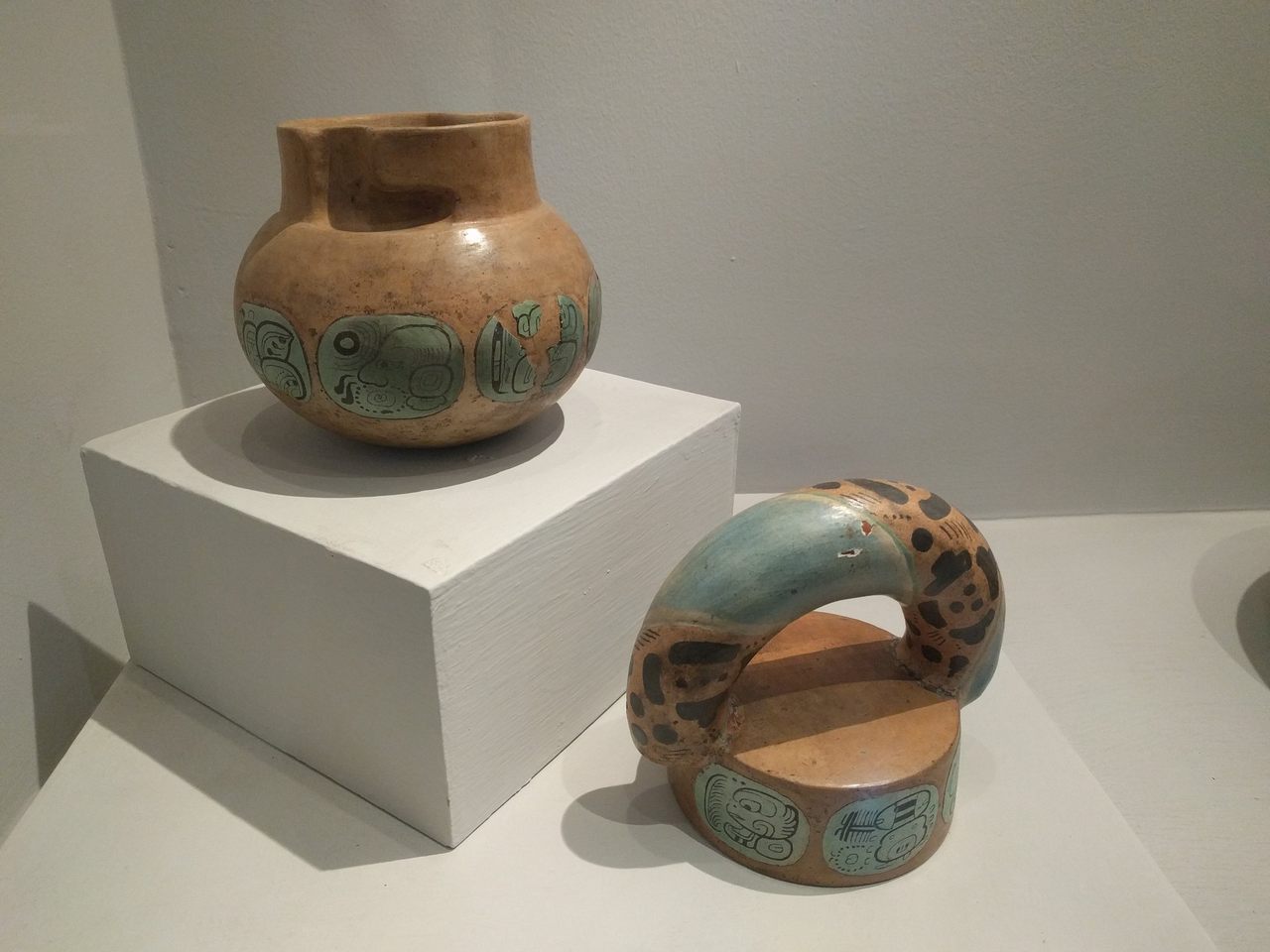
This pot also had a number of Mayan glyphs on the outside, and the excavators called in Mayanist David Stuart to decipher them. “’I was actually the person they brought on to read all of the hieroglyphs that they found in their excavations, which was a pretty cool job to have,’ Stuart says. While Stuart only saw photographs of the pot, he was nevertheless struck by it. ‘Wow, that is one bizarre vessel,’ he remembers thinking. Not only did it have an unusual shape, but the glyphs adorning it were remarkably well preserved. ‘and then it was like, Wait a minute, two of them spell out the word kakaw.’” (Ewbank 2019:2) Kakaw is the Mayan equivalent for our modern word cocoa, one of the few Mayan words that are also common in our modern English.

Chaco canyon cylindrical jars, American Museum of Natural History. Photograph by Marianne Tyndall.

At Chaco Canyon in western New Mexico the archaeologists who excavated Pueblo Bonito found a large number of cylindrical pieces of pottery. “Scientists have long puzzled over the purpose of tall, cylindrical jars found in the northwestern New Mexico site known as Pueblo Bonito in Chaco Canyon. Speculations range from vessels for corn beer or, with skin stretched over the tops, for drums.” (Ehrenberg 2009)

Patricia Crown of the University of New Mexico “had learned of similarly sized jars from some Maya sites that researchers knew were specialty vessels for cacao drinks. (When the symbols on the Maya jars were finally deciphered, they read the equivalent of ‘This is Bill’s cacao vessel’) Crown sent shards from several jars and a pitcher to paper coauthor Jeffrey Hurst, a specialist in analysis of cacao remains with the Hershey Center for Health and Nutrition in Hershey, Pa.” (Ehrenberg 2009) This is the same scientist who had done the analysis for the Mayan pot from the Rio Azul site.

“Using mass spectrometry and high performance liquid chromatography, Hurst analyzed the traces of residue on the jar shards. Cacao has more than 500 compounds, but theobromine gives it away. The chemical could have only come from the cacao plant, a neotropical tree that doesn’t grow north of Mexico. Three of the five shards had traces of theobromine, the pitcher shards did not Crown says.” (Ehrenberg 2009) This analysis, then, seems to provide proof that Mexican cacao was present in the American Southwest.

Indeed, “this is not only evidence for cacao use north of the Mexican border, but, if these sherds are indeed from cylinder jars, it is evidence for how cylinder jars were used in rituals in Pueblo Bonito. At least on some occasions, the jars held a drink made from cacao seeds brought from a great distance.” (Crown and Hurst 2009: 2112)

“Pueblo groups and an ensuing Southwest society traded turquoise for Mesoamerican cacao for about five centuries, from around 900 to 1400, proposes a team led by archaeologist Dorothy Washburn of the University of Pennsylvania in Philadelphia. Surprisingly, large numbers of people throughout Pueblo society apparently consumed cacao, from low-ranking farmers to elite residents of a multistory pueblo.” (Bower 2011)

“Whether Chacoan ritual practitioners appropriated and adapted the use of cacao and cylinder vessels to existing ritual in a way that was uniquely southwestern or adopted a Mesoamerican ritual remains and open question.” (Crown and Hurst 2009: 2112)

If cacao itself was present at Chaco Canyon it could only have been traded in from Mesoamerica, and with the physical presence of cacao, is it not conceivable that the Mayan symbol designating cacao could have come north with it? “Cacao: that is, chocolate. ‘It’s one of the few words we use that is actually Mayan,’ Stuart says. The Maya glyph for cacao, as it appears on the Rio Azul vessel, looks like a fish. But ‘it turns out the fish is a phonetic sign,’ Stuart says. He recognized that the glyph combining a fish (ka), a comb or fin (ka), and the sign for –w(a) was, of course, Kakaw. While Mayanist Floyd Lounsbury was the first to phonetically decipher a cacao glyph a decade prior, deciphering the cacao glyph on a Maya vase was a breakthrough.” (Ewbank 2019)

Fish variant of Mayan glyph for cocoa. Drawing by David Stuart. Internet illustration, public domain.

So the fish provides for the syllable KA, the fin provides another KA, and the small ear-like oval is the W, adding up to KAKAW or cacao.

Head variant of Mayan glyph for cocoa.  Drawing by David Stuart. Internet illustration, public domain.

In another rendering of the glyph the fish is replaced with a head and two fins provide the KA and the KA, with an ear-like oval still providing the W. So. if we are going to find an equivalent to the Mayan Kakaw glyph in the American Southwest we should look for a pair of fin or comb like shapes with the ear-like oval. And I have indeed found at least a couple of examples that just might fill this bill.

Mesa Prieta, Rio Arriba county, New Mexico. Photograph Peter Faris, 14 May 1997.

Mesa Prieta petroglyph, kakaw highlighted on photograph. Peter Faris.

Drawing of glyph, Peter Faris.

My first possibility is found on Mesa Prieta in Rio Arriba County, New Mexico. Two fans or combs are contained in a circle with the oval ear-like oval appended to it, much like the second, or face variant, example of the Mayan glyph.

Taos county, San Luis Valley, northern New Mexico. Photograph Peter Faris, March 1995.

Petroglyphs highlighted on photograph. Illustration by Peter Faris.
Drawing of glyph. Peter Faris.

Another possibility, although somewhat weaker, also has two fans or combs with an ear-like oval, but without the enclosing circle. This one is in the San Luis Valley, in Taos County in Northern New Mexico.

Were these meant to be references to cacao in northern New Mexico? I really do not know, but it is certainly fun to do the speculation.

NOTE: Some images in this posting were retrieved from the internet with a search for public domain photographs. If any of these images are not intended to be public domain, I apologize, and will happily provide the picture credits if the owner will contact me with them. For further information on these reports you should read the original reports at the sites listed below.

REFERENCES:

Bower, Bruce, 2011, Pueblo trade for chocolate big-time, 17 March 2011, https://www.sciencenews.org, accessed 17 September 2022

Crown, Patricia L., and W. Jeffrey Hurst, 2009, Evidence of cacao use in the Prehispanic American Southwest, pp. 2110-2113, PNAS, 17 February 2009, Vol. 106, No. 7, www.pnas.org.

Ehrenberg, Rachel, 2009, Chocolate may have arrived early to U. S. Southwest, 2 February 2009, https://www.sciencenews.org, accessed 15 October 2022.

Ewbank, Anne, 2019, Archaeologists, Mayanists, and Hershey’s Collaborated to Reveal This Ancient Vessel’s Secrets, 21 February 2019, https://atlasobscura.com/articles/mayan-chocolate?, accessed 15 October 2022.

Faris, Peter, 2021, Symbols for Geologic Phenomena in Rock Art – Earthquakes Revisited, 30 October 2021, https://rockartblog.blogspot.com/2021/10/symbols-for-geologic-phenomena-in-rock.html

Faris, Peter, 2015, Wind Symbols in Rock Art of Chaco Canyon, 15 August 2015, https://rockartblog.blogspot.com/2015/08/wind-symbols-in-rock-art-of-chaco-canyon.html 

Saturday, October 21, 2017

IF NOT AN ECLIPSE - PERHAPS ANOTHER SUPERNOVA?


Pictograph, trail to Peñasco Blanco,
Chaco Canyon, New Mexico.
Photo Peter Faris, May 1994.

Along the trail to Peñasco Blanco in Chaco Canyon is the panel that has long been identified as a representation of the 1054 A.D. supernova explosion that was the origin of the Crab Nebula. It is shown as a star or sun with ten prominences or coronal outbursts.


Newly discovered petroglyph,
Chaco Canyon, New Mexico. 
www.colorado.edu, Public Domain.

I recently wrote on the announced discovery of a supposed solar eclipse in Chaco Canyon giving my reasons why I disagree with the discoverers as to it representing an eclipse. Actually, I think it just as likely that this petroglyph represents another portrayal of the supernova observed in 1054 A.D. than an eclipse.

To sum up my previous arguments, the corona and prominences of a total eclipse are really only visible during totality, at which point the sun itself is a featureless dark disk (see rockartblog for August 21, 2017, Solar Eclipse - Lessons Learned and Theories Burned). I would expect that any attempt at a realistic portrayal of a total eclipse would include the ring of the edge of the sun's disk in the center. A supernovae, on the other hand, should be expected to be as bright or brighter in the center than toward the edges, thus, no ring.

What other clues might we look for? The Peñasco Blanco supernova has ten prominences/projections or flames extending outward from the body. This new petroglyph also shows prominences/projections or flames extending outward. On each side and on the lower edge are double lines curling out from the edge in opposite directions. Between those are single lines projecting out from the edge, and, at the top is a more complicated portrayal of curling projecting lines made from double lines. If we count, not the individual lines, but the number of curled projections portrayed, we also get ten (counting each double curl at the top as a single, thicker prominence). Is this significant? I really don't know, perhaps I am stretching it too far. But it might be a possibility that should be considered.


NOTE: An image in this posting was retrieved from the internet in a search for public domain photographs. If any of this image is not intended to be public domain, I apologize, and will happily provide the picture credits if the owner will contact me with them. For further information on these reports you should read the originals at the sites listed below.
                               
REFERENCE:

Faris, Peter
2017   Solar Eclipse - Lessons Learned and Theories Burned, August 21, 2017, http://rockartblog.blogspot.com/2017/09/august-21-2017-solar-eclipse-lessons.html

Saturday, September 2, 2017

AUGUST 21, 2017 SOLAR ECLIPSE - LESSONS LEARNED AND THEORIES BURNED:


Photograph Becky Green Bowman,
August 21, 2012, Knoxville,
Tennessee.

We were lucky enough to reach a location (Wheatlands, Wyoming) to view the August 21, 2017 solar eclipse in totality. I will omit any whining about the traffic, and the price gouging for motel rooms, and will focus on the ideas that came out of
observing this amazing phenomenon.


August 21, 2017 eclipse in partial
phase, the moon's encroachment on
the Sun is not visible. Photograph
Peter Faris, August 21, 2017.

One lesson that was immediately apparent as we watched the eclipse proceed was that the old wife's tale about explorers saving their lives from primitive natives by correctly predicting an eclipse must be totally untrue. As the moon proceeded to cover the sun the appearance of the sun did not vary. The world got dimmer, and cooler, but the brilliance of the remaining portion of the sun made it impossible to see a bright disk being consumed by the dark moon. The sun remained an unbearably bright light in the sky up until literally just a moment before totality. The process of a "sky monster" eating the sun could not, I repeat could not, have been viewed without proper eclipse filters.

I also believe that this would apply to eclipse mythology such as this.
"To the Vikings thought that an eclipse occurred, when a pack of wolves chased the sun across the sky and then captured the celestial orb. Meanwhile in Vietnam, it was a giant frog that devoured our nearest star. And in the Pacific Northwest, the Pomo Indians rationalized that the culprit was a giant bear. Even in ancient China, people believed that a giant dragon was the cause of the sun's demise." (https://owlcation.com/)


Photograph by Becky Green
Bowman, August 21, 2017,
Knoxville, Tennessee.

As was observable during the August 21, 2017 total eclipse, you do not see any sort of diminishing crescent during a solar eclipse, indeed you do not see anything removed from the disc of the sun until it is literally in the "diamond ring" phase of the eclipse immediately followed by the blackened disc of totality.

Pinhole projection of partial eclipse.
Photograph Peter Faris, May 20, 2012.

In order to see the bite being taken out of the sun you either need proper eclipse filters, or you need to use the pinhole camera technique to project its image on a white surface.

This realization should be applied to any rock art identified as a representation of an eclipse. If it shows a crescent it is probably not an eclipse, because the creator of the rock art would not have seen a crescent when observing the eclipse supposedly being pictured.


Raftopolis Ranch, Moffat County,
Colorado. Photograph Peter Faris,
September 1987.


Pecos rock art, Texas. 
Photograph Teresa Weedin.

On February 9, 2013, I posted a column titled A Possible Total Eclipse Of The Sun In Rock Art, showing a petroglyph from northwestern Colorado which shows the sun as a disc surrounded with triangular prominences or flames. This was followed on February 23, 2013, with another posting titled Another Possible Solar Eclipse Symbol In Rock Art about my identification of the Zia Sun Symbol as a possible representation of a total solar eclipse. Both of these cases show a symbol that can be interpreted as the totality stage of a solar eclipse. A definite disc surrounded by rays or prominances.


Chaco Canyon, New Mexico.
Photograph phys.org,
Public Domain.


Chaco Canyon, New Mexico.
Photograph newsweek.com,
Public Domain.

A widely reported recent example of a petroglyph from Chaco Canyon which supposedly illustrates a solar eclipse does indeed show rays or prominences (flames?) around its edges, but it lacks the circle defining the blackened interior of the sun obscured by the moon. For this reason, while I accept it as a possible sun symbol, I certainly cannot accept it as an illustration of an eclipse. To my thinking it just does not fit all the criteria to illustrate a total eclipse.


REFERENCES:

https://owlcation.com/stem/The-Myth-and-Reality-of-Solar-Eclipses

Faris, Peter
2013 A Possible Total Eclipse Of The Sun In Rock Art, February 9, http://rockartblog.blogspot.com/2013/02/a-possible-total-eclipse-of-sun-in-rock.html

2013 Another Possible Solar Eclipse Symbol In Rock Art, February 23, http://rockartblog.blogspot.com/2013/02/another-possible-solar-eclipse-symbol.html