Showing posts with label Nazca. Show all posts

Saturday, October 24, 2020

NEWLY DISCOVERED PARACAS CAT GEOGLYPH WAS LITERALLY UNDERFOOT:


Newly discovered and restored Paracas cat geoglyph, Peru. Internet photo, public domain.

The extensive geoglyphs in the Nazca valley of Peru, known as the Nazca lines were created by the removal of rocks covered with dark desert varnish leaving a lighter colored sandy soil beneath. The passing of millenia and natural erosion processes would tend to make these fade from view, especially if the image had been created on a hillside.

These famous Nazca lines are notoriously difficult to see. At ground level you can only see a small portion of whatever is around you, and you are not allowed to wander around freely among the images. In general the only satisfactory views are either from chartered airplane or from one of the viewing platforms providing a higher vantage point. One of these viewing platforms is on the small hill that sports the cat image. “Archaeologists came across the faded feline outline while conducting maintenance work at the UNESCO heritage site.” (May 2020) Proposed work to upgrade the path led to a closer look that identified the degraded geoglyph on the side of the hill. Upon a closer look workers identified the image of the cat, literally underfoot.


Newly discovered and restored Paracas cat geoglyph, Peru. Photo ancient-origins.net.


Relaxing cat, internet photo, public domain.
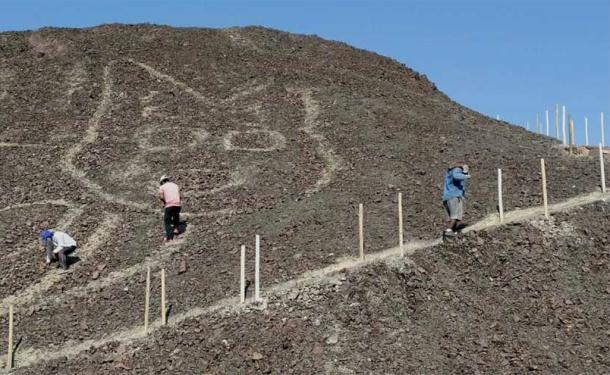

Newly discovered and restored Paracas cat     geoglyph, Peru. Photo ancient-origins.net.

“The Nazca lines, a Unesco World Heritage site, is home to designs on the ground - known as geoglyphs - created some 2,000 years ago. Scientists believe the cat, as with other Nazca animal figures, was created by making depressions in the desert floor, leaving coloured earth exposed. The cat then went unnoticed until plans were recently drawn up for a new path leading to an observation platform. The platform would have provided a vantage point for visitors to see many of the other geoglyphs.” (BBC 2020)


Newly discovered and restored Paracas cat geoglyph, Peru. Internet photo, public domain.

These geoglyphs were made possible by the special nature of the surfaces of the desert ground on the Nazca plain. A light colored soil is pretty much covered with very dark rocks stained by desert varnish. To create an image all the people needed to do was move some of the rocks aside to expose the light soil. However, over the ±2,000 or so years since the cats creation the wind had removed some of the soil and wind and earthquakes may have moved some of the rocks back to obscure the lines. Luckily the restoration process is fairly simple for these images. Once again the dark rocks are moved to the side exposing the lighter colored substrate beneath the rocks. 


Paracas woven textile cats. Internet photos, public domain.

“People created the giant cat figure between 2,500 and 1,800 years ago, according to the chief archaeologist for the Nazca Lines site, Johny Isla. He told Spanish news agency Efe that the cat looks very similar to cat motifs on textiles from the Paracas culture, which flourished in the area between 500 BCE and 200 CE - centuries before the Nazca culture, which usually gets the credit for most of the valley’s geoglyphs.” (Smith 2020)


Pampas Cat, leopardus colocola, Cincinnati Zoo. Public domain.

Since the Precolumbian Americas had no domestdicated cats, this animal represented a natural wild cat species found in the area. "Wild pampas cats, slightly larger than modern house cats, prowled the fields of the Paracas, attacking rodents and insects feeding on a wide array of cultivated crops." (Spivak 2020) Paracas farmers undoubtedly recognized the favor that these felines were doing them in controlling rodent numbers. An agricultural people in such an extreme environment would have been extremely aware of the loss of food to rodents, and they must have felt that wild cats, if not gods themselves, were sent by the gods to help the people. The artist in charge was obviously very familiar with these cats, however, to catch the relaxed pose so convincingly. The longitudinal and crosswise markings on the tail of the geoglyph subtly indicate the natural markings of the pampas wild cat.

Cats were a familiar subject matter to the Paracas people with many examples found in their pottery and weaving, attesting to their importance in the culture. 


Paracas pottery cats, internet photos, public domain.

This wonderful cat is now restored and should be good for another 2,000 years.

NOTE: Some images in this posting were retrieved from the internet with a search for public domain photographs. If any of these images are not intended to be public domain, I apologize, and will happily provide the picture credits if the owner will contact me with them. For further information on these reports you should read the original reports at the sites listed below.

REFERENCES:

May, Tiffany, October 19, 2020, 2,000-Year-Old Cat Etching Found at Nazca Lines Site in Peru, https://www.nytimes.com

Smith, Kiona N., October 19, 2020, A giant cat picture was just discovered among the Nazca Lines, https://arstechnica.com

Spivak, Deborah, July 8, 2020, A Paracas Textile Tribute to Cats, Cloth, and Death, Saint Louis Art Museum, https://www.slam.org

Staff writer, October 1-8, 2020, Large 2,000-year-old cat discovered in Peru’s Nazca lines, BBC News.

Saturday, February 29, 2020

NEW NAZCA GEOGLYPHS DISCOVERED:


New geoglyph discovered
near Nazca,
Credit Yamagata University.

A team from Yamagata University has announced the discovery of 143 new geoglyphs at Nazca, Peru. A paper by Dr. Masato Sakai explained that "The Yamagata University Institute of Nasca was founded in October 2012 in the City of Nasca, Peru. It is the only research group in the world that the Peruvian government gives a permission to conduct on-site field study in the long run. Yamagata University is playing the central role in conducting international collaborative research with the group of specialists in anthropology, archaeology, geography, psychology, information science, conservation science, zoology and chronology." (Sakai)  Sakai was part of the team that also recently identified the species of some of the bird geoglyphs at Nazca which I wrote about on August 10, 2019, and August 17, 2019 with Avian Subjects Identified In Nazca Geoglyphs: Part One - The Hummingbird and the second article Avian Subjects Identified in Nazca Geoglyphs: Part Two - The Others!


Diagram of the new geoglyph
discovered near Nazca,
Credit Yamagata University.

This was made possible by the founding of the Yamagata University Institute of Nasca in October 2012 in the city of Nasca, Peru. "It is the only research group in the world that the Peruvian government gives a permission to conduct on-site field study in the long run." (Sakai)

Researchers have used a number of new technologies in this search. They have used aerial photography from drones as well as airborne laser detection. Perhaps most interesting and important, one of the figures they discovered was actually recognized by analyzing their images with artificial intelligence (AI).


Geoglyph discovered by Watson,
Credit Yamagata University.

"We analyzed high-resolution images of the entire Nas(c)a Pampa, obtained through aerial laser measurements among other methods, and conducted fieldword in the area, 'the researchers said. Through these efforts, we constructed a hypothesis that a thype of biomorphic geoglyph was chiefly produced along some paths situated in the western region of the Pampa.'" (Sci-News 2019)

They have now made a number of major discoveries of unknown geoglyphs. "Archaeologists at the Japanese University of Yamagata report that a long-term study conducted since 2004 has uncovered 143 previously unknown Nazca gdoglyphs, including a figure who escaped human detection and (was) discovered by artificial intelligence." (ScienceNews)

The scientists divided the new geoglyphs into two categorized based on the techniques of their original creation. This also implied two different age groupings of the figures.

"They are categorized into two main types, depending on whether the geoglyphs were made by removing stones to form lines (type A) or to form solid-colored surfaces (type B). Type A geoglyphs date relatively later and were likely created in the Early Nazca period (100 CE to 300 CE). On the other hand, the type B geoglyphs were produced at least during the Initial Nazca period (100BCE to 100CE), if not earlier." (Sci-News 2019)

This may be the first reported instance in which artificial intelligence has aided in rock art-related research and shows it to have great potential in the long run.


Diagram of the geoglyph
discovered by Watson,
Credit Yamagata University.

"The team also used the IBM Watson Machine Learning Community Edition (formerly known as IBM Power AI) to analyze images of the Naz(c)a Pampa and find candidates for new biomorphic geoglyphs. 'We selected a promising candidate from the results and conducted fieldwork at the area in 2019,' the archaeologists said. 
'This led to the discovery of one new figure in the west of the Nazca Pampa. This figure is relatively small, spanning about 16 feet (5m) across, and depicts a humanoid figure standing on two feet. It was likely created during the Initial Nazca period, as it is a type B geoglyph produced by removing stones to form a a solid-colored shape. This newly discovered figure was also situated near a path, indicating that it was likely used as a kind of waypost.'" (Sci-News 2019)

This last sentence somewhat confused me as the way I first read it I thought it meant that Watson used the presence of the path as a clue to look for something in the near vicinity, after re-reading it I have decided that the writer meant it to indicate that the figure may have been intended by its Nazca creators as a waypost/landmark along the path.

I find this report really exciting, the addition of Artificial Intelligence as a tool to locate and record rock art would be an additional possibility and a powerful future tool for preservation, study, and interpretation. I can hardly wait.

NOTES: 1. In quoting from published material I have generally used the spelling of Nazca or Nasca used by the authors. However, in the quotations from Sci-News I corrected a few that were spelled Nasza.

2. Some images in this posting were retrieved from the internet with a search for public domain photographs. If any of these images are not intended to be public domain, I apologize, and will happily provide the picture credits if the owner will contact me with them. For further information on these reports you should read the original reports at the sites listed below.

REFERENCES:

Greshko, Michael
2018 Exclusive: Massive Ancient Drawings Found in Peruvian Desert, April 5, 2018, https://www.nationalgeographic.com/news/2018/04/new-nazca-lines-discovery-peru-archaeology/

Sakai, Masato, Ph.D,
undated     World's Only Research Team on Nasca Lines and Geoglyphs, https://www.yamagata-u.ac.jp/en/research/highlights/lit1/

Science News Staff,
2019 More than 140 new Nazca geoglyphs have been discovered, November 20, 2019, https://scientistsstudy.com/2019/11/more-than-140-new-nazca-geoglyphs-have.html

Sci-News Staff
2019 Archaeologists Discover 143 New Nazca Geoglyphs, November 25, 2019, http://www.sci-news.com/archaeology/new-nazca-geoglyphs-07836.html

Saturday, August 17, 2019

AVIAN SUBJECTS IDENTIFIED IN NAZCA GEOGLYPHS: PART TWO – THE OTHERS!

Last week I began a two-report on a recent paper from the Journal of Archaeological Science: Reports titled “Identifying the Bird Figures of the Nasca Pampas: An Ornithological Perspective” by Masaki Eda, Takeshi Yamasaki and Masato Sakai. Now we will look at some more of their conclusions.


BG-4c, Fig. 4c, identified as a parrot
hatchling. Internet, Public Domain.


Parrot hatchling,
abc.net.au.

“Geoglyph BG-4c (Fig. 4c) was listed as a duck (Lumbreras, 2000). The bill is short and thick, and almost as thick as the head. There is a raised portion on the forehead and an irregular circle at the center of the body trunk. If this feature represents a wing, the birds’ upper limbs are quite short. One short leg is recognizable; it is attached to a wide foot with three toes. The tail is short and equal in length to the bill. The small, wing-like feature of the geoglyph suggests that the bird is a flightless bird or a hatchling. When we assume that the bird was standing or walking, we considered that it may represent a precocial species that is able to stand and walk soon after hatching. Ducks (Anatinae, Anatidae) have bills much thinner than the bill depicted in the geoglyph. Ratites have short wings, although their long legs are completely different from the legs in the geoglyph. Assuming the bird is lying (down), it would be a hatchling of the altricial
species. The short and thick bill, rump-like feature on the forehead, short wings, legs, and tails are recognizable in parrot (Psittacidae) hatchlings (personal communications with Dr. Scott Echols). Although exclusive studies involving parrot hatchlings are required to make this assertion, the geoglyph appears to depict one of these birds.”
(Masaki et. al. 2019:4)

 BG-5b, Aveni's Frigate Bird,
Identified by Masaki et.al. as a pelican.
Illustration from Aveni, Fig. 8a, p. 31.
BG-5b, Fig. 5b, Identified as a pelican,
Masaki et. al., 2019,
used with permission.


Displaying frigate bird,
(fregata-magnificens),
Photograph oceanlight.com
- Public Domain. 


Peruvian pelican, resting with
head and neck down,
(note small feather crest)
Illustration otlibrary.com
- Public Domain.

Their most controversial identifications is the image that they list as BG-5b.

“The crest depicted in the geoglyph (BG-5b) appears in a wide range of taxonomic groups. In Peru, it is found in pelicans, guans and curassows (Cracidae), hawks and eagles (Accipitridae), antbirds (hamnophilidae), and flycatchers (Muscicapidae). Among these birds, only pelicans have long, hooked bills. Assuming that the protruding portion under the head represents the breast, this geoglyph closely resembles a pelican resting on a reef.” (Masaki et. al. 2019:4)

“Geoglyph BG-5b was listed as a guano bird by Lumbreras (2000), but was also identified as a frigatebird exhibiting display behavior based on the presence of a long, hooked bill and the pouch-like throat feature under the bill (Aveni 2000). In Peru and other South American countries, the term “guano bird” is not taxonomically specific, but includes pelicans (Pelecanidae), boobies (Sulidae), and cormorants (Phalacrocoracidae); these birds breed on islands and produce guano, which is a substance composed of deposited excrement and bird carcasses and used as fertilizer [for its nitrates which were also valuable in the production of black gunpowder]. The geoglyph depicts the head and neck or protruding breast of a bird seen from the side. It is characterized by a distinctive crest and an extremely long bill that is hooked at the tip.” (Masaki et. al. 2019:4)

Although Aveni (2000:31) identified this as a displaying frigate bird (and it certainly has the outline of the head and breast of a displaying frigate bird) the frigate bird does not possess the crest shown on the head of the geoglyph. Masaki et. al. have concluded that this is most likely a pelican. Indeed, I can imagine that a pelican with its head and neck tucked back and its breast protruding could look a lot like that. None of the pelican pictures I have seen showed it with such a prominent crest, but there were raised feathers in many of them that could be called a crest.


BG-5c, Fig. 5c, identified as a flying
pelican by Masaki et. al. Internet
photograph, Public domain.


Flying Pelican, BG-5c, Fig. 5c,
Illustration Masaki et. al.
Used by permission.


Flying pelican, Internet
photograph, Public domain.

The next example is also listed as a pelican. “BG-5c was listed as a bird (Lumbreras 2000); the geoglyph depicts a bird with a crest and a long, thin bill that is hooked. Its short tail is fan-shaped, and the legs are not drawn. As stated above, pelicans are the only birds in Peru with crests and long, hooked bills. Although pelicans have long necks, they become folded when the bird is in flight. This makes the neck appear shorter and the throat pouch less conspicuous, as is the case with the bird depicted in the geoglyph. In addition, pelicans completely conceal their legs during. For these reasons we have concluded that geoglyphs BG-5b and BG-5c depict pelicans.” (Masaki et. al. 2019:4)

So, are they correct in their assumptions? I certainly have no reason to question their conclusion about the hermit (hummingbird), but does that mean that the other Nazca hummingbird geoglyphs are hummingbirds (Trochilinae), not hermits (Phaethornithinae), or are they just not classified?

The parrot hatchling seems convincing although there is always the possibility that it is just a generic bird geoglyph, only coincidentally possessing the characteristics that the researchers identified. I am the least confident about the pelicans, especially the apparent lack of the large throat pouch that pelicans possess, and which is not apparent in these geoglyphs, but I am not an ornithologist, so I will bow to their expertise on these.

What I find really fascinating is their observation that none of these birds live anywhere near Nazca today. Although the people would have seen pelicans on trips to the coast, the hermits and parrots live a long way away from Nazca, in the Amazon across the Andes to the east. How do we interpret that? And how far did Masaki et. al. go in looking for matches? There might be a better match just a county farther away. All in all though, these are fascinating questions, and a real contribution to our understanding of some of the Nazca geoglyphs.

NOTE: Some images in this posting were retrieved from the internet with a search for public domain photographs. If any of these images are not intended to be public domain, I apologize, and will happily provide the picture credits if the owner will contact me with them. For further information on these reports you should read the original publications listed below.

REFERENCES:

Aveni, A. F.
2000 Between the Lines: The Mystery of the Giant Ground Drawings of Ancient Nasca, Peru, University of Texas Press, Austin.

Lumbreras, L. G.,
2000 Contexto Arqueologico de las Lineas y Geoglifos de Nasca, UNESCO-INC.

Masaki Eda, Takeshi Yamasaki and Masato Sakai,
2019 Journal of Archaeological Science: Reports, Identifying the Bird Figures of the Nasca Pampas: An Ornithological Perspective, https://doi.org/10.1016/j.jasrep.2019.101875

Saturday, August 10, 2019

AVIAN SUBJECTS IDENTIFIED IN NAZCA GEOGLYPHS: PART ONE – THE HUMMINGBIRD.


Hummingbird geoglyph, Nazca, Peru.
Photo Masaki Eda, used with
permission.

A favorite pastime of rock art researchers has long been trying to identify animal or plant images portrayed in rock art as to species or breed. This can have productive results in learning the appearance and physical characteristics of extinct species, or in gaining information as to the range of animals or plants during certain prehistoric periods, or give insight into the technology and cultural practices of the peoples who created the images. Now, a paper by non-rock art specialists has provided the identities of some of the birds portrayed in the geoglyphs of the Nazca desert of Peru. Masaki Eda, a Zoo-archaeologist, and self-described Archeo-ornithologist, from the University of Hokkaido in Japan, and his colleagues have applied their knowledge to analyze details in some of the bird geoglyphs and identify these with some degree of certainty and the results are somewhat surprising.


Hummingbird geoglyph, Nazca, Peru.
Photo Masaki Eda, used with permission.
Contrast enhanced by Peter Faris. 

In their report in the Journal of Archaeological Science they said “in this study, we identified bird geoglyphs in Nasca and Pampas de Jumana by noting any recognizable morphological traits. We then categorized the geoglyphs from an ornithological perspective and compared the identified characteristics with those of modern birds in Peru. In addition, we compared our identification results with those of other studies.” (p. 2)

“20 bird geoglyphs comprise the largest number of all geoglyphs that depict plants and animals at the Nasca and Palpa pampas. These geoglyphs are mainly considered to have been created during the late Paracas and the Nasca Period (c. 2400 to 1300 years ago).” (p. 1) Some of the figures previously listed as bird figures were virtually unrecognizable, either too distorted, incomplete, or too damaged to classify, but the researchers attempted to identify 16 of them. 


Koepcke's hermit hummingbird, Peru.
neotropical.birds.cornell.edu,
Public Domain.

The most commonly identified birds at Nazca are the hummingbirds. The first bird listed by Masaki et. al. is one of them. Lumbreras (2000) listed two bird geoglyphs as hummingbirds. “The bird geoglyph “3a” (BG-3a; Fig. 3a) was listed as a hummingbird (Lumbreras 2000) Its bill is notably long (almost as long as the rest of the body) and relatively thin compared to the width of the head. Short legs extend from either side of the body trunk, and each foot has three toes. The tail (with an elongated middle section) is almost as long as the body trunk. In the geoglyph, the bill is extremely long, and appears to be depicted in an exaggerated way. While hummingbirds (Trochilidae) have long bills, long tails, and short legs, these traits are also found in hacamars (Galbulidae). The feet of hummingbirds are anisodactyl (i.e., three toes face forward, and one faces backward), while those of the jacamars are zygodactyls (i.e., two toes face forward and two face backward). We, therefore, consider that geoglyph BF-3a more closely resembles hummingbirds. The family Trochilidae consist of typical brightly-colored hummingbirds (Trochilinae) and dull-colored hermits (Phaethornithinae). In Peru, long and pointed tails only occur in hermits (Fig. 3d), whereas the tails of typical hummingbirds are forked or fanshaped. We, therefore, consider that geoglyph BG-3a depicts hermits.” (Masaki et. al. 2019:2)

If this identification is correct it leaves us with an interesting question to answer. Why, of all the varieties of hummingbird to be found in the same area as Phaethornithidae, would the ancient Nazcans  choose to portray the drab hermit instead of one of the brightly colored “flying jewels” that hummingbirds are usually considered to be? A question of the habitat that this bird is found in will be brought up in Part 2.


NOTE: One image in this posting was retrieved from the internet with a search for public domain photographs. If this image is not intended to be public domain, I apologize, and will happily provide the picture credits if the owner will contact me with them. For further information on this subject you should read the original reports listed below.

REFERENCES:

Lumbreras, L. G.,
2000 Contexto Arqueologico de las Lineas y Geoglifos de Nasca, UNESCO-INC.

Masaki Eda, Takeshi Yamasaki and Masato Sakai,
2019 Journal of Archaeological Science: Reports, Identifying the Bird Figures of the Nasca Pampas: An Ornithological Perspective, https://doi.org/10.1016/j.jasrep.2019.101875

Saturday, March 17, 2018

ORCA GEOGLYPH REDISCOVERED AND RESTORED IN PERU:


Orca geoglyph, Palpa, Peru.
thehistoryblog.com
public domain. 

A wonderful geoglyph of what what has been identified as an orca has been found and restored in the Palpa region of southern Peru, near the famous Nazca Lines.
"Archaeologists rediscovered a giant geoglyph of a killer whale, etched into a desert hillside in the remote Palpa region of southern Peru, after it had been lost to science for more than 50 years. The 230-foot-long (70 meters) figure of an orca - considered a powerful, semi-mythical creature in ancient Peruvian lore - may be more than 2,000 years old, according to the researchers. They said it may be one of the oldest geoglyphs in the Palpa region, and older than those in the nearby Nazca region, which is famous for its vast collection of ancient ground markings - the Nazca Lines - that include animal figures, straight lines and geometrical shapes." (Metcalfe 2017)

However, in a strange and ironic twist, its discoverer first located it in Bonn, Germany, and then later relocated it on the ground in Peru. "Archaeologist Johny Isla, the head of Peru's Ministry of Culture in Ica province, which includes the Palpa and Nazca valleys, explained that he saw a single photograph of the orca pattern for the first time about four years ago. He'd seen it while researching studies of geoglyphs at the German Archaeological Institute in Bonn." (Metcalfe 2017)


Nazca pottery orca stirrup
jar, www.wikiwand.com
- public domain.

"The photograph appeared in an archaeological catalog of geoglyphs printed in the 1970s, which was based on research carried out in Palpa and Nazca by German archaeologists in the 1960s, Isla said. But the location and size of the orca geoglyph were not well-described in the catalog, Isla told Live Science in an email. As a result, he said, the glyph's whereabouts in the desert hills of the Palpa Valley, about 250 miles (400 kilometers) south of Lima, were by then unknown to local people or scientists." (Metcalfe 2017)

"After returning to Peru, Isla looked for the orca geoglyph on Google Earth and then on foot. "It was not easy to find it, because the [location and description] data were not correct, and I almost lost hope," he said. "However, I expanded the search area and finally found it a few months later," in January 2015." (Metcalfe 2017)


Nazca pottery orca stirrup
jar, Larco Museum, Lima,
Peru - public domain.

This orca is therianthropic, with a human arm under the lower jaw on the left side. This is a symbol that is common on Nazca pottery. It turns out that many Nazca representations of killer whales possess these humanoid arms, often clutching trophy heads. The number of its fins is also a discrepancy. An actual killer whale has one dorsal and two ventral fins, as well as a tail that ends in a horizontal triangular shape. The geoglyph has five fins showing, three dorsal and two ventral (and there should be a matching pair of ventral fins on the opposite side). Additionally, its tail is notched as if somewhat divided. What these differences might have represented mythologically to the people of that time we probably cannot know.


NOTE: Images in this posting were retrieved from the internet with a search for public domain photographs. If any of these images are not intended to be public domain, I apologize, and will happily provide the picture credits if the owner will contact me with them. For further information on these reports you should read the originals at the sites listed below.

REFERENCES:

Larco Museum, Lima, Peru.

Metcalfe, Tom
2017   2,000 Year Old Killer Whale Geoglyph Found in Peru Desert, November 28, 2017, https://www.livescience.com/61035-ancient-killer-whale-geoglyph-peru.html?utm_source=1s-newsletter&utm_medium=email&utm_campaign=20171128-1s.

thehistoryblog.com

www.wikiwand.com

Saturday, October 1, 2016

HILLSIDE INITIALS AS MODERN GEOGLYPHS:


One aspect of the broader field of rock art is the geoglyph. "A geoglyph is a large design or motif (generally longer than 4 meters) produced on the ground." (Wikipedia) In this posting I am going to present the idea of the modern hillside initial as a geoglyph, and discuss a few examples.


Hummingbird geoglyph, Nazca, Peru.
Image from National Geographic,
Volume 217(3), p.62.

The first images that come to mind when discussing geoglyphs are the Nazca Lines, formed by removing patinated rocks from the ground to create lines and patterns with the lighter material beneath.


Uffington White Horse, Great
Britain. From Wikipedia.


Cerne-abbas giant, Great
Britain. From Wikipedia.

England has its great chalk hillside figures although their ages and provenance are really unknown.

Here, in the United States, a modern manifestation of geoglyphs are the hillside initials overlooking so many towns. According to Wikipedia "hillside letters or mountain monograms are a form of geoglyph (more specifically hill figures) common in the American West, consisting of large single letters, abbreviations, or messages emblazoned on hillsides, typically created and maintained by schools or towns. There are approximately 500 of these geoglyphs, ranging in size from a few feet to hundreds of feet tall. They form an important part of the western cultural landscape, where they function as symbols of school pride and civic identity, similar to water towers and town slogans on highway "welcome to" signs in other regions." (Wikipedia)


Today, the "A" in fall, Fort Collins, Colorado.
From alumni_relations@Mailing.
Advance.ColoState.EDU


Painting the "A", 1923, From  alumni_relations@Mailing.
Advance.ColoState.EDU

My undergraduate Alma Mater, Colorado State University, is represented by a large "A" on the foothills of the mountains west of Fort Collins, Colorado. Before 1957, Colorado State University was Colorado Agricultural and Mechanical College (Colorado A & M), nicknamed the "Aggies", thus the "A". The large "A" was created with rocks and  whitewash on the hill in 1924, and is renewed annually as a rite.


Butte, Montana. Photograph
Peter Faris, June 27, 2016.


School of Mines, Golden, Colorado.
From petroleum.mines.edu

I recently photographed this large "M" for Montana on the hills over Butte, Montana, and another "M" is emblazoned on the side of Lookout Mountain, at Golden, Colorado, for the Colorado School of Mines.

Most discussions of the Nazca Lines, as well as the British Chalk Figures, and indeed  of any prehistoric to antique geoglyphs, make the a priori assumption that they represent a religious or spiritual sentiment of their makers, in other words, the motive for their creation is assumed to be cult related.

I also assume that the motive for the creation of a hillside initial to represent a school is usually tied up with sports enthusiasm for the school's teams, and we all know that a collection of sports fans is pretty much a cult in and of itself. In light of this perhaps we need to reevaluate our opinion of the prehistoric/antique figures, or of the new ones. Do people really ever change?


REFERENCES:

alumni_relations@Mailing.Advance.ColoState.EDU

National Geographic Magazine, Volume 217(3), p.62.

petroleum.mines.edu

Wikipedia

Saturday, May 26, 2012

ANIMAL EFFIGY MOUNDS DISCOVERED NEAR NAZCA, PERU:


Duck-shaped mound, Peru.


Orca Mound with village, Peru.

We are all familiar with the marvelous geoglyphs, the Nazca Lines, in the western desert of Peru. However, a new discovery nearby proves that the Nazca Lines are not the only geoglyphs in that location.

A press release issued on March 29, 2012, by Timothy Wall, of the University of Missouri – Columbia, announced the discovery of animal-shaped effigy mounds near Nazca, in Peru. Writing of the discoveries by University of Missouri Anthropology Professor Emeritus Robert Benfer, Wall stated: “COLUMBIA, Mo. - For more than a century and a half, scientists and tourists have visited massive animal-shaped mounds, such as Serpent Mound in Ohio, created by the indigenous people of North America. But few animal effigy mounds had been found in South America until University of Missouri anthropology professor emeritus Robert Benfer identified numerous earthen animals rising above the coastal plains of Peru, a region already renowned for the Nazca lines, the ruined city of Chan Chan, and other cultural treasures.”

“Benfer identified the mounds, which range from five meters (16.5 feet) to 400 meters (1,312 feet) long in each of the six valleys he surveyed in coastal Peru. The mounds pre-date ceramics and were probably built using woven baskets to carry and pile up rock and soil. “
“Like the Nazca lines, which include a series of giant animal outlines drawn on the ground to the south, the animal mounds were best observed from a higher vantage point. Google Earth images of the mounds revealed the shapes of birds, including a giant condor, a 5,000 year-old orca, a duck, and a caiman/puma monster seen in bone and rock carvings from the area.”


Buzzard-shaped mound, Peru.


Caiman/Puma mound, Peru.

What I find particularly exciting about these animal-shaped effigy mounds is that although Benfer dates them to pre-ceramic periods, their subjects and shapes resemble later portrayals of those creatures on effigy pots, decorated ceramic pots, and even some of the famous Nazca geoglyphs. The imagery persisted over a very long period of time.
“Previously, the only other effigy mounds known from South America were a few sites in the Andes, but Benfer's discoveries may be just the beginning. "In each field season, I have found more giant mounds and more fields of smaller ones. I will go back in June and July confident of identifying more on the ground," Benfer said. Although they appear to be plentiful, researchers overlooked the animal effigies since the first days of scientific archeology in Peru.”

These images still resonate with us today. There is something about the scale of the art at Nazca, the giant geoglyphs on the rocky surface of the desert and now animal-shaped effigy mounds really capture our imaginations. It seems like every time that we relax and assume that all the big discoveries have been made, something else pops up to surprise us.


REFERENCE:
http://www.eurekalert.org/pub_releases/2012-03/uom-ram032912.php
Contact: Timothy Wall, walltj@mizzou.edu, 573-882-3346, University of Missouri-Columbia