Showing posts with label meteor. Show all posts

Saturday, November 14, 2020

PETROGLYPHS SUGGESTING THAT METEORS WERE RECORDED IN ANCIENT MOROCCO ARE QUESTIONABLE:

Ida 1, Photo Abderrahmane Ibhi.

An article in online magazine Meteor News, on January 19, 2019, reported petroglyphs carved into stone recording a meteor fall in Morocco. The find in the rural village of Ida Oukazzou, in the Tiwrare area, about 100 km north of Agadir, Morocco, consisted of three rounded rocks named by the investigators Ida 1, Ida 3, and Ida 3.


Ida 2, Photo Abderrahmane Ibhi.

“The characteristics for Ida1 and Ida2: length 20 cm, width 17 cm, thickness 5 cm and length 18 cm, width 15 cm, thickness 5 cm respectively. These are two pebbles of melanocratic cryptocrystalline quartz sandstone of subcircular form and very flat. They show traces of corrosion and a surface calcification layer consisting of thin platelets of carbonates. After careful cleaning Ida 1 (brushing and vinegar), the only engraved side of this piece offers a spectacular scene of a man and a woman seemingly distraught by the fall of a meteor (Figure 1). Identically on Ida 2, not yet cleared of its gangue of clay and sand and under the secondary precipitation of carbonate layers, we can identify a scene that includes a fleeing anthropomorphic and a huge fireball (Figure 2).” (Abderrahmane et al. 2019:1)

Ida 3, Photo Abderrahmane Ibhi.


              Ida 3 drawing, Photo                                 Abderrahmane Ibhi.

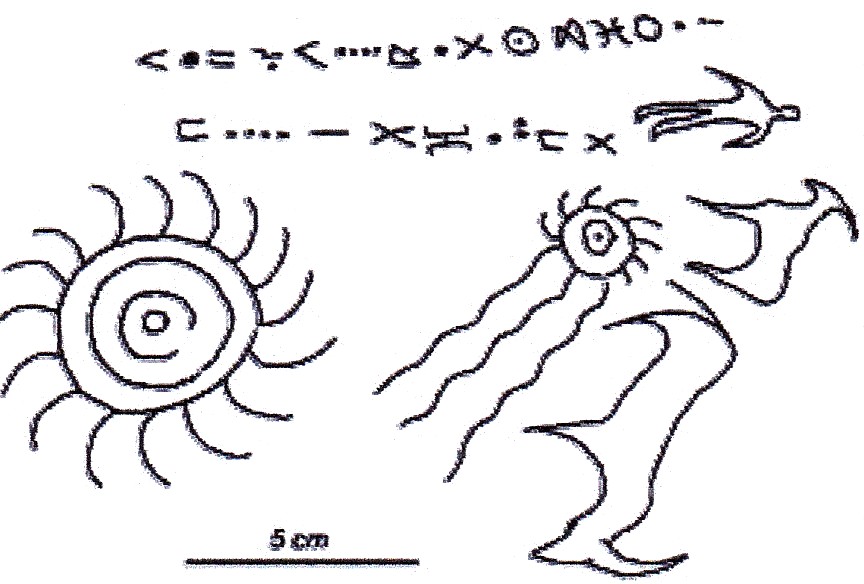
“Ida 3 (length 35 cm, width 27 cm, thickness 12 cm) is a thin, leucocratic sandstone pebble, rather flat and more or less square in shape. After cleaning, Ida 3 symbolizes a scene that includes an anthropomorphic, two cattle of different sized, a meteor and a figurative of the Sun with concentric circles in the center. To complete this ideogram, the artist has arranged two lines of inscriptions with Tifinagh characters with dull incised lines (Figure 3), this showing an image-inscription association which is arranged in the empty interval where it integrates harmoniously. These Tifinagh inscriptions, difficult to translate, are quite old, it is impossible to date them accurately.” (Abderrahmane et al. 2019:2)

Here is where I begin to doubt the whole story. “The astronomical observations reveal that these sculptures are those of a meteor, the three petroglyphs seem to represent the impact of a great meteorite that has frightened the inhabitants and that the artist has certainly experienced this astronomical event spectacular enough to be recorded on the rock.” (Abderrahmane et al. 2019:2)

These just do not strike me as fully believable. They admit to a cleaning with brush and vinegar. This treatment removed the calcite (which might have been datable) and seems to have also removed any patination which have allowed other analyses to be made. There is no mention of the circumstances of the discovery, were they buried, face up or face down, where and when? We are not even given many details of their claimed examination “performed with a binocular magnifier equipped with an integrated digital camera.”  (Abderrahmane et al. 2019:1) Such an examination should have offered clear evidence of tool marks which would have provided a great deal of information. Were I examining a supposed petroglyph with a binocular magnifier with an integrated digital camera I would have photographs of tool marks to help determine questions of possible age and authenticity. From what I can see in the photographs provided I feel the lines are suspiciously even, suggesting that they were created with a metal chisel, but without close-up photographs I can never personally know.

These just do not look believable to me, short of being able to examine the carving and surfaces with magnification I will remain skeptical. Whether the authors perpetrated the fraud, or have been taken in by someone else’s fraud, I also do not know, but I will give them the benefit of the doubt on this one for now and assume that they are naive but innocent, but I just cannot buy it.

NOTE: Some images in this posting were retrieved from the internet with a search for public domain photographs. If any of these images are not intended to be public domain, I apologize, and will happily provide the picture credits if the owner will contact me with them. For further information on this report you should read the original report listed below.

REFERENCE:

Abderrahmane, Ibhi, Fouad Khiri, Lahcen Ouknine, Abdelkhalek Lemjidi, and El Mahfoud Asmahri, 2019 This Discovery of Mysterious Petroglyphs Suggests That a Meteor Has Been Observed in Ancient Times in Morocco, eMeteorNews, Vol. 4, Issue 1, January 2019

Monday, July 1, 2019

METEORS, PHOSPHENES, OR COSMIC RAYS:


Meteor exploding, Shropshire,
England. Photo Nick Jackson.

I am an avid sky-watcher. I have had a life-long fascination with clouds, weather, and the phenomena of the night sky such as meteors and comets. I have to believe that the creators of rock art would have also reacted with fascination to sky phenomena and recorded them, especially meteors. Meteors, however, come in a whole spectrum of sights, from the occasional spectacular fireball (bolide) to the quick little streak that you just aren't quite sure you actually saw.
So, in my mind there are essentially two categories: the "wow, look at that" spectacular meteor, and the "I think I saw a meteor." The first cannot be mistaken, when you see it you know it.

Fouriesbourg, South Africa.
Coimbra, 2009, p. 637,
The Sky On The Rocks.


Fouriesbourg, South Africa.
Coimbra, 2009, p. 637,
The Sky On The Rocks.

Fernando Coimba has written on meteors and comets in rock art, and presents examples of my first category painted by the San people in the Fouriesbourg District of South Africa. These are very convincingly depictions of meteors or comets, it is hard to imagine them being anything else.  


Chumash, Pictographs at the
Burro Flats Painted Cave, California.
Wikipedia, Public Domain.

"Meteors or Comets from Burro Flats, California (USA). This example regards two paintings by the Chumash Indians, consisting one of them on a circle with a tail with four lines and the other on a circle with internal and external rays and also a tail. The astronomer F. Whipple (1985) considers that these engravings depict comets. But according to E. C. Krupp these images have a dynamic appearance suggesting rapid movement and change, being this way more related with meteors than comets." (Coimbra 2009:638)


Barrier Canyon Style rock art,
Head of Sinbad, Emery County,
Utah. Photo Aug. 1993, Peter Faris.

Another possible depiction of meteors is found in a Barrier Canyon style panel at Head of Sinbad, in Emery County, Utah. There four circles can be seen at the right of the panel, approaching the anthropomorphs. These circles have tails behind them seemingly implying motion, or the streak of light behind the meteor.

In his 2009 paper Coimba presents examples that argue that flashes of light seen at night might not represent a meteor. In discussing the San examples he writes "Thackeray (1988) argues that this people associated comets and meteors with flashes of light seen during states of trance. This author based his theory on examples provided by linguistics, but in the same article recognizes that "these questions are difficult to address directly." - I think that although it may exist some connection between astronomical events and trance, I agree more with Fraser when he writes that "Bushmen lived close to nature and would have been acutely aware of any extraordinary happenings in their surroundings . Astronomical events such as comets, supernovae, meteors and bolides probably made a huge impression on these folk."" (Coimba 2009:637)

How many times have you stepped out back late at night to try to catch a meteor shower that has been advertised and experienced the frustration of not knowing for sure whether you really saw that quick flash of a meteor, or just imagined it? Well, perhaps you really saw the flash of light, but it might not have been a meteor. Perhaps you saw a phosphene. The subject of phosphenes as inspiration for rock art has been extensively discussed elsewhere but, in short, phosphenes are shapes or flashes of light seen in the eye in the dark when stimulated by something like pressure on the eyeball. "Phosphenes can be directly induced by mechanical, electrical, or magnetic stimulation of the retina or visual cortex as well as by random firing of cells in the visual system." (Wikipedia) I do not find this explanation very convincing. I know a phosphene when I see it, and I assume others do also, but it is a possibility.

 Or even more interesting, perhaps you saw a cosmic ray.

Some people report seeing flashes in the dark that seem to originate within the eye. These light flashes are a phenomenon that is not totally understood but are apparently stimulated by cosmic rays. This is believed to happen in one of two ways. Either the ray stimulates the retina in the eye or the visual cortex in the brain to signal a flash of light, or the cosmic ray passing through the medium within the eye creates a flash of Cherenkov radiation. "Cherenkov radiation is an electromagnetic radiation emitted when a charged particle (such as an electron) passes through a dialectric medium - -. The characteristic blue glow of an underwater nuclear reactor is due to Cherenkov radiation." (Wikipedia)

As I said at the beginning, I am an avid sky-watcher. I have been lucky enough to have seen a few spectacular meteors in my life, the fireball or bolide that presents a large ball of light that sometimes even breaks apart as if flies. Something like this is impossible to mistake. I tend to credit the astronomical explanation - comets or meteors - as the inspiration for these examples of rock art, but, we should be aware of the other possibilities.

NOTE: Some images in this posting were retrieved from the internet with a search for public domain photographs. If any of these images are not intended to be public domain, I apologize, and will happily provide the picture credits if the owner will contact me with them. For further information on these reports you should read the original reports at the sites listed below.


REFERENCES:

Coimba, Fernando
2009 The Sky On The Rocks: Cometary Images In Rock Art, Quaternary and Prehistory Group, Centre of Geosciences, Congresso International da IFRAQ, 635-646

https://en.wikipedia.org/wiki/Cherenkov_radiation

https://en.wikipedia.org/wiki/Phosphene

Saturday, August 18, 2018

A POSSIBLE RIO GRANDE GORGE METEOR PETROGLYPH:


Petroglyph panel, on the Trail to
Manby Hot Springs, Rio Grande
Gorge, outside of Taos, New Mexico.
Photograph Jerry Hansen.


Arrow pointing out possible
meteor symbol.

I have, on a number of past occasions, speculated on the subject of meteor portrayals in rock art. On May 6, 2009, I posted "When The Stars Fell." On January 18, 2013, I posted "Meteorites." On February 16, 2013, I posted "Meteorites In Rock Art - Continued?" And, on January 17, 2015, I posted "Meteorites In Rock Art - A Possible Portrayal." In these, I made the assumption that something as impressive as a major meteor storm or meteor fall would have been recorded in rock art. Indeed, there are such records in other mediums such as winter counts, so why not in rock art. Now, I have received photos from Jerry Hansen in New Mexico, in the Rio Grande River Gorge southwest of Arroyo Hondo that he suggests as a possible meteor portrayal.


Hansen's interpretation of the
Rio Grande Panel.
Photograph Jerry Hansen.


Tiwa/Tewa Constellations and
Stars. Dorcas, 1997. 

I have not visited this site myself so I know nothing about it directly, but if the location is correct we may be able to deduce some things about it. First, from the location I am assuming that these petroglyphs were probably made by the northern Tiwa or the Tewa speaking Pueblos of the North Rio Grande area. Second, if that symbol does indeed represent a meteorite, the other petroglyphs on the panel likely represent a sky chart showing the constellations of the Tewa or Tiwa people that the meteorite appeared in. Miller (1997) lists many different names for these constellations (and asterisms). Pretty much each group uses a different name for many of them. One that most of the people agree on, however, is Turkey Track, and that appears in the left side of the panel. The other figures on the panel may or may not represent Tiwa/Tewa constellations, but if some correlations could be made here then the possibility that the image in question represents a meteorite would be fairly strong.

So, where do we go from here? Perhaps some anthropology student searching for a thesis project would like to take over and dig into this.


REFERENCE:

Miller, Dorcas S.
1997 Stars of the First People: Native American Star Myths and Constellations, Pruett Publishing, Boulder, Colorado.

Saturday, January 17, 2015

METEORITES IN ROCK ART – A POSSIBLE PORTRAYAL:


Head of Sinbad, Emery County, UT.
Photograph Peter Faris, Aug. 1993.

On May 6, 2009, I posted a column titled “WHEN THE STARS FELL” about the November 12-13, 1833, Leonid meteor storm. On January 18, 2013, in a posting entitled METEORITES I speculated on the possibility of portrayals of meteorite observances in rock art. Then, on February 16, 2013, in METEORITES IN ROCK ART – CONTINUED? I expanded that to associate later Navajo Star Ceilings to the November 12-13 meteor storm of 1833. Now I wish to continue that thread with a Barrier Canyon Style panel (BCS) from Utah which appears to show two figures and a group of four meteors streaking through the sky. The panel in question is one of two remarkably well preserved panels located at Sinbad, in Utah. This site is located in the San Rafael Swell, in east central Utah.

Kenneth Castleton, Petroglyphs and Pictographs of
Utah, Volume One: The East and Northeast, 1984,
p. 133, Fig. 3.36.

This BCS rock art is usually dated by experts at from 6,000 to 7,000 years old. The two figures display the traits of classic Barrier Canyon Style (BCS). The left figure is a standard Barrier Canyon Style (BCS) figure with the goggle eyes, indeed, the eyes of this figure are a little more detailed than usual with what appears to be the iris of the eye portrayed as well. It is accompanied by the floating serpent so common the Barrier Canyon Style (BCS) figures on the  side. The figure on the right of the panel is not a standard BCS figure. It wears an ornate headdress and has a large pectoral on its chest. It has a bird flying just over its right shoulder, a group of small birds or insects flying around its headdress, and it holds a BCS standard plumed serpent in its left hand. Additionally, there are a group of symbols between the two figures above their shoulders which may represent birds seen flying from the front or back instead of in profile, and a row of seven small white figures between the two larger figures at approximately waist height.

Finally, to the right of the right hand figure are a group of four circles which are attached a cluster of lines extending out to the right, and looking like nothing more than four round things flying through the air and leaving a trail behind them. These are the figures that I am proposing as meteors.


1833 Meteor storm in White Swan Winter Count, from
Candace S. Greene and Russell Thornton, 2007, The
Year the Stars Fell: Lakota Winter Counts at the
Smithsonian, Smithsonian National Museum.


These shapes show enough similarity to many of the Winter Count portrayals of the 1833 Meteor Storm that I believe we have to consider the possibility that they too represent a group of meteors flying through the sky. They could either represent a dense meteor shower or storm (similar to the 1833 example, although BCS rock art is many thousands of years older), or a large meteor that has broken up into four pieces in the atmosphere. In Fall of 2012 I was lucky enough to observe a large fireball in the sky. As it fell pieces broke off and became smaller points of light on their own. This is known as a bolide and the pictographs at Sinbad could represent an effective attempted portrayal of that phenomenon.

It is also possible that these were meant to represent birds. Between the two figures are a half dozen small circles with lines sticking out on both sides, very like the possible meteors. These resemble birds seen from the front or back so that a wing is seen sticking out on both sides of the round body. These shapes are not included in Castleton's drawing but can be clearly seen in the photograph. We must keep this in mind as a possibility. I suggest that it is more likely however, that these are meant to be other meteors so what we are seeing is a proper meteor storm.

And, of course, not being able to resist the irony in the situation, you have caught me stating that this rock art panel illustrates four Flying Objects that are Unidentified, but I would much rather conclude that they are a meteors or a bolide than UFOs. 

SOURCES:

Castleton, Kenneth B.,
1984    Petroglyphs and Pictographs of Utah, Volume One: The East and Northeast, Utah Museum of Natural History, Salt Lake City, Fig. 3.36, p. 133.

Greene, Candace S. and Russell Thornton
2007    The Year the Stars Fell: Lakota Winter Counts at the Smithsonian,  Smithsonian National Museum.

Saturday, February 16, 2013

METEORITES IN ROCK ART - CONTINUED?


On January 18, 2013, I posed the question “can we identify meteorites or meteorite falls in rock art?” Although I have been looking for some time I have not, as yet, been able to identify any image that I can realistically state might represent a meteorite. However, there are examples of images of meteors and meteorites in Native American art that we might use as models in our search.


Lone Dog winter count, painted on buffalo hide.

In their wonderful 2007 book The Year the Stars Fell: Lakota Winter Counts at the Smithsonian, Candace S. Greene and Russell Thornton illustrate the imagery used by Lakota artist/historians to record each year in Winter Counts, kept as a historic record of the tribe or clan.  For the year 1821-22, many winter counts use the symbol of a star with a tail or line behind it. This records a large meteor that passed over Lakota territory from the southeast to the northwest, and reportedly exploded with great noise over Dakota Territory.

They provide illustrations of this drawn in the Lone Dog winter count, The Flame winter count, The Swan winter count, Long Soldier winter count, Cloud Shield winter count, Rosebud winter count, and Battiste Good winter count, and each example is a variation of the star with a line extending from it.


1821-22, Lone Dog Winter Count.
Greene and Thornton, 2007.


1821-22, Long Soldier Winter Count.
Greene and Thornton, 2007.


1821-22, Battiste Good's Winter Count.
Greene and Thornton, 2007.

In viewing these remember that the direction of the line may indicate where it passed overhead in relation to the observer. To understand this, think of an airplane contrail above you in the clear sky.  Thus, in the examples by The Flame, Rosebud, Cloud Shield, Lone Dog, and the one procured from Major Bush, the line is beneath the star suggesting that it was observed somewhere toward the horizon for the viewer and appeared to rise upwards as it approached the zenith. Long Soldier’s image shows it passing from right to left suggesting that he was to the south of its apparent track and he saw it going from right to left in the northern sky. Battiste Good’s drawing shows the meteorite on a generally downward path suggesting that from his viewing point the meteorite appeared generally above him, and he saw it as if descending toward the  horizon.

As I stated above, I personally know of no rock art imagery that fits these descriptions, however, that certainly does not mean that they are not out there. Indeed, given that so many illustrations of this event were created on hide and muslin in Winter Counts, the surprise would be if there were no rock art examples created also. If you know of any please send me a photo and let's get it posted.

And if you find this of interest check my PowerPoint WHEN THE STARS FELL - the 1833 meteor storm  listed in the right sidebar of this page.

REFERENCES:

Greene, Candace S. and Russell Thornton
2007    The Year the Stars Fell: Lakota Winter Counts at the Smithsonian, Smithsonian National Museum.

Friday, January 18, 2013

METEORITES:


Willamette Meteorite, From Let's Investigate Meteorites, by Madelyn Carlisle.

A couple of months ago while driving home after dark I was lucky enough to observe the breakup and burning of a good sized fireball in the sky. Instead of being just the little streak of light of most meteors this one was large enough to have shape and to see burning pieces splitting off it and burning up. Any part of this that survived to reach the ground would be designated a meteorite.


Photograph of a Navajo star ceiling from the Internet.

With astronomical phenomenon known to have been of importance in Native American culture, are there any indications of representations of meteorites in rock art? On May 6, 2009 I published a post titled “When the Stars Fell” about the November 12-13, 1833, Leonid meteor storm. I suggested that the multitude of star representations in later (post-1833) Navajo star ceilings might have been influenced by this meteor storm. That was about a phenomenon that was essentially worldwide. Here I am speculating about any rock art records of a local meteorite fall, something that would have greatly impressed the local people.

The largest meteorite found in the United States is named the Willamette, because it was found in Oregon’s Willamette Valley. The Willamette is an iron-nickel meteorite and weighs 28,000 pounds, the sixth largest in the world. The local tribe of Native Americans, the Clackamas Indians called it “Tomanowos” (Visitor from the Moon) and believed it has spiritual powers. “Before going into battle, the warriors dipped their arrows and washed their faces in the rainwater that collected in hollows in the huge stone from the sky”. (Carlisle 1992:13)

"Since there was no impact crater at the discovery site; geologists believe the meteorite landed in what is now Canada or Montana, and was transported as a glacial erratic to the Willamette Valley during the Missoula Floods at the end of the last Ice Age (~13,000 years ago). The meteorite is currently on display at the American Museum of Natural History, which acquired the meteorite in 1906." (Wikipedia 2010)

"The meteorite was apparently venerated by the Native American tribe inhabiting the area where it was found. The Confederated Tribes of the Grand Ronde Community of Oregon, a confederation of Native American  tribes, used the meteorite in ceremonies and have demanded that it be returned. They filed a NAGPRA action (Native American Graves Protection and Repatriation Act) against the American Museum of Natural History in 1999 to this end. In response, the Museum filed a federal lawsuit seeking a declaratory judgment against the Grand Ronde in 2000. An agreement with the Museum was reached later that year in which the meteorite would remain at the museum with tribal members being able to conduct a private ceremony around the meteorite once a year, and that ownership will be transferred to Grand Ronde should the museum cease to have the meteorite on display." (Wikipedia)


A name like “Visitor from the Moon” suggests to me that the fall of the meteorite was witnessed and that its track had seemed to originate near the moon in the sky. At least that seems to be the most logical reason for an association with the moon, of course it is possible that the Clackamas people generally associate anything that seems out of place or different from the norm with an origin from the moon, but that seems unrealistically imprecise. So here is the problem, if it fell in Montana or Canada, and not in the Willamette Valley why would it have been given a name that associated it with the moon?

An inquiry with D. Russell Micnhimer of http://www.oregonrockart.com elicited the fact that there are no known examples of rock art in the Willamette valley that would seem to portray a meteorite fall, so where did the designation of “Visitor from the Moon” come from? 

Another example of a meteorite that was associated with ancient peoples in North America is known as the Mesa Verde meteorite which was found in the Sun Shrine ruin at Mesa Verde in Colorado (Matthews 2000:30). Found in 1922, it weighs 3.52 kilograms and is classified as octahedrite in composition. The location in the Sun Temple ruin suggests that it had been placed there by Ancestral Puebloan people who lived at Mesa Verde.


Paquime meteorite in the Smithsonian Institution. 
http://www.curiousexpeditions.org/?p=547.

Another meteorite was found carefully preserved in the ruins of Paquime. “Paquime is famous among astronomers for its 1,500-kilogram meteorite, discovered by looters in a “temple” at the ruin, in the 1860s. The extraterrestrial omen is now in the Smithsonian. Does the Spanish retelling of obscure Native tales describe some aspect of the founding of Paquime and of the migrations of the Chichimec tribes out of the north?” (Lekson 2008:214) “Many Hopis think that Paquime was their Red City, Palatkwapi. The Red City was overthrown by earthquake and flood (according to Courlander), or by strife among the clans, ending in siege, destruction, and escape (according to Waters) – or by other means, not known to these two often discredited chroniclers of Hopi History. But it seems that the Red City died hard, with calamity and violence.” (Lekson 2008:214)

“When Onate’s conquistadors marched to New Mexico through Chihuahua in 1598, they recorded stories of Native peoples – tribes unknown today and languages perhaps gone. One of those stories told of two large groups of people – warriors, women, children – marching boldly out of the north from the Pueblo region, led by two brothers. On their journey to the south, they encountered an immense “mass of solid ore . . . so smooth and polished and free from rust as though it were the finest Capella silver.” A terrible hag carried this huge rock, which she “hurled . . . through the air with the speed of a lightning bolt.” After that she vanished. “No sooner had this missile struck the ground than the whole earth trembled.” One brother took this portent as a sign to found a city (or, in another version, to turn around and head back north!), which the Spaniards later saw on their march north as “the ruins of a great capital.” The second brother led his group southward into central Mexico, and they were lost from memory.” (Lekson 2008:214)

I would like to suggest that rock art enthusiasts might wish to look over their body of rock art images with an eye toward anything that might imply connection with falling from the moon or sky, and let me know if you find anything.

REFERENCES:

Carlisle, Madelyn Wood
1992    Let’s Investigate Magical, Mysterious Meteorites, Barron’s Inc., Hauppauge, NY.


Lekson, Stephen H.
2008    A History of the Ancient Southwest, School for Advanced Research, Santa Fe, NM.

Morgan, Matthew L.
2000    The Handbook of Colorado Meteorites, Colorado Geological Survey, Denver.

Wednesday, May 6, 2009

WHEN THE STARS FELL!

November 12, 1833, meteor
storm over Pennsylvania,
contemporary woodblock print.

On the night of November 12-13, 1833, the skies were lit by a storm of meteors. This entered the records of Anglo astronomers as an extreme manifestation of the annual Leonid meteor shower, but was remembered by Native American observers as the "Night the Stars Fell". The Leonid meteor shower is an annual display, which occurs in, mid-November and is usually a rather sedate display (Moore 1965:209). This annual show is caused by material from comet Tempel-Tuttle. Roughly every thirty-three years, however, the display is extreme.

Estimates of the frequency of meteors in this storm run in the neighborhood of tens of thousands per hour. Among the preponderance of people who did not expect this occurrence the range of responses would have run the gamut from wonder to terror. Among Native Americans the night the stars fell has been remembered in historical records, especially in the winter counts produced as records by the tribes of the Great Plains.

Lone Dog Winter Count,
Lone Dog, Yankton Lakota,
collected in 1876.
The pictogram for 1833-4 is low
in the picture, to the left of center, comprising
a crescent moon surrounded by stars.

The first Winter Count known to Anglos was Lone Dog’s Winter Count, which started with the year A.D. 1800-01. Lone Dog was a Yankton Lakota who painted his record on a buffalo robe, starting in the middle and spiraling counterclockwise outward. His Dakota name was Shunka-ishnala, which translates as dog-lone. Lone Dog was not of sufficient age in 1800 to have started painting this count. Either he inherited this project from a predecessor or he gathered his earlier traditions from tribal elders and worked back. Lone Dog’s record for the winter of 1833-34 shows a cluster of red spots around a black crescent moon (seen in the lower left quarter of the illustration) and represents the meteor storm of November 12, 1833. The Lone Dog calendar was collected in the fall of 1876 by Lt. H. T. Reed of the First U. S. Infantry, while he was stationed at Fort Sully in Dakota Territory, just North of present Pierre, South Dakota. “Reed used black and red ink to trace the pictographs onto a square of cotton cloth, working from a duplicate of the buffalo hide calendar of Lone Dog. The cloth copy traced by Reed was used as the basis for the image of Lone Dog’s calendar seen in Mallery’s “A Calendar of the Dakota Nation”. The cloth was photographed and then superimposed onto a buffalo robe, thus re-creating the original winter count kept by Lone Dog. The present location of Reed’s copy is not known, and the photograph in Mallery’s papers is the only known image of it." Many various copies of Lone Dog’s Winter Count are know in various media, on hide, cloth, and paper.

This event turned out to be a boon for students of Native American art because it was such a significant event that it was used to portray that year in almost every known winter count. This means that there is a single, known fixed point that can be used to align other winter counts and allow students to extend the scale in both directions.

So, what does this have to do with rock art? I cannot believe that an event which had such an impact on the Native American cultures would only have been pictured in winter counts. Polly Schaafsma believes that only half of the Navajo star ceiling panels were created before the date of the Night the Stars Fell. This means that the other half would have been created later. Given its impact is it not reasonable to assume that many of the latter star ceilings would represent that amazing night?

Star panel, Picture Canyon,
Baca County, Colorado.
Photo: Mike Maselli.

Beyond that, as we know the interpretation of rock art records from the past can be modified or changed by later cultures, according to their interests or needs. After the night of November 12-13, 1833, I am pretty sure that anyone who saw a rock art panel with recognizable star images would have associated it with The Night the Stars Fell. So that might not have been the original intended meaning of the rock art panel, but it could well have been believed to be the meaning of the panel when interpreted by later cultures.

So now we have the question of what does a rock art panel really mean, and to whom? If a petroglyph that had been created with a specific intended meaning by an early culture, but was generally understood by a later culture to have a different meaning, what does it mean? Does it carry the old meaning, the new meaning, neither, or both? I believe that in total, it has to be considered as to now carry both meanings.

A very interesting book on this subject is The Year the Stars Fell: Lakota Winter Counts at the Smithsonian.

Another interesting book on the astronomical knowledge and beliefs of Native Americans is Stars of the First People: Native American Star Myths and Constellations.