Salmon jumping a waterfall. Internet image, public domain.
Improved
analytical techniques have made it possible to trace hominin use of fish for
food back a considerable distance in the historical record. In 2011 Hardy and
Moncel wrote about fish remains associated with Neanderthal occupation 125 –
250,000 years ago.
“Fishing and fowling
are often used as markers of modern human behavior, despite their remains
having been reported from numerous early hominin (as far back as 1.95 Ma) and
Neanderthal sites. In fact, fishing is difficult to detect in the
archaeological record for several reasons: 1) many coastal sites are lost due
to rise in sea level; 2) fish bones are fragile and may be lost due to
taphonomic processes; 3) many fish bones are small and may require specialized
recovery techniques; and 4) the widespread assumption that fishing is a modern
human behavior may lead investigators not to look for evidence in the first place.
The argument that Neanderthals did not fish has recently been bolstered by stable
isotope research that suggests that Neanderthal dC13 values do not match those
of fish. This evidence must be treated with caution, however, as dC13 for fish
can vary greatly, particularly from freshwater fish.
Sites with possible evidence of Neanderthal
consumption of fish include Milan, Almada and Abreda Caves, Spain, Grotte XVI,
France, Devil’s Tower and Vanguard Cave, Gibraltar, Raj Cave, Poland, Grotta
Maggiore, Italy, UstKanskaya Cave, Siberia, and Figueira Brava Cave, Portugal.
Evidence at these sites includes the recovery of osteological remains, fish
bones in association with hearths, and cut-marks on fish bones. At Payre,
residues and use-wear indicative of fish are found in the absence of
osteological remains. Fish may have been processed off-site (at local streams
or rivers), and the tools returned to the site or fish may have been processed
on site but the bones did not preserve. In Level Fa, all of the artifacts with
fish residues are located in one square meter near the wall, a possible indicator
of a specialized intrasite activity area. These results highlight the
difficulty in recognizing fish consumption archaeologically and suggest that
fish consumption by Neanderthals may be underrepresented. The growing list of
sites with fish remains as well as the detection of fish processing in the
absence of fish bones at a site further suggests that fish consumption should
not be seen as exclusively in the domain of modern humans.” (Hardy and Moncel 2011:7-8) I know of no
rock art of fish attributable to Hominin (including Neanderthal) sources but we
now know they procured them somehow and ate them.
Hardy et al. (2013:30)
again reported on fish remains at Abri du Maras. Remains found there include
bones and scales of chub and perch. “Estimated
body weights range between 550 and 850 g. Few predators are able to catch and
carry fish of this size. Hence, the possibility of Neanderthals as predators
cannot be discarded, and the presence of these fish remains in layer 4 may be
considered the result of anthropic activity. Once again, the combination of
residue and zooarchaeological analyses provides corroborating evidence and
strengthens the case of Neanderthal fishing.” (Hardy et al. 2013:30) So
Neanderthals caught and ate fish, probably including salmon, but as far as we
know they did not leave any images of fish in rock art.
Salmon carving in Abri Poisson Cave, France. Internet image, public domain.
Salmon carving in Abri Poisson Cave, France. Showing attempted removal of the carving from the cave ceiling. Photograph Heinrich Wendel.
Then we reach the
Paleolithic Period and the high point of cave art. Abri du Poisson (Fish
Shelter) is known for a beautiful relief carving of a salmon. A series of holes were drilled
around the fish and chiseling had begun to undercut that section when the
vandals were discovered and saved. The damage can be seen in these photographs
of the panel in situ. “The shelter is discovered by Paul
Girod in 1892 which recognizes an Aurignacian level .
It was not until 1912 that Jean Marsan identified the superb fish that made the
site famous. Represented life-size (1.05 m ), it is
engraved and carved in low relief on the ceiling of the vault, highlighted with
red color. It is a becquart salmon, with its jaw turned up; the attitude is
characteristic of the male exhausted by spawning. The theme is rare since
only a dozen fish have been identified in Paleolithic cave art. Other
parietal works have since been identified by Christian Archambeau and Alain
Roussot, including a black negative hand and incomplete animal engraved
figures.The attribution of these works to the Gravettian (- 25 000 years) is likely; it makes engraved
salmon one of the oldest representations of fish known in the world, possible
testimony of prehistoric fishing activities.” (Wikipedia)

Carved reindeer antler. Lortet, Hautes Pyrenees, France. Internet image, public domain.
Somewhat
later, during the Magdalenian Period (18,000 to 15,000 BC), an artist produced
a carving on reindeer antler of wading or swimming reindeer with salmon swimming around their legs
which was recovered from the Grotte de Lortet in France.
Broken carved bone salmon. Grotte de Lortet, France. Internet image, public domain.
Maz, D'Azil, France. Image from www.donsmaps.com.
Other
carvings of salmon include a broken fragment of bone with the head of a salmon
at one end, and a broken spear thrower with a salmon carved into it. One might
almost be tempted to assume it was intended for spear fishing.
There are
also representations of other fish in European Cave Art, indeed elsewhere in
the world as well, but I am focusing on salmon in this column.
Closer to
home, the culture of the Pacific Northwest Coast tribes of North American
relied to a great extent on the availability of salmon.
“Salmon are an essential component
of the ecosystem in Tsleil-Waututh Nation’s traditional, ancestral, and
contemporary unceded territory, centred on present-day Burrard Inlet, BC,
Canada, where Tsleil-Waututh people have been harvesting salmon, along with a
wide variety of other fishes, for millennia. Tsleil-Waututh Nation is a Coast
Salish community that has called the Inlet home since time immemorial. This
research assesses the continuity and sustainability of the salmon fishery at
təmtəmíxʷtən, an ancestral
Tsleil-Waututh settlement in the Inlet, over thousands of years before European
contact (1792 CE). We apply Zooarchaeology by Mass Spectrometry (ZooMS)
analysis to 245 archaeological salmon vertebrae to identify the species that
were harvested by the ancestral Tsleil-Waututh community that lived at təmtəmíxʷtən.
The results demonstrate that Tsleil-Waututh communities consistently and
preferentially fished for chum salmon (Oncorhynchus keta)
over the period of almost 3,000 years. The consistent abundance indicates a
sustainable chum salmon fishery over that time, and a strong salmon-to-people
relationship through perhaps 100 generations. This research supports
Tsleil-Waututh Nation’s stewardship obligations under their ancestral legal
principles to maintain conditions that uphold the Nation’s way of life.” (Efford et al. 2023) Burrard Inlet,
British Columbia, is on the east side of the Strait of Georgia, where the
modern city of Vancouver is located. Approximately 40 miles west across the
open water is Nainamo on Vancouver Island, British Columbia, Canada. These are
both in the Coastal Salish culture group.
“Tsleil-Waututh is a distinct,
Indigenous Coast Salish nation whose ancestral and contemporary territory is
centred on səlilwət, part of the inlet ecosystem that is now also known as
Burrard Inlet, British Columbia, Canada. Since European contact in 1792 CE,
colonial development and resource extraction have driven dramatic change and
development in Tsleil-Waututh territory to the extent that today it includes
Canada’s busiest port and metropolitan Vancouver, a city of 2.5 million people.
Consequent damage to and loss of vulnerable ecosystems, habitats, and animal
and plant populations have impacted Tsleil-Waututh ways of life and greatly
reduced their ability to harvest important traditional foods. Despite these
impacts, the area is rich with archaeological evidence of Tsleil-Waututh’s
relationship to the lands and waters throughout their territory and confirms
Tsleil-Waututh oral histories and traditional knowledge of continuous
connections to land, waters, plants, and animals.” (Efford et al. 2023)
“Both oral histories and the
archaeological evidence identify chum as being particularly important for
Tsleil-Waututh communities over the millennia. The consistency of the
comparative abundance of salmon species across time suggests that
Tsleil-Waututh Nation’s chum salmon fishery was a stable and sustainable salmon
fishery, maintained over the course of almost 3,000 years. We would expect to
see a drop off in the abundance of chum salmon over time, or a switch to
another species as the most abundantly harvested, if the fishery had been
unsustainable, or if there had been a major ecological impact. Instead, through
this work as others, we see consistent use of salmon, particularly chum salmon,
as well as herring, anchovy, and eulachon over millennia.” (Efford et al. 2023)
In their 2018 article on rock art of the Tsleil-Waututh
people Arnett and Morin purposely avoided ascribing any particular identities
or meanings to the imagery, focusing instead on their cultural significance of
marking important locations to the Tsleil-Waututh people.
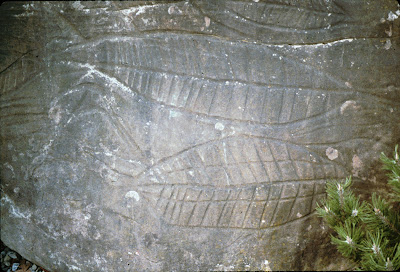
Nanaimo, Vancouver Island, British Columbia, To Welcome the Salmon Back From the Sea, removed from Jack Point, Vancouver Island. Photograph J&E Faris, 1992.
“In this article we
have described the specific historical and cultural context of rock art
production in the territory of one Coast Salish group. The rock paintings
are best understood in terms of marking culturally significant places in the
Tsleil-Waututh landscape so that future generations might know their significance.” (Arnett and Morin 2018) Their paper included no
illustrations that could be identified as images of salmon. As I stated above,
however, as a branch of the Coastal Salish culture they were culturally related
to the people who produce other rock art of the area. One particularly
important concentration of Salish is found at Nainamo on Vancouver Island, and,
at Nainamo, there are images of salmon. These are on a boulder that was
recovered from Jack Point in Vancouver Island, which is just a few miles to the
east of Nainamo. This petroglyph panel on this boulder shows a group of salmon,
supposedly to welcome the return of the salmon to begin their spawning run.
So, we find that across the Northern Hemisphere, and
through a period of tens of millennia, salmon were considered a valuable food
source and were of great spiritual and ceremonial significance.
NOTE: Some images in this
posting were retrieved from the internet with a search for public domain
photographs. If any of these images are not intended to be public domain, I
apologize, and will happily provide the picture credits if the owner will
contact me with them. For further information on these reports you should read
the original reports at the sites listed below.
REFERENCES:
Choi, Charles Q., 2011, World’s Oldest Fish Hooks Show Early Humans Fished Deep Sea, 24
November 2011, https://www.livescience.com.
Accessed online 30 August 2023.
Efford, Meaghan et al., 2023, Archaeology demonstrates sustainable ancestral Coast Salish salmon
stewardship over thousands of years, 25 August 2023, https://journals.plos.org. Accessed online 31 August 2023.
Hardy, Bruce and
Marie-Helene Moncel, 2011, Neanderthal Use of Fish, Mammals, Birds, Starchy Plants and Wood 125 –
250,000 years ago, August 2011, Plos ONE 6(8),
DOI:10.1371/journal.pone.0023768. Accessed online 13 September 2023.
B.L. Hardy et al., 2013, Impossible Neanderthals? Making String,
Throwing Projectiles and Catching Small Game during Marine Isotope Stage 4
(Abri du Maras, France), Quaternary Science Reviews 82 (2013) 23-40.
Accessed online 13 September 2023.
Arnett, Chris and Jesse Morin, 2018, The Rock Painting/Xela:Is of the Tsleil-Waututh: A Historicized Coast
Salish Practice, Ethnohistory 65:1, American Society for Ethnohistory.
Accessed online 16 September 2023.
Walls, Alex, 2023, Salmon bones confirm sustainable chum fishery for 2,500 years under
Tsleil-Waututh Nation, 20 August 2023, https://phys.org.
Accessed online 30 August 2023.
Wikipedia, Fish
Shelter, https://fr.wikipedia.org/wiki/Wikip%C3%A9dia:Accueil_principal.
Accessed online 30 August 2023.




 National Geographic, Vol. 209 (2). Photo: Steve Winter.



 Posts

