The philosophical search for shadows and the question of their existence in rock art:
Aurochs, horse and deer, Lascaux Cave, France. Internet image, public domain.
The idea for this began with an article from the online site JSTOR Daily dated 1 December 2021, by Roy Sorensen titled "Do We Actually See Shadows?"
Sorensen approached this as a philosophical question beginning with Fridugisus of Tours in the 8th century who wrote "a short treatise which deals with the nature of nothing and darkness. The epistle was written probably during the author's residence at Tours. It is addressed "to all the faithful and to those who dwell in the Sacred Palace of the most serene prince Charles (Charlemagne). It dealt with the question, are nothing and darkness real things? (Some suggest that this was inspired by the Biblical use of the words in the first chapter of the Book of Genesis). If the Bible uses the words 'nothing' and 'darkness', it seemed that there must be things corresponding to those words. Fridugisus accepts this answer and defends it both by arguments from authority and by arguments from reason." (Wikipedia) Is nothing or nothingness a real thing, and is darkness a real thing in and of itself"
Sorensen, in effect, was asking that if a shadow is composed of the absence of light, how can we see the presence of the absence of something? In other words, we see because of the light illuminating the things around us. How can we see something it is not illuminating? He goes to considerable historical detail referencing, among others, Plato's "Allegory of the Cave." He brings in the Metaphysical with the question if you spin a ball does the shadow of the ball spin?" Some say "yes." but can you see the shadow spinning?
Sorensen gets deeper with this but what drew my attention was his reference to Medieval artists who did not paint shadows. He stated "Shadows were fringe phenomena in the Dark Ages. They are rarely depicted in the era's paintings. Perhaps the artists portrayed only what they believed to be visible." (Sorensen 2021) This can be checked and I did so, searching online for public domain medieval paintings.
The
Trinity (detail) in Saint Augustine’s City of God”, about 1440–50, Master of
the Oxford Hours. Tempera colors, gold and silver paint, and ink on parchment,
14 ¼ x 10 ¾ in. (36.2 x 27.3 cm). The J. Paul Getty Museum.
A few, very
faint traces of shadows beneath the figures. Shading on the figures, yes, but
they cast no shadows in their environment.
“Saint
Martin Dividing His Cloak” in the Prayer Book of Charles the Bold, 1469, Lieven
van Lathem, made in Ghent and Antwerp. The J. Paul Getty Museum.
Likewise, shading within the elements of the painting, but no cast shadows.
Medieval
women hunting. Internet image, public domain.
And again, no shadows cast by the
women and their dogs in the environment.
Now
since I warp everything toward the question of how it applies to rock art I
began looking for examples of rock art that somehow portrayed shadows. I looked
at examples from literally all over the world (my photos, books, online) but
could find no instances of what can be identified as a shadow. Then I
remembered that I had done a column on counter-shading on the images of horses
in European Cave Art back in January 2022, so I went back to my own notes.
Torch illuminating a cave. Image from Medina-Alcaide et al., 16 June 2021.
In
looking at my file for that article I found the paper by a team of Spanish
researchers on cave lighting. This simple, but clever, experiment used a
variety of sources of fire to illuminate a cave, one of which was a hand-held
torch. Others were things like small fires on the floor of the cave and animal
fat lamps. To my way of thinking the hand-held torch would give the most
dramatic effect.
I
started looking at the Paleolithic paintings of animals in European Caves, such
at Lascaux, Chauvette, Les Trois-Freres, and Tito Bustillo and found shadows
under the animals, but not shadows painted by the cave artists. Now the nature
of torch light is that it acts much like a point source and, depending on how
high you hold it, the irregularities of the stone wall in a cave will have
shadows of their own underneath any change of contour in the surface.
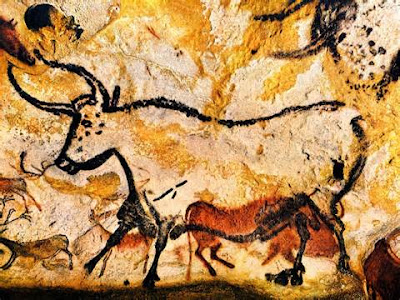
Horses
and Aurochs, Lascaux Cave, France. Early Magdanenian period (17,000 BCE). Internet image, public domain.
The
first image I noticed this effect on is this one from Lascaux. The small horse on the left and the Aurochs have their hooves approximately on the upper edge of
the shadow on the cave wall. And once I saw this, examples started jumping out
at me all over the place. It
must be remembered, these are not shadows created by the artist or image maker,
they are shadows on the cave wall created by the angle the light of the torch
is falling from, but the image maker has used them cleverly to create the
desired effect. Other effects that visually approximate shadows under animals
painted on cave walls can be color change in the stone wall, and/or other
sources of discoloration. And not all are done this way, indeed most panels
also have animals that are not standing on shadows, but it turned out a
surprising number are.
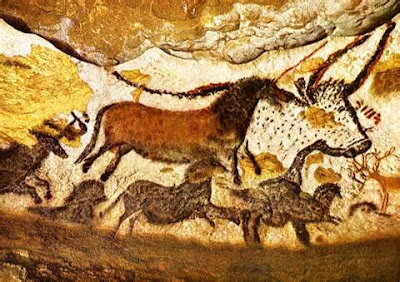
Aurochs,
Horses, and Deer, Lascaux Cave, France. Internet image, public domain.
There were a great number of examples from Lascaux Cave in France. In this one we see horses, aurochs, and a deer with their feet on the top edge of the shadow on the cave wall.
Aurochs, Lascaux Cave, France. Internet image, public domain.
Horse,
Lascaux Cave, France. Internet image, public domain.
In some examples the shadow
seems to be the result of a color change in the stone surface. Also, we need to
keep in mind that these modern photographs were made in lighting that is as even
as possible to show up the images, not to accentuate shadows underneath them.
Horse and two superimposed
mammoths, Chauvet Cave, France. Illustration from Jean-Marie Chauvet, et al., 1996, “Dawn of Art: The Chauvet Cave.
Although this is not a strong
example we can see the break in the cave wall underneath thehorse and mammoths and it would be
shadow under the right lighting conditions.
Mammoth, Chauvet Cave, France. Illustration from Jean-Marie Chauvet, et al., 1996, “Dawn of Art: The Chauvet Cave, p. 58.
Owl, Les Trois Freres Cave,
France. 15k BP. Illustration from Paul Bahn and Jean Vertut, “Journey Through
the Ice Age,” fig. 10.24, p. 155.
Horse, Tito Bustillo Cave,
Spain. Ca. 25k BP. Bahn, Paul, and Jean Vertut, 1997, “Journey Through The Ice Age,” University of California Press, Berkley, California.
From these various illustrations, and from various ages and locations, we see that this design factor was used across a large geographic area and for a very long time. The fact that it is associated with a large number of different animals also is a strong suggestion that it is not just associated stylistically with aurochs, or horses, etc., but that it may indeed have been the simulation of the creature's shadow that was the goal.
So, is this a real phenomenon?
Well yes, it is real in that we have seen it exists. But was the placement of
animals so that they are standing on a shadow, or an area of color change in the
stone intentional, or a coincidence? That is to be decided in the future,
probably with a whole lot of arguing involved. But, I will end with this, the cave
artists were certainly intelligent and sophisticated enough to have done this
intentionally.
NOTE 1:
Some images in this posting were retrieved from the internet with a search for
public domain photographs. If any of these images are not intended to be public
domain, I apologize, and will happily provide the picture credits if the owner
will contact me with them. For further information on these reports you should
read the original reports at the sites listed below.
NOTE 2: This paper was presented at the 2023 IFRAO (International Federation of Rock Art Organizations) Rock Art Symposium, Valcamonica, Italy, by the author on 27 May 2023.
REFERENCES:
Medina-Alcaide et
al., 16
June 2021, “The
conquest of the dark spaces: An experimental approach to lighting systems in
Paleolithic caves”, https://journals.plos.org/plosone/article?id=10.1371/journal.pone.0250497
(Public Library of Science)
Sorenson, Roy, 1 December 2021,
“Do We Actually See Shadows?”, https://daily.jstor.org/
(short for Journal Storage).
Illustration credits:
Illustrations
1 – 9 are Public Domain images from online.
Illustrations 10 –
11: Jean-Marie Chauvet, et al.,
1996, “Dawn of Art: The Chauvet Cave (The
Oldest Known Paintings in the World)”, H. N. Abrams, New York.
Illustrations 12 - 13: Bahn, Paul, and Jean Vertut,
1997, “Journey Through The Ice Age,” University
of California Press, Berkley, California.


%20in%20Saint%20Augustine%E2%80%99s%20City%20of%20God,%20about%201440%E2%80%9350,%20Master%20of%20the%20Oxford%20Hours.%20Tempera%20colors,%20gold%20and%20silver%20paint,%20and%20ink%20on%20parchment,%2014%20%C2%BC%20x%2010%20%C2%BE%20in.%20(36.2%20x%2027.3%20cm).%20The%20J.%20Paul%20Getty%20Museum,%20Ms.%20L.png)
,%20fol.%2034v.jpg)





 Posts
Posts

