Showing posts with label Germany. Show all posts

Saturday, October 18, 2025

DID PALEOLITHIC ARTISTS HAVE THE BLUES?

Azurite mineral deposit. Internet image, public domain.

I have posted previous columns about the use of the color blue in rock art and other ancient art (click on ‘color’ in the cloud index at the bottom). Recently, one column was about the discovery of indigo on grinding stones dated 34,000 years ago. Now we have evidence of the use of a blue mineral pigment, azurite, in Europe from about 13,000 years ago.

Doctor Izzy Wisher of the Department of Archaeology and Heritage Studies, and the Department of Linguistics, Cognitive Science and Semiotics of Aarhus University, Denmark, wrote: “Blue pigments are absent in Palaeolithic art. This has been ascribed to a lack of naturally occurring blue pigments or low visual salience of these hues. Using a suite of archaeometric approaches, the authors identify traces of azurite on a concave stone artifact from the Final Palaeolithic site of Mühlheim-Dietesheim, Germany. This represents the earliest use of blue pigment in Europe. The scarcity of blue in Palaeolithic art, along with later prehistoric uses of azurite, may indicate that azurite was used for archaeologically invisible activities (e.g. body decoration) implying intentional selectivity over the pigments used for different Palaeolithic artistic activities.” (Wisher et al. 2025:1) The evidence was found as trace deposits in between the grains of a grinding stone, presumably used to grind the azurite as a pigment, or somehow shape it.

Blue pigment residue found at site in Central Germany. Photograph by Izzy Wisher.

Detection of these mineral traces depended upon a suite of techniques available to modern, cutting-edge laboratories. “To characterize the composition and crystalline structure of the blue residue, and to determine whether it resulted from the processing of a blue pigment, we deployed a suite of archeometric methods: micro- and x-ray florescence (μXRF/XRF); scanning electron microscopy coupled with electron dispersive spectroscopy (SEM-EDS); particle induced x-ray emission (PIXE); Fourier transform infrared spectroscopy (FTIR); fibre optic reflection spectroscopy (FORS); multi-collector inductively coupled plasma mass spectrometry ((MC-)ICP-MS); and multiband imaging.” (Wisher et al. 2025:5) Presumably this is why the paper lists a team of fifteen scientists involved in this investigation.

Azurite deposit on artifact. Internet image, public domain.

The team “confirmed the traces were from the vivid blue mineral pigment azurite, previously unseen in Europe’s Paleolithic art. Their results are published in the journal Antiquity. ‘This challenges what we thought we knew about Paleolithic pigment use,’ says lead author of the study, Dr. Izzy Wisher from Aarhus University. Until now, scholars believed Paleolithic artists predominantly used only red and black pigments – no other colors are present in the art of this period. This was thought to be due to a lack of blue minerals or their limited visual appeal.” (Phys.org 2025) I certainly have to disagree with the ‘limited visual appeal’ statement. What is more beautiful and attention grabbing than a bright blue stone? Remember the importance of turquoise throughout human history. Now, shortage of natural sources makes much more sense because azurite is not that common.

Azurite ore deposit from Serbia. Internet image, public domain.

"Azurite is a soft, deep-blue copper mineral produced by weathering of copper ore deposits. During the early 19th century, it was also known as chessylite, after the type locality at Chessy-les-Mines near Lyon, France." (Wikipedia)

The three areas of blue residue present on the sandstone layer of the stone artefact from Mühlheim-Dietesheim. Area A, due to its more accessible location on a flatter area of the sandstone, was the primary focus of archaeometric analyses. Scale bar is 50mm (figure by authors). Figure 1, page 3, Wisher et al., 2025.

I only know of two older examples of the human use of blue pigment. “’It’s nearly the oldest blue pigment in the world – the only other known example that predates our case is from Siberia, where traces of blue-green pigment were found on figurines dating to around 19-23,000 years ago,’ Dr. Izzy Wisher, lead study author and archaeologist at Aarhus University in Denmark, told IFLScience. There is also evidence from Georgia, dating to 32,000–34,000 years ago, of people potentially creating a purplish-blue pigment from crushed indigo plants (Isatis tinctoria), the same plant that would later give rise to the dyes behind blue jeans. Outside of these rare cases, however, true blue pigments are exceptionally scarce in the prehistoric world.”(Hale 2025) We do not know what this azurite was to be used for, but it was obviously possessed and used for something by these ancient peoples.

So, it would seem that the conclusion has to be that yes, they had the blues, but apparently did not use them in their pictographic art.

NOTE 1: The above reference to IFLScience refers to the website https://iflscience.com.

NOTE 2: Some images in this posting were retrieved from the internet with a search for public domain photographs. If any of these images are not intended to be public domain, I apologize, and will happily provide the picture credits if the owner will contact me with them. For further information on these reports you should read the original reports at the sites listed below.


REFERENCES:

Hale, Tom, 2025, Dating Back 13,000 Years, One Of The Earliest Uses Of Blue Pigment Has Been Unearthed, 29 September 2025, https://www.eflscience.com. Accessed online 29 September 2025.

Phys.org, 2025, Europle’s oldest blue mineral pigment found in Germany, September 2025, https://phys.org/. Accessed online 29 Septembe 2025.

Wikipedia, Azurite, https://commons.wikimedia.org/w/index.php?curid=164155

Wisher, Izzy et al., 2025, The earliest evidence of blue pigment use in Europe, Antiquity, https://doi.org/10.15184/aqy.2025.10184. Accessed online 19 September 2025.


Saturday, July 27, 2024

STONE BLINDS AND DRIVELINES REVISITED – BALTIC SEA ‘BLINKERWALL':

Rollins Pass Driveline, Grand County, CO.,1 mi. of fence, 174 pit blinds & 184 cairns, ca. 6,000 - 3,000 BC, Photograph Peter Faris,  25 July 1987.

One interesting facet of the study of geoglyphs is the fact that many of them are connected to hunting in some way. Some are just simple hunting blinds where the hunter can be concealed while waiting for prey. Some are complex traps for prey, and some are meant to influence the movement of the animals in such a way that benefits a waiting hunter. This last seems to be the case for the recently discovered wall under the Baltic Sea.

Back on 14 February 2015 I published” Stone Blinds and Drivelines – Rollins Pass, CO.” on RockArtBlog, about visiting the vast stone drivelines and hunting blinds on Rollins Pass in the Colorado Rockies with Doctor James Benedict, the noted high mountains archaeologist. Most of the drive lines are now only one or two stones high, any animal could easily step over them, but apparently they are still doing the job today that they were constructed for long ago. Dr. Benedict stated that one day during one of his recording trips to the site he watched a deer or elk wandering up the slope stop and divert to the side when it came to one of the drive lines, even in their modern broken down and aggraded condition.” (Faris 2015) Apparently their effectiveness depends on the artificial appearance of a straight line in the natural environment. Benedict had estimated that more than a mile of stone walls remain on that location.

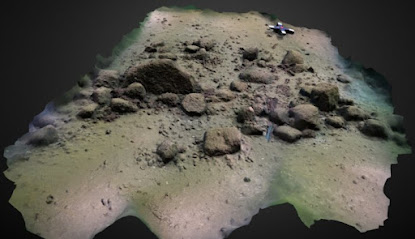
3-D model of the west end of the Blinkerwall. Image by Phillipp Hoy, Rostock University, Rostock, Germany.

Now, in 2021, such a construction has been located under the Baltic Sea dating back to before the rise in sea levels at the end of the glaciations period, estimated to be roughly 11,000 years ago there.

“In 2021, Jacob Geersen, a geophysicist with the Leibniz Institute for Baltic Sea Research in the German port town of Warnemünde, took his students on a training exercise along the Baltic coast. They used a multibeam sonar system to map the seafloor about 6.2 miles (10 kilometers) offshore. Analyzing the resulting images back in the lab, Geersen noticed a strange structure that did not seem like it would have occurred naturally. Further investigation led to the conclusion that this was a manmade megastructure built some 11,000 years ago to channel reindeer herds as a hunting strategy. Dubbed the "Blinkerwall," it's quite possibly the oldest such megastructure yet discovered, according to a new paper published in the Proceedings of the National Academy of Sciences—although precisely dating these kinds of archaeological structures is notoriously challenging.” (Ouellette 2024) The assumption is that it functioned with the local reindeer exactly like Dr. Benedict (above) related for the Rollins Pass drive lines. The reindeer would divert and follow the fence to a location where the hunters waited in ambush.

The Blinkerwall, the oldest structure in the Baltic Sea. Illustration by Michal Grabowski.

“The discovery is made up of more than 1,300 stones and roughly 300 larger boulders, and it stretches for more than half a mile along the seafloor. Resting nearly 70 feet underwater in the Bay of Mecklenburg, the wall stands, on average, about 1.5 feet tall. Natural events, such as glacial deposits or other land movements, cannot account for this structure’s existence, researchers report in a study published Monday in Proceedings of the National Academy of Sciences. Instead, they argue, the roughly 11,000-year-old wall was a tool built by hunters to guide and trap reindeer, which tend to travel along straight elements of the landscape, such as cliff sides or streams. ‘Hunters tapped into the natural behavior of the animals and created their own linear feature,’ Ashley Lemke, an underwater archaeologist at the University of Wisconsin-Milwaukee who was not involved with the research, tells Science’s Andrew Curry. ‘It’s not an obstruction, it’s a trail. They follow it to where the hunters are waiting.” (Thorsberg 2024) This preceding description is a very good explanation of how and why such drivelines work.

Scan of the west end of the Blinkerwall.

"'At this time, the entire population across northern Europe was likely below 5,000 people. One of their main food sources were herds of reindeer, which migrated seasonally through the sparsely vegetated post-glacial landscape. The wall was probably used to guide the reindeer into a bottlenick between the adjacent lakeshore and the wall, or even into the lake, where the Stone Age hunters could kill them more easily with their weapons,' explains Marcel Bradtmoller from the University of Rostock. The last reindeer herds vanished from these regions approximately 11,000 years ago due to climate warming and forest expansion. Consequently, the stone wall was probably not constructed after this period. If this is accurate, it would classify the wall as the oldest human-made structure ever found in the Baltic Sea." (Waters 2024)

The animals are diverted along the construction by its very existence on the site, ending up exactly where the waiting hunters want them to be for maximum advantage in harvesting game. Since reindeer migrate in large groups the harvest could have been quite large, illustrating the effectiveness of such a tactic.


Detailed structure of the Bay of Mecklenburg including the location of the Blinkerwall. Bathymetric data from The Federal Maritime and Hydrographic Agency Bundesamt für Seeschifffahrt und Hydrographie (BSH).

The only other possible explanation for this wall (other than it being a drive line) was what the authors (Geersen et al.) call ‘stone fishing.’ “In the absence of basal complexes and basement rocks in Northern Germany, glacially derived stones were used for construction purposes in this area toward the end of the last millennium. The demand for stones resulted in the birth of stone fishing as a profession. Stone fishing represents an anthropogenic effort to move and conquer boulders from the marine environment using stone pincers and ropes. -  After 1906, stone fishing was prohibited, and the stones were left in place being identified as important habitat and also useful for coastal protection. Because stone fishing (had) concentrated on the near-coastal waters and was not done in the central basins, we consider an anthropogenic movement of the stones for the purpose of stone fishing an unlikely candidate to explain the construction of the Blinkerwall. Furthermore, it seems unlikely that within the 18th and 19th century, stone fishers would have been able to place the stones next to each other over a distance of about 1 km given the water depth of about 21 m. Let alone the fact that their intention was to remove the stones rather than place them elsewhere on the seafloor.” (Geersen et al. 2024)

So, logically, the fact that the wall is now under 21 meters of water and that it was constructed by humans, the most likely explanation for it is that it was constructed when that area was still dry land, which dates it to the end of the last Ice Age. A very impressive accomplishment for people back then, and an impressive job of deduction for the authors (Geersen et al. 2024) of the report.

NOTE 1: Some images in this posting were retrieved from the internet with a search for public domain photographs. If any of these images are not intended to be public domain, I apologize, and will happily provide the picture credits if the owner will contact me with them.

NOTE 2: I have not included secondary citations in the References (below). For further information on these reports and all sources you should read the original reports at the sites listed below.


REFERENCES:

Faris, Peter, 2015, Stone Blinds and Drivelines – Rollins Pass, CO., 14 February 2015, https://rockartblog.blogspot.com.

Geersen, Jacob, Marcel Bradtmoller, Jens Schneider von Deimling and Harald Lubke, 2024, A submerged Stone Age hunting architecture from the Western Baltic Sea, 12February 2024, PNAS, Vol. 121, No. 8, https://www.pnas.org. DOI.org/10.1073/pnas.231008121. Accessed online 20 May 2024.

Ouellette, Jennifer, 2024, Scientists found a Stone Age megastructure submerged in the Baltic Sea, 14 February 2024. Proceedings of the National Academy of Sciences 2024, DOI: 10.1073/pnas.2312008121, https://arstechnica.com. Accessed online 17 February 2024.

Thorsberg, Christian, 2024, Stone Age Wall Discovered Beneath the Baltic Sea Helped Early Hunters Trap Reindeer, 13 February 2024, https://www.smithsonianmag.com. Accessed online 17 February 2024.

Waters, Conny, 2024, Underwater Drone Images Reveal Oldest Human-Made Structure In The Baltic Sea, 13 February 2024, https://ancientpages.com. Accessed online 14 February 2024.

Saturday, July 29, 2017

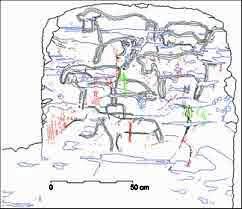
FIRST PALEOLITHIC ROCK ART IN GERMANY: ENGRAVINGS ON HUNSRUCK SLATE.


Paleolithic slate engravings,
Hunsruck, Germany.
Public domain.

A recent paper on thefreelibrary.com reported the discovery of the first large-scale paleolithic art in Germany. Originally discovered in 2010, the engravings were found on a rock face in the mountainous Hunsruck area.
The engraving shows a group of three horses and one other unidentified animal deeply carved into the surface of a large slate boulder.


Close-up of Paleolithic slate
engravings, Hunsruck,
Germany. Public domain.

A number of experts, including Paul Bahn in 2013, have authenticated the find and attribute it to the paleolithic period. Other examples of open-air paleolithic art have also been attributed in France and Spain, but this is Germany's lone example so far.


Drawing of the Paleolithic slate
engravings, Hunsruck,
Germany. Public domain.

This boulder is located in the German state of Rhineland-Palatinate, near the village of Gondershausen. The slate deposits in this area have long been mined and are famous for fossils recovered. Analysis of the images has discovered that at least three periods of engraving were undertaken, with the deep lines of the animal engravings coming first. Lighter lines, added later, are hard to decipher with portions obscured by lichen growth, and weathering.

Hopefully other examples of large-scale paleolithic art will be discovered there to add to our knowledge of the people of that time and place.

NOTE: Images in this posting were retrieved from the internet in a search for public domain photographs. If any of these images are not intended to be public domain, I apologize, and will happily provide the picture credits if the owner will contact me with them. For further information on these reports you should read the originals at the sites listed below.


REFERENCE:

https://www.thefreelibrary.com/First+Palaeolithic+rock+art+in+Germany%3A+engravings+on+Hunsruck+slate.-a0446932799

Saturday, June 17, 2017

MORE ON BUFFALO/LION WOMAN:


Chauvet Buffalo Woman,
pinterest.com,
public domain.

Last week I wrote about the question of the time depth of the Pied Piper myth, the Paleolithic origins of the Polyphemus myth according to Julien d'Huy, and whether a woman/buffalo transformation figure in Chauvet Cave in France could illustrate a Paleolithic version of Buffalo Woman of Native American mythology.


D'Huy's analysis traced the Polyphemus myth through space as well as time, indicating that it had reached North America in the Paleolithic period and had evolved into an explanation of the coming of the buffalo. He even related a Blackfoot version that involved Trickster Crow hiding a herd of buffalo in a cave, but two hunters outwitted him and freed the buffalo. (d'Huy 2016) For other peoples of North America the trickster who hid the buffalo was Coyote. For the Lakota people, however, the buffalo were brought to the people by Buffalo Woman, or White Buffalo Maiden.

Deep inside Chauvet Cave there is a painting that seems to illustrate the transformation of a buffalo into a woman and vice versa. It could be possible that this illustrates some variant of the Buffalo Woman myth. Drawn on a downward projecting stalactite is a frontal view of the lower half of a nude woman's figure from the pubic triangle on down. "There are also a couple of good examples of the hybrid figure of a bison-woman, such as the famous image from Chauvet, in France. This black painting features the detailed head of a bison on top of the lower half of a female body (she is nude and her pubic triangle has been emphasized by the artist)." (Von Pezinger 2016:91)

Whether or not this composition was meant to actually illustrate some Paleolithic version of the Buffalo Woman myth, it certainly does a great job of conveying the idea of animal to human transformation.

Chauvet bison woman,
redrawn from Clotte.

There is another aspect of this figure that fascinates me and I have been unable to find any information on from other sources so I will have to tackle this one on my own. It involves the woman's other leg (her right leg). A careful examination of the composite figure shows that the woman's right leg originates as the front leg of a lion drawn facing away from her torso. When I first noticed it I immediately felt a flicker of recognition. The lion's head and left front leg (the woman's right leg) reminded me of the of the head and left arm of the Lion-man of Hohlenstein-Stadel.


Lion Man  of Hohlenstein-Stadel,
Public domain.

The Lion-man of Hohlenstein-Stadel "is a prehistoric ivory sculpture that was discovered in the Hohlenstein-Stadel, a German cave in 1939. - The lion-headed figurine is the oldest-known zoomorphic (animal-shaped) sculpture in the world, and the oldest known uncontested example of figurative art. It has been determined to be between 35,000 and 40,000 years old by carbon dating of material from the layer in which it was found, and is thus associated with the archaeological Aurignacian culture. It was carved out of wooly mammoth ivory." (Wikipedia) 


To my eye the similarity of the head and bent arm of the carved ivory figure and the head and bent front leg of the lion figure on the left in the group in Chauvet Cave is so remarkable as to be  highly evocative. Now I will be the first to admit that I am not at all sure what this similarity evokes; some Paleolithic myth cycle, a religious belief, or something I cannot imagine? Can there be any connection? Probably not based upon ages, the Chauvet Cave art is dated to 30,000 - 32,000 BCE by radiocarbon, and the Lion-man is 35,000 - 40,000 BCE, quite a discrepancy. However, they are both considered to be Aurignacian in origin, and similar beliefs and myth cycles are a possibility.

There are many instances of beliefs that have lasted essentially unchanged for thousands of years. Indeed, if I change the term from myth to religious belief we can point to Christianity and its basic tenets, or Judaism for a longer time frame. In his book The Cave and the Cathedral, Amir D. Aczel traces the cult of the bull from the aurochs painted in the Paleolithic cave art of Europe, through the bull horns and heads so prevalent in neolithic Catalhoyuk on the Anatolian plain, to the bulls and acrobats in the Minoan murals of the Palace of Knossos, on Crete. This, if true, would give that theme a time-depth of perhaps 10,000+ years. So perhaps it is not completely outlandish to suggest a possible mythological connection between the "sorcerer" painted in Chauvet, and the Lion-man of Hohlenstein-Stadel.

There is one other possibility that should be pointed out, it could be an example of a visual pun, or a puzzle picture, like the duck's head/rabbit optical illusion. Perhaps the artist was just having fun? In any case the form of the woman's figure morphing into a bison and a lion in Chauvet cave is a remarkably sophisticated piece of work, both in concept, and in design and rendering. Not only are the painted caves of Europe a testament to the artistic abilities of our Paleolithic ancestors, they are evidence of their sophisticated thought processes and beliefs, and, as such, are real treasures of human heritage.


NOTE: Images used in this column were retrieved from the Internet with a search that included the phrase Public Domain. If any of these images were not intended to be public domain I apologize for their use, and will be happy to correct my error if so informed.

REFERENCES:

Aczel, Amir D.
2009 The Cave and the Cathedral: How a Real-Life Indiana Jones and a Renegade Scholar Decoded the Ancient Art of Man, John Wiley & Sons, Hoboken, New Jersey.

Clottes, Jean
2001 Chauvet Cave: The Discovery of the Worlds Oldest Paintings, University of Utah Press, Salt Lake City.

d'Huy, Julien
2016 The Evolution of Myths, pages 62-69, Scientific American, vol. 315, No. 6, Dec. 2016.

Von Petzinger, Genevieve,
2016 The First Signs, Unlocking the Mysteries of the World's Oldest Symbols, Atria Books, New York, London.


Wikipedia

Saturday, October 3, 2015

A PALEOLITHIC PALIMPSEST:

Scratches on a stone plaque
Gonnersdorf, Germany. From
Bahn and Vertut, 1997.


"A palimpsest is a manuscript page from a scroll or book that has been scraped off and used again. The word "palimpsest" comes through Latin from Greek  παλιν + ψαω = (palin "again" + psao "I scrape"), and meant "scraped (clean and used) again." Romans wrote on wax-coated tablets that could be smoothed and reused, and a passing use of the term "palimpsest" by Cicero seems to refer to this practice. - -  The term has come to be used in similar context in a variety of disciplines, notably architectural archaeology." (Wikipedia)

In art cases the term palimpsest is usually used to describe a composition with traces of previous work (or pentimenti) showing through. In rock art or cave art it would most often refer to trying to pick a recognizable image out of a mass of marks (scratches or lines). Some early recorders picked out whatever image they could decipher and often only recorded the lines of that image, ignoring all the other markings.

Paul Bahn explained the modern attitude toward such recording in his 1997 book Journey Through The Ice Age:


"Deciphering or copying images on a cave wall is rather like an excavation, except that the 'site' is not destroyed in the process; the pictures are 'artifacts' as well as art and, if superimposed, they even have a stratigraphy. Moreover, instead of selecting and completing animal figures from the mass of marks, like early archaeologists seeking, keeping and publishing only the belles pieces and ignoring the 'waste flakes', the aim for the last thirty years has been to copy everything. This helps to reduce psychological effects akin to identifying shapes in clouds or ink-blots: faced with a mass of digital flutings or engraved lines, the mind tends to find what it wants to find, in accordance with its preconceptions, and often detects figurative images which ae really not there. In addition, one needs to counteract the psychological effect whereby the eye is drawn to the deeper lines (although these may have been of secondary importance) and to lines in concave areas which are generally better preserved than those on convex areas which are more exposed to wear and rubbing.

To eliminate lines we do not understand is an insult to the artist, who did not put them there for nothing; where there are so many lines that it is difficult to 'isolate' anything, however, it is still necessary to 'pull out' any definite figures which exist hidden in the complex mass (this is also far less strain on the eyes), though one should still try to publish the mass, leaving the reader free to make a different choice. In his herculean twenty-five year study of the 1512 slabs from La Marche with their terrible confusion of engraved lines, Leon Pales isolated and published only those figures which his expert knowledge of human and animal anatomy revealed to his eye: but he estimated that only one line in 1000 has been deciphered on these stones. Unfortunately, there are very few scholars with similar skills in deciphering and reproducing Palaeolithic engravings." (Bahn 1997:55)

Horse image from plaque, Gonnersdorf,
Germany. From Bahn and Vertut, 1997.

In his book he illustrated a detailed tracing of an engraved stone plaque (20 cm. by 18 cm.) from Gonnersdorf, Germany, and then a horse figure extracted from the mass of lines.


Horse on plaque, Gonnersdorf,
Germany. From Bahn and
Vertut, 1997.

One can search such a mass in the attempt to identify additional images as I have attempted to do. In my short examination of the detailed drawing I located a possible lion head in profile immediately behind the head of the horse. The lines are certainly there, but the question is was that actually intended to be a lion by the original creator, or is it merely a figment of my imagination. How many other figures can you find?


Horse and possible lion. Gonnersdorf,
Germany. From Bahn and Vertut, 1997.

REFERENCES:

Bahn, Paul G., and Jean Vertut,
1997    Journey Through the Ice Age, University of California Press, Berkeley and Los Angeles.

Wikipedia