Showing posts with label Basketmaker. Show all posts

Saturday, August 2, 2025

DUCK-HEADED FIGURES REVISITED:

Bird-headed figure, Kiva Point, Ute Mountain Ute Reservation, Colorado. Photograph Peter Faris, 1981.

RockArtBlog has previously visited the subject of bird-headed figures in 2011 and 2016 (see references below) but it has come back up in an article by Eric A. Powell in Archaeology magazine.

Tracing of figure with a duck on his head. Procession panel, Combs Ridge, near Butler Wash, Utah.

Just to reset the stage, there are essentially two kinds of bird-headed figures. On kind is an anthropomorph with a bird sitting on top of his head. The second kind has the head replaced by a bird. In this column I am going to limit my comments to bird-headed figures surmounted by what seem to be ducks.

Bird-headed figure from Muley Point, John's Canyon, Utah. Illustration from Castleton, Petroglyphs and Pictographs of Utah, Vol. 2, 1984, Fig. 7.78, p. 239.

In the July/August issue of Archaeology magazine, an excellent article by Eric Powell (2025) credits the creation of figures of anthropomorphs with ducks resting on their head to the Basketmaker culture. “Around AD 550, Basketmaker artists began to focus on depicting groups of simplified human figures rather than emphasizing individuals. In the canyonlands surrounding the San Juan River, crane, quail, and the occasional turkey are shown alongside humans but ducks resting on the heads of human figures dominate the bestiary of this later Basketmaker rock art.” (Powell 2025:48) Basketmaker is the name given to archaic cultures represented in the American southwest running from as early as possibly 7,000 BCE to 750 CE. (Wikipedia)

Flock of ducks and duck-headed figures. Photograph by Jim Larkey, image 45170426.

In his article Powell mentions various potential meanings for the figure of an anthropomorph with a duck on its head to the Basketmaker people. One possibility mentioned is that it is the symbol for a “duck clan.” Another possibility discussed is some sort of deity. “Some archaeologists have speculated that ducks represented a single Basketmaker clan, much as animals symbolize modern-day Pueblo kin groups, including the Hopi Bear and Spider Clans. In this scenario, the duck-head figures would have served as a kind of logo for a clan whose descendants eventually spread throughout the region. Other scholars have proposed that the duck-head figures might all have been meant to depict a single deity. Schaafsma believes clues to the importance of ducks might lie in present-day Pueblo oral traditions that give these birds a special role. According to traditions of the Zuni people in western New Mexico, a duck guides the blind god Kiaklo as he wanders the Earth.” (Powell 2025:50)

Duck-headed figure, Ute Mountain Ute Reservation, Train Rock -2, Colorado. Photograph John and Daphne Rudolph, 1991.

Ducks are unique creatures in the animal world because of their abilities to travel under the water and on it, on the land and through the sky. Later Pueblo people’s beliefs that the duck was a messenger to the katsinas may have been handed down from the Basketmaker cultural pantheon. “Ancestral Zuni spirits are also believed to transform into ducks to travel between Zuni Pueblo and a lake known as Kolhuwalaaw'a, the  underwater home of the spirits. These beliefs were recorded some 1,500 years after Basketmaker people created images of duck-head figures. Nevertheless, Schaafsma says these oral traditions suggest that people in the Four Comers region revered the duck's ability to travel through many realms with ease. "The duck is at home in the sky, walks on the land, swims on the water, and dives under the water for minutes at a time," she says. "Of all the birds, ducks seem to most explicitly traverse a layered cosmos." For the Basketmaker people, combining themselves with an animal that possessed the adaptive abilities of the duck would have been especially meaningful, says art historian Anna Blume of the Fashion Institute of Technology. "These are real powerful hybrids," she says. "In the imagination of the people who made them, these murals would have given them access to that special connection." (Powell 2025:50)

Closeup of Bird-headed figure, Kiva Point, Ute Mountain Ute Reservation, Colorado. Photograph Peter Faris, 1981.

On March 5, 2011, I posted a column that was titled BIRD-HEADED FIGURES. In this I presented a petroglyph panel from Kiva Point on the Ute Mountain Ute Reservation in southeastern Colorado that includes a portrayal of an Ancestral Puebloan figure with a duck-like bird perched on its head, and I pointed out the fact that Lovelock Cave in Nevada held 3,000-year-old duck decoys. I cited Sandra Olsen's description of their creation and use: "Remarkable preservation at Lovelock Cave, Nevada, has led to the recovery of 3,000-year-old duck decoys - - - that were made by stretching a bird skin over a tule reed form. Many ethnographic reports describe hunters putting duck skins - on their heads as they swam right up to live ducks. They captured the ducks by grabbing their feet and pulling them underwater, so as not to disturb other nearby fowl." (Olsen 1998:104) I suggest that the Basketmaker fascination with duck-headed figures may be a tradition passed down from this early duck hunting technique.

Tule reed duck decoys, Lovelock Cave, Nevada.

In 1985 Rob Buchanan wrote about the findings in a cache in Lovelock Cave. This discovery was made by M. R. Harrington of New York City’s Museum of the American Indian in 1924. “This contained eleven remarkable decoys made of rushes, most of them feathered and painted to represent ducks. The decoys, which resemble  canvas-back drakes, were about 11 inches long, their bodies formed by 25 or 30 large bulrush stems bound in a tight hairpin and trimmed at the ends to simulate a duck’s tail. A billed head, smoothly tied with split reeds, was sewed fast to each body. White feathers were attached lengthwise to the body with twing. ‘Some waterfowl hunter had hid his decoys here against another season,’ concluded Harrington.” (Buchanan 1985) The finding of such a group of duck decoys provides strong evidence to back up Olsen’s testimony.

This becomes more likely when we see climatic data suggesting that the climate in the American southwest was wetter during the Basketmaker period. V.J. Polyak et al., studied past climates in the record preserved in a stalagmite. “Here, we report data from stalagmite HC-1, from Hidden Cave, Guadalupe Mountains, New Mexico, covering the past 3400 years, showing an interval of increased frequency of droughts from 1260 to 370 yr B2K that is coeval with the entire pre-Hispanic Pueblo period. Our record suggests that this Puebloan Late Holocene climatic interval was the most arid and highly variable climatic period of the last 3400 years. Climatic conditions favoring the introduction of cultivation existed prior to the Pueblo period during more pluvial-like conditions from at least 3400 to 1260 yr B2K.” (Polyak et al. 2022) This suggests that wetter climatic conditions of early Basketmaker may have favored duck hunting as part of their subsistence scheme.

Duck-headed figure with flute player, Southwestern Utah. Photograph from Carol Patterson

Referring back to Olsen (1998) I can see Basketmaker duck hunters tying a tule reed duck decoy covered with the skin of a real duck on top of his head, or just pulling the preserved duck skin down over his own head and slipping gently into lake Lahontan to collect dinner. Powell (2025) did not include that interpretation as a possibility, but given the wetter climate of the American southwest during the Basketmaker era I believe it should be considered a strong possibility. As a final thought, if these figures do not represent duck hunters then I suggest that they may represent dance costumes. Indeed, in some places the duck headed figures are accompanied by flute-players, suggesting some kind of ritual situation. This would mean that the Lovelock Cave findings, interpreted as duck decoys, would be dance headdresses instead, but given Olsen’s (1998) testimony I personally favor the duck hunting interpretation.


NOTE: Some images in this posting were retrieved from the internet with a search for public domain photographs. If any of these images are not intended to be public domain, I apologize, and will happily provide the picture credits if the owner will contact me with them. For further information on these reports you should read the original reports at the sites listed below.

REFERENCES:

Buchanan, Rob, 1985, When it came to duck decoys the Paiute Indians made them to last, 25 February 1985, Sports Illustrated Vault online. https://vault.si.com. Accessed online 22 June 2025.

Faris, Peter, 2016, Bird-Headed Figures Revisited, 5 March 2016, https://www.rockartblog.blogspot.com.

Faris, Peter, 2011, Bird-Headed Figures, 5 March 2011, https://www.rockartblog.blogspot.com.

Olsen, Sandra L., 1998,   Animals in American Indian Life: An Overview, pages 95-118, in Stars Above, Earth Below: American Indians and Nature, Marsha C. Bol, editor,  Roberts Rinehart Publishers, Niwot, CO.

Polyak, V.J., Asmerom, Y. and Lachniet, M.S., 2022, Climatic backdrop for Pueblo Cultural development in the southwestern United States. Scientific Relports 12, 8723. https://doi.org/10.1038/s41598-022012220-6.

Powell, Eric A., 2025, Birds of a Feather, Archaeology, July/August 2024, Vol. 78, No. 4. pp. 46-51.

Wikipedia, Basketmaker Culture, https://en.wikipedia.org/wiki/Basketmaker_culture. Accessed online 5 July 2025.


Saturday, July 5, 2025

FENDING STICKS, RABBIT STICKS, BOOMARANGS OR SERPENTS?


Sand Canyon, Canyons of the Ancients, Colorado. Photograph and drawing from Radislaw Palonka, 2019.

Virtually any sinuous form by itself in rock art has been identified either as a serpent, or a ‘rabbit stick’. These were once often referred to as ‘boomerangs’ as well. There is another possibility, however, that is not mentioned as often – these forms may represent fending sticks. These date back to the period before the bow and arrow when the common projectile weapon system was the atlatl and dart. Warriors could carry fending sticks to deflect the darts from an atlatl. With the right timing the dart could be deflected to the side with a sweeping movement of the fending stick held in front of you. This has actually been demonstrated as an experimental archeology project by some fearless, or crazy, graduate students.


Basketmaker II, from White Dog Cave, Arizona. Photograph from semanticscholar.org.

In the early days of archeology in the American southwest these “S-shaped” grooved sticks were usually identified as rabbit sticks or boomerangs, assuming that they were meant as a throwing weapon for small game hunting analogous to Australian aboriginal non-returning boomerangs. “Curved wooden throwing sticks, or “rabbit sticks,” also could be hurled at small game. In concept, they are not unlike the Australian boomerang, although rabbit sticks do not return to the sender. Also, known as fending sticks, the curved sticks may been used as weapons, for warding off blows in battle.” (Texas Archaeological Research Laboratory)

Rabbit Stick, Photograph B. Bernard, University of New Mexico Field School collections, 66.90.50.

When found in rock art, however, these shapes were once almost universally identified as snake images. I would argue, however, that an image intended to be a serpent would include some serpent-like details; a head, forked tongue or in the American southwest rattlesnake rattles.


Petroglyiph, anthropomorphs with S-shaped stick, John's Canyon, SE Utah. From Phil R. Geib, 2016, Fig. 11.8.

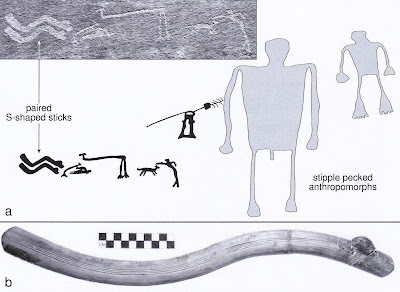
More recently the use of these items as fending sticks has gained some purchase. These fending sticks can indeed be taken as evidence of warfare. As Stephen A LeBlanc (1999) explained “There are Basketmaker rock art depictions of men holding trophy skins, there was a special form of basket used only to dry and stretch scalps, and fending sticks are commonly recovered along with atlatls. This last item may need clarification. During the earliest times in the Southwest, the bow and arrow were not present, and the atlatl was used to throw small spears or darts. With these atlatls, curved sticks with a thong that was wrapped around the user's wrist are often found. The best explanation for these sticks is that were used to fend off darts thrown by atlatls. That is, they served as a kind of shield-thus, their sole function would have been warfare. If frequency and standardization of fending sticks are any measure, warfare using atlatls was also quite common.” (LeBlanc 1999:3) In other words, the argument is that their association with images of atlatls suggests a relationship, and indicates their use as fending sticks.

Petroglyiph, anthropomorphs with paired S-shaped sticks. From Phil R. Geib, 2016, Fig. 11.4.

An explanation from the Maxwell Museum in Albuquerque gives a clear description, and suggests the relationship between fending sticks and rabbit sticks. ”The prehistoric sticks come in two basic shapes: the S-shaped version shown above, and sticks shaped like an open C. It's possible that the S-shaped sticks are older, and functioned primarily to defend the user against incoming atlatl darts. Such darts travel slowly enough that with practice, it's possible to deflect them as they approach—at least that's the theory. The S-shaped sticks are our best candidates for "fending sticks." Fending sticks became obsolete once the bow and arrow was adopted in the Southwest, about 1,400 years ago. Arrows travel too quickly to be batted to one side by the intended target. Instead, the region's warriors began using shields. Under this telling of events, the loss of the "fending" function led to the use of shorter, C-shaped sticks used primarily for throwing—the modern Pueblo "rabbit stick." (Maxwell Museum) Of course, a thrown stick can still be thought of as a weapon as well.

Petroglyiph, anthropomorphs with S-shaped sticks, Chinle Wash, Arizona. From Phil R. Geib, 2016, Fig. 11.7.

Phillip R. Geib has also led in the area of study into the use of fending sticks in the American southwest and rock art. “A defender can knock aside atlatl darts from close range with these sticks. Some tribes in South America perform a similar feat in a duel-like context and Diego de Landa may have observed an analogous ritual in the 1500s among the Yucatec Maya. The fending hypothesis is most logical in a duel. Many of the analyzed prehistoric sticks come from a known Puebloan war god shrine in central New Mexico, where an informant identified one as symbol of membership in a warrior society. In addition to prowess as a man killer, war society membership in the distant past might have involved atlatl duels where dart defense with a stick displayed great skill and courage. Basketmakers may have considered S-shaped sticks as an ancient symbol of warrior status.” (Geib 2016) This is very strong evidence of the use of these bent sticks in personal defense, and a reasonable hypothesis for their being recorded on the rocks, a record of a warrior’s personal status.


Petroglyiph, anthropomorphs with paired S-shaped sticks, Chinle Wash, Arizona. From Phil R. Geib, 2016, Fig. 11.5.

Geib backed up his researches into the use of fending sticks in the American southwest with related and contemporary examples from South America. “Deflecting atlatl darts with a short stick might seem absurd or illogical, yet certain tribes in South America still conduct duel-like atlatl fights that involve dart deflection for defense. -  - Warriors from opposing villages are paired to face each other; one is on offense first while the other is on defense, then the roles switch. The group with the greatest number of ‘hits’ is judged the winner. - - Dart defense in this South American example is achieved with a more substantial obstacle than a FCS (flat curved stick). Still, it shows that atlatl darts can be deflected or dodged, even when thrown from a close range. It is key that attention is focused on single projectiles. It is within such a rule-bound, duel-like fight that use of FCS for defense against atlatl darts makes sense: a duel would be far less risky, even if lethal tips were used. The antiquity of South American atlatl dueling remains unknown but it could be considerable given the weapons involved.” (Geib 2017)


Australian woomeras serve as spear throwers and fending sticks. Image from aboriginal-bark-painting.com.

Not only in South America can we find examples of the use of deflection for defense against the thrown spear. In Australia the aboriginal woomera (their version of the atlatl) is a multipurpose tool. Its primary use is to launch a spear for greater distance. However, it is also used as a fire making tool, a receptacle for mixing ochre in ceremonies, and also as a fending stick to deflect spears in battle. Woomeras have even been found with a stone blade set into the handle to use as a tool for working on other wooden artifacts (sort of a prehistoric Swiss Army Knife). So we have a number of examples from other parts of the world for the use of fending sticks as defense against thrown spears in conflict. Obviously, when atlatls were replaced by the bow and arrow the era for using fending sticks for personal defense was over. The smaller size and considerably greater speed of an arrow would make it virtually impossible to count on deflecting them with a fending stick, and selection would have soon removed any warriors who refused to learn that lesson.

Petroglyiph, anthropomorph with S-shaped stick. From Phil R. Geib, 2016, Fig. 11.10d.

Are these images fending sticks or rabbit sticks (non-returning boomerangs) used for hunting small game? Well, I would argue that such an image could represent either, or both at the same time. In any case these curved sticks are obviously an important tool and/or weapon, and as such likely subject matter to record in the people’s rock art.


NOTE: Some images in this posting were retrieved from the internet with a search for public domain photographs. If any of these images are not intended to be public domain, I apologize, and will happily provide the picture credits if the owner will contact me with them. For further information on these reports you should read the original reports at the sites listed below.

REFERENCES:

Geib, Phil R., 2017, Mesoamerican Flat Curved Sticks: Innovative ‘Toltec’ Short Sword, Fending Stick, or Other Purpose?, 31 August 2017, Published online by Cambridge University Press. Accessed online 12 January 2024.

Geib, Phil R., 2016, Basketmaker II Warfare and Fending Sticks in the North American Southwest, 1 May 2016, PhD dissertation, University of New Mexico, https://digitalrepository.unm.edu/anth_etds/27. Accessed online 13 January 2024.

Leblanc, Stephen A., 1999, Southwestern Warfare: Reality and Consequences, Archaeology Southwest, Spring 1999, Volume 13, Number 2, pp. 1-7. Accessed online 25 November 2023.

Maxwell Museum, undated, The Testimony of Hands: An Online Exploration of the Archaeology Collections of the Maxwell Museum, University of New Mexico, Albuquerque, New Mexico. Accessed online 13 January 2025.

Palonka, RadosÅ‚aw2019, Rock Art from the Lower Sand Canyon in the Mesa Verde Region, ,Colorado, USA, KIVA, 85:3, 232-256, DOI: 10.1080/00231940.2019.1643071

Texas Archaeological Research Laboratory, Undated, About Darts, Atlatls, and Other Weaponry Systems, University of Texas, Austin, Texas. Accessed online 25 November 2023. Accessed online 13 January 2025.


Friday, April 18, 2014

CRUCIBLE OF PUEBLOS – PART ONE: THE PROCESSION PANEL.


Procession panel, 42Sa24318, Wilshusen et al., Fig. 11.5.

This posting began as a review of an interesting book by Richard H. Wilshusen, Gregson Schachner, and James R. Allison editors, titled Crucible of Pueblos: The Early Pueblo Period in the Northern Southwest (Monograph 71, Cotsen Institute of Archaeology Press, UCLA, Los Angeles, 2012). More specifically, it was going to focus on one chapter in that book; chapter eleven entitled Processions, Leaders, and Gathering Places: Changes in early Pueblo Community Organization as Seen in Architecture, Rock Art, and Language (pages 198 – 218), by Richard H. Wilshusen, Scott G. Ortman, and Ann Phillips. The book itself is an excellent summation of much new information and new conclusions about the development of the early Pueblo cultures in the 4-Corners area and the Colorado Plateau. However, I find that instead of merely reviewing this excellent volume I also want to make some comments on the rock art illustrated. This has considerably lengthened what would have been a simple review and has led me to divide it up into two postings. This, the first one presents the authors (Wilshusen, Ortman, and Phillips) conclusions on the so-called Procession panel from southeastern Utah.


First things first, however. This book is an up-to-date survey of new knowledge of the 4-corners and Colorado Plateau civilizations we know as Basketmaker and Early Pueblo. Written by a new generation of archaeologists it discards some of the old assumptions and fills them in with new data that provides a clearer picture of what was actually happening at that time. It traces the development of that civilization from Basketmaker to Early Pueblo. I certainly give it a five-star rating. Anyone interested in the archaeology of the 4-corners and Colorado Plateau areas should read this book carefully. For the purposes of RockArtBlog, however, I was personally most interested in their Chapter 11, titled Processions, Leaders, and Gathering Places, and which looks closely at two rock art procession panels to illustrate some of the social evolution.

“The late Basketmaker-early Pueblo procession panels appear to reflect these changes in social life. Nowhere are these changes more clearly depicted than in the well-known Procession Panel, a 7-meter long composition in southeastern Utah (Figure 11.5). This panel illustrates a ritual gathering of at least two large groups coming from opposite directions to a great kiva or dance circle. The composition dates no earlier than A.D. 650 and no later than A.D. 800, based on the style of the rock art, the presence of a bow and arrows in the image, and construction dates for early great kivas and dance circles. The panel is located on the crest of a prominent ridge from which one can view much of the surrounding landscape. Robins and Hays-Gilpin (2000:fig. 12.7) discuss this panel with a primary focus on gender relations and the shifting division of labor and power during late Basketmaker III period. Our discussion here focuses on the creation and transformation of group identity reflected in this panel. The organization of the assembling groups and the identities of their members are partly revealed in the elements, organization, and design of the panel, along with its subject matter, narrative, and setting.” (Wilshusen et al 2012:210) 


Procession Panel, right side, from Wilshusen et al, Fig. 11.5.

“It is a narrative, a visual “telling” of at least two social groups coming together from different directions. Of course, it also may be a composite story of several repeated gatherings at the same place involving the same groups of people. The panel appears to have objectified and sanctified this event by showing the involvement of supernatural beings and powerful images. Numerous elements of the panel and its design reflect aspects of archetypical Pueblo gatherings as they occur today. Although the visual focus is clearly on the two lines of anthropomorphic figures approaching from opposite directions, two smaller and less conspicuous lines also approach the center. The number four is typical in Pueblo emergence accounts, directional symbolism, and ceremonial performances.” (Wilshusen and Ortman 2012:210-11)


Procession Panel, left side, from Wilshusen et al, Fig. 11.5.

“Closer inspection of the panel reveals details about the organization of these groups and the identities of some of the individuals. The majority of the anthropomorphic figures in the four procession lines are nondescript, but about one in five have notable hairstyles or headdresses (ponytails, top knots, feathers, or birds), badges of office or instruments of power (crook neck staffs, bags on their backs, lobed circles, and so forth), or are gesturing with their hands or carrying unique items in their hands (lobed circles, bow and arrows, a flute?). The sheer variety of items and the distribution of items throughout the lines suggest that some, or all, of these figures may represent specific individuals known to the artist. The fact that symbols of authority are distributed somewhat evenly throughout the procession lines suggests that leaders of distinct household groups from both directions may have orchestrated the gathering. Although the right-side procession line has four times the number of figures in the left-side line, it is remarkable that the same number of figures with notable characteristics such as hairstyles, headdresses, gestures, or authority symbols occur in each line (24). This panel provides a livelier and more detailed picture of late Basketmaker-early Pueblo society than is possible using the excavation record alone.” (Wilshusen and Ortman 2012:212)

Notice that the authors mention identifiable personal characteristics in the panel. I have written elsewhere that for a culture in which personal possessions are all hand-made, and are thus usually unique, the presence of such items as recognizable costumes, adornment, headdresses, etc., make those characters recognizable to anyone who knew them. In this way they approach our concept of portrait; a recognizable portrayal of someone’s unique possessions representing the owner of the items. This means that we can speculate that this procession panel may represent either a symbolic gathering or meeting of specific groups of people, or the actual occasion of such a gathering.

The panel also represents a narrative, and not only a narrative on what is happening right at that time, but also what has happened previously. Note that there is a line of dots on the left side coming down from above about half way down the length of the procession, probably representing tracks joining the left row of figures indicating that people from farther in the distance in that direction walked over and joined the procession. This gives every indication of being a narrative of actual events. Not that every detail is meant to be accurate. For instance I doubt that whatever processions actually occurred had been accompanied by gigantic deer. There seem to be many symbols in the composition, possibly mythological references that would have conveyed meaning to the intended audience at that time. This remarkable artistic composition brings social and cultural events of that time to life in a way that no scientific examination of data possibly can.

The article Processions, Leaders, and Gathering Places: Changes in early Pueblo Community Organization as Seen in Architecture, Rock Art, and Language goes on with an examination of another procession panel, the Waterflow panel (LA79511) in New Mexico, and I will address that in a future posting.

REFERENCES:

Robins, Michael R., and Kelly A. Hays-Gilpin
2000    The Bird in the Basket: Gender and Social Change in Basketmaker Iconography. In Foundations of Anasazi Culture: The Basketmaker-Pueblo Transition, edited by P. F. Reed, pp. 231-247. University of Utah Press, Salt Lake City.

Wilshusen, Richard H., Scott G. Ortman, and Ann Phillips
2012    Processions, Leaders, and Gathering Places, in Crucible of Pueblos: The Early Pueblo Period in the Northern Southwest, by Wilshusen, Richard H., Gregson Schachner, and James R. Allison, editors, Monograph 71, Cotsen Institute of Archaeology Press, UCLA, p. 198-218.