Showing posts with label perception. Show all posts

Saturday, July 19, 2025

COULD THE CAVE ARTISTS ACTUALLY SEE THEIR COLORS? – CONTINUED, PART 2:

 This one is just for fun, perhaps more for philosophers, please don’t take it too seriously – I do not.


Cave painting of auroch, Lascaux, France. Internet image, public domain.

Then the question became whether the lack of blue was actually based on a physical difference, or was perhaps a cultural or linguistic question.

“Anthropologists took up the challenge next. They were curious about how color was perceived by traditional cultures with limited or no contact to outsiders. In 1898, anthropologist and psychiatrist W.H. R. Rivers went to the Torres Straits Islands, located between New Guinea and Australia, where he investigated the islanders’ color perception. Rivers was astonished to hear the elders describe the sky as black, and a child describe the sky as being dark like dirty water. Rivers and other anthropologists concluded that early humans and members of isolated cultures were not color blind. They saw the same colors we see but linguistically don’t distinguish beyond hues of white, black, or red. This might be a simple enough explanation for Homer’s wine-dark sea, but it still raises the question: did ancient peoples perceive the color ‘blue’?” (Hall 2018) Remember, it is difficult to cognitively contemplate a phenomenon that you do not have a name or label for.

“Before the color blue became a common concept, perhaps humans saw it but simply didn’t recognize it as such. Even more fascinating—or perhaps disturbing—is the realization that the way we perceive the world around us may be something of an illusion, a trick played on us not by some external force but by our own minds, shadows cast against the back of Plato’s allegorical cave. We are oblivious to whatever realities exist outside of our perception. While we modern humans can differentiate between 1 million colors today, our perception is still largely limited to eleven color categories (in the English language: white, black, gray, red, yellow, green, blue, brown, pink, orange, purple). More humbling is the fact that we humans get by with just three types of photoreceptor cone cells (corresponding roughly to red, green, and blue sensitive detectors). Somewhere, silently scuttling beneath Homer’s wine-dark sea, the modest mantis shrimp boasts 16 different types of photoreceptor cone cells, viewing the world through a kaleidoscopic vision of unknowable colors, the likes of which we can only dream.” (Hall 2018) Once again, I enjoy Hall’s slightly sardonic comparison of our human color vision to that of the mantis shrimp.

In  2018, Fiona MacDonald reported on a field trial conducted in 2006 by Jules Davidoff, among the Himba people of Namibia. “But just because there was no word for blue, does that mean our ancestors couldn’t see it? There have been various studies conducted to try to work this out, but one of the most compelling was published in 2006 by Jules Davidoff, a psychologist from Goldsmiths University of London. Davidoff and his team worked with the Himba tribe from Namibia. In their language, there is no word for blue and no real distinction between green and blue. To test whether that meant they couldn’t actually see blue, he showed members of the tribe a circle with 11 green squares and one obviously blue square. But the Himba tribe struggled to tell Davidoff which of the squares was a different color to the others. Those who did hazard a guess at which square was different took a long time the get the right answer, and there were a lot of mistakes. But, interestingly, the Himba have lots more words for green than we do.” (MacDonald 2018) They could see the one square as different, but lacking the mental concept of a color ‘blue’ they had trouble seeing it as different enough to point out. This tends to confirm the statement that we cannot fully comprehend something until we have a name (or label) for it.


Hachure on a Mimbres bowl. Internet image, public domain.

MacDonald also reported on a “study by MIT scientists in 2007 that showed that native Russian speakers, who don’t have one single word for blue, but instead have a word for light blue (goluboy) and dark blue (sinly), can discriminate between light and dark shades of blue much faster than English speakers.” (MacDonald 2018)

In 2022 Nikola Jones explained a reasonable hypothesis for the development of color terms throughout the history of a culture. “There are several big datasets out there looking at color categorization across cultures. And the consensus is that there are some commonalities. This implies that there might be some biological constraints on the way people learn to categorize color. But not every culture has the same number of categories. So, there’s also this suggestion that color categories are cultural, and cultures experience a kind of evolution in color terms. A language might initially make only two or three distinctions between colors, and then those categories build up in complexity over time.” (Jones 2022)

Hachure on a Mimbres bowl. Pinterest.

I have already written about the use of hachure on ceramics by the Ancestral Puebloans in the American southwest, and the theory that it represented the color blue to them (see my column of 7 June 2025). The origin of the idea that hachure, closely spaced, parallel thin lines, used to fill a space might be intended to symbolize the color blue was credited to J. J. Brody by Stephen Plog (2003). “One of the common design characteristics on black-on-white pottery from the eleventh and twelfth centuries in the northern American Southwest is the use of thin, parallel lines (hachure) to fill the interior of bands, triangles, This essay explores a proposal offered by Jerry Brody that hachure was a symbol for the color blue-is examined by exploring colors and color patterns used to decorate nonceramic material from the of northwestern New Mexico. His proposal is supported and the implications of this conclusion for future studies of this nature are discussed.” (Plog 2003:1) This, however, was not a suggestion that Ancestral Puebloans could not see the color blue, they had a name for the color, comprehended it, and designated it as the color of the direction West in many of these cultures. The assumption is, rather, that good blue pigments are much rarer than blacks or reds, especially blues that would stand up to the firing of a piece of pottery. There are, however, some remarkable examples of blue pictographs in the American west although considerably fewer than most other pigments. I should also point out that most indigenous peoples lend spiritual significance to various colors.

Blue painted figures, Carrot Man site in western Colorado. Photograph Peter Faris, 2005.


I also questioned whether or not hachure on rock art might have also symbolized blue, even if painted on with a different pigment. Of course, the rock art we study does actually, if rarely, have blue pigments based on natural clays and other materials.


Blue painted figures, Carrot Man site in western Colorado. Photograph Peter Faris, 2005.

Given all of this, the basic question remains ‘did the ancient painters of cave art such as can be found in Lascaux and Chauvet caves see the same range of colors as we do?” There is certainly very little blue found in Paleolithic cave painting, but I take that as a lack of convenient sources of blue pigment at that time, not a lack of visual acuity in color determination. Most of the readily available sources of blue for them would have been in plants in the indigo family which, if used in painting cave walls, might be fugitive, leaving us no evidence of blue in Europe’s painted caves.

I hope you have found this as interesting as I.


NOTE: Some images in this posting were retrieved from the internet with a search for public domain photographs. If any of these images are not intended to be public domain, I apologize, and will happily provide the picture credits if the owner will contact me with them. For further information on these reports you should read the original reports at the sites listed below.


REFERENCES:


Hall, Christopher, 2018, Blue is the Rarest Color: Language and Visual Perception, 30 August 2018, Burnaway digital magazine online, https://burnaway.org/magazine/blue-language-visual-perception. Accessed online 19 February 2025.


Jones, Nicola, 2022, Color is in the eye, and brain, of the beholder, 27 October 2022, Knowable Magazine online. Accessed online 8 April 2025.


Macdonald, Fiona, 2018, There’s Evidence Humans Didn’t Actually See Blue Until Modern Times, 7 April 2025, https://www.sciencealert.com. Accessed online 19 February 2025.


Plog, Stephen, 2003, Exploring the Ubiquitous Through the Unusual: Color Symbolism in Pueblo Black on White Pottery, October 2003, American Antiquity, Volume 68 (4), pp. 665-695. Accessed online at JSTOR, 7 March 2025.


SECONDARY REFERENCE:


Brody, J. J., 1991, Anasazi and Pueblo Painting, A School of American Research Book, University of New Mexico Press, Albuquerque, New Mexico.

Saturday, July 12, 2025

COULD THE CAVE ARTISTS ACTUALLY SEE THEIR COLORS? – PART 1:

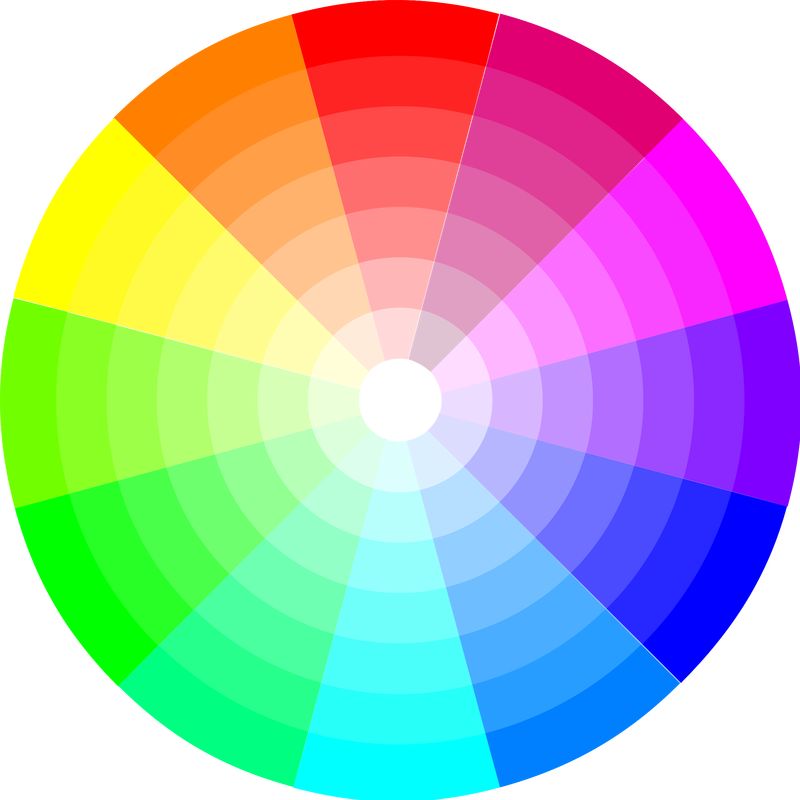
Color wheel. Internet image, public domain.

What follows is my take on a philosophical question – “did ancient people see colors the same way we do?” This one is just for fun, please don’t take it too seriously – I do not.


I have recently run across a very strange line of inquiry (or speculation anyway) that investigates whether or not ancient people could see/discriminate/comprehend all of the colors that we see. This became a fascinating mental exercise for me. Such a question would perhaps be pertinent to us as to whether or not the Paleolithic cave-artists saw the same colors we see, and did that reflect in their paintings? Before beginning I have to confess that in extensive searches of cave paintings in Europe, both on the internet and in printed books, I have failed to find an example painted in blue.


Cave painting of auroch, Lascaux, France. Internet image, public domain.

One strong possibility is that while they certainly saw the colors, meaning that their eyes picked up on all the same wavelengths of light that we do, they may not have comprehended what they were seeing. Based upon the old truism that you cannot actually comprehend something that you do not have a name for, until the name for the color blue was invented (in whatever language they spoke) they just were not as aware of it as they would have been shades of red. Remember, there seems to have been a historic fascination with red ocher.


Cave painting of auroch and horses, Lascaux, France. Internet image, public domain.

One of the first examples scholars noticed was in the writings of the Greek poet Homer. Christopher Hall (2018) has studied this subject extensively and explains that “Then Achilles, in tears, moved far away from his companions, and sat down on the shore, and gazed out over the wine-dark sea. (Iliad, 1. 351-353, trans. Stephen Mitchell) What color is the sea? Perhaps a silver-pewter at dawn, or a deep blue, or a warm green-blue, depending on the particular day, depth, and geographic location —but have you ever described the sea as being the color of claret? One of the characteristics of Homer’s writing is his use of epithets:  rosy-fingered dawn, swift-footed Achilles. Arguably the most famous of these is his oinops pontos, his wine-dark sea; it appears over a dozen times in the Iliad and the Odyssey, companion books chronicling the Greek siege of Troy, the Trojan War, and then the difficult journey undertaken by Odysseus after the war as he attempts to find his way home back to Ithaca. Wine-dark sea has been the subject of much speculation over the past couple hundred years. Shouldn’t the sea be blue? Strangely, nowhere in Homer’s epic poetry is the color blue ever mentioned. Water, water everywhere, but not a hint of blue.” (Hall 2018) I love the humor in Hall’s use of Coleridge’s “Rime of the Ancient Mariner” (way back when I read this in High School English it was spelled “Rhyme of the Ancient Mariner). He is pointing out the omission of any reference to the color blue, and some of Homer’s substitute phrases for it.


To begin with I need to add another disclaimer – an online search for “ancient Greek blue pigments” will yield many sites that do claim that the ancient Greeks had a word for blue. But again I have to confess that in extensive searches of images of Greek art, both on the internet and in printed books, I have failed to find an example painted in blue.

Hall continues “One of the first people to seriously study Homer’s use of color was the 19th-century classics scholar and British Prime Minister William Gladstone. In 1858, Gladstone published a seminal 1,700-page study of Homer’s epic poetry, which included a 30-page statistical analysis of Homer’s use of color. Gladstone notes that, compared to modern writers, Homer rarely mentions color, and what is mentioned is mostly limited to shades of black and white, with red, yellow, and green making only occasional appearances. Black is mentioned almost 200 times, white about 100. Red is mentioned fewer than 15 times, and yellow and green fewer than 10. Moreover, Homer’s descriptions of color can be, at times, completely bizarre: skies the color of bronze, stars are an iron or copper hue, sheep wool and ox skin appear purple, horses and lions are red, and honey glows green. Most conspicuous, however, Gladstone noted the complete absence of the color blue. Nothing is ever described as ‘blue.” (Hall 2018) Might it just have been that Homer was color blind? This turned out to be Gladstone’s explanation.

Wall painted Egyptian blue, Tomb of Meruka, Egypt. Internet image, public domain.

But then the question is was it just Homer who was color blind or were all ancient Greeks color blind? “But Homer’s blindness could not be an explanation for the strange use of color in the Iliad and Odyssey. The existing texts record stories from a longstanding oral tradition. Moreover, once Gladstone sifted through Homer’s texts, he also analyzed the descriptions in other ancient Greek texts and found they too had a conspicuous lack of color terms, limited to mostly shades of black and white—and again, a total absence of the color “blue.” The word didn’t even exist. Did the Homeric Greeks have defective color vision? Was there something physically different about their eyes? Indeed, that was Gladstone’s conclusion: “[The] organ of colour and its impressions were but partially developed among the Greeks of the heroic age.” The ancient Greeks, according to him, were color blind.” (Hall 2018) In other words, it was not just Homer, it apparently was his whole culture.

Egyptian blue pyxis (cylindrical container). Internet image, public domain.

Since then, many other theories have been posited for the lack of the word blue in Homer’s writings. “All of these potential explanations fail to account for one very important thing, however: the absence of the word “blue” in ancient Greek literature. The Greek islands are practically surrounded by the color blue: blue sky, blue sea—and yet the word for “blue” is conspicuously absent. Gladstone was on to something with his statistical compilation of color use in ancient Greek literature, but as it turns out, his study was a bit narrow: the ancient Greeks were not alone in their limited color descriptions, nor in the conspicuous absence of the color “blue.” Expanding upon Gladstone’s research, philosopher and philologist Lazarus Geiger found the same phenomenon in ancient Hebrew literature, Assyrian texts, Icelandic sagas, the Koran, ancient Chinese stories, Hindu Vedic hymns and Indian epics such as the Mahabharata. It is as though the entire ancient world were living in murky world of black and white, basking under heavy, brazen bronze skies, interrupted on rare occasion by flashes of red or yellow. The only ancient culture to have a word for blue was the Egyptians, as they developed the first synthetic pigment, Egyptian blue (the secret of its manufacture was lost in Roman times, but is thought to have been derived from heating together a quartz sand, a copper compound, calcium carbonate, and a small amount of alkali).” (Hall 2018) This resulted in a coarse blue sandy, partially vitrified product (somewhat similar to faience blue glaze) that was then ground fine enough to be used as the pigment. Egyptian blue was possibly the first artificially produced pigment.

Egyptian blue, Nebamun hunting. wall painting from the tomb-chapel of Nebamun, Thebes, New Kingdom, 1350 BC. Image credit Werner Forman Archive  Bridgeman Images.

“In the annals of history, ancient Egyptian society emerges as the trailblazer in embracing a distinct term for the color blue, owing to its pioneering development of blue dyes. This innovation found its vibrant expression in the renowned hue known as Egyptian blue. This stunning color featured in artworks such as the tombs of Mereruka  from the Old Kingdom (2600 to 2100 BC).” (Cowie 2024)


Then the question became whether the lack of blue was actually based on a physical difference, or was perhaps a cultural or linguistic question.


NOTE 1: The second part of this column will be posted next week.

NOTE 2: Some images in this posting were retrieved from the internet with a search for public domain photographs. If any of these images are not intended to be public domain, I apologize, and will happily provide the picture credits if the owner will contact me with them. For further information on these reports you should read the original reports at the sites listed below.


REFERENCES:


Cowie, Ashley, 2024, Hidden Hue: Why Ancient Civilizations Failed to See the Color Blue? 18 June 2024, Ancient Origins, https://www.ancientorginsunleashed.com. Accessed online 19 February 2025.


Hall, Christopher, 2018, Blue is the Rarest Color: Language and Visual Perception, 30 August 2018, Burnaway digital magazine online, https://burnaway.org/magazine/blue-language-visual-perception. Accessed online 19 February 2025.