Showing posts with label historic inscriptions. Show all posts

Saturday, November 26, 2022

ANCIENT CHINESE INSCRIPTIONS IN ARIZONA AND NEW MEXICO – REALLY?


Petroglyphs at Petroglyph National Monument, Albuquerque, New Mexico. From Ruskamp, 2017.

Abstract symbols from two locations in the American Southwest have been supposedly translated and read as 2500 year old Chinese inscriptions. This, from a publication by the Early Sites Research Society, a group of fringies which advocates a large number of eccentric beliefs regarding human presence in the New World. I first became aware of the group back in the days of the Ogam controversy and Barry Fell in the early 1980s. Not only Ogam, but many other languages such as Phoenician and other North African and Mediterranean dialects are supposedly found in New World inscriptions according to these people. No wonder they can read ancient Chinese inscriptions in Arizona and New Mexico.

Now, readers of RockArtBlog may remember that I have, in fact, in the past expressed my openness to more prehistoric contact between the Old and New Worlds than just the Viking settlement at L’Anse aux Meadows. If we were talking about some sort of prehistoric Chinese evidence found along the Pacific Coast of America, I might suspend some of my skepticism, but here we are talking about prehistoric Chinese presence hundreds of miles from the coast through the Mojave desert. I just cannot go this far. I will, however, summarize the gist of the arguments and let you decide for yourself.

Highlighted petroglyphs at Petroglyph National Monument, Albuquerque, New Mexico. From Ruskamp, 2017.

“In the roadless Rinconada Canyon area of Albuquerque, NM’s, Petroglyph National Monument, high above a sandy trail frequented daily by hikers, joggers, and dog-walkers, is a set of very old petroglyphs, readable as ancient Chinese script. Here, in public view yet remaining unrecognized and miscategorized, are the ancient written Chinese symbols; xiàn ‘to offer sacrifice in worship to deceased ancestors’, quặn ‘dog’, dà ‘great’, jiẻ ‘to kneel down in reverence’, Dà Jiặ (the name of the third(or fourth) king of the Shang dynasty), and gệng (the seventh Chinese Heavenly Stem).” (Ruskamp 2017:1) Now all of the other rock art at Petroglyph National Monument is known to have been produced by the ancestral First Nations people of that region.

Arizona petroglyphs claimed to be an ancient Chinese Inscription. From Ruskamp, 2017.

“In the Upper Little Colorado River drainage of east-central Arizona, approximately 250 miles to the southwest of Albuquerque NM, there exist three ancient and uniquely subdivided petroglyph cartouches, each filled with readable combinations of what clearly appear to be ancient Chinese logograms. Instructively, these cartouches were numbered by their ancient author, for written beside them is the Chinese character yī, meaning ‘one’, and similarly inscribed beside the adjoining cartouche is the symbol yĭ, meaning ‘second’. Together, the equivalent positioning of these numeric designations, one beneath what is meant to be the bottom of each cartouche, provides a visual clue for the intended alignment as well as the reading order of these writings.” (Ruskamp 2017:5 &6) In this example we are talking about an area in which the Hopi claim a deep prehistoric connection. (Riggs 2022)

Hopi Nakwach symbol. From Ruskamp, 2017.
Ancient Chinese jiū symbol, From Ruskamp, 2017.

Obviously, Ruskamp is relying on what he sees as similarity of symbols in his interpretation of the petroglyphs. “More than once, the ancient author of the cartouches described above recorded his message with graphic images that were, and still are, understood in the same manner by both Native American and Asiatic populations. The first of these mutually symbolic figures portrays the interlocking fingers of two hands. Persisting into modern times, the Hopi people of Northern Arizona refer to this figure as Nakwach, their symbol for ‘brotherhood, friendship.’ Chinese calligraphers, both ancient and modern, use an identical figure, jiū, which for them represents the twisting of multiple items into one.” (Ruskamp 2017:11) I have written previously that one can easily go too far in relying on similarity of symbols to make connection. After all, there are only so many shapes available to the human mind. The fact that the Hopi nakwach symbol somewhat resembles the Ancient Chinese jiū is meaningless. There are tens of thousands of similar symbols in the rock art of cultures around the world.

Linked Native American rectilinear spirals. From Ruskamp, 2017.


Ancient Chinese huí symbol. From Ruskamp, 2017.

The same goes for Ruskamp’s second example, the rectilinear spiral. “A second prominent example of the parallel symbolism employed by North American and Asiatic authors, evident in the study cartouches, is their joint use of a rectilinear spiral to convey the concept of a ‘round trip journey.’ This symbol, which the Chinese pronounce huỉ, appears frequently in North American rock art, both as a single object and in repetitive patterns. Historically, the Hopi have used this symbol to portray the four complete migrations that their legendary god Massau instructed them to make, once to each of the four cardinal directions and finally to the ‘Center Place.’” (Ruskamp 2017:12) This symbol is found in rock art around the world and from all chronological periods. Ruskamp makes a point to discuss the resemblance of these symbols to Hopi symbols, of course they resemble Hopi symbols, they are Hopi symbols.

“Accordingly, what does seem certain is that the origin of the significantly repatinated and uniquely styled Asiatic script symbols identified in this report must be assigned to China, for ‘The Chinese script is obviously and original system of signs created to record an ancestral form of the Chinese language’ (Houston 2008:258). Never in the history of humanity has such a uniquely complex and readable set of characters been invented more than once.” (Ruskamp 2018:18)

“The comparative evidence presented in this report, which is supported by both analytical evaluation and expert opinion, documenting the presence of readable sequences of Archaic Chinese scripts located upon the rocks of North America, indicates the creation of these images prior to the extinction of memory of oracle-bone script. Therefore, in contrast to any previous historical uncertainty, we may conclude that trans-Pacific exchanges of epigraphic intellectual property took place between Chinese and North American populations approximately 2,500 years ago.” (Ruskamp 2018:18)

In evaluating Ruskamp’s thesis I am not just a skeptic, I am a non-believer, yet I hope that my evaluation has been fair. I do not even go so far as to say that there could not have been prehistoric trans-Pacific contact. There are a few interesting arguments for that to have actually happened. It is just that I do not see Archaic Chinese inscriptions in these examples. My reasoning relies on two main arguments. First, I would expect ancient Chinese inscriptions, if they exist in North America, to be fairly near the Pacific coast, not hundreds of miles across the Mojave Desert. And my second objection is the same one used for decades now in arguing against the epigraphic diffusionism of Barry Fell – the resemblance seen in the symbols is just a coincidence as they have been used by hundreds of cultures over thousands of years. They are the result of independent invention, not cultural diffusion, and certainly not the result of an Ancient Chinese expedition.

NOTE: Some images in this posting were retrieved from the internet with a search for public domain photographs. If any of these images are not intended to be public domain, I apologize, and will happily provide the picture credits if the owner will contact me with them. For further information on these reports you should read the original reports at the sites listed below.

Also, I have no idea why Blogger decided to make the text background for most of this column white, but, as I have said before, I am an Art Historian, not a techie.


PRIMARY REFERENCE:

Riggs, Sarah, 2022, Hopi Connections to the Little Colorado River, 5 January 2022, Grand Canyon Trust, https://www.grandcanyontrust.org/blog/hopi-connections-little-colorado-river, accessed 9 November 2022.

Ruskamp, John A., Jr., with a comment by Stephen C. Jett, 2015-2017, Two Ancient Rock Inscriptions Indicate and Archaic Chinese Presence in the American Southwest, from Pre-Columbiana: A Journal of Long-Distance Contacts, Volume 6, Numbers 2-4, Early Sites Research Society, Independence, Missouri.

SECONDARY REFERENCES:

Houston, Steven, ed., 2008, The First Writing: Script Inventions History and Process. New York: Cambridge University Press.

Wieger, Lèon, 1965, Chinese Characters: Their Origin, Etymology, History, Classification and Signification. A Thorough Study from Chinese Documents, 2nd ed. St. Paul, MN: Para[1]gon Book Reprint Corp.; Mineola, NY: Dover Publications (orig. pub. Hsien[1]Hsien, China: Catholic Mission Press, 1927).

Saturday, October 15, 2016

INSCRIPTION CAVE AND SENTINEL ROCK, PERRY PARK, DOUGLAS COUNTY, COLORADO:


Sentinel Rock, Perry Park, Douglas
County, Colorado. Photo: Peter Faris,
September 19, 2016.

Every once in a while on RockArtBlog I like to throw in some information on historical inscriptions to present material of interest to historians and genealogists. I first became interested in historical inscriptions a number of years ago when I was asked to give a rock art presentation to a genealogical society, and going through my rock art slides I found that I had inscriptions among the rock art pictures that really had a fascinating back story.

On September 19, 2016, I was guided by my friend Garry to Inscription Cave, in Perry Park, near Larkspur in Douglas County, Colorado. Garry is a very knowledgeable local historian, and the president of a local historical society, who generously gave of his time and knowledge to show me this interesting site.

Inscription Cave, Perry Park, Douglas
County, Colorado. Photo: Peter Faris,
September 19, 2016.

Inscription cave is near the base of Sentinel Rock which is a local landmark. "In the late 1800s, the cave was used as a stopping place for stagecoaches by people going to Larkspur, where they linked up with the railroad that connected them with Denver and Colorado Springs. The rock was a good stopping place because at its base is the cave, which travelers used as a refuge from rain and snow when needed. While they waited for the stagecoach, some of them carved their initials, names, and/or dates into the soft rock of this cave." (O'Hara 2015)


Carrie Curtis, 1871, Inscription Cave,
Perry Park, Douglas County, Colorado.
Photo: Peter Faris, Sept. 19, 2016.

To me this is precisely the fascination that such inscriptions possess. They are a direct link to the history and people of an area. "The history of Perry Park goes back to the earliest days of settlement in Colorado. - The Hayden Survey of 1869 called the region Pleasant Park. John Perry, president of the Kansas Pacific Railroad, discovered the area while searching for railroad routes; by the early 1870s he owned 4000 acres here. Later owners decided to make "Perry Park" a tourist haven. A hotel was built in 1889 at the foot of 300-foot-high Nanichant Rock, and the house that later became the site of the golf course headquarters (Manor House) was built in 1891." (O'Hara 2015)


San Francisco, 1871, Inscription Cave,
Perry Park, Douglas County, Colorado.
Photo: Peter Faris, Sept. 19, 2016.

Examining the names and dates of Inscription Cave (almost all of the inscriptions are actually outside the cave on the cliff face) gives one insight into family names that have been important in the area as well as the comings and goings of visitors. The earliest dates that I saw were Carrie Curtis, 1871, and another that says San Francisco, 1871. The Curtis family were one of the pioneering families in Douglas County Colorado. An inscription that reads H. H. Curtis, 1876, records the visit of the patriarch of the Curtis clan, and other Curtis's that are represented on the rock over different dates are Bess, Fern, and H. B. Of course, many other names are recorded as well, from 1871 up to Carrie and Jerry, 1961. A Smith family is represented by H. J. Smith, 7-4-81, and W. H. Smith, Boston, 09, perhaps records a visit by a family member from Massachusetts.


H. H. Curtis, 1876, and H. J. Smith, 7-4-81. Inscription Cave, Perry Park, Douglas
County, Colorado. Photo: Peter Faris,
Sept. 19, 2016.

There is nothing like these little pieces of local history to give one a feeling of being grounded in place and time. Thank you Garry for your time and effort. I enjoyed it greatly.

NOTE: The designation Inscription Cave is our own and is not an official name for this feature.

REFERENCE:

O'Hara, Garry
2015   Sentinel Rock, self-published.

Saturday, September 17, 2016

CARIBBEAN ROCK ART - PUERTO RICO:


Cave with wall markings (inset).
Mona Island, Puerto Rico.
www.livescience.com.

Writing for LiveScience on July 20, 2016, Megan Gannon introduced the petroglyphs of Mona  Island, Puerto Rico. Citing an article in the July 19, 2016 journal Antiquity, she presented both prehistoric and Spanish settler images. This considerably expands the knowledge of rock art in the Caribbean.


Cave markings. Mona
Island, Puerto Rico.
www.livescience.com.

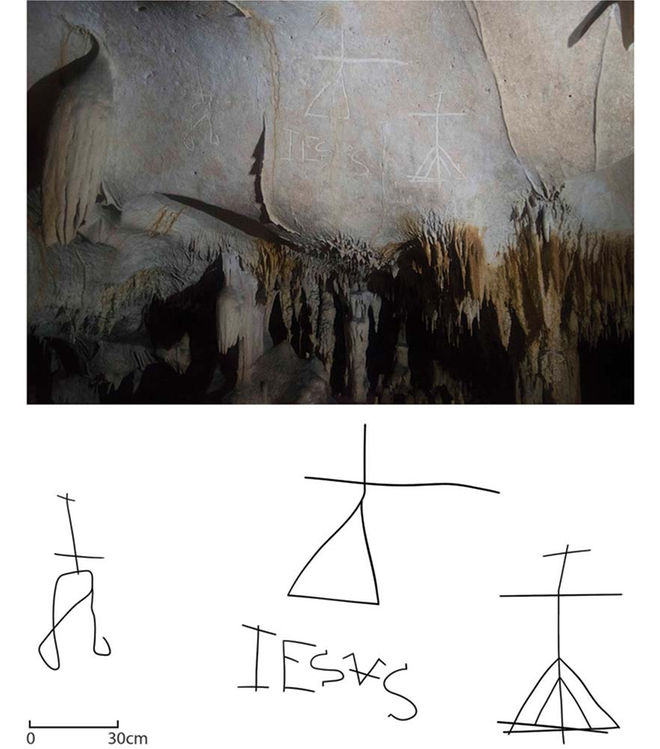
This collection of rock art is found in caves on Mona Island, and many of the markings were made by dragging fingers or a tool through a soft surface layer on the limestone walls of the caves. Researchers reportedly found markings in thirty of seventy caves they explored, and date the oldest back to 500 years B.P.


Historic cave inscription.
Mona Island, Puerto Rico.
www.livescience.com.

In one cave they found a mix of prehistoric and historic imagery. "Alongside the indigenous artwork there are names, dates, and Christian symbols like crosses and Christograms (a symbol of Christ usually consisting of letters) from the 16th century. There are also some Christian phrases and Bible verses, in Spanish and Latin, such as "dios te perdone" (may God forgive you") and "verbum caro factum est" ("and the Word was made flesh")." (Gannon 2016)

Christograms on cave wall.
Mona Island, Puerto Rico.
www.livescience.com.

"In one case, a name scribbled graffiti-style on a cave wall could be tied to a real person. Francisco Alegre, who came to the Caribbean from Spain with his father in the 1530s and became a royal official in Puerto Rico." (Gannon 2016)

So much more rock art is there to be discovered, if only we look.

REFERENCE:                       

Gannon, Megan,
2016      http://www.livescience.com/55467-pre-columbian-cave-art-discovered.html

Saturday, January 9, 2016

HISTORIC INSCRIPTIONS - KID CURRY, 1901:


Another illustration from the PhD
thesis of Timothy Urbaniak (2014)
identifies "Kid Curry, 1901."

"While inscriptions of "outlaws" have been documented further south into Wyoming, evidence of them roaming eastern Montana is scarcer, with the exception of the inscription "Kid Curry 1901" (Figure 5.77), located on a lone sandstone outcrop north of Ingomar, Montana." (Urbaniak 2014:130)

"Kid Curry came to Montana when he was about 16 and eventually started a ranch south of Landusky with his brothers. But when a feud erupted and Curry shot Pike Landusky, owner of the brothers’ favorite saloon, Curry skipped town for Wyoming." (Tribune Staff 2014)
 
The Wild Bunch, Logan is on
the right in the rear, public
domain photograph.

In Wyoming "he joined a gang of bandits led by “Flat-Nosed” George Currie (no relation) and Harry Longabaugh, alias the “Sundance Kid.” George Parker, alias “Butch Cassidy,” later joined the gang, eventually known as the Wild Bunch. The group’s legendary robberies include a bank hold-up in Belle Fourche, S.D., and Union Pacific train robberies." (Tribune Staff 2014)

"On July 3, 1901, Kid Curry and the Wild Bunch pulled off one of the most successful train robberies in U.S. history. At Exeter Creek, about six miles west of Malta, they held up the Great Northern Railway passenger train. They disappeared with $41,500 in unsigned tender. 
No one was ever convicted for the Great Northern robbery, but Kid Curry was arrested later that year in Tennessee for forging bank notes — presumably from the same train heist. 
He was sentenced to 41 years in prison but escaped in 1903." (Tribune Staff 2014)

The 1901 inscription of Kid Curry at Ingomar, Montana, would likely have been carved before the July 3, 1901 train robbery because, afterward the gang (including Kid Curry) would have been concentrating on evading the law. Indeed, if you are being chased by a posse, or just sought by Pinkerton agents, you are not likely to leave your name carved on a rock to give a clue towards where you had gone. Urbaniak concluded that the inscription was connected with the train robbery. "It has been speculated that the inscribing is connected with a trip to rob the Great Northern train near Wagner, Montana, which he did on July 3, 1901." (Urbaniak 2014:130)


Harvey Logan, AKA Kid Curry,
public domain photograph.

"Curry’s later activities are debated, but Nate Murphy, curator of Outlaw Lawmen Collections at the Phillips County Museum, said the most reliable information comes from the Pinkerton detective agents who trailed the Wild Bunch’s crime spree. Their records say Curry’s corpse was identified in Colorado. He was wounded in 1904 during a gunfight after a botched train robbery in Parachute, Colo. To avoid being captured, he shot himself in the head." (Tribune staff 2014) Kid Curry was buried in Linwood Cemetery, in Glenwood Springs, Colorado (Doc Holliday is also buried there).

Although the popular movie Butch Cassidy and the Sundance Kid glamorized the details of the gang's activities, including train robberies, we will do well to remember that these were violent acts and innocent people were injured and killed.


Linwood Cemetery, Glenwood Springs, Colorado. http://www.tripadvisor.com/

Such historic inscriptions can provide us with a direct emotional and intellectual link to events of the past, to the deeds and circumstances that have led to our society today. Indeed, I have been to Parachute and Glenwood Springs, Colorado, many times, and I have even ridden the train through them. I love these historic inscriptions because of such feelings of connection, and the way they allow us to better  understand the history of who we are and where we live.

.  .  .  .  .  .  .  .  .  .  .  .  .  .  .  .  .  .  .  .

NOTE: This material is presented through the generosity of Tim Urbaniak, who compiled much of this material for his 2014 PhD thesis, HISTORIC INSCRIPTIONS OF THE NORTHERN PLAINS IDENTITY AND INFLUENCE IN THE RESIDUAL COMMUNICATION RECORD at the University of Montana, in Missoula.


REFERENCES:

Staff, Great Falls Tribune, 2014.

Urbianik, Timothy Rostov,
2014    HISTORIC INSCRIPTIONS OF THE NORTHERN PLAINS IDENTITY AND INFLUENCE IN THE RESIDUAL COMMUNICATION, Dissertation Presented in partial fulfillment of the requirements for the degree of Doctor of Philosophy in Anthropology The University of Montana Missoula, MT,  July 2014.

Wikipedia.

www.tripadvisor.com

Sunday, March 29, 2015

ROCK ART OF EL MORRO, NEW MEXICO:


El Morro, Cibola County, NM.
Photograph: Peter Faris, June 1993.

I have formerly posted some columns on historic inscriptions found at Morro Rock, in Cibola County, New Mexico. This interesting site has a permanent water tank at its base, a huge premium in this arid landscape, and the ruins of an ancestral Puebloan village on its summit. Long known for the large number of historic inscriptions carved into the rock face which record many episodes from the history of New Mexico and the southwest, it is less well known for Native American ancestral Puebloan rock art left carved into its surface by early inhabitants. Much of this ancestral Puebloan rock art has been defaced and overcarved by later inscriptions which are now considered to be historic. Those inscriptions record much of the history of the Spanish and American periods in the American southwest by providing a ledger of who was passing by Morro Rock, and often why they were there, and they provide an interesting historic resource in their own right. But, in this posting, I intend to look at the prehistoric rock art that can still be seen at Morro Rock.


Atsinna pueblo, El Morro, Cibola County, NM.
Photograph: Peter Faris, June 1993.

"Atsinna Pueblo, the largest of the pueblos atop El Morro, dates from about 1275. Its builders made use of what they had around them: flat sedimentary rock easily cut up as slabs they could pile one on top of another and cement with clay and pebbles. The pueblo was about 200 by 300 feet, and it housed between 1,000 and 1,500 people. Multiple stories of interconnected rooms - 875 have been counted -- surrounded an open courtyard. Corn and other crops were grown in irrigated fields, down on the plain; the surplus was stored in well-sealed rooms in the pueblo against times of need. The grinding bins and fire pits remain today. Cisterns on top of the mesa collected rainwater. The pool at its base was often used too, as hand-and-toe steps on the cliff face attest. An alternate trail for the residents may have followed the one that is still in use." (http://www.nps.gov/elmo/learn/historyculture/atsinna.htm)
 
 
Petroglyphs, El Morro, Cibola County, NM.
Photograph: Peter Faris, June 1993.

 The subjects that can be seen in the remaining rock art around the base of Morro Rock seem to be fairly common ancestral Pueblo themes. Human figures, animals, hand and foot prints, concentric circles, etc.
 
 
Petroglyphs, El Morro, Cibola County, NM.
Photograph: Peter Faris, June 1993.
 
Note the lovely row of bighorn sheep crossing the middle of this panel. Deeply carved and of excellent preservation, they are familiar to many as one of the most photographed petroglyph groups at El Morro.


Petroglyphs, El Morro, Cibola County, NM.
Photograph: Peter Faris, June 1993.

And above is my favorite, a roadrunner. Note the topknot projecting from the back of his head. This is a very common animal in this environment in the desert southwest.

 
Petroglyphs, El Morro, Cibola County, NM.
 
Spread-legged human  figures that are so familiar in ancestral Puebloan rock art. The dates for occupation of Asinna on top of Morro Rock fall in the late Pueblo III to early Pueblo IV periods, and Shaafsma puts the style of rock art at El Morro as "Plateau Anasazi mixed with Rio Grande Style." (Schaafsma 1992:25)

Given the historic importance of the Spanish and American inscriptions, it is perhaps understandable that the rock art of El Morro is not better known, but it is a shame. It fully deserves as much attention as other rock art sites. Stop in if you are ever in that part of New Mexico, it is well worth a visit. 

REFERENCES:

Schaafsma,Polly
1992      Rock Art in New Mexico, Museum of New Mexico Press, Santa Fe.