Showing posts with label Iberia. Show all posts

Saturday, September 19, 2026

EASTERN IBERIAN CAVE USED FOR 24K YEARS:

Cova Dones (Cave of the Women), Spain. Internet image, public domain.

Finding caves occupied and decorated during the Paleolithic is no longer a unique phenomenon, neither is finding traces of Roman occupation in Iberia and Europe. Finding a cave that has both Paleolithic art and traces of Roman occupation is somewhat less common. Add to that, this cave is on the eastern side of the Iberian peninsula, not in the Franco-Cantabrian region where most of the decorated caves in Europe are found and we have something that is almost unique. This is Cova Dones, the Cave of the Women

Horse head painted with red clay, Cova Dones, Spain. Internet photograph, public domain.

The art in Cova Dones was discovered in 2021 and is being studied by a team of academics. (Ruiz-Redondo et al. 2023:1) “So far, we have identified more than 110 graphic units, including at least 19 zoomorphic representations, located in three different zones of the cave. Despite being deep inside the cave (the main decorated area is approximately 400m from the entrance), all zones, and the panels and figures they contain, are easily accessible without any climbing required. The depicted animals are seven horses, seven hinds (female red deer), two aurochs, a stag, and two indeterminate animals. The rest of the art consists of conventional signs (rectangles, meanders), several panels of ‘macaroni’ (‘flutings’ made with either fingers or tools dragged across a soft surface), isolated lines, and poorly preserved unidentified paintings. The variability and rarity of the technical features of the artworks are noteworthy because the assemblage includes different types of engravings and paintings.” (Ruiz-Redondo et al. 2023:2)

Aurochs painted with red clay, Cova Dones, Spain. Internet photograph, public domain.

The cave possesses a wide variety of human made markings and images.  “The variability and rarity of the technical features of the artworks are noteworthy because the assemblage includes different types of engravings and paintings. The engravings comprise the classic single-trait outlines of figures, but also figures shaded by scraping the mondmilch (a type of limestone precipitate) on the surface of the walls. This technique is rare in Paleolithic cave art and previously unknown in eastern Iberia. The painting technique is no less surprising; motifs were created through the application of red clay on the walls, instead of the usual diluted ochre or manganese powder. This iron-rich clay is abundant on the floors of the cave. Examples of such technique are known in the Mediterranean area and beyond (e.g. Ardales, Bernifal, Higuerón, La Pasiega, Pileta, Rouffignac), but they are rare in all of these sites (except at La Baume Latrone). In Cova Dones the entire painted corpus (>80 graphic units) is made using this technique.” (Ruiz-Redondo et al. 2023:2-3) The variety mentioned above may suggest that the images were produced over quite a period of time by many different artists.

Cova Dones, Spain. Internet photograph, public domain.

There are also a number of scratched claw marks of a scale that would match the claws of a cave bear, in one location scratched across some of the finger fluting. “Stylistic analysis of the figures points to a pre-Magdalenian age (>20 ka cal BP) and, considering the date for the extinction of the cave bear, we estimate that at least part of the rock art must be more than 24,000 years old.” (Ruiz-Redondo et al. 2023:4)

Cova Dones, Spain. Internet photograph, public domain.

“While the project is still in its early stages, preliminary results reveal an enormous potential for research at the site and establish this assemblage as arguably the most important for the eastern Iberian coast. Its iconographic and technical features make it one of the few major Pleistocene decorated sites of eastern Iberia.” (Ruiz-Redondo et al. 2023:4) This decorated cave is far from done presenting researchers with surprises.

Roman inscription, Cova Dones, Spain. Image from University of Alicante, San Vicente del Raspeig, Spain.

Along with the Paleolithic cave art this cave holds a large number of inscriptions in Latin carved into the walls. “Archaeologists recorded the inscriptions during a 2026 campaign at Cova de les Dones, near Millares in Valencia. Most date from the first and second centuries CE. The new finds raise the known number of Latin texts at the site from about 15 to at least 129. The inscriptions sit on the walls and ceilings of a chamber more than 200 meters underground. Researchers call the space the Roman Sanctuary. Their location and tight grouping point to a planned place of worship rather than a cave used for occasional religious visits. Five votive inscriptions refer to a goddess addressed as Domina, meaning ‘the Lady.’ Three also contain the word ‘MALACI,’ and unknown title or name linked to the goddess. Researchers are still working on its exact reading and meaning. The title might relate to water, and important feature of the underground setting.” (Radley 2026) Another possibility is that the word MALACI may be a millennia-old ‘Kilroy was here.’

Roman ring, and coin of Hadrian, Cova Dones, Spain. Internet images, public domain.

And, along with the inscriptions in Latin were found a large number of artifacts including many spindle whorls which point to a focus on female activities or concerns. Other finds include rings and a coin featuring the emperor Hadrian. (Radley 2026)

It is always interesting when a discovery opens up a new area or field of inquiry, and Cova Dones has provided more than one.

NOTE: Some images in this column were retrieved from the internet with a search for public domain photographs. If any of these images are not intended to be public domain, I apologize, and will happily provide the picture credits if the owner will contact me with them. For further information on these reports you should read the original reports at the sites listed below.


REFERENCES:

Radley, Dario, 2026, 120 Roman inscriptions reveal a mysterious goddess worshiped in Spain’s Cave of the Women, 21 August 2026, https://archaeologymag.com/2026/08/roman-inscriptions-mysterious-goddess-spain-cave/. Accessed online 22 August 2026.

Ruiz-Redondo, Aitor et al.,2023, Cova Dones: a major Paleolithic cave art site in eastern Iberia, Antiquity, Vol. 97, 396, 1-5. https://doi.org/10.15184/aqy.2023.133. Accessed online 11 August 2026.

Saturday, February 1, 2025

THE DISAPPEARING OWLS – IBERIAN SLATE PLAQUES ARE NOW WRITING, OR GENEALOGICAL RECORDS:

Map of locations of discovery of plaques on the Iberian Peninsula. Map from urn-cambridge.org.

Owl plaque (from 2023 posting). Illustration from Negro et al., 2022, Fig 1. Slate plaque from Cerro de las Cabezas, Valencina de la Concepción, Sevilla, Spain (Museo Arqueológico de Sevilla, REP25837).

Back in March 2023, I posted a column that identified a number of decorated slate plaques found in Iberia, as toy owls created by children. These owl themed plaques are a subset of a very large number of similar plaques from the Chalcolithic Period (Copper Age, ca. 5200 BP) created in a time frame of 5500 to 4750 BP. It is important that we note that the owl plaques are only a fraction of similar decorated plaques from that period. I found this theory hard to accept based on a level of workmanship that would, in my opinion, have taken longer to acquire than the short period of childhood.


From anthropology.net, Illustrations of classic slate plaques housed at Portugal’s Museu Nacional de Arqueologia. 

A new study has now been published that argues that the plaques are an early form of writing and record genealogical records (Lillios et al. 2024).

Katina Lillios and her collaborators state that the owl plaques represent only 4% of the overall number (p. 4). “Typically found as grave goods in tombs in south-western Iberia, the plaques are hand-sized objects (150 mm) most often made from slate. They are primarily found in southern Portugal but also known in south-western Spain.” (Lillios et al. 2024:4) Presently there are 1826 of these engraved plaques recorded according to the team. They argue very convincingly that the owls could not have been toys created by children primarily because they are such a small percentage of the overall number, while children are often the largest demographic group in a society.


Illustration from urn-cambridge.org.

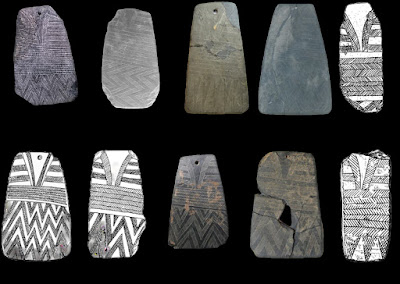
“That only a minority of the plaques (4 per cent) have clear biomorphic traits, such as ‘eyes’ (or oculi) or a ‘nose’ (or ‘beak’), presents a challenge to the notion that all plaques represent a deity, such as a Mother Goddess. These plaques include the Biomorph Simple and Biomorph Whiskered types. The overwhelming majority (70 percent) are of the Classic type— the focus of this article. Classic plaques have a ‘ top’ and a ‘base’ separated by a horizontal line or bands. The bands are filled with hachures or small triangles, or are unfilled. The top can have straps (horizontal or vertical)or other motifs, such as inverted ‘v’s, rays, and a collar. In rare cases (n = 10), Classic plaques have ‘eyes’ or oculi, like the Biomorph plaques. The base is typically decorated with six design

motifs, which can be found on their own or in combination with other motifs, and are most often organized along horizontal registers. These motifs include triangles, checkerboard, vertical bands, chevrons,

zigzags, and herringbone. That these motifs are all textile weaves may suggest that the plaques were inspired by clothing or other woven goods that have not survived, except in rare cases.” (Lilios et al. 2024:5) The plaques that had been identified as owls fall into the categories that the authors here are calling “biomorph simple,” and “biomorph whiskered.” The statement that “these motifs are all textile weaves” is unproven and seems a little reckless.

Illustration from urn-cambridge.org. Note that the plaque in the bottom left (no. h) is the same as my owl plaque illustration above.

In the following paragraph, note that the authors refer to the design elements as “records” as if they somehow contain data – another leap to conclusion.  “A key question the study addresses is whether there is a correlation between the number of records on the plaques and their geographical distribution. If the plaques represent genealogical records, the researchers expected to find plaques with fewer records concentrated in Alentejo (in southern Portugal), regarded as the ‘heart’ of this tradition, while those with more records would be more geographically dispersed. This pattern would be consistent with the expansion of successive generations of a lineage to other areas. The results of the analysis show a significant, though not conclusive, correlation between the number of records and the dispersion of the plaques, which supports the hypothesis that they may represent lineages that expanded over time. Another fundamental aspect explored by the researchers was the possible relationship between the size of the tombs where the plaques were found and the number of bands separating the base from the upper part. Tomb size is an indicator of labor investment and, possibly, the status of the individuals buried within. This study found that plaques found in larger tombs tended to have a greater number of bands, which could suggest a connection between the complexity of the design and the social prestige of the individuals they accompanied.” (Carvajal 2024)

“A final theory exists that states these slates may have been genealogical records, similar to how heraldic emblems denote a person’s ancestry, as did the plaques. For Prof. Lillios, the spark that led to this hypothesis was one particularly unique plaque, ‘if there was any real spark in this research, it was in the study of one particular plaque in the Museu Geologico in Lisbon, in 2003.” (Oster 2024) ) If these plaques are genealogical, perhaps there is a basic design for a clan or family that gets more complicated from generation to generation by adding lines, triangles, or stripes while maintaining the basic design. The term “heraldic” implies this connection to an identifiable group of people, whether it is family or clan.

Illustration from urn-cambridge.org.

“Our work reassesses the genealogical hypothesis for the Classic plaques using a series of statistical analyses to evaluate whether significant patterning exists among their design, their geographic distribution, and the size of the tombs in which they were found. Our study indicates a positive relationship between tomb size and the presence of plaques with high numbers of bands. There is also a relationship between the number of bands, the presence of a collar, and the base design. What the bands and collars specifically denote is, however, unclear. Perhaps bands recorded the number of children, territorial claims, military conquests, or something else considered remarkable enough for Late Neolithic and Copper Age people to record on that plaque (and the person associated with it).” (Lilios et al 20024:13) Marks to record data, this would be the idea behind claims that the slates represent a very early example of a written language, although again, I think that is going a little far.

“Clearly much more work remains to be done on the plaques to elucidate their formal patterning and understand the organization of their production. To conclude, much of the debate around the Iberian plaques, which is centered around whether they were heraldic, or were related to ancestors, or represented deities, obscures more than reveals. Individual plaques clearly had social lives, and as a class of objects, perhaps sacred texts, their use or meaning no doubt changed over time. When they were first created, Classic plaques may have been accorded to individuals whose genealogical history was central to the mythos of a community, but who, over time, became important ancestors, or even deities themselves.” (Lilios et al. 2024:14) This is a possibility that certainly cannot be disproven at this time. They were clearly important, so many of them were created.

Many of the slate plaques have one or twos hole in the  narrower end apparently to hang them up somehow. This implies display and reinforces that they represent something that identifies an individual, family, or group as different from the others. This could seemingly be defined in some ways as heraldic.

REFERENCES:

Carvajal, Guillermo, 2024, The Enigmatic Prehistoric Engraved Slate Plaques of the Iberian Peninsula are Genealogical Recordds and One of the Earliest Forms of Writing in Europe, 1 November 2024, https://www.labrujulaverde.com. Accessed online 15 January 2025.

Lillios, Katina T., Tang Zhuo, and Jay Bowen, 2024, The Engraved Slate Plaques of Late Neolithic and Copper Age Iberia: A Statistical Evaluation of the Genealogical Hypothesis, European Journal of Archaeology 2024. Accessed online 15 January 2025.

Negro, J. J., Blanco, G., Rodriguez-Rodriguez, E., et al., 2022, Owl-like plaques of the Copper Age and the involvement of children, Sci. Rep. 12, 19277, https://doi.org/10.1038/s41598-022-23530-0. Accessed 2 December 2022.

Oster, Sandee, 2024, Ancient Iberian slate plaques may be genealogical records, 3 December 2024, https://phys.org. Accessed online 15 January 2025.

Sci.News Staff, 2022, Iberian Owl-Shaped Plaques Were Toys Made By Copper Age Children: Study, 5 December 2022, Sci.News online. Accessed online 1 March 2023.