Showing posts with label hadrosaur. Show all posts

Saturday, December 13, 2014

THE DOHENY SCIENTIFIC EXPEDITION TO THE HAVA SUPAI CANYON, NORTHERN ARIZONA, OCTOBER AND NOVEMBER, 1924:


The Grand Canyon petroglyph in question.

On June 21, 2014, I posted a column titled DINOSAURS IN ROCK ART – THE HAVASUPAI CANYON HADROSAUR. In this I expressed my disbelief in the claims of creationists that there are rock art examples of dinosaurs that prove that humans and dinosaurs coexisted and interacted. The example I discussed in that posting, the Havasupai Canyon so-called “hadrosaur” was first recorded by the Doheny expedition in October and November of 1924 and here is an abbreviated version of that account from Samuel Hubbard's account of that expedition.

“The Doheny Scientific Expedition to the Hava Supai Canyon in Northern Arizona, was organized for the express purpose of bringing before the scientific world, certain discoveries relating to prehistoric man made by the writer in three previous visits to this isolated region.” (Hubbard 1925:3)

“This canyon was first visited by the writer in November, 1894, and in February and March, 1895. Most of the matters of prehistoric interest described in this pamphlet, were observed at that time but their true significance was not fully recognized. Endeavors were made at various times to interest scientists in this discovery, but without avail. - - - -


Havasupai Canyon hadrosaur,
Doheny expedition, p. 10.


Hubbard's conception of what the petroglyph
represents. Doheny expedition, p. 11.

The fact that some prehistoric man made a pictograph of a dinosaur on the walls of this canyon upsets completely all of our theories regarding the antiquity of man. Facts are stubborn and immutable thins. If theories do not square with the facts than the theories must change, the facts remain.
Samuel Hubbard, Director of the expedition.
Oakland, California,
January 26th, 1925.” (Hubbard 1925:5)
                   
Hubbard's map. Doheny Expedition, p. 4.

“THE DINOSAUR PICTOGRAPH
The “Tobocobe Trail” after leaving the “Warehouse” at the Hill Top, makes its way for about six miles down Lee Canyon, a tributary canyon to the main canyon of the Supai. Just at the junction of these two canyons are the most important wall pictures so far discovered. –
The accompanying halftone, taken from a photograph made by Robert L. Carson of San Gabriel, California, gives a better idea of the figure than any description can possibly attempt to do. The fact that the animal is upright and balanced on its tail would seem to indicate that the prehistoric artist must have seen it alive.” (Hubbard 1925:7)

“That dinosaurs were in the vicinity, is proved by the tracks we discovered, which were identified by Mr. Gilmore as belonging to one of the carnivorous dinosaurs. These tracks were in the “Painted Desert” not over 100 miles from the picture.
The dimensions of the figure are as follows: Total height, 11.2 inches; greatest width, 7 inches; length of leg, 3.8 inches; length of body, 3.9 inches; width of body, 3 inches; length of neck to top of curve, 3.5 inches; length of tail (approximately) 9.1 inches, length of neck (approximately) 5.1 inches.
About a year ago a photograph of the “dinosaur” was shown to a scientist of national repute, who was then specializing in dinosaurs. He said, “It is not a dinosaur, it is impossible, because we know that dinosaurs were extinct 12 million years before man appeared on earth.” (Hubbard 1925: 9)


 Edmontosaurus (an early hadrosaur)by 
Mineo Shiraishi. museumvictoria.com


Diplodocus, wikipedia.org

In my previous posting of June 21, 2014, titled DINOSAURS IN ROCK ART – THE HAVASUPAI CANYON HADROSAUR, I pointed out that, while this petroglyph fit what was thought about dinosaurs at the time we now know that the figure is completely inaccurate according to today’s scientific knowledge. Far from being the limp nebbish shown, standing on his hind legs with his tail dragging on the ground behind it, modern paleontologists see the hadrosaur as running bipedaly with his tail straight out behind, and relatively rigid. So, while the image might have made sense as a dinosaur in 1925, it no longer does. The same goes for the tail of the diplodocus that Hubbard equates the petroglyph with. It stuck out straight and relatively rigid, and while it would have been able to swing from side to side it probably rarely dragged on the ground at all. The designation of this petroglyph as a picture of a dinosaur must be rejected on the basis of our current scientific knowledge. So sorry creationists, it just isn’t true.

SOURCE:

Hubbard, Samuel
1925    The Doheny Scientific Expedition to the Hava Supai Canyon, Northern Arizona, October and November, 1924, Oakland Museum, Oakland, CA.

Wikipedia

Saturday, June 21, 2014

DINOSAURS IN ROCK ART? – THE HAVASUPAI CANYON HADROSAUR:


Havasupai Canyon panel. Picture
from www.6000years.org.

One of the first, and still most popular, examples of dinosaurs in rock art that creationists and young-earthers point to is the Havasupai Canyon hadrosaur (duck-billed dinosaur). Creationists are driven to prove the position that the bible says the earth is only 6,000 years old based upon 17th century Bishop Usher’s calculation that “the first day of creation began at nightfall preceding Sunday, October 23, 4004 BC” (Wikipedia).

This dinosaur petroglyph was discovered by Samuel Hubbard, Curator of Archaeology of the Oakland Museum, in the late 1800s. Hubbard led an expedition to the Havasupai Canyon area of the Grand Canyon. “On two occasions in the late 1800s, Samuel Hubbard, Curator of Archaeology of the Oakland Museum, visited an area of the Grand Canyon known as the Havasupai Canyon. As an evolutionist, he was amazed to find a petroglyph (carved rock drawing) of an elephant made by Native Americans. But another depiction was “cut into the sandstone much more deeply than the elephant.” Its height was 11.2 inches, with a neck approximately 5.1 inches in length and a tail of 9.1 inches. What kind of animal is it? Dr. Hubbard believed that he had found an ancient drawing of a dinosaur.” http://www.genesispark.com/exhibits/evidence/historical/ancient/dinosaur/)


Charles R. Knight  painting of a hadrosaur. 
Photograph from www.muttpop.fr.

I first heard of this one many years ago. When I was young these creatures were often pictured as standing upright on the tripod formed by their legs and tail, pretty much as this petroglyph shows. Recently, of course, paleontologists have rethought those old assumptions and now know that these creatures held their body and tail much more horizontally. What this means is that, where some time back this image seemed to make some sense, we now know that this is totally incorrect. That brands this either as an error of identification, or a hoax. Indeed some researchers now point to the shape of the head and suggest it might be a poorly drawn bird, but, of course, then the tail makes no sense at all.


Grand Canyon hadrosaur petroglyph showing the 
supposed "bullet hole" at the base of the tail.
Photograph from www.bible.ca.

“An example of Native American rock art carved into the walls of Grand Canyon. It was discovered in 1879 by E. L. Doheny and documented in 1924 by a scientific expedition which included Dr. Charles W. Gilmore, Curator of Vertebrate Paleontology, United States National Museum. The resulting publication reported as "fact" that "some prehistoric man made a pictograph of a dinosaur on the walls of this canyon..." Doheny Scientific Expedition, p.5. Recently someone used it as a target practice and you can see a bullet hole at the base of the tail. It shows just how old the etchings must be since the fresh bullet mark cuts through the thick "rock varnish". (www.bible.ca)

Now I have to question the “bullet hole” alluded to above. It shows in the photo as a white disk with not internal textural detail or shading visible and no sign of the color of the base rock. Even if a real hole had been heavily chalked to make it stand out it would show differences of light and shadow with the brightest side facing the direction of the sun and shadowing on the side facing away from the sun. This leads me to suspect that the “bullet hole” was created in Photoshop or Microsoft Paint and is not real. Notice in the photo of the petroglyph with the illustration by Paul Taylor (below) there is no bullet hole.


Havasupai Canyon petroglyph and a rendering by Paul Taylor of
how the model would have been standing were it an authentic
picture of a hadrosaur. www.paleo.cc/ce/dino-art.htm.

That brings us to the pair of pictures by Paul Taylor. He shows a photo of the petroglyph on the left and a painting of his interpretation of the actual animal on the right, and he has concluded that it is an Edmontosaurus. This is explained as follows: “For example, in his creationism-promoting book The Great Dinosaur Mystery, which is aimed at young readers, Paul Taylor shows a petroglyph from Havasupai Canyon in Arizona. He highlights the petroglyph with a white outline, shown alongside a painting labeled "Edmontosaurus" (a type of two-legged Hadrosaur dinosaur). As depicted by Taylor, the two profiles look virtually identical. To an unsuspecting reader (especially a child) this might be impressive, and foster the conclusion artist must have seen such a dinosaur.” 


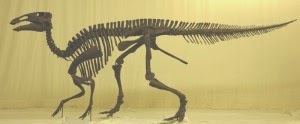
Edmontosaurus, a typical hadrosaur, Credit: Wikipedia.


Edmontosaurus skeleton. Edmontosaurus was a typical
hadrosaur. Credit: Palaeontologia Electronica.

As I said above, fifty years ago this would seem to have made sense because our picture of all dinosaurs (including hadrosaurs) was quite different. Compare the illustrations above with the illustration of the hadrosaur from Wikipedia, and look at the reconstructed skeleton. Indeed, had it really been made by a Native American who co-existed with dinosaurs and could see them in person, he would have known that the tail should stick out straight and portrayed it that way. This in itself brands this petroglyph as a modern hoax. Either that, or it is meant to be something else and was done so poorly that it is totally unrecognizable. Either way, it certainly is not a hadrosaur dinosaur.


REFERENCES:

www. 6000years.org
Wikipedia