Showing posts with label Hicklin Springs. Show all posts

Sunday, December 21, 2014

MERRY CHRISTMAS 2014
From RockArtBlog


Rain tree, from Hicklin Springs,

5BN7, Bent County, Colorado.

Saturday, May 3, 2014

ABSTRACT OR INSECT?

No matter how certain you or I are of the identity of a particular rock art element it is inevitable that on some occasions we will disagree on it. Thus, in many instances people recording rock art rely on lists that define and identify the shapes and images in an attempt to standardize the results and promote such agreements - trait lists or element lists.


Hicklin Springs , 5BN7, Bent County, Colorado.
Photograph Peter Faris, 1993.

Personally, I have never been in favor of using so-called trait or element lists to identify images in rock art recording just because of the disagreements in their identity. My favorite example is usually a variant of the "is it a man or a lizard" based upon the length of the middle lower appendage.

Back in the early 1990s I organized and led a multi-year project to record the rock art at Hicklin Springs (5BN7) in Bent County, Colorado. One of the panels that we dealt with in 1993 is illustrated here. According to published descriptions of rock art styles in that area the team agreed that this was a panel of abstract figures, and it was recorded as such. Not what are often called “geometric abstract” based upon simple geometric shapes, but certainly not readily identifiable as to a specific subject matter. While I found the fact of this group of similar figures existing in this one panel to be unusual and even remarkable, I acquiesced with the group vote on their identification and labeling at that time.


Centipede, Vogel Canyon, Otero County, Colorado.
Photograph Peter Faris, 1993.

Later that same year I was in Vogel Canyon south of La Junta and saw the remarkably large centipede (illustrated) in the trail. I immediately thought of the panel from Hicklin Springs and its enigmatic figures.


Tarantula, Picketwire Canyonlands, Otero County,
Colorado. Photograph Peter Faris, 1994.

Then, the next year, and also down in the Picketwire Canyonlands south of La Junta, I came across the large tarantula (illustrated) again in the trail. Compare its size to the footprints in the dust. In both these cases it occurred to me that an insect that notable might be a candidate for recording in petroglyph form.

I am now more than ever convinced that you really cannot trust the so-called trait or element lists in rock art recording. I recognize the desire for standardizing descriptions to make any data base more user friendly, but you just cannot discern the intentions of the creators of different images and panels in that way. So, the question remains – Abstract or Insect?

Saturday, January 11, 2014

ROCK ART SYMBOLS FROM HORSE PAINTING:

Of the many symbols found in rock art inscriptions it would indeed be strange if none of them were found in other contexts of Native American art.
Hicklin Springs, 5BN7, Bent County, Colorado.
Photograph: Peter Faris, May 1992.


Panel # 3.B2, Hicklin Springs, 5BN7, Bent County,
Colorado. Drawn by Peter Faris, 25 Sept. 1993.

At site 5BN7(Hicklin Springs) in southeastern Colorado’s Bent County one of the petroglyph panels (Panel# 3.B2) carved in the cliff face shows a grouping of short curved lines - semicircles (horseshoes) in four vertical columns.

My field sketch of the panel allows us to count 26 of these symbols on the panel. This is a relatively common symbol in rock art in southeast Colorado and the west, but this is a particularly good grouping of them. According to Thomas Mails if this symbol is painted upon a horse it represents a horseshoe or horse track and symbolizes a horse taken from an enemy in a horse stealing expedition or a fight. Now my grandfather taught me that when you hung up an actual horseshoe for good luck you hung it this way, with the open side up so the good luck would not run out - the way the semicircles are oriented on the rock art panel at Hicklin Springs. Notice that with the Mails and the Bad Heart Buffalo examples the horseshoe is presented the other way around, with the opening down.


Thomas Mails, 1972, Mystic Warriors of the Plains, Barnes and
Noble Books, New York. Pages 220 (left) and 222 (right).

In his book Mystic Warriors of the Plains (1972), Thomas Mails illustrated a number of such symbols that he identified as being used in horse painting. “Painted exploit symbols used on horses. a, war party leader. b, enemy killed in hand combat. c, owner fought from behind breastworks. d, hail. e, coup marks. f, horse raids or number of horses stolen. g, mourning marks. h, medicine symbol.” (Mails 1972: 220)

Writing in Ledger Book Art: A Key to Understanding Northern Plains Biographic Rock Art, James D. Keyser (1989:92) called Ledger Book Art a “lexicon” for Biographic rock art. In this he was pointing out that Ledger Book art, and Plains Biographic rock art as well, are usually records of specific events and that the symbolism used extends to both media.


Amos Bad-Heart Bull, p. XV, in Wind on the
Buffalo Grass, Leslie Tillet, 1976.

“Amos Bad Heart Buffalo’s drawing of himself as a cowboy, done Dec. 3, 1900. The inscription, translated by Helen Blish reads, “Oglalas from White Clay district herding their cattle.” The sketch at upper left is of a cattle ranch of that time, and the label above it reads, “Chenney River S. Dak. Squn Hamper Creek.” (Tillet 1976: XV) Even though he seems to have reconciled to living the white man’s life, he still has his horse painted with traditional symbols, a holdover of the traditional attitudes and ways.


Amos Bad-Heart Bull, p. 34, in Wind on the
Buffalo Grass, Leslie Tillet, 1976.

Also by Amos Bad Heart Buffalo, this panel from a warrior parade shows a horse painted with symbols denoting successful horse raids. “Warrior parades – provided the audience with another means of measuring prestige. Each detail in his drawings gives clues to the particular warrior society that the Indian belonged to. “(Tillet 1976:32)

Does the difference in orientation between the rock art panel and the other examples negate any comparison or assumption of similarity? With a symbol this simple and common my feeling is no, it is recognizable from any angle and is probably not changed by changes in orientation. Perhaps some of the other shapes and symbols in rock art had similar meanings to the artist’s who produced them. Many of Mail’s other symbols are fairly common in rock art of Colorado and the West. Keep your eyes open, it’s at least worth thinking about.

REFERENCES:

Keyser, James D.
1989    Ledger Book Art: A Key to Understanding Northern Plains Biographic Rock Art, p. 86-111, Rock Art of the Western Canyons, edited by Jane Day, Paul D. Friedman, and Marcia J. Tate, Denver Museum of Natural History and Colorado Archaeological Society, Denver.

Mails, Thomas E.
1972    Mystic Warriors of the Plains, Barnes and Noble Books, New York.

Tillet, Leslie
1976    Wind on the Buffalo Grass: The Indians’ Own Account of the Battle at the Little Big Horn River, & the Death of their life on the Plains, Thomas Y. Crowell Company, New York.

Saturday, July 16, 2011

ATLATL, PHI-SIGN, OR CAT TAIL:

It is a dictum that we tend to find pretty much what we are looking for, and what we are looking for is primarily affected by our mind set and the knowledge that we have to apply to the quest. In evaluating rock art we are looking for its meaning and we too often interpret the clues in that rock art to fit our preconceived notions. One excellent example of that can be found in interpretations of the symbol that consists of a circle or oval bisected by a line. This is usually dismissed by rock art researchers as a known quantity – it is an atlatl, the Aztec name for a spear thrower. Although that can be correct in the case of some hunting scenes, it is often misapplied even there in that the term is so often used to designate the fletched dart projecting from the prey animal instead of the actual spear thrower (atlatl) that launched it.

5BN7, Hicklin Springs, Bent County, CO.
Photo: Jeannie Hope Gibson, 1991.

On the other hand, among those interested in epigraphy the same symbol, at least when seen alone and not sticking out of the back of an animal, it is often called a “phi-sign” because of its resemblance to the Greek letter phi. Indeed, in some parts of the world, in inscriptions of certain ages this interpretation may make much more sense.

Dr. Douglas Reagan is an ecologist. This gives him a mental framework and a set of knowledge tools that is somewhat different than that of so many rock art researchers who usually tend to be from an archaeological background, or the arts.

While hiking in The Narrows of Utah’s Canyonlands Dr. Reagan observed a rock art panel like the examples from Kenneth Castleton’s book Petroglyphs and Pictographs of Utah. It included images of ducks or geese as well as images of our symbol in question. As an ecologist however, Douglas saw ducks among cattails, and he soon saw other examples. Douglas had observed and recognized a complex of water-related images in this dry and desert environment. Many images of various types of water fowl and shore birds have been long known from the 4-Corners region and Colorado Plateau. They are traditionally interpreted as a plea for rain through sympathetic magic. When found with the “atlatl” images of a circle or oval bisected by a straight line, they are interpreted as a hunting scene. Douglas Reagan has now given us an alternative interpretation, a wetlands scene.
p. 248, Fig. 7.99, Petroglyphs and Pictographs of Utah,
 Vol. II, Kenneth B. Castleton.1987, Utah Museum
 of Natural History, Salt Lake City.

Dr. Reagan applied his knowledge as an ecologist to an examination of the landforms of the area and found definite indications of much wetter periods in the past in the ground. In other words, instead of being a desert at the time the petroglyphs were created, the scenes of water birds and possible cat tail plants were created at a time that the area was much wetter. Reagan believes that he has since found evidence of this in the presence of soil deposits that were laid down in relatively still water, and in buried snail shells of a species that indicate the presence of lake water at the soil level that relates to the period of creation of the rock art.

So what do we make of this; it is certainly an intriguing possibility, as well as a reminder to us to look for the context before deciding that we know what we are talking about.

Tuesday, September 28, 2010

COUP COUNTS IN ROCK ART – CONTINUED:

On September 28, 2010, I posted a column on portrayals of coup counts in rock art of the northern Great Plains. In this I showed examples of lines of rifles that researchers assume represent weapons captured from some enemy group, and also mentioned examples which illustrate a row of bows or tomahawks that are assumed to represent the same thing. Another example that might be postulated is a row or column of arcs assumed to represent horse hoof prints and have been suggested to represent the coups of a group of horses stolen in a horse raid.


Field sketch, 5BN7, Hicklin Springs, Colorado,
by Peter Faris, 25 September 1993.

One example of this type of portrayal can be found at Hicklin Springs (5BN7) in southeastern Colorado. Toward the bottom of this panel twenty four curved arcs resembling horse hoof prints can be seen aligned in four vertical columns. This has been interpreted as representing a record of a successful horse raid in which the raiding party returned with two dozen captured horses and the bottom portion of this panel represents a record of this.

One problem with this interpretation is the style of pecking itself. These are fairly deeply pecked with no abrading and in this area that type of petroglyph usually predates the early historic period during which the horse became available to people on the southern Great Plains. Deeply pecked petroglyphs in this area are generally prehistoric; historical era imagery in this area is usually incised. This could mean that the panel of “U” shaped symbols does not represent horse hoof prints at all, but then if that is the case, what do they represent? The deep pecking could, of course, represent an anomalous technique that was created later, but in the earlier style.

Wednesday, June 10, 2009

PROTECTING ROCK ART:


5BN7, Hicklin Springs, Bent County,
Colorado.
It sometimes seems as if the greatest enemy to rock art consists of the people who are fascinated with it. Rubbings (and even tracings) can damage fragile surfaces, the latex peels so common up to perhaps the 1990s, can pull the surface right off the rock face, chalking or otherwise touching up the images for photography is now known to cause irreparable damage to the rock art, even just gently touching it by tourists or interested students can deposit skin oils and perspiration that change chemical compositions in negative ways. In many instances we are literally loving it to death (I will deal with vandalism of rock art with future posts).
Most experienced rock art students have gotten to the point by now of insisting that the rock art be left totally inviolate, that no one touch in, and that even recording methods must be non-contact.
A number of years ago during a search for some of the rock art on Albuquerque’s West Mesa I turned up a small box canyon and found myself surrounded by dumped trash, waste, old appliances, and bed springs. I did locate some great rock art behind the piles of garbage, but I came away from the experience with very negative feelings overall. After a period of reflection, however, I developed the germ of an idea, entertaining in its irreverence, but socially beneficial as it solves two problems at once – two birds with one stone.
With the need for protection of rock art sites in my subconscious, a mention of toxic waste in a news story led to a “eureka” moment for me. The answer to both came to me in a blinding flash. If we establish our toxic waste dumps at rock art sites we can kill two birds (or more – literally) with one stone. A toxic waste dump could be an effective deterrent to vandalism of rock art. And if toxic waste might protect it, would not radioactive waste be even more effective? And if the waste is radioactive enough we might not need flashlights to see the rock art at night!

Archaic panel, 5BN7, Hicklin Springs, Bent County, CO.

A few years later, while I was leading a rock art recording project for the Denver Chapter of the Colorado Archaeological Society, we undertook to record the pictographs and petroglyphs at a huge site in southeastern Colorado – the Hicklin Springs site. What we found there put the whole question of protecting rock art into a new perspective. Hicklin Springs has been a popular destination for people of the area for over a century. People used to have excursions and picnics there, students go there to build fires and drink beer, and people have even dug for Spanish treasure at Hicklin Springs. As one might expect in such a popular site the most accessible rock art is pretty badly vandalized. A lot of the rock art at Hicklin Springs is, however, untouched and un-vandalized. Large areas are almost totally protected from access and vandalism – by poison ivy (Rhus toxicodendron).

5BN7 Hicklin Springs, Bent County, CO.
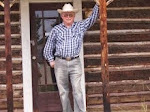
Luxurious growths of wild plum and
poison ivy plants.

And this is not just the common poison ivy, the low-lying, bright green plant with three leaves that we learn to avoid in brushy and woody areas. With perennial water seeps (the Springs of Hicklin Springs) some of this stuff has grown to sizes varying from large bushes to small trees. Two of our enthusiastic recorders who swore they were completely immune to poison ivy began (against my horrified protests) to pull it out and clear it by hand, wearing shorts. It was too big, too strongly rooted, and too thick, but before they gave up they had streams of white sap running down their legs. A day or two later they were also both hospitalized from the reactions. Parts of Hicklin Springs still have to be the best protected rock art sites I know.
So there you have it, my contribution to the literature of how to protect rock art. All we have to do is plant poison ivy in front of every accessible panel. The answer is really so simple, as is the advice to visitors. “Don’t touch the poison ivy, or the rock art.”