Showing posts with label Norway. Show all posts

Saturday, December 13, 2025

ASSEMBLED FRAGMENTS OF THE WORLD’S OLDEST DATED RUNESTONE:

Assembled Svingerud rune stone with drawings. Image from Solheim et al., 2025.

Fragments of sandstone recovered from several graves in Svingerud, Norway have been reassembled into a single stone with runic inscriptions that have yielded the earliest known date for such an inscription. Various references read so far from the stone are Svingerud and Hole (a small village nearby).

It is believed that the idea of runic writing, of recording their language by making marks on a surface, was inspired by writing from somewhere around the Mediterranean. The shapes of the runes were, however, independently invented, not copied from Mediterranean examples.

“The development of runic writing (the early Germanic alphabetic script) and the practice of inscribing runes on stone are difficult to trace, particularly as rune-stone inscriptions are rarely found in original and/or datable contexts. The discovery of several inscribed sandstone fragments at the grave field at Svingerud, Norway, with associated radiocarbon dates of 50 BC–AD 275, now provide the earliest known context for a runestone. An unusual mixture of runes and other markings are revealed as the fragments are reconstructed into a single standing stone, suggesting multiple episodes of inscription and providing insight into early runic writing practices in Iron Age Scandinavia.” (Solheim et al. 2025:422) What is so fascinating is that it was broken up and the fragments distributed like this with at least one found in a grave.

Runic inscription. Photograph by Alexis Panto KHM.

I think that the context of the discovery suggests that runic writing and the stone upon which it had been inscribed, must have been considered especially significant to the people of that time and place.

“In a flat grave beneath one of the grave mounds,a sandstone fragment with runes from the older futhark was uncovered. Five radiocarbon dates and artifacts included in the burial suggest that the grave dates to the Roman Iron Age, between 50 BC and AD 275. Additional sandstone fragments with runes were discovered in other contexts during the excavations. Detailed examination confirms that the fragments are all from the same original slab while the inscriptions may represent different acts of carving. In this first comprehensive archaeological and runological study of the Svingerud find, we piece together the finds made during different seasons of excavation and drawn from different dating contexts, and assess the multiple inscriptions found on the different fragments. Associated radiocarbon dates indicate that this is the earliest dated rune-stone found so far; runological analysis of the multiple thinly incised markings therefore provides important insights into early runic writing and inscriptional practices on stone.” (Solheim et al. 2025:423) With different carving episodes the purpose of this stone is a real conundrum. Not only that, but then the stone was broken up and distributed around – why?

Map of Norway showing the general location of the find. Online image, public domain.

A great number of the symbols have been identified, but the researchers do not yet have translations of the meanings of the inscriptions. “The runic fragments from the Svingerud grave field can be dated between 50 BC and AD 275 based on radiocarbon dates from grave A4367, which contained the inscribed fragment Hole 2. This is a rare example of finding several fragments of a rune-stone, with some of the fragments in well-preserved, datable archaeological contexts. The dating frame is relatively wide, but still makes the Hole fragments the earliest known archaeologically dated rune-stone. The early dates and the inscriptional features are new evidence on the use of runes on stone, prompting discussion on the meanings and functions of the fragments and early Scandinavian rune-stones. Particular rune-forms on the dated fragments—such as the multi-pocket ‘b’ and the multitude of zigzag-like marks—underpin the epigraphic importance of the find. The recorded forms may show some early variants of runes, used on stone.” (Solheim et al. 2025:437) The episodes of engraving were apparently far enough apart in time that the forms of some of the runes had changed, leading to the difficulties in translation.

So we have the earliest known rune stone, with inscriptions dating from more than one episode of engraving, which was then broken up and the pieces distributed around the area of a burial site. This brings up so many questions, and provides very few answers, but it is certainly intriguing.

NOTE: Some images in this column were retrieved from the internet with a search for public domain photographs. If any of these images are not intended to be public domain, I apologize, and will happily provide the picture credits if the owner will contact me with them. For further information on these reports you should read the original reports at the sites listed below.

REFERENCES:

Ancientist.com, 2025, Norway’s Oldest Dated Runestone? Svingerud Fragments Reveal a 2,000-Year-Old Writing Tradition, DOI:https://doi.org/10.15184/aqy.2024.225. Accessed online 22 September 2025.

Biornstad, Lasse, 2025, Researchers found more pieces of the world’s oldest runestone – may change the history of runes, 6 February 2025, sciencenorway.no. Accessed online 22 September 2025.

Solheim, Steinar et al., 2025, Inscribed sandstone fragments of Hole, Norway: radiocarbon dates provide insight into rune-stone traditions, Antiquity , Volume 99 , Issue 404 , April 2025 , pp. 422 – 439. Accessed online 6 September 2025.

Saturday, August 5, 2023

REINDEER HERD MIGRATION PORTRAYED IN NORWEGIAN ROCK ART:

Migrating reindeer closeup, Gamnes, Norway. Photograph Jan Magne Gjerde, Tromsø Museum - The University Museum.

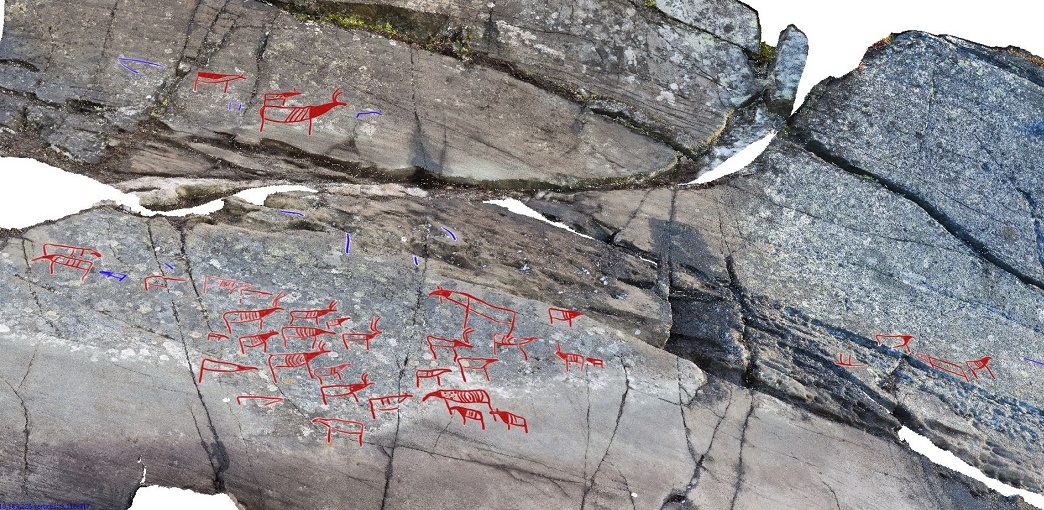
A report about a rock art site in Norway caught my attention recently. It is a petroglyph of a herd of reindeer. Now there is nothing unusual about a bundh of reindeer in petroglyphs in Scandinavia, this is a common theme, but they are usually portrayed with a number of other subjects as well. This panel shows a number of reindeer with a few moose as well. The unique thing about them is that they are almost all facing the same way as if the herd is on the move.

Migrating reindeer panel, Gamnes, Norway. Photograph Erik Kjellman, Tromsø Museum - The University Museum. 

Central portion of the panel enlarged. Photograph Erik Kjellman, Tromsø Museum - The University Museum. 

“Six to seven thousand years ago, the road system in Norway was essentially non-existent. That meant Stone Age residents mainly used waterways as they moved from place to place, especially on the hunt.

One area called Gamnes, located between the outlet of a river and the mouth of a fjord that opens onto the Barents Sea, is particularly rich with rock art. There are petroglyphs of reindeer and moose, in herds and alone, with and without young animals.” (Kvittingen 2016)


“In general, animals depicted in rock carvings are shown moving in all different directions. But in Gamnes, most of the reindeer have been drawn with their muzzles pointed in the same way. ‘The reindeer are following the fjord inland. This may mean that the artist was trying to depict a migration route,’ says Anja Roth Niemi, who is project manager for archaeological excavations for the University Museum in Tromsø, UiT – The Arctic University of Norway.” (Kvittingen 2016)

The map shows an estimate of where the sea level was when the petroglyphs were carved about 7,000 years ago. Under this scenario, the petroglyphs were right at sea level and were easily visible to those who paddled past. Image by Erik Kjellman, Tromsø Museum - The University Museum. The red dot at waterline shows the position of the petroglyph panel.

“These rock carvings are the only ones of their kind from the Stone Age in East Finnmark. The drawings were found last summer, and probably date from 5200-4200 BC. So far, scientists have tallied 48 figures, some of them incomplete, but they expect even more will become apparent when the lichen that covers the rock is removed.” (Kvittingen 2016)

Swimming reindeer crossing a river in Siberia. Internet photograph, public domain.

”The selection of subjects is not that varied, which is unusual. Petroglyphs from the same period in Alta, also in northern Norway, depict boats, bear, fish and hunting scenes. Here there are only reindeer and moose. Why would Stone Age people draw only these animals here?” (Kvittingen 2016)

One possibility is that the images represent a group of reindeer that have just emerged from the water. Reindeer are accomplished swimmers who cross bodies of water routinely. I would suggest that since this location is essentially surrounded on three sides by water it is likely that the reindeer shown all facing the same way are indeed migrating, but that they have just left the water and are heading inland. BTW – moose are good swimmers too.

NOTE: Some images in this posting were retrieved from the internet with a search for public domain photographs. If any of these images are not intended to be public domain, I apologize, and will happily provide the picture credits if the owner will contact me with them. For further information on these reports you should read the original report at the site listed below.

REFERENCE:

Kvittingen, Ida, translated by Nancy Bazilchuk, 2016, Stone Age artists used rock art as a billboard, 16 April 2016, https://sciencenorway.no/. Accessed online 5 July 2023.

Saturday, January 16, 2021

UNDERWATER ROCK ART - PART 2, ROCK ART IN THE PROCESS OF BEING SUBMERGED:

The major factor in natural coastal rock art submersion is climate change, the warming of the earth by the addition of greenhouse gases to the atmosphere. “Global mean sea level has risen about 8-9 inches (21 - 24 centimeters) since 1880, with about a third of that coming in just the last two and a half decades. The rising water level is mostly due to a combination of meltwater from glaciers and ice sheets and a thermal expansion of seawater as it warms. In 2019, global mean sea level was 3.4 inches (87.61 mm) above the 1993 average - the highest annual average in the satellite record. From 2018 to 2019, global sea level rose 0.24 inches (6.2 millimeters).” (Lindsey 2020) Sites that currently lie just a few inches to a few feet above mean sea level will inevitably become submerged as rising waters continue to creep up year by year.


View of Alta fjord, Norway. Photo Ralph Frenken, 2012, from Donsmaps.com


Alta fjord, Norway, Googleearth, Don Hitchcock, Donsmaps.com.

One rock art site listed by Tiwary (2014) is the Alta Fjord site in Norway which, although currently exposed, he expects to be submerged by rising sea-levels. “The World Heritage Rock Art in Alta is a rich cultural monument consisting of several carvings and paintings localized in the inner parts of Altafjord in Finnmark, Norway. The rock art in Alta was made over a period of time from 4200 B.C. to 200 A.D. After a few years it may get submerged into the sea.” (Tiwary 2014)


Alta fjord rock art, Norway. Internet photo, whc.unesco.org.


Alta fjord, Norway. Photo Ralph Frenken, 2012, From Donsmaps.com.

“The Alta site is at the head of the fjord, and is very well protected from the swells of the Norwegian Sea. The depth of the fjord increases rapidly from about 60 metres close in shore to more than 400 metres further out in the fjord. It was used as an anchorage by the German battleships Tirpitz and Scharnhorst in 1943 during WWII.” (Hitchcock 2019)

“At the end of the last ice age, the land ‘rebounded’ after the bulk of the ice melted, and so this part of Norway slowly lifted by a process known as isostasy. The ice sheet reached its greatest extent and thickness 20,000 years ago, and most melting occurred between 16,000 and 10,000 years ago. This uplift did not stop when the ice had melted, it continues to this day.” (Hitchcock 2019)

This isostasy will be competing with the sea-level rise caused by global warming, but the projections for sea-level rise suggest that it will win the competition and that the Alta petroglyphs are eventually as doomed as the other sites I have listed.


Waianae coast, Oahu, Hawaii. Online photo from LiveScience.


Waianae coast, Oahu, Hawaii. Internet photo, Public Domain.


Waianae coast, Oahu, Hawaii. Internet photo, Public Domain.


Waianae coast, Oahu, Hawaii. Internet photo, Public Domain.


Waianae coast, Oahu, Hawaii. Internet photo, Public Domain.


Waianae coast, Oahu, Hawaii. Internet photo, Public Domain.

There are many other rock art sites that sit near sea level that will become underwater rock art  sites with continued sea-level rise. One site is a recently discovered petroglyph site on Hawaiia’s Waianae coast on Oahu. “Archaeologists from the Hawaii Department of Land and Natural Resources and the U.S. Army have been working together to record and document the petroglyphs; which now number at least 17 figures.” (Sci-News 2016) The figures stretch over sixty feet of beach. These figures are on the beach and were covered by sand until recently and, depending on wave action and storms, may be covered again. A few inches of sea-level rise, however, will submerge them.


Petroglyph Beach, Wrangell, Alaska. Photo Peter Faris, August 2, 2001.


Orca petroglyph, Wrangell, Alaska. Photo                    Peter Faris, August 2, 2001.

Another major petroglyph site which will inevitably be covered by sea-level rise is Petroglyph Beach at Wrangell, Alaska. Produced by the Tlingit people it is representative of much of the rock art on the northwestern coast of North America.


Bird petroglyph, Wrangell, Alaska. Photo Peter Faris, August 2, 2001.

  
Mask petroglyph, Wrangell, Alaska. Photo                     Peter Faris, August 2, 2001.

“While Tlingit rock art (especially petroglyphs) may sometimes have been made to attract the salmon, the figures include clan crests, ancestors, mythological figures and sailing ships, as well as symbols of wealth or victory. Tlingit rock art may, like the elaborate totemic figures on poles and house screens, serve as illustrations of important events, mythic or historical, in the clan traditions and so bear witness to the achievements, wealth, or supernatural powers obtained by the clan ancestors.” (De Laguna 1990:215) Of the rock art at Petroglyph Beach, the figures are pecked and carved into basalt boulders on the beach. Many of them seemingly consist of masklike faces, but the famous orca there is undoubtedly a clan figure as described above. Again, if left as they are, a foot or two of sea level rise will submerge almost all of them.

Undoubtedly many other locations like this exist. It has not been my intention to present a complete catalog of threatened rock art sites, but to present a different angle to rock art conservation, one not commonly considered. Next week I will discuss some rock art sites that are underwater as a result of human, not natural, activity.

NOTE: Some images in this posting were retrieved from the internet with a search for public domain photographs. If any of these images are not intended to be public domain, I apologize, and will happily provide the picture credits if the owner will contact me with them. For further information on these reports you should read the original reports at the sites listed below.

Additionally - I wish to express my gratitude to Dr. Sachin Tiwary for his permission to quote his study as well as reproduce images from it.

REFERENCES:

De Laguna, Frederica, 1990 Tlingit, pp. 203-228, in Handbook of North American Indians, Volume 7, Northwest Coast, Wayne Suttles, editor, Smithsonian Institution, Washington D.C.

Hitchcock, Don, 2019, Norwegian Rock Art - Alta Fjord, Don’s Maps, https://www.donsmaps.com/norge.html

Lindsey, Rebecca, 2020, Climate Change: Global Sea Level, National Oceanic and Atmospheric Administration (NOAA), https://www.climate.gov

Staff, 2016 400-Year-Old-Petroglyphs Found on Hawaii Shoreline, Ausust 11, 2016, www.sci-news.com

Tiwary, Sachin Kr., 2014 Underwater Rock Art: In Global Context, En Rupestreweb, http://www.rupestreweb.info/underwaterrockart.html

Saturday, August 20, 2016

A PETROGLYPH OF A SKIER HAS BEEN VANDALIZED IN NORWAY:


The Ancient Skier carving before it
was damaged. (Nordland County)

At this time of the Olympic games in Rio de Janeiro we have a story on vandalized rock art with an Olympic connection. On 4 August, 2016, Smithsonian.com ran a column by Danny Lewis about the vandalism of a petroglyph of a figure on skis on the Norwegian island of Tro. This image, dated 5,000 B.P. is famous as the earliest portrayal of what we now classify as a winter sport, and inspired the symbol for the 1994 Winter Olympics in Lillehammer, Norway.

""It's a tragedy, because it's one of the most famous Norwegian historical sites," Bård Anders Langø, the mayor of the nearby Alstahaug Municipality - "It is one of the most internationally known symbols of Norway."" (Lewis 2016)

""As the oldest-known image of a person on skis, the stone age symbol is often seen as an iconic part of Norwegian culture. In addition to an important glimpse into the lives of ancient humans, the carving inspired the logo for the 1994 Norway Winter Olympics in Lillehammer."" (Lewis 2016)


The Ancient Skier carving after
damage. (Nordland County)

Two boys, visiting the site, decided to touch it up to make the lines more visible. They also decided to improve a nearby petroglyph of a whale.

" The news of the damage - broke when a person staying in the area informed Tor-Kristian Storvik, the official archaeologist for Nordland County, that the petroglyph had been damaged. - Storvik investigated and found that in addition to the damage done to the famous carving, a nearby etched whale had also been harmed. The boys have come forward and publicly apologized for the incident. Officials are keeping their identities secret to protect the minors from potential abuse." (Lewis 2016)

Apparently Norwegian officials are considerably more lenient in cases of vandalized rock art than our current social sentiment demands. Cases of such vandalism in our country nowadays usually end up in trials and fines if the perpetrators are discovered. While I applaud such generosity and sympathetic treatment, I also see this as a teaching opportunity missed. In this case only two individuals have learned a lesson from this vandalism, not the whole society. We must find ways to get the word out and promote an understanding throughout the whole society that rock art is irreplaceable and must not be altered, defaced, or damaged.

You can read the whole story at  www.smithsonianmag.com/smart-news.

REFERENCE:

Lewis, Danny, 2016      http://www.smithsonianmag.com/smart-news/norwegian-youth-destroys-one-earliest-images-skiing-trying-improve-it-180960013/#D4h6TAsqWid36uLV.99