Showing posts with label manuports. Show all posts

Saturday, August 30, 2025

A PALEOLITHIC SHRINE IN THE SINAI PENINSULA?


Flint nodule manuports erected in the shrine on Har Karkom. Image from Emmanuel Anati.

This column originated when I accidentally ran across a picture on the internet of a shrine on Mount Har Karkom in Israel’s Sinai Desert. It was labeled Paleolithic in age and what attracted my interest was that it is centered on upright standing stones that look weirdly human. When I tracked it down it came from a book by Emmanuel Anati (2001) titled “The riddle of Mount Sinai: Archaeological discoveries at Har Karkom.”

This book presents a great deal of archeological work in this area and mentions hundreds of features and thousands of petroglyphs, unfortunately, it does not give any scientific facts so the reader has to take Anati’s conclusions on trust. For instance, Anati seems to have set the age of this shrine as Paleolithic based on the styles and shapes of a large number of stone tools located there. There is no mention of any scientific dating.

Eastern cliff of Har Karkom, site HK86B. Emmanuel Anati, Fig. 9, p. 20.

Anati’s writings, of which the book cited is only one sample, ostensibly about the archaeology of Mount Har Karkom, are actually expressing Anati’s interpretation of the facts to prove his theories about biblical truth and that this is indeed Mount Sinai. “Presuming that the Israelites travelled across the Sinai Peninsula towards Petra in a fairly straight line, a number of scholars have contemplated the possibility of Har Karkom being the biblical Mount Sinai. Following this theory, Emmanuel Anati excavated at the mountain, and discovered that it was a major Paleolithic cult centre, with the surrounding plateau covered with shrines, altars, stone circles, stone pillars, and over 40,000 rock engravings. Although Anati, on the basis of his findings, advocates the identification of Har Karkom with Mount Sinai, the peak of religious activity at the site may date to 2350-2000 BCE, and it appears to have been abandoned perhaps between 1950 and 1000 BCE. The Exodus is sometimes dated between 1600-1200 BCE. However, there is no archaeological evidence supported by scholars to maintain a date of 1600-1200 BCE. Anati instead places the Exodus, based on other archaeological evidence, between 2350 and 2000 BCE.” (Wikipedia)

View of the two "breasts," the twin summits of Har Karkom, from the Paleolithic shrine site HK 86B. Emmanuel Anati, Fig. 198, p. 176.

Now I am uninterested in whether Har Karkom is or is not Mount Sinai, but the discovery of the shrine on top of the mountain fascinates me.  “In 1992 the discovery of the Palaeolithic ‘sanctuary’ (HK86B) changed the previous assessment of Har Karkom’s cult use. The flint industry in the sanctuary belongs to a phase known in several sites at Har Karkom as ‘Karkomian,’ that is the initial phase of the Upper Paleolithic age, likely to be about 40,000 years old. This site is located on the eastern edge of the plateau, where its heights dominate the Paran Desert from above.”  (Anati 2001:16)  I cannot say that Anati does not have hard dates for any of this. I can only state that I have been unable to find any. So to repeat what I said above, Anati apparently is basing his paleolithic age for the shrine on the style of flint tools found there in large numbers. A practice that I find somewhat shaky.

Petroglyph on a nodule shaped like a resting animal. Emmanuel Anati, Fig. 193, p.171.

“Traces of Neolithic and Hellenistic cult sites have thus been found in the area of Har Karkom. Further, the discovery of the Paleolithic sanctuary HK86B provides a new temporal frame for the cult functions of this mountain. We know of no other cult sites with such a testimony: a Paleolithic sanctuary likely to be 35,000 to 40,000 years old, a Neolithic sanctuary, and over 100 BAC (Note: BAC stands for Bronze Age Culture.) cult sites, then, after a lapse of time, an Iron Age sanctuary and a Hellenistic sanctuary.” (Anati 2001:111-114) But, once again notice no sign of actual data on how these dates were assigned.

Anati uses a number of features in the landscape to back up his conclusions. “Another ceremonial trail runs from the Paran Desert to the Paleolithic sanctuary (HK68B). These various roads show a tradition of ceremonial processions while people climbed to the Har Karkom plateau.” (Anati 2001:117) Notice that this is a ‘ceremonial’ trail. If it is a ceremonial trail it must lead to somewhere that ceremonies happen.

Modified manuport, Emmanuel Anati, Fig. 192, p.171.

What immediately caused my interest in this is the use of large flint upright stones in this shrine. As can be seen in the photographs there are some that are eerily human looking. These remarkable examples of pareidolia would also be great evidence for the fringies who look for ancient aliens. “About forty flint monoliths with sinuous and provocative shapes were grouped in the ‘sanctuary’ by Paleolithic man. Some were collected locally and erected, while others derive from two different flint sources, one of which is nearly three kilometers away. Some, more than one meter high, are still standing, like silent ghosts with human forms, while others have fallen from upright positions. On the surface of this area of about four hundred metre, several flint stones of natural anthropomorphic and zoomorphic shapes have been found, along with numerous flint tools. Some have been retouched by man, modified by an Upper Paleolithic technique of flaking, picking, and etching to produce figurative details and more defined facial features.” (Anati 2001:16) Large numbers of these flint forms are manuports, having been gathered from around the mountain together as a collection at this shrine. And, as reported, some have been altered to emphasize an appearance.


Geoglyph near Paleolithic shrine. Emmanuel Anati. Fig. 188, p. 169.


“In a corner of this ‘sanctuary’ the paleosoil is covered by alignments of flint pebbles in non-figurative patterns.” (Anati 2001:16)

There are also geoglyphs here created, like the ones at Nazca, by removing stones to leave the soil bare, and alignments of stones as well.

“The geoglyphs of Har Karkom represent anthropomorphic and zoomorphic figures and a variety of patterns. Several details give clues to their dating. Non-figural geoglyphs in the palaeosoil of the Paleolithic sanctuary (KHK86B) seem to mark sectors in the area next to the sanctuary. Because of the quantity of Upper Paleolithic flint implements, it may be postulated that the geoglyphs belong to the same age as the sanctuary.” (Anatie 2001:114) So, once again we see that the whole dating construct is based upon the appearance of the stone tools. Anati may be correct, I really do not know, but again this seems to me to be a pretty shaky conclusion.

Anati’s main aim seems to be verification of the bible and to try to prove that Mount Har Karkom is the biblical Mount Sinai. I couldn’t care less about any of that, but am absolutely fascinated by the flint figures in and about the shrine HK86B recorded in his writings. I am really grateful he has recorded these and will let him interpret things any way he wishes. I just do not have to agree.

NOTE: Some images in this posting were retrieved from the internet with a search for public domain photographs. If any of these images are not intended to be public domain, I apologize, and will happily provide the picture credits if the owner will contact me with them. For further information on these reports you should read the original reports at the sites listed below.


REFERENCES:

Anati, Emmanuel, 2001, The riddle of Mount Sinai: Archaeological discoveries at Har Karkom, Studi Camuni Vol. 21, Valcamonica, Italy.

Wikipedia, Mount Karkom, https://en.wikipedia.org/wiki/Mount_Karkom. Accessed online 26 July 2025.

Saturday, August 6, 2022

PREHISTORIC COLLECTING:


One aspect of art that I have not seen discussed in relation to rock art is collecting. The whole point of having something as non-utilitarian as art is its possession, or collecting it. In this paper I am using the term “collection,” not as the gathering or acquiring of material for utilitarian purposes, but in the sense of keeping it in one’s possession for non-utilitarian purposes (as in a modern stamp collection). Many, although not all, of these collected items were also purposely modified to some extent making them also Paleoart.

“Paleoart of the Lower Paleolithic period seems to have been found for well over 150 years but it has remained largely ignored, misinterpreted, or its existence was fundamentally denied. Most archaeologists and paleoanthropologists of recent decades attempt to refute anthropogenically modified objects located in Lower and Middle Paleolithic contexts as being taphonomic accidents or ‘natural’ in origin. Their presumption is that all Lower and Middle Paleolithic humans (including Homo habilis, H. rudolfensis, H. ergaster, H. georgicus, H. erectus, H. heidelbergensis, and H. sapiens neanderthalensis) were cognitively incapable of expressing themselves through ‘art’ or exograms. They ‘know’ these hominins were cognitively incapable of expression because they were not modern humans; they have been convicted of mental deficiency by negative evidence (Speth 2004). This is despite the clear evidence that these hominins have engaged in maritime colonization since approximately a million years ago, and have crossed sea barriers of up to 189 km to reach over twenty islands and one continent prior to having ‘Upper Paleolithic’ technology (Bednarik 1999).” (Bednarik 2015:1)

So, with the existence of items that have been gathered and modified, or not, to have in the possession of these early humans, we find the earliest known instances of collecting.

Australopithecus:

Makapansget Cobble: South Africa, north of Mokopane, found in 1925.

Makapansget cobble, north of Mokopane, South Africa, found in 1925. Illustration www.donsmaps.com.

 “Collection of fossils and ‘curious’ or unusual objects, which were transported to the inhabited areas and probably became the object of interest and observation, if not invested with other value and meaning – certainly difficult to define – by the archaic human forms and then they were apparently abandoned on the paleosols that constitute the same archaeological deposits and which are distributed over a long chronological arch, from about 3.0 Ma BP to the entire middle Paleolithic. It should be noted that in some cases these objects were transported several kilometers away from their place of collection. As an example, we can mention the diasprite pebble from the cave of Makapansget (South Africa), probably collected by an Australopithecus africanus between 2.95 and 2.6 Ma BP (Bednarik 2013:8-9, Harrod 2014:136-137, 142).” (Mussi and Rossi 2018:313) Presumably, and austrealopithecene recognized the resemblance to a face in the rock and picked it up and carried it for curiosities sake.

Homo erectus:

Tan-Tan Figurine: Morocco, discovered in 1999.

Tan-Tan figurine, Morocco, discovered in 1999. Internet photograph, public domain.

“The object, which is around six centimeters in length, is shaped like a human figure, with grooves that suggest a neck, arms and legs. On its surface are flakes of a red substance that could be remnants of paint.

The object was found 15 metres below the eroded surface of a terrace on the north bank of the River Draa near the town of Tan-Tan. It was reportedly lying just a few centimeters away from stone handaxes in ground layers dating to the Middle Acheulian period, which lasted from 500,000 to 300,000 years ago.” (Rincon 2003) So this object resembling a human figure was definitely from the time of Homo erectus. It was undoubtedly ‘collected’ because of its resemblance to the finder and was then apparently modified somewhat to improve the illusion.

“The object, including its ‘arms’ and ‘legs’, was created by natural geological processes. The horizontal grooves on both sides of the object seem to be formed partly naturally partly artificially (by percussion). The object also contains traces of pigment, which seems to be iron and manganese according to preliminary study.” (Wikipedia)

Berekhat-Ram Figurine: Found at Berekhat-Ram on the Golan Heights, 1981.


Berekhat-Ram figurine, Golan Heights, Israil, 1981. Internet photograph, public domain.


Berekhat-Ram figurine, Golan Heights, Israil, 1981. Internet photograph, public domain.

“Excavated and first described by Naama Goren-Inbar from the Institute of Archaeology, The Hebrew University of Jerusalem. The artifact is a scoria pebble, 35mm long, 25mm wide, and 21mm thick. – It was excavated in 1981 at the Acheulian site of Berekhat Ram, Golan Heights. The object is dated 280,000 – 250,000 BP. Goren-Inbar reported several artificial grooves on the object: one is a transversal groove in the upper third, others are longitudinal grooves on the sides below the transversal groove.

Goren-Inbar and Marshak suggested that the object resembled a female body and was artificially modified by hominids to emphasize its anthropomorphic features.” (Wikipedia)

The Erfoud Manuport: Eastern Morocco, 1984.

The Erfoud Manuport, Eastern Morocco, found in 1984. Photograph from Bednarik, 2002.

“The object in question is from Site No. A-84-2, a surface cluster of Acheulian tools in the vicinity of the townships Erfoud and Rissani, eastern Morocco. – The region is essentially a desert of small pebbles and sand, and the site consists of a dense cluster of numerous late Acheulian stone tools measuring about six-metres across. It includes the apparent remains of a dwelling consisting of a pile of stones forming and enclosed space of a few square metres, adjacent to a rock outcrop. – Within what appears to be the foundation of an Acheulian dwelling at Site A-84-2, Professor Lutz Fiedler from Marburg University collected in 1984 and object called here the Erfoud manuport. The manuport consists of a silicified fragment of a cuttlefish fossil cast dating from the Devonian or Carboniferous period (Orthoceras sp.). Such fossils are very common in other parts of Morocco, but they do not occur naturally in the region of the find site. – The object’s surface condition suggests that it was deposited in the same period as the stone tools found with it. An explanation is required for why it became a manuport, having been brought from some distance, and considering its apparently unworked, non-artefact status. This is readily found in its shape, being that of a perfectly naturalistic and life-size, non-erect human penis. The only realistic explanation for the curation of this object is that this clear similarity was perceived by a hominid.” (Bednarik 2002:138-9)

Neandertal: I have previously written about a number of instances of Neandertal produced art (available through the index at the bottom of the page) dating back to 65,000 years BP, but producing art is not collecting. If, however, we have some sort of accumulation of images in a location that can be thought of as a collection.

Neandertal manuport, patterned limestone, found in Croatia. Photograph Smithsonian magazine, Daley, 2017.

There is also a manuport, found in Neandertal context in a cave in Krapina, Croatia. “According to a press release, a group of international researchers re-examining material excavated from a cave where archaeologists found 900 Neandertal bones between 1899 and 1905, came across an unusual split limestone rock. It stood out from the other 1,000 pieces of stone collected because of its composition and the interesting black lines spidering across its face. – The researchers believe that the Neandertals brought the rock to their home cave simply because they thought it was interesting. In other words, whoever picked it up was rock collecting.” (Daley 2017)

So here we have a number of instances of pre-modern hominids who have been demonstrated to have acquired something for the purpose of collecting, keeping it in their possession for intellectual pleasure, not for utilitarian use. This is an immensely human trait that we can all identify with, and should give us a new perspective on pre-modern humans. I believe that it was just this sort of impulse which eventually gave rise to the creation of art and the magnificent palimpsests in the painted Stone Age caves, and thus, to the study of Art History and Rock Art which fascinates us all.

NOTE: Some images in this posting were retrieved from the internet with a search for public domain photographs. If any of these images are not intended to be public domain, I apologize, and will happily provide the picture credits if the owner will contact me with them. For further information on these reports you should read the original reports at the sites listed below.

REFERENCES:

Bednarik, Robert G., 2002, An Acheulian palaeoart manuport from Morocco, Rock Art Research Vol. 19, number 2, pp. 137-139.

Bednarik, Robert G., 2013, Pleistocene Palaeoart of Africa, Arts, 2, 6-34.

Bednarik, Robert G., 2015, Paleoart of the Lower Paleolithic, January 2015, ResearchGate, accessed on 17 April 2022.

Daley, Jason, 2017, Did Neanderthals Like Pretty Rocks?, 23 January 2017, Smithsonian.com, http://www.smithsonianmag.com/smart-news-did-neanderthals-pretty-rocks-180961865/#IJCeswdiLPg3FICF.99

Goren-Inbar, Naama, 1986, A figuring from the Acheulian site of Berekhat Ram, January 1986, Mitekufat Haeven:Journal of the Israel Prehistoric Society, reprinted by Jstor, https://www.jstor.orb/stable/23373142, accessed 12 January 2022.

Harrod, James, 2014, Palaeoart at Two Million Years Ago? A Review of the Evidence, Arts, 3, 135-155.

Mussi, Piero and Pietro Rossi, 2018, You Snooze, you win: Perception, dream and symbolization in pre-sapiens Evolution, NeanderART 2018 (proceedings), pp. 311 – 349.

Rincon, Paul, 2003, ‘Oldest sculpture’ found in Morocco, 23 May 2003, BBC Science, http://news.bbc.co.uk/2/hi/science/nature/3047383, accessed 17 May 2022.

Wikipedia, Venus of Berekhat-Ram, https://wikipedia.org/wiki/Venus_of_Berekhat_Ram, accessed on 10 June 2022.

Wikipedia, Venus of Tan-Tan, https://en.wikipedia.org/wiki/Venus_of_Tan_Tan, accessed on 10 June 2022.

SECONDARY REFERENCES:

Bednarik, Robert G., 1999, Maritime navigation in the Lower and Middle Palaeolithic, Comptes Rendus de l’Academie des Sciences Paris, Volume 328, pp. 559-563.

Speth, J. D., 2004, Newsflash: negative evidence convicts Neanderthals of gross mental incompetence, World Archaeology, Volume, 36, No. 4, pp. 519-526.

Saturday, March 9, 2019

ARE THESE UTE WOODEN MAPS? - OR APOPHENIA - PAREIDOLIA - MIMETOLITHS - MANUPORTS


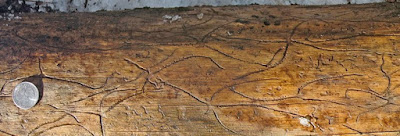
Supposed Ute map,
engraved in wood,
with explanation.

Supposed Ute map,
left side,
with explanation


Supposed Ute map,
right side,
with explanation.

I have been writing recently on the phenomenon known as Apophenia - the "human tendency to seek patterns in random information." (Wikipedia) This is manifested in pareidolia (recognizing ponies in the clouds, for instance), and also by fascination with mimetoliths (items that naturally look like something else - mimic them).


Identified as a Map of Stratton
Open Space and Drainage.

Well, it turns out that there are plenty of people who experience that, whose facility for seeing artifacts in natural objects is considerably more sensitive than mine (or they are just a lot better at fooling themselves). I was recently sent a number of photos of pieces of pine branches showing insect boring patterns that the discoverer is certain represent maps created by Ute Indians. He has even been able to identify the area they portray, now a neighborhood in Colorado Springs, Colorado. Now, to me, they represent prime examples of Apophenia/Pareidolia, and even could be classified as Mimetoliths (mimicking actual maps), but the discoverer appears completely convinced by what he has found. Indeed, he apparently agrees that most pieces of wood that can be found with these markings are merely insect tracks, but he believes he can tell a difference and recognize the few examples that he has collected as "the real thing."


Map of Stratton Open Space,
Parks Department, City of
Colorado Springs, CO.

I think of this situation as paralleling the rock art/ogam controversy. I know those marks are not ogam, but I cannot convince the proponents - indeed, I have no way of proving it to them. This is the power of Apophenia, it is psychologically ingrained deeply into our makeup. Once, our ancestors were on the lookout for predators in the underbrush who could be recognized by the shape of a lion's ear through a break in the foliage, the contour of the side of a jaguar's head in a shadow, this is instinctive and was basic to our very survival. Our subconscious does this all the time, it is primal and not under our conscious rational control. Whereas scientific facts are merely new ideas on the surface that we trade between ourselves, nowhere near as powerful in our overall conscious-subconscious makeup.

So, I do not expect to be able to convince the discoverer of what I recognize as the truth - insect chewed wood. That would be merely boring fact. He has the power of belief on his side, and he knows down to his soul that he has made this important, historically significant discovery. He is, of course, wrong, but I almost envy him the strength of his belief. (Although I suspect that with a microscope we could detect the actual bite marks of the larvae that tunneled through the wood.)

This also represents the ideal time to introduce another term sometimes applied in this field - a Manuport. "In archaeology and anthropology, a manuport is a natural object which has been moved from its original context by human agency but otherwise remains unmodified." (Wikipedia) These pieces of tree limb are manuports because they interested their collector enough to pick them up and take them back to his residence. Mimetoliths that are seen to be interesting enough often become Manuports. In this case - you be the judge.

NOTE: For these particular objects I cannot use the term mimetolith (which basically translates as rock that mimics) because they are not rocks. Perhaps we can call them mimetoports to indicate that they are mimics that were collected by a human and transported. 

Also: I am purposely withholding the name of this individual to preserve his privacy. If he wants me to release it he can e-mail me and I will pass it along.

REFERENCE:

https://en.wikipedia.org/wiki/Apophenia

https://en.wikipedia.org/wiki/Manuport

Saturday, March 2, 2019

PAREIDOLIA:


The mountainous face on Mars
in the most favorable light.
Public domain.

One phenomenon that we have to keep in mind when discussing meaning or intention in rock art is pareidolia. "Pareidolia is a psychological phenomenon in which the mind responds to a stimulus, usually an image or a sound, by perceiving a familiar pattern where none exists. Common examples are perceived images of animals, faces, or objects in cloud formations, the Man in the Moon, the Moon rabbit, hidden messages in recorded music played in reverse or at high- or lower-than-normal speeds, and hearing indistinct voices in random noise such as that produced by air conditioners or fans." (Wikipedia)


The so-called face on Mars
under the more normal lighting
conditions. Public domain.


The moon rabbit
(dark areas). Public domain.

One example of pareidolia that recently received considerable attention among fringies was the so-called face on Mars, a rock formation that under certain lighting conditions resembles a human face, but under other lighting conditions can be seen to be just a mountain (of course that did not stop the fringies from adopting it as proof of alien civilization).


"Los toros," The bulls of Altamira,
Spain. Public domain.

I can think of a couple of excellent examples of pareidolia in classic rock art. The first (literally the first discovered) is the bulls of Altamira. Even back in the 1960s in the very small unit on Cave Painting and Paleolithic art in Gardner's Art Through The Ages we were told that the bulls were on the cave ceiling because natural rounded projections from the rock reminded the painter(s) of their shape, and they were painted to fit those contours and shapes.


Spotted horses, Pech-Merle, France.
Note: the horse's head fits shape of
rock wall on the right. Public domain.

The second example of pareidolia in cave painting that comes to mind is the Spotted Horse in Pech-Merle, where the horses head and placement were suggested by the shape of a rock projection on a corner of the cave wall. In both of these instances a form recognized in the shape of the rock suggested the content of the painting - pareidolia.

Robert Bednarik gave a number of examples of pareidolia in rock art in an excellent paper in 2016 (see below). Do yourself a favor and read it. What examples can you think of?

NOTE: Some images in this posting were retrieved from the internet with a search for public domain photographs. If any of these images are not intended to be public domain, I apologize, and will happily provide the picture credits if the owner will contact me with them. For further information on these reports you should read the original reports at the sites listed below.

REFERENCES:

Bednarik, Robert G.
2016 Rock Art and Pareidolia, Rock Art Research, Vol. 33, No. 2, pp. 167-181.

(https://en.wikipedia.org/wiki/Pareidolia)