Showing posts with label Mimetolith. Show all posts

Sunday, March 15, 2020

BRONZE AGE CARVED STONES FROM ORKNEY - FIGURINES OR WHAT?


Two of the figurines
before cleaning.
Photo - finstown.orkney

Over the past few years enigmatic shaped rocks have been recovered on the British island of Orkney. The team discovering them has dubbed them "human figurines."


Photo - finstown.orkney

Compared to Paleolithic carvings, or other bronze age stone carvings from elsewhere, these are laughable - loom weights or fishing weights perhaps? I just don't see human figures in these.

"Figurine" shown in situ
next to hearth.
finstown.orkney

Perhaps they served as "deadmen" buried in the floor to tie cords to for holding something upright. Indeed, this quote gives one such possibility. "Some of the objects look remarkably like stylized representations of the human form whilst others look more like stones set upright into the floor of a Bronze Age building excavated by EASE Archaeology at the links of Noltland, Westray. These may have been used to tie mooring ropes onto, to help hold the roof on." (Heritagedaily 2019)


Internet photo.

"Dating the necked stones firmly will require further work, since they have also been found on Iron Age sites in Orkney. On initial evidence, the ones from Finstown possibly date to around the Late Neolithic or Early Bronze Age, roughly 2000 BC. Identifying the purpose of these stones, and if they are figurines, will also require further work, with a close study for abrasion, wear, and any other marks on these anthropomorphic objects." (Lisle 2019)


Note the smoothed neck
as if abraded by a
rope tied around it.
Internet photo.

I am tempted to think that these so-called "figurines" represent another example of pareidolia in rock art. On both March 2 and March 9, 2019, I wrote about the phenomena of pareidolia and mimetoliths in rock art. "This is manifested in pareidolia (recognizing ponies in the clouds, for instance), and also by fascination with mimetoliths (items that naturally look like something else - mimic them)." (Faris 2019)

"Pareidolia is a psychological phenomenon in which the mind responds to a stimulus, usually an image or a sound, by perceiving a familiar pattern where none exists. Common examples are perceived images of animals, faces, or objects in cloud formations, the Man in the Moon, the Moon rabbit, hidden messages in recorded music played in reverse or at high- or lower-than-normal speeds, and hearing indistinct voices in random noise such as that produced by air conditioners or fans." (Wikipedia)

Whatever these pieces of rock recovered in Orkney actually are, I certainly cannot see human figures in any of them, and so I have to classify them as mimetoliths, and examples of pareidolia manifested within the discoverers imaginations. Perhaps the "further work" mentioned above will provide enough information to better guess the purpose of these rocks.

REFERENCES:

Anonymous,
2019 A Team From ORCA Archaeology Has Discovered An Amazing Series of Half-Metre Tall Stone-Carved Objects, Heritage Daily, https://www.heritagedaily.com/2019/12/nine-possible-bronze-age-figurines-unearthed-at-substation-excavation-in-orkney/124965

Faris, Peter
2019 Are These Ute Wooden Maps? - or Apophenia - Pareidolia - Mimetoliths - Manuports, March 9, 2019, https://rockartblog.blogspot.com

2019 Pareidolia, March 2, 2019, https://rockartblog.blogspot.com

Lisle, Sean
2019 Nine Possible Bronze Age Figurine Unearthed at Substation Excavation in Orkney?, University of the Highlands Archaeology Institute, https://archaeologyorkney.com/2019/12/06/ nine-possible-bronze-age-figurines-unearthed-at-substation-excavation-in-orkney/

(https://en.wikipedia.org/wiki/Pareidolia)

Saturday, March 9, 2019

ARE THESE UTE WOODEN MAPS? - OR APOPHENIA - PAREIDOLIA - MIMETOLITHS - MANUPORTS


Supposed Ute map,
engraved in wood,
with explanation.

Supposed Ute map,
left side,
with explanation


Supposed Ute map,
right side,
with explanation.

I have been writing recently on the phenomenon known as Apophenia - the "human tendency to seek patterns in random information." (Wikipedia) This is manifested in pareidolia (recognizing ponies in the clouds, for instance), and also by fascination with mimetoliths (items that naturally look like something else - mimic them).


Identified as a Map of Stratton
Open Space and Drainage.

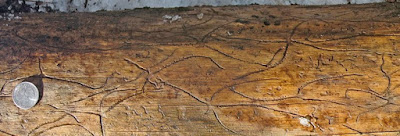
Well, it turns out that there are plenty of people who experience that, whose facility for seeing artifacts in natural objects is considerably more sensitive than mine (or they are just a lot better at fooling themselves). I was recently sent a number of photos of pieces of pine branches showing insect boring patterns that the discoverer is certain represent maps created by Ute Indians. He has even been able to identify the area they portray, now a neighborhood in Colorado Springs, Colorado. Now, to me, they represent prime examples of Apophenia/Pareidolia, and even could be classified as Mimetoliths (mimicking actual maps), but the discoverer appears completely convinced by what he has found. Indeed, he apparently agrees that most pieces of wood that can be found with these markings are merely insect tracks, but he believes he can tell a difference and recognize the few examples that he has collected as "the real thing."


Map of Stratton Open Space,
Parks Department, City of
Colorado Springs, CO.

I think of this situation as paralleling the rock art/ogam controversy. I know those marks are not ogam, but I cannot convince the proponents - indeed, I have no way of proving it to them. This is the power of Apophenia, it is psychologically ingrained deeply into our makeup. Once, our ancestors were on the lookout for predators in the underbrush who could be recognized by the shape of a lion's ear through a break in the foliage, the contour of the side of a jaguar's head in a shadow, this is instinctive and was basic to our very survival. Our subconscious does this all the time, it is primal and not under our conscious rational control. Whereas scientific facts are merely new ideas on the surface that we trade between ourselves, nowhere near as powerful in our overall conscious-subconscious makeup.

So, I do not expect to be able to convince the discoverer of what I recognize as the truth - insect chewed wood. That would be merely boring fact. He has the power of belief on his side, and he knows down to his soul that he has made this important, historically significant discovery. He is, of course, wrong, but I almost envy him the strength of his belief. (Although I suspect that with a microscope we could detect the actual bite marks of the larvae that tunneled through the wood.)

This also represents the ideal time to introduce another term sometimes applied in this field - a Manuport. "In archaeology and anthropology, a manuport is a natural object which has been moved from its original context by human agency but otherwise remains unmodified." (Wikipedia) These pieces of tree limb are manuports because they interested their collector enough to pick them up and take them back to his residence. Mimetoliths that are seen to be interesting enough often become Manuports. In this case - you be the judge.

NOTEFor these particular objects I cannot use the term mimetolith (which basically translates as rock that mimics) because they are not rocks. Perhaps we can call them mimetoports to indicate that they are mimics that were collected by a human and transported. 

Also: I am purposely withholding the name of this individual to preserve his privacy. If he wants me to release it he can e-mail me and I will pass it along.

REFERENCE:

https://en.wikipedia.org/wiki/Apophenia

https://en.wikipedia.org/wiki/Manuport