Showing posts with label mammoth. Show all posts
Saturday, December 5, 2015
EXTINCT ANIMALS IN ROCK ART - MAMMOTHS:
On November 6, 2011,
I reviewed a paper by Ekkehart Malotki and Henry D. Wallace about the discovery
of a possible petroglyph of a mammoth along the San Juan River, near Bluff,
Utah. (Malotki and Wallace, 2011: 143)
In the article by Agenbroad and Wallace (2004) cited below the
authors argue that the belief that Paleo-hunters did not live on the Colorado
Plateau because the megafauna that they depended upon were absent is just a
myth. They point to fossil remains located throughout the area in question, as
well as rock art that they identify as the megafauna in question, as proof that
both the animals and the hunters occupied the Colorado Plateau from 12,000 to
6,000 BP. (Agenbroad and Hesse 2004:189-195)
If this is indeed the case, then the rock art that they show
as evidence toward their claims must be illustrations of the extinct megafauna
species (mammoth and bison) that existed during that period. The actual existence of rock art illustrating mammoths is somewhat problematical although opinion is not as closed against it as before.
The Clovis culture is a prehistoric Paleoindian
culture, named after distinct stone tools found at Clovis, New Mexico, in the
1920s and 1930s. The Clovis culture appeared around 13,200 - 12,900
years before present, at the end of the last glacial period. Clovis is
characterized by the manufacture of Clovis points and distinctive bone and
ivory tools. Clovis peoples are considered to be the ancestors of most
of the indigenous cultures of the Americas. (Wikipedia)
Some instances of mammoth remains with evidence of
intentional butchering have been recorded and Clovis artifacts are often found
with mammoth remains in archaeological contexts pointing to the Clovis culture
as mammoth hunters.
"The distribution
of 35 Clovis localities, most of which are surface finds, closely resembles the
reported mammoth distribution. In other words, mammoth hunters were where the
mammoths were." (Agenbroad and
Hesse 2004:194)
"Only 14 of the
42 documented mammoth sites (33 percent) have been radiocarbon dated. These
dates range from 30,800 to 10,350 B.P., with no major temporal absence. The
weighted average of the four youngest radiocarbon dates for mammoths is 11,270
± 65 B.P. , which approximates the time
of mammoth extinction on the Colorado Plateau (Agenbroad and Mead 1989)."
(Agenbroad and Hesse 2004:195)
"Figure 16.6
shows the known rock-art localities that depict mammoth and bison on the
Colorado Plateau. Some of the mammoth petroglyphs are in the same canyons that
contain mammoth skeletal and fecal remains. Figure 16.7 provides examples of
mammoth rock art on the Plateau." (Agenbroad and Hesse 2004:195)
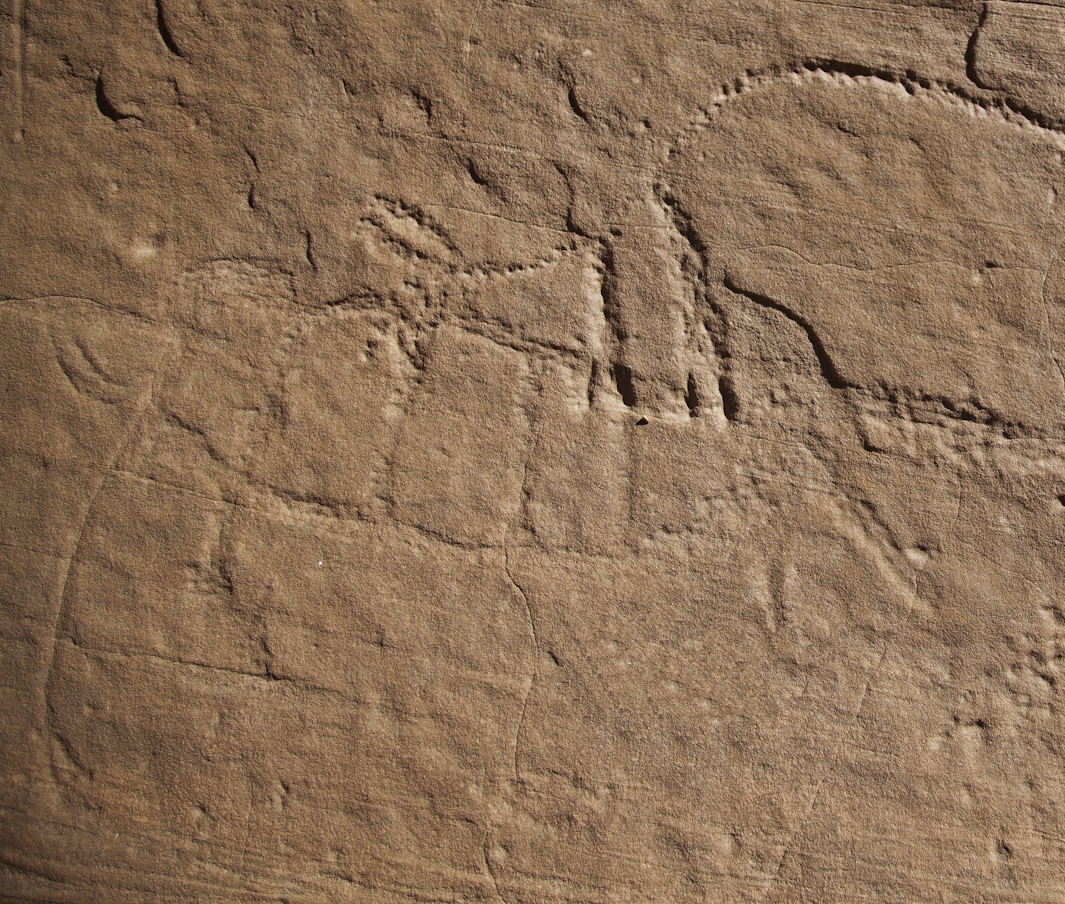
Proposed San Juan river mammoth
and bison petroglyph. Ekkehart Malotki
and Henry D. Wallace, 2011.
While I am certainly open to the possibility of some rock
art in North America portraying mammoths, I am skeptical about many of the
claimed examples. I have previously argued against the authenticity of the
so-called "Moab mastodon", and I have guardedly accepted the
identification of a petroglyph along the San Juan river near Bluff, Utah, as a
Columbian mammoth by Malotki and Wallace (2011). In Agenbroad and Hesse's
figure 16.7, however, I fear a number of the illustrated examples do not strike
me as convincing.
One image that I personally do find very convincing was discovered in 2002 by Mike
Maselli on an outlying boulder at the Farrington Springs site in southeastern
Colorado. In this instance Larry Agenbroad disagreed, stating he did not
believe that the image represented any type of pachyderm (personal
communication). On the question of mammoths in rock art, I fear the votes are
not yet in, and we will have to wait a while for further data before we can
state conclusively yes or no.
REFERENCES:
Agenbroad, Larry D., and India S. Hesse,
2004 Megafauna,
Paleoindians, Petroglyphs, and Pictographs of the Colorado Plateau, in The Settlement of the American Continent: A
Multidisciplinary Approach to Human Biogeography, edited by C. Michael
Barton, Geoffrey A. Clark, David R. Yesner, and Georges A. Pearson, University
of Arizona Press, Tucson.
Malotki, Ekkehart, and Henry D. Wallace
2011 Columbian
Mammoth Petroglyphs From The San Juan River Near Bluff, Utah, United States, in
Rock Art Research 2011, vol.28,
number 2, pages 143-152, Australian Rock Art Research Association, Caulfield
South, Victoria, Australia.
Wikipedia
Labels:
Colorado,
Ekkehart Malotki,
Farrington Springs,
mammoth,
petroglyph,
rock art,
Utah
Saturday, April 18, 2015
THE HOLLY OAK PENDANT - PALEOLITHIC ART, OR HOAX?
Negative image of the Holly Oak Pendant from the cover
of Science Magazine, 21 May, 1976. Note, the mammoth
image has been picked out from background details.
It is easy to see the lack of feet.
The Holly Oak Pendant is a fraudulent artifact created as a shell gorget bearing the image of a mammoth on the converse side. It was originally presented in 1889 as an authentic Paleolithic artifact from North America, given the image of the mammoth engraved on it.
Late in 1863, Edouard Lartet, the paleontologist, with Henry
Christy, his friend and benefactor, had turned a few shovels of earth in the
rock shelter of La Madeleine by the side of the Vezere River in France. They
found remains of stone, bone and ivory tools so they returned in the Spring of
1864. That May, Lartet’s dig crew recovered five fragments of an ivory plate.
When reassembled they displayed a wonderful engraved mammoth with almost all of
the details of its appearance clearly defined. All this engraving lacked was
the feet, which may have been on an un-recovered piece of the plaque or may have
never existed because of lack of space on the surface.
Illustration of the Holly Oak pendant
from www.museumofhoaxes.com.
In 1889, an archaeological assistant at Harvard's Peabody
Museum named Hillborne T. Cresson, announced that he had discovered a
prehistoric seashell pendant/gorget that bore the engraving of a woolly mammoth
on one surface. He stated that he had discovered it near Holly Oak railroad
station, in northern Delaware, in a layer of peat in the forest. This find was
suspected of being fake by some establishment figures. One reason for suspicion was the unusual circumstance of
its discovery. Cresson claimed he had discovered it in 1864, when he was a
teenager, in the company of his music teacher, Mr. Saurault. He offered no
explanation for why he had waited twenty-five years to share the discovery,
even though its significance should have been obvious to him — especially since
his music teacher was himself a student of archaeology. (http://www.museumofhoaxes.com/hoax/archive/permalink/holly_oak_pendant)
“The Holly Oak Pendant
was accepted as authentic by many when it was discovered in the middle of the
nineteenth century. The pendant, found in Delaware, appeared to be an incised
drawing on shell of a prehistoric woolly mammoth. It reminded many of the
Paleolithic cave paintings and carvings of the Europe of 20,000 years ago,
convincing some of the existence of a similar – and similarly ancient –
artistic tradition in North America.
The Holly Oak Pendant,
if genuine, should have dated to more than 10,000 years ago, since that is
about the time that woolly mammoths became extinct – obviously, people would
not have been drawing mammoths long after they had disappeared. In fact, the
shell turned out to be only about 1,000 years old. The artifact was a fake,
though cleverly carved on an old piece of shell. “(Feder 2010:139)
The 1864 Holly Oak Pendant/Gorget bears a very similar
engraved mammoth to the one portrayed on the ivory plaque from La Madeleine –
even down to the missing feet. That is the first detail that gave rise to
suspicion that the image was fraudulent. The mammoth on the Holly Oak
Pendant/Gorget had been copied from a published image of the ivory plaque from
La Madeleine and the feet could not be included, even though there was
sufficient room on the shell, because the forger did not know what they should
have looked like.
“Thus something is
terribly wrong with the context Cresson provided or created. Occam’s Razor
slices right through this one – the Holly Oak Gorget, with its wonderful wooly
mammoth, is not a genuine prehistoric artifact of any significant age. Indeed,
the shell gorget itself, with no engraving on it, may well be from the very
late Fort Ancient culture of Ohio. Cresson dug on one such site, and he was
fired for stealing artifacts in Ohio. A radiocarbon date recently run on the
shell gorget dates it to less than a thousand years ago. Even (Barry) Fell’s Epigraphic Society Occasional
Publication volume branded it a fake based on the carbon 14 finding!”
(Williams 1991:127)
This strongly suggests that the shell gorget in question was one of the artifacts stolen by Cresson, with the mammoth image later added to manufacture the evidence that would ensure his fame. The dating was carried out by Accelerator Mass Spectrometer
C14 analysis, and resulted in a date of AD 885 within a range of AD
750 to AD 1000. (Meltzer 1990:55) The irony of this all is, of course, that we
now know that not only were there also mammoths here in the New World, but
there were people here hunting and eating them – only somewhat earlier than
Cresson claimed, and just not carving their pictures on shells.
Note: Readers who find these subjects to be of interest will be well served to read the books referenced above, and listed below in my References list.
REFERENCES:
Feder, Kenneth L.
2010 Encyclopedia
of Dubious Archaeology: From Atlantis to the Walam Olum, Greenwood, Santa
Barbara, Denver, and Oxford.
Meltzer, David
1990 In Search of a Mammoth Fraud, New Scientist,
July 14, 1990, Volume 127, No. 1725, p. 51-55.
Williams, Stephen
1991 Fantastic
Archaeology, The Wild Side of North American Archaeology, University of
Pennsylvania Press, Philadelphia.
Labels:
Delaware,
earliest art.,
engraved shell,
France,
hoax,
Holly Oak Pendant,
La Madelaine,
mammoth,
paleolithic
Saturday, March 2, 2013
THE GRAND TRAVERSE BAY, MICHIGAN, PROBOSCIDIAN:
On February 23, 2013, we attended the excellent exhibit
MAMMOTHS AND MASTODONS: TITANS OF THE ICE AGE, at the Denver Museum of Nature
and Science (DMNS). This is a traveling exhibit that originated at the Field
Museum in Chicago, and can be seen at the DMNS from February 15 to May 27,
2013. Aside from being a fascinating and well done exhibit on a fascinating
subject, the exhibit surprised me by identifying a supposed mammoth or mastodon
petroglyph on a boulder under water in Grand Traverse Bay, Michigan.
Carved face of underwater boulder,
Grand Traverse Bay, Michigan.
This petroglyph was located by underwater archaeologist Dr.
Mark Holley who was documenting shipwrecks when he found it. The supposed
mammoth or mastodon is on one boulder in what he described as “a circular pattern
of rocks on the bay floor.” If this image is human produced it must have been
made more than 13,000 years ago when enough water was tied up in the
Pleistocene glaciers and the site would have been on dry land.
Carved face of underwater boulder - retouched
in photo, Grand Traverse Bay, Michigan.
With no prominent bump on the top of the skull, and from the
relatively smooth back approaching the horizontal instead of strongly sloping
toward the rear, the animal (if authentic) may be provisionally identified as a mastodon. The
animal’s trunk is described as in a curled up position as if it were drinking,
and some vaguely wedge-shaped lines
within the body outline are described as representing the protruding end of a
fletched dart or spear that a hunter launched at the creature with an atlatl.
This leads to the speculative scenario of a hunter concealed at a watering
spot, waiting until the creature came to the water to drink and then launching
his dart into the prey.
Add this as one more entry on the speculative list of
possible, but unproven, proboscidians in North America.
REFERENCE:
Labels:
atlatl,
Grand Traverse Bay,
mammoth,
mastodon,
Michigan,
Pleistocene,
rock art
Sunday, November 6, 2011
THE UPPER SAND ISLAND MAMMOTH PETROGLYPH, UTAH:
Veteran readers of RockArtBlog may remember that I have published postings on the subject of mammoths in North American rock art in the past. On May 4, 2009, I posted A Possible Mastodon Petroglyph in Southeastern Colorado, and on April 16, 2011, I posted a column entitled The Earliest Art in North America, The Vero Beach Mammoth. Additionally, on November 25, 2009, I posted Elephantids in North American Rock Art – The Moab Mastodon, in which I explained my disbelief in the identification of what has been called the Moab Mastodon.
Ekkehart Malotki. Photograph used by
Petroglyph panel with images highlighted, San Juan
River, Utah,upstream from Sand Island. Photograph
used by permission of Ekkehart Malotki.
Behind all of this, however, I have always felt a strong conviction that there should be examples of mammoths and mastodons in North American rock art. We know people in North America coexisted with these Pleistocene giants, we know that they preyed on them, there should be examples of mammoths and mastodons in rock art, but, of all the candidates suggested so far only the Vero Beach mammoth has supposedly been scientifically authenticated (and I say supposedly because I do not believe that test results have been fully proven yet). Mammoth petroglyph from the right side of the panel.
The mammoth image on the left side of the picture is
partially superimposed by a large bison. Photograph
used by permission of Ekkehart Malotki.
Mammoth 1 - close up of proposed mammoth petroglyph.
Photograph used by permission of Ekkehart Malotki.
Now from the great rock art site of Sand Island on the San Juan River, near Bluff, Utah, internationally known author and rock art researcher Ekkehart Malotki, and H. D. Wallace, have put forth a new candidate (I should say candidates) in the search for elephantids in rock art. Malotki is emeritus professor of modern languages at Northern Arizona University, while Wallace is an archaeologist from Tucson, Arizona. They have described a couple of petroglyphs from that site that they have identified as representations of mammoths dating to the Pleistocene/Holocene transitional period. Malotki was originally introduced to the possible mammoth by Joe Pachak, an artist from nearby Bluff, Utah. This identification is based upon details such as the bifurcated trunk tip of the mammoth which Malotki suggests a forger would not know about, and their height (approx. 5 meters) above the present day ground level and weathered condition.
Mammoth 2 - close up of proposed mammoth petroglyph
from the left side of the panel. Photograph used by
permission of Ekkehart Malotki.
As I have not yet seen the petroglyphs in person I will refrain from cluttering up the discussion with my own speculation other than to say that I truly hope that Malotki and Wallace are correct. I want there to be petroglyphs of mammoths and mastodons in North American – there should be petroglyphs of mammoths and mastodons in North America. People were here while the great beasts were still alive, and people make marks and pictures.
Ekkehart Malotki. Photograph used by
permission of Ekkehart Malotki.
I also want to congratulate Malotki and Wallace on having the courage and dedication to stand up and say what they believe they have, especially knowing that stating this opinion may invite considerable controversy, and sometimes personal attacks. I hope that this debate can stay civilized. In any case this will be fun to watch as it plays out in the arena of scientific opinion.
See the full paper at www.stonepages.com/docs/malotki-wallace.pdf
Labels:
Bluff,
Ekkehart Malotki,
elephantids,
H. D. Wallace,
mammoth,
petroglyph,
San Juan river,
Utah
Saturday, April 16, 2011
THE EARLIEST NORTH AMERICAN ART – THE VERO BEACH MAMMOTH BONE:
Carved bone, Vero Beach, Florida. Photograph from fhttp://news.nationalgeographic.com/news/2009/06/090610-oldest-art-mammoth-picture.html
A candidate for the earliest known art in North America was found a few years ago near Vero Beach, in east central Florida. Vero Beach is known to fossil collectors for its prehistoric mammal fossils and shark teeth. Fossil hunter James Kennedy had discovered a 15” (38 centimeter) piece of bone and placed it in a box under his sink for storage for a time and had retrieved it and dusted it off when he discovered that something was engraved on the bone.
Writing in the National Geographic Blog Central, June 10, 2009, Chris Sloan reported that “when the specimen came to the attention of Dr. Barbara Purdy and other experts at the University of Florida and the Florida Museum of Natural History, they initiated a study which has thus far been unable to show that it is a fake. At this time, they are cautiously supporting its authenticity. Dennis Stanford of the Smithsonian National Museum of Natural History said, "One does have to wonder, but at face value it looks pretty good.”
Purdy, a professor emerita at the University of Florida, and scientists there, also “determined the bone belonged to one of three animals: a mammoth, a mastodon, or a giant sloth—all of which died out at the end of the last ice age, between about 12,000 to 10,000 years ago. I literally went on the assumption that [the carving] was a fake," said Purdy, who was later convinced of its authenticity after the bone had passed a barrage of tests by University of Florida forensic scientists. The examinations revealed that the light etching is not recent, and that it was made a short time after the animal died, according to Purdy.”
Now we know that in other parts of the world where humans and mammoths co-existed, the humans left imagery of the mammoths in paint, bone and stone. To a certain extent we have to then ask ourselves if they did that elsewhere, why would they not have done so here as well. Until further scientific testing has managed to conclude the question of the engraving’s authenticity and date as an ancient artifact, we will have to leave the discussion open, but it is a fascinating possibility.
Reference:
http://blogs.ngm.com/blog_central/2009/06/mammoth-art-in-america-or-mammoth-fraud.html
Wednesday, December 8, 2010
PACHYDERMAGLYPHS - NOT REALLY ROCK ART:
In March 2004, we had an opportunity to visit the fascinating rock art of Hueco Tanks, east of El Paso, Texas. While the main purpose of the visit was to see the numerous mask pictographs at that location we saw many other things as well. Named for a number of natural pools of rainwater (or tanks) so valuable to non-technological people in that arid landscape, Hueco Tanks has obviously attracted visitors for millennia. According to the DesertUSA website: “Over the millennia, Hueco Tanks has drawn desert plant and wildlife communities and prehistoric and historic man into its folds primarily because its huecos (a Spanish word for “hollow”) – especially the deep ones that lie beneath sheltering rock ceilings – trap and hold drinkable water, that most valuable desert commodity. Indeed, as Robert Miles and Ron Ralph said in an article in The Handbook of Texas Online, Hueco Tanks held virtually the only dependable source of water between the Pecos River, roughly 120 miles to the east, and El Paso, some 30 miles to the west.”
Not too far from the park headquarters, our ranger guide pointed out an area up on the cliff face where the rock projection had been been artificially smoothed and polished. This smoothing had been done by mammoths scratching their itches by rubbing against the rock. According to the ranger this had been confirmed by laboratory analysis which found the remnants of proteins from their skin and hair absorbed into the rock.
A number of other such locations have been discovered and can be researched online. This vestige of Paleolithic giants gave one a sense of personal connection. Unlike the sterility of simply academic knowledge of their former existence, here we could personally experience contact with a rock that they had rubbed up against. This feeling was not at all unlike the feeling we get when in the presence of rock art, that we can somehow contact on a personal level the reality of the person who created the art, and what can be more exciting than that?
Although these are generically known as "mammoth rubbing stones" and that is certainly accurate and descriptive, I have been looking for a technical term to apply to these sites. In the context of RockArtBlog I have decided to name them pachydermaglyphs - what do you think?
Reference:
http://www.desertusa.com/mag07/april07/Hueco.html
Mammoth rub, Hueco Tanks, Texas.
Photo: Peter Faris, March 2004.
Not too far from the park headquarters, our ranger guide pointed out an area up on the cliff face where the rock projection had been been artificially smoothed and polished. This smoothing had been done by mammoths scratching their itches by rubbing against the rock. According to the ranger this had been confirmed by laboratory analysis which found the remnants of proteins from their skin and hair absorbed into the rock.
A number of other such locations have been discovered and can be researched online. This vestige of Paleolithic giants gave one a sense of personal connection. Unlike the sterility of simply academic knowledge of their former existence, here we could personally experience contact with a rock that they had rubbed up against. This feeling was not at all unlike the feeling we get when in the presence of rock art, that we can somehow contact on a personal level the reality of the person who created the art, and what can be more exciting than that?
Although these are generically known as "mammoth rubbing stones" and that is certainly accurate and descriptive, I have been looking for a technical term to apply to these sites. In the context of RockArtBlog I have decided to name them pachydermaglyphs - what do you think?
Reference:
http://www.desertusa.com/mag07/april07/Hueco.html
Monday, September 6, 2010
THE TOMB OF REKHMIRE – A DWARF MAMMOTH IN ANCIENT EGYPT?
Rekhmire was “Governor of the Town” of Thebes, and the vizier of Egypt during the reigns of Tuthmose III and Amenhotep II (ca. 1479 to 1401 B.C.E.) during the XVIII dynasty (Wikipedia). This made him the most powerful official in the civil administration during that period of the Egyptian empire’s greatest extent and prosperity. As the most powerful official he rated a large and highly decorated tomb in the Theban necropolis. The illustrations include many illustrating Rekhmire’s duties for the Pharaoh and provide an invaluable record of his duties and daily life for the court.
Because of space constrictions on the tomb wall these portrayals are shown in a rough echelon of scale, the larger animals are shown as larger than smaller species, but not to full proportion. The tallest animal is the giraffe which stands a little taller than the Nubian leading him. Other animals shown are scaled roughly in proportion down from the giraffe based upon their relative sizes, with one notable exception, the elephant. The elephant is little larger than the bear which precedes it in procession. That makes the elephant the most interesting animal in the tomb and it also brings up a fascinating question. What kind of elephant is it anyway?
There actually was, at this time, a resident population in the Syrian area of a native elephant, the Syrian elephant, Elephas maximus asurus. The most extreme western population of the Asiatic elephant, this became extinct in ancient times by around 100 BC. This was also the largest sub-species of the Asian elephant, standing up to 3.5 meters tall (11½ feet). This size provides a problem with the elephant in the tomb painting. It is portrayed as waist high on its handler, and given the relative sizes of the animals shown it should have been considerably larger in scale like the giraffe on the register above it, - perhaps it is a baby Asian elephant. It seems to portray some features that could belong to an Asian elephant, the domed head and small ears. It cannot however be intended as a baby elephant of any kind because it has a pair of impressively long tusks which would be huge if scaled up to full size. Such tusks could only be meant to represent a fully grown adult animal. There is one other puzzling feature about the elephant in Rekhmire’s tomb, it seems to be covered with hair (compare the portrayal of the elephant’s surface with the bear in front of it). What kind of elephant had small ears, a domed head, huge tusks, and a covering of hair?
The only elephantid with the domed head, small ears, huge tusks, and covered with hair that I can think of was the wooly mammoth (Mammuthus primigenius). But, in ca. 1479 to 1401 B.C. how could they have seen a mammoth to portray in Rekhmire’s tomb.
According to Wikipedia, “during the last ice age, woolly mammoths (Mammuthus primigenius) lived on Wrangel Island in the Arctic Ocean. It has been shown that mammoths survived on Wrangel Island until 1700 B.C.E., the most recent survival of any known mammoth population.” This time frame is close enough to the 1479 B.C.E. of the beginning of the reign of Tuthmose III to make me wonder. The latest date from dwarf mammoth remains on Wrangel Island (1700 B.C.E.) surely does not represent the last individual to perish, so many must have lived longer. That makes it conceivable to imagine an overlap in time between the existence of dwarf mammoths on Wrangel Island, and the creation of Rekhmire’s tomb. Could a representative captive sample of Wrangel Island dwarf mammoths actually been traded from far northeastern Siberia to Syria, to be presented to an Egyptian pharaoh as tribute? Stranger things have happened.
Wall mural from the tomb of Rekhmire showing
tribute bearers. The giraffe is at upper right and
the miniature elephant following the bear is at
the lower left.
One wall of his tomb shows Rekhmire supervising the collection of tribute to the Pharaoh from foreign emissaries. Rows of figures bearing tribute are illustrated divided by nationality. The top row shows tribute from the land of Punt and includes myrrh, gold, precious stones and ivory, a baboon, monkeys and exotic animal skins. The next row down records the tribute from Mediterranean islands including Crete. These bearers are dressed in Mycenaean kilts. Next in order is a row of Kushite (Nubian) tribute bearers with representative animals including a giraffe, leopard, baboons, monkeys, cattle and dogs, as well as ostrich eggs and feathers. The next in vertical order represents the tribute from Syrians dressed in long white robes and pointed beards with wagons and horses, a bear, and an elephants, weapons and metal vessels, copper ingots and pottery.Because of space constrictions on the tomb wall these portrayals are shown in a rough echelon of scale, the larger animals are shown as larger than smaller species, but not to full proportion. The tallest animal is the giraffe which stands a little taller than the Nubian leading him. Other animals shown are scaled roughly in proportion down from the giraffe based upon their relative sizes, with one notable exception, the elephant. The elephant is little larger than the bear which precedes it in procession. That makes the elephant the most interesting animal in the tomb and it also brings up a fascinating question. What kind of elephant is it anyway?
Wall mural from the tomb of Rekhmire showing
the miniature elephant following the bear.
The only elephantid with the domed head, small ears, huge tusks, and covered with hair that I can think of was the wooly mammoth (Mammuthus primigenius). But, in ca. 1479 to 1401 B.C. how could they have seen a mammoth to portray in Rekhmire’s tomb.
According to Wikipedia, “during the last ice age, woolly mammoths (Mammuthus primigenius) lived on Wrangel Island in the Arctic Ocean. It has been shown that mammoths survived on Wrangel Island until 1700 B.C.E., the most recent survival of any known mammoth population.” This time frame is close enough to the 1479 B.C.E. of the beginning of the reign of Tuthmose III to make me wonder. The latest date from dwarf mammoth remains on Wrangel Island (1700 B.C.E.) surely does not represent the last individual to perish, so many must have lived longer. That makes it conceivable to imagine an overlap in time between the existence of dwarf mammoths on Wrangel Island, and the creation of Rekhmire’s tomb. Could a representative captive sample of Wrangel Island dwarf mammoths actually been traded from far northeastern Siberia to Syria, to be presented to an Egyptian pharaoh as tribute? Stranger things have happened.
Labels:
Amenhotep II,
egyptian,
mammoth,
Rekhmire,
tomb of Rekhmire,
Tuthmose III,
Wrangel island
Monday, May 4, 2009
A POSSIBLE MASTODON PETROGLYPH IN SOUTHEASTERN COLORADO?
One perennial question in the study of rock art in North America is the possible presence of images of extinct paleolithic megafauna. Various suggested images of mammoths and mastodons have been publicised but none of these have been accepted by the field. In 2002 a discovery in southeastern Colorado added another potential contender to the field.
This image is not portrayed on the cliff like the others at this site, but sits on a separate block of stone, out away from, but facing the cliff. It is pretty much surrounded by a tree which has grown in close around it. As it is oriented now the image would be described as looking upward at the sky. It is, however, quite easy to imagine a scenario in which erosion and/or the pressure of growth from a small tree could have turned it the 90° counter-clockwise out of proper orientation.
southeast Colorado, Photo:
Mike Maselli.
In March, 2002, a previously unknown petroglyph was discovered by Mike Maselli and a companion while visiting a large petroglyph site in southeast Colorado. Located on a detached boulder about ten feet from the cliff face that holds all of the other known images at the site, it is obscured by vegetation growing around it.
Possible mastodon petroglyph,
southeast Colorado.
Photo by the author.
In a visit to the site in May, 2002, the author rephotographed the image which he located with the help of directions from Mike Maselli. On this visit later in the spring the vegetation had come out and shaded and partially obscured the image. The image itself measures a few inches wide and appears to be completely repatinated suggesting considerable age.
southeast Colorado, rotated
90° clockwise, and enhanced on photo.
This image is not portrayed on the cliff like the others at this site, but sits on a separate block of stone, out away from, but facing the cliff. It is pretty much surrounded by a tree which has grown in close around it. As it is oriented now the image would be described as looking upward at the sky. It is, however, quite easy to imagine a scenario in which erosion and/or the pressure of growth from a small tree could have turned it the 90° counter-clockwise out of proper orientation.
If it is an elephantid portrayal, it shows the beast's head from a large ear forward. The facial details are somewhat problematical suggesting that if there is a trunk, then the beast has no tusks. Paleolithic elephantid expert Larry Agenbroad could find no traits in this image that would convince him that it was a mastodon or mammoth. At the same time it is almost harder for many to see it as something else. The question must be considered open for now.
Labels:
Colorado,
elephant,
Farrington Springs,
mammoth,
mastodon,
petroglyph,
rock art
Subscribe to:
Posts (Atom)