
I am taking the opportunity to revisit the subject of ‘shamanism’ in rock art because it seems that more and more references to shamanism can be found in books and articles about rock art. I feel I need to state here (again) that I am not denying that there is shamanistic rock art. I am stating that there are a myriad of potential meanings for a rock art image and reasons for its production, some of it shamanic, some not.
I once had an opportunity to attend a lecture by the great Joseph Campbell, author of so many books on mythology and belief systems. Campbell believed that similarities in myths were of much greater significance than differences, so he had no trouble equating myths from different sides of the globe. At this lecture he explained the significance of the dying man/wounded bison panel from the chimney at Lascaux in terms of Australian Aboriginal belief. To my way of thinking this goes way too far afield. These cultures were separated by tens of thousands of years and thousands of miles, with no possibility of reciprocal influencing.

My example from the Campbell lecture is indicative of a problem that I see cropping up all too frequently in rock art studies. The shamanic or neuropsychological model for explaining rock art has become such a fad explanation that it is hard to find people giving credence to any other possibilities. As far as trancing and/or entoptics influencing rock art I really do not need a trance hallucination or entoptic vision to inspire the images I make. Once the pigments or hammerstones are picked up in front of a rock face there are only so many things I can do with them. Trying to reproduce an image from life or create a geometric shape needs no artificial stimuli. There are only so many geometric shapes available, and a reproduction of a living being is inspired by the being itself. To invariably attribute these to anything else is nonsense.
An understandable, but biased interpretation of rock art is found in the tendency of the viewer to attempt to define what they are viewing on the basis of what has been successfully applied to interpretations in the past. An example of this is seen in the case of David Lewis-Williams whose early work with interpreting South African rock art in light of San bushman shamanism so impressed the rest of the rock art community. Since that early success Lewis-Williams seems unable to consider any other possible interpretation no matter what the conditions or location the rock art is found in, or what age it is from. An early success of intellectual application that was thought to approach the genius level seems to have led him to the status of a one-trick pony.

I suggest that Lewis-Williams made the mistake of taking the wrong message away from his earlier work. Instead of learning the lesson that he had succeeded by a rigorous application of reasoning based upon knowledge of ethnographic material for the San people of Africa, he seems to have come away with the message that “shamanism” was the correct answer so it would always be the correct answer. In other words he seems to have subsequently used his mental abilities, knowledge, and reason, to fit other rock art into his shamanic framework instead of using those same gifts and abilities to find a unique answer that would fit the unique conditions of the rock art he was appraising.
Paul Bahn (1997) pointed out that “Throughout the book by Clottes and Lewis-Williams (see references below), possibilities are presented as ‘evidence’, then used as building blocks for speculation that magically acquires the status of ‘fact’ (Bahn). This is a crucial problem for, in the words of Carl Sagan, if we become ‘self-indulgent and uncritical, when we confuse hopes and facts, we slide into pseudoscience and superstition’ (Sagan 1997: 27). As Hamayon (1997:65-66, my translation) puts it, the book’s ‘approach is devoid of any critical thought: conjectures on one page become, as if by magic, assertions on the next . . . I have rarely seen such reductionism, I have rarely seen such simple-minded determinism.” (Bahn 2010:118-119) This is a phenomenon I see all too often in rock art writings. A concept that is introduced as a possibility on one page will be used as a fact a page or two later to support another surmise.
We would do well to remember that the limited remains of the physical cultures studied by archaeologists represent a very small proportion of those cultures. They had a whole world of beliefs, mythology, rituals, and physical knowledge that is not necessarily represented by those physical remains. Rock art represents that world of beliefs, mythology, rituals, etc. aspect of the whole world that these people lived in, and we have no physical artifacts from that world for most of the cultures that we are studying.

In 2011 I wrote “In his 2002
book The Mind in the Cave:
Consciousness and the Origins of Art, David Lewis-Williams revisited the
shamanism argument for the dying man panel. Lewis-Williams originally
swept the rock art community with his early analysis of much of South African
rock art in light of San (bushman) religious practices that he defined as
Shamanism. He eventually served as director of the Rock Art Research Institute at the
University of the Witwatersrand from which he retired in 2000. He has since
published many important books and reached a position of respect world-wide. He
has a great ability to organize and analyze data and search for clues and
patterns. As might be expected, considering his focus and early success on the
interpretation of South African rock art in light of shamanic influences, he
tends to find shamanism behind pretty much anything he looks at. At this point
I must confess that I believe that the use of shamanism as an explanation of
rock art is hugely overdone. I have gotten to the point where I think of
shamanism as the “S”-word.
It has reached the position where anyone who cannot come up with a better
explanation for rock art just calls it shamanic. A few decades ago pretty much
all rock art of animals was dismissed as “hunting magic” and much of the early
respect afforded Lewis-Williams came from the fact that he very convincingly
gave us an alternative to that overused term. We need to be very careful that
we now do not just automatically substitute the “S- word” for “hunting magic” and continue to make the same
mistake.” (Faris 2011)
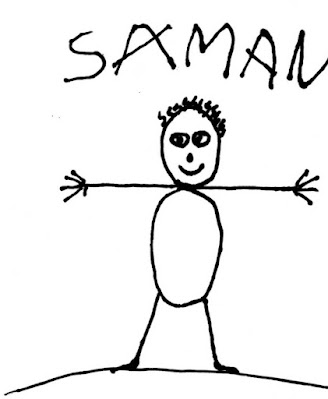
Self portrait by Samantha (last name unknown), 1998.
”A number of years ago on a field trip an enthusiastic rock art fan explained to me that all human figures in rock art that have their arms stretched out straight represent shaman figures. Upon return from that trip to the museum where I worked as exhibits curator at the time I was confronted by the illustration above. It turned out that the picture had been done by a young girl named Samantha who had run out of space on the page when signing her name. The resulting picture had been posted on a lobby wall by the institution’s education curator. I kept a copy of the picture because at that time its innocent childishness seemed to sum up so perfectly the statement that “all figures in rock art that have their arms outstretched straight represent shaman figures”; why she even spelled shaman almost correctly. At the very least it represents scientific proof as definitive as some of Lewis-Williams’.” (Faris 2011) In this I have not modified my opinion since.
Grant McCall wrote in 2006 that “The “shamanism” or “neuropsychological” model proposed by Lewis-Williams and colleagues has had a powerful impact on rock art research, and has significantly added to our knowledge of past foragers lifeways in southern Africa and elsewhere in the world. However, this model is primarily based on the view of shamanism as a universal and unvarying characteristic of foragers over space and time. This paper raises both theoretical and empirical problems with this view. The paper examines the relationship between the specific social roles and practices of shamanism and the overarching cosmological structures on which they are based in both southern Africa and Northern Eurasia. In both cases, the paper argues that many cosmological beliefs are highly persistent and durable, extending into prehistory, while the specific practices and roles of shamans are variable, changing to meet the immediate and local needs of their communities.” (McCall 2006)
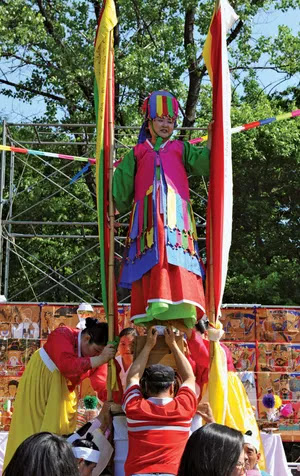
This concept of rock art being the product of shamanism had been pushed by the Abbe Breuil. “By Breuil’s death in 1961, the concept of shamanism aligned an idea of universal early religion with the eminence of the painter, the beauty of the cave art, the violence of the imagined ritual, and the political influence of the charismatic leaders. It explained the painter as a shaman too. Like Picasso, Breuil enjoyed what this meant for himself: the painter saw and moved where others could not, and like the shaman he plumbed the animal depths and made them accessible to everyone. The Renaissance of cave painting in the twentieth century was built on this myth. Contemporary artists, confronted with an unpleasant, disenchanted world in their own time, couldn’t resist.” (Stefanos Geroulanos 2024:302) I, for instance, grew up in the Unitarian church, my wife a Baptist church. If either, or both of us were to paint a picture of a deer on a cliff or cave wall, would it then be shamanic in nature. According to Breuil and Lewis-Williams it would.
Bahn argued basically the same point. “Unfortunately, the claim is often made that ‘shamanism is the religion of all hunting and gathering cultures’, which, as we have seen, is simply not true. For example, there is no shamanism at all in Australia. Trance and ecstasy are not found in many cultures known to have produced prehistoric and historic rock art.” (Bahn 2010)
How can anyone state so positively that they know what was in the mind of people from thousands of years in the past? “There are both theoretical and empirical flaws with the view that shamanism is a universal feature of forager societies, and that forager rock art invariably relates to shamanism. Future rock art research in southern Africa must work to address these flaws in moving beyond past paradigmatic dispositions. This paper has also argued that rock art is (a) class of archaeological remains originating from the process of landscape enculturation. The production of rock art is affected by many short-term and local contingencies, but rock art affects human behavior at scales beyond human lifetimes. The accumulation of rock art on landscapes represents a long-term, inter-generational process. Therefore, this paper has argued that the content of rock art at regional scales is easier to relate to the durable and persistent cosmological structures of forager societies than to the variable, flexible, and transitory social practices of shamanism.” (McCall 2006)
Another point to consider is that among all the rock art images identified as shaman (ie. the Dying Hunter, The Sorcerer, The White Shaman), it is often hard to find common traits. I fear that the S-word has often merely supplanted the term "ceremonial" as an explanation for images that cannot otherwise be identified.
I feel the need to state here (again) that I am not denying that there is shamanistic rock art. I am stating that there are a myriad of potential meanings for a rock art image and reasons for its production, some of it shamanic, some not. Let us not automatically jump to the use of the “S-word” in all instances. It is just not the only answer.
NOTE 1: In some of the quotations I have included above I
have left citations that are not listed in my references below. To find these I
recommend that you go to the sources listed.
NOTE 2: Some images in this column were retrieved from the internet with a search for public domain images.
REFERENCES:
Bahn, Paul G., 2010, Prehistoric Rock Art: Problems and Polemics, Cambridge University Press, Cambridge.
Clottes, Jean, and David Lewis-Williams, 1996. The Shamans of Prehistory, Harry N. Abrams, New York.
Faris, Peter K., 2011, The S-Word, Shamanism- or, The Dying Man in Lascaux Revisited, Rock Art Blog, 9 July 2011, https://www.rockartblog.blogspot.com.
Geroulanos, Stefanos, 2024, The Invention of Prehistory, Liveright Publishing Company, a division of Norton and Co., New York.
McCall, Grant S., 2006, Add Shamas and Stir? A Critical Review of the Shamanism Model of Forager Rock Art Production, 25 September 2006, Journal of Anthropological Archaeology, doi:10.1016/j.jaa.2006.09.001
Williams, David Lewis, 2004, The Mind in the Cave: Consciousness and the origins of Art, 1 April
2004, Thames and Hudson, New York.



 Posts
Posts

