Showing posts with label carved stone balls. Show all posts

Saturday, November 23, 2024

1.4 MILLION YEAR OLD STONE SPHERES?

Limestone spheroids, Ubeidiya, Israel. Illustration from phys.org.

This column is not about rock art, per se, but a fascinating phenomenon found at early hominin sites. Carefully manufactured stone balls or spheres. These discoveries come from a number of Acheulean sites spread over much of the world.

“Acheulean tools were produced during the Lower Paleolithic era across Afriica and much of West Asia, South Asia, East Asia and Europe, and are typically found with Homo erectus remains. It is though that Acheulean technologies first developed about 2 million years ago, derived from the more primitive Oldowan technology associated with Homo Habilis. The Acheulean includes at least the early part of the Middle Paleolithic. Its end is not well defined, depending on whether Sangoan (also known as “Epi-Acheulean”) is included, it may be taken to last until as late as 130,000 years ago. In Europe and Western Asia, early Neanderthals adopted Acheulean technology, transitioning to Mousterian by about 160,000 years ago.” (Wikipedia)

Spheroid sites in Israel including Ubeidiya. Illustration from royalsocietypublishing.org.

A publication authored by Antoine Muller of the Hebrew University of Jerusalem recently presents his team’s analysis of a number of limestone spheroids retrieved from an Early Acheulean site in Israel known as Ubeidiya dating to ca. 1.4 million years ago. “Excavations at the Early Acheulean site of ‘Ubeidiya have yielded a large number of stone balls offering a unique opportunity to conduce quantitative and objective three-dimensionsl (3D) analyses to explore how and why these curious artifacts were made. ‘Ubeidiya is situated in the Dead Sea Rift Valley, at the northern margin of the Red Sea – East African Rift System. Dated to ca 1.4 Ma, the site presently constitutes the oldest evidence of the Acheulean outside of Africa. Its geographical position in the southern Levant makes it a key site for exploring the first Acheulean hominin forays out of Africa.” (Muller et al. 2023)

Known spheroid sites worldwide. Illustration from royalsocietypublishing.org.

Muller and team performed a detailed analysis of the stone spheres to investigate whether they were intentionally created stone balls, or if this was essentially an accidental result of their being used as hammerstones.

Limestone spheroids, Ubeidiya, Israel. Illustration from phys.org.

“If spheroids represent hammerstones or percussors, then they should become both smoother and more spherical. If spheroids represent expedient cores, then we expect to see some pattern in the removal of scars. This pattern could take the form of scars of regular size, orientation or distribution over the surface. The spheroids may even become smoother during a final stage of battering attempts to remove flakes. However, we do not expect them to become more spherical. While even random flaking can mimic intentional artifact shaping, this strategy is unlikely to approach anything as unnatural as a true sphere. Due to the limits on the fracture mechanics of flaking that govern detachable platform angles, the high-angled flake removals necessitated by a spherical form would require much more effort and shaping than is involved in expedient flaking.” (Muller et al. 2023) In the end the Muller paper does not give a conclusion as to why these (or any other) stone spheroids were laboriously created.

A large number of stone spheres were also recovered from Qesem Cave, of roughly the same age as the Ubeidiya site, also in Israel.

Fremont figure at Balanced Rock, Nine Mile Canyon, Utah. Photograph Peter Faris, 1993.

On 4 April 2021 I published a column on RockArtBlog titled “The Enigmatic Figure at Balanced Rock, Utah – Bolas, Juggling or Rattles” in which I mentioned that some have interpreted the stone balls found in Fremont cultural contexts might have been used to create bola or boleadero, the implement commonly associated with South American gauchos. The Fremont culture is roughly dated to a span the ran from AD 1 to AD 1301 and has no connection to the Acheulean period at all so this is just a coincidence.
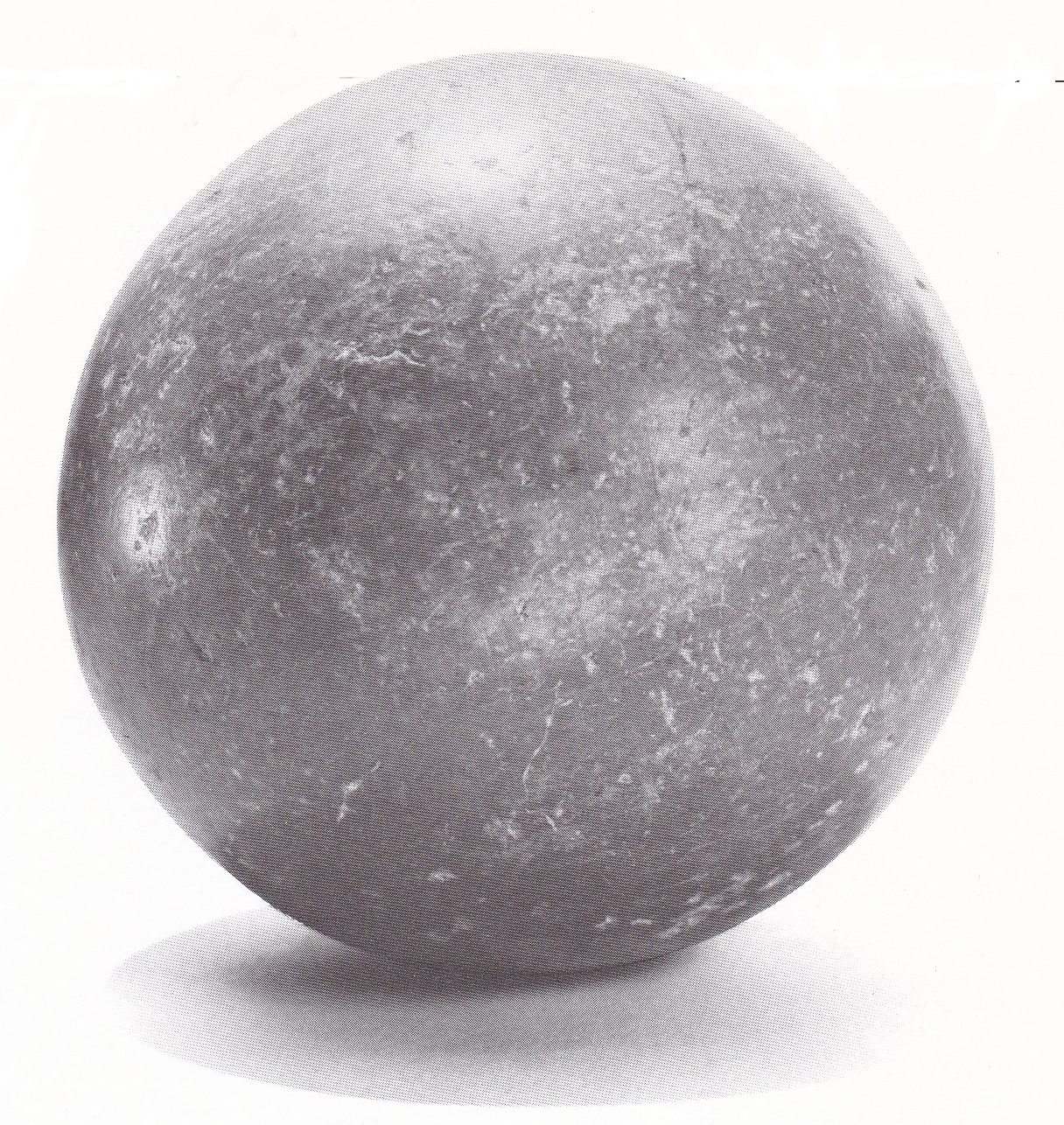
Fremont stone sphere. Illustration from Madsen, 1989.

“For a long time stone balls commonly found at Fremont village sites were thought to be part of a game, but recent work suggests that they may have been used with metates.” (Madsen 1989:33) and “Some stone balls, such as this highly polished specimen from the Old Woman site, suggest a use other than as a grinding tool.” (Madsen 1989:66) I also concluded that the Balanced Rock petroglyph was likely carrying a rattle, not a boleadero so this throws no light on the frequent occurrence of stone balls at Fremont sites at all. As I said above, this is just a coincidence, but a very interesting one.

NOTE: Some images in this posting were retrieved from the internet with a search for public domain photographs. If any of these images are not intended to be public domain, I apologize, and will happily provide the picture credits if the owner will contact me with them. For further information on these reports you should read the original reports at the sites listed below.

REFERENCES:

Faris, Peter, 2021, The Enigmatic Figure at Balanced Rock, Utah – Bolas, Juggling or Rattles, 4 April 2021, RockArtBlog, https://www.blogger.com/blog/post/edit/7760124847746733855/1434956800556132596.

Madsen, David B., 1989, Exploring the Fremont, University of Utah Occasional Publications No. 8, Utah Museum of Natural History, Salt Lake City.     

Muller, Antoine et al., 2023, The limestone spheroids of ‘Ubeidiya: intentional imposition of symmetric geometry by early hominins?, Royal Society Open Science, Volume 10, issue 9, September 2023. Accessed online 6 September 2023.

Wikipedia, Acheulean, https://en.wikipedia.org/wiki/Acheulean. Accessed online 10 Sept. 2024.


Wikipedia, Qesem Cave, https://en.wikipedia.org/wiki/Qesem_cave. Accessed online 14 October 2024.

Saturday, September 21, 2019

WHAT THE HELL ARE THEY? – NEOLITHIC CARVED STONE BALLS:


Neolithic stone balls,
Ashmolean Museum,
Internet, Public Domain.


Carved Stone Ball from
the British Museum,
Wikipedia,
Public Domain.

Here is one of my favorite conundrums involving rock art. These Neolithic carved stone balls – what the hell are they? “Carved stone balls are petrospheres dated from the late Neolithic to possibly as late as the Iron Age mainly found in Scotland, but also elsewhere in Britain and Ireland. They are usually round and rarely oval, and of fairly uniform size at around 2.75 inches or 7 cm across, with 3 to 160 protruding knobs on the surface. They range from having no ornamentation (apart from the knobs) to extensive and highly varied engraved patterns.” (Wikipedia) Originally thought to be associated with the Picts, these are now known to date from the Neolithic to Iron Ages, and thus predate the Picts who arose in the Late Iron Age.

Alford ball, Wikipedia,
Public Domain.


Towie Ball, from Scotland,
Internet photo,
Public Domain.

Towie Ball, from Scotland.
Wikipedia drawing,
Public Domain.

Suggested uses range from weapons (like mace heads, bolas, or sling stones) to tools (grinders like pestles, rollers like ball bearings for the stone blocks used to build Stonehenge, weights for fishing nets), standardized weights for traders, and of course the fall back for when you don’t really know anything, “objects of ritual significance or social status.” They have also been explained as perhaps functioning like the “speaker’s staff” to control or order deliberation in meetings. 

I would like to suggest another possibility related to the concept of social status. How about tokens of wealth like the “coppers” of the Indians of the Northwest coast of North America, or Rai (the stone money of the island of Yap). Tokens of wealth depend for their value on rarity. Rarity, in turn, depends upon how hard it is to procure the object in question because of either scarcity of the raw material or because of difficulty of fabrication.

North American Northwest
Coast Indian copper,
picture from Internet,
Public Domain.

In the case of the coppers prehistorically the material was very rare and hard to procure prehistorically for the native people, as well as the effort to produce the item was great. “Coppers, which are still in use today, experienced a real golden age in the 19th and the beginning of the 20th century. Due to contacts with western explorers and merchants their production increased substantially. However there are several indications that suggest they were already in use before the first contacts with the West, about 1790. The coppers were an exceptionally important symbol in the northwestern societies of the American continent. Apart from being a means of payment in a complex system of transactions, they were also a symbol of wealth and prestige.” (nbbmuseum.be)


Rai, stone money from the
island of Yap. Picture
intchyfeetphotography.com,
Public Domain.

And in the case of the Rai the production of the pieces involved a difficult process of stone carving as well as a sea voyage to and from the quarry on a different island. “Rai, or stone money (Yapese: ray), are more than 6,000 large, circular stone disks carved out of limestone formed from aragonite and calcite crystals. Rai stones were quarried on several of the Micronesian islands, mainly Palau, but briefly on Guam as well, and transported to Yap for use as money.” (Wikipedia) There is no limestone naturally on the island of Yap – thus scarcity. And, of course, prehistorically they had no metal tools so it took considerable effort to create them. When metal tools were introduced after contact Rai became much easier to create and this caused economic inflation and depreciation in the value of the Rai, but they are still held to be important by the people.

Glasgow Ball, Scotland.
Wikipedia,
Public Domain.


Stone Ball, Photo
ancientorigins.net,
Public Domain.

Stone Ball, Internet
photo. Public Domain.

The value of these stone balls does not depend on scarcity of material, hard rocks are abundant in their homeland. It therefore depends on the difficulty of crafting them. It undoubtedly took considerable effort and precision to create most of these stone balls. “Many are said to be made of “greenstone”, but this is a general term for all varieties of dark, greenish igneous rocks, including diorites, serpentinite, and altered basalts. Forty-three are sandstone, including Old Red Sandstone, 26 greenstone and 12 quartzite. Nine were serpentinite and these had been carved. Some were made of gabbro, a difficult material to carve. Round and oval natural shaped sandstones are sometimes found. Examples made from Hornblende gneiss and granitic gneiss were noted, both very difficult stone to work. Granitic rocks were also used and the famous Towie example may be serpentinised picrite. The highly ornamented examples were mainly made of sandstone or serpentine.” (Wikipedia)

Elgin petrosphere, slate ball.
Internet photo, Public Domain.

“By the late 1970s a total of 387 had been recorded. Of these, by far the greatest concentration (169) was found in Aberdeenshire. By 1983 the number had risen to 411 and by 2015 over 425 balls had been recorded. A collection of over 30 carved balls from Scotland, Ireland and northern England are held by the British Museum.” (Wikipedia)

Some of these are fairly crude but many of them are examples of great precision and craftsmanship in their manufacture. I love the mystery here. Along with objects of considerable rarity, some of them are of beautiful design and execution, and no-one knows what they were for. We might as well call them dragon eggs. But they are rock, and artistic – thus, Rock Art.

NOTE: Some images in this posting were retrieved from the internet with a search for public domain photographs. If any of these images are not intended to be public domain, I apologize, and will happily provide the picture credits if the owner will contact me with them. For further information on these reports you should read the original reports at the sites listed below.

REFERENCES:

https://en.wikipedia.org/wiki/Carved_stone_balls

https://en.wikipedia.org/wiki/Rai_stones

https://www.nbbmuseum.be/en/2007/07/the-coppers-of -america.htm

Metcalfe, Tom
2018 Enigmatic Stone Balls from 5,000 Years Ago Continue to Baffle Archaeologists, June 18, 2018, Live Science, https://www.livescience.com/62843-enigmatic-stone-balls-scotland.html