Showing posts with label epigraphy. Show all posts

Saturday, November 26, 2022

ANCIENT CHINESE INSCRIPTIONS IN ARIZONA AND NEW MEXICO – REALLY?


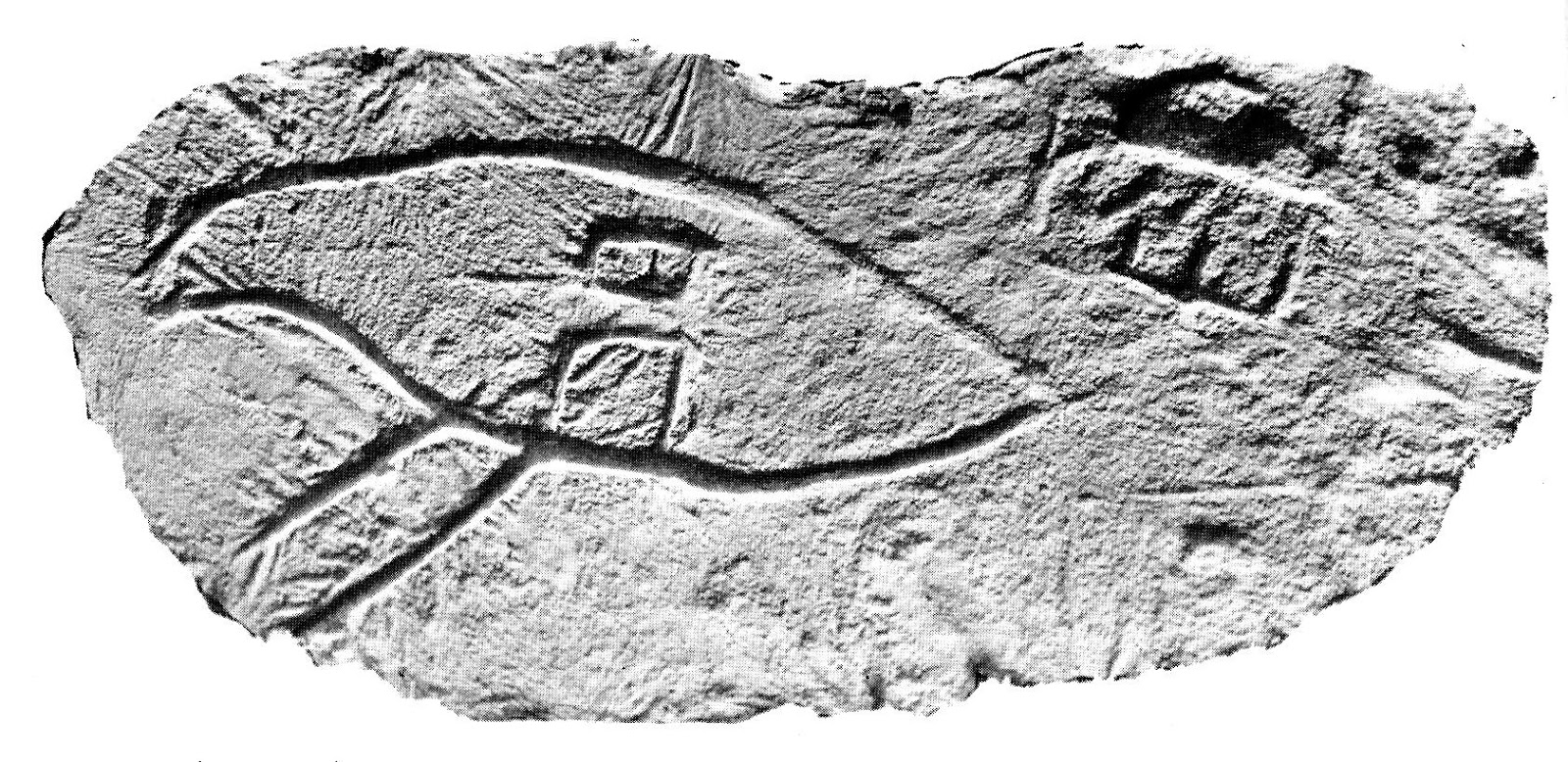
Petroglyphs at Petroglyph National Monument, Albuquerque, New Mexico. From Ruskamp, 2017.

Abstract symbols from two locations in the American Southwest have been supposedly translated and read as 2500 year old Chinese inscriptions. This, from a publication by the Early Sites Research Society, a group of fringies which advocates a large number of eccentric beliefs regarding human presence in the New World. I first became aware of the group back in the days of the Ogam controversy and Barry Fell in the early 1980s. Not only Ogam, but many other languages such as Phoenician and other North African and Mediterranean dialects are supposedly found in New World inscriptions according to these people. No wonder they can read ancient Chinese inscriptions in Arizona and New Mexico.

Now, readers of RockArtBlog may remember that I have, in fact, in the past expressed my openness to more prehistoric contact between the Old and New Worlds than just the Viking settlement at L’Anse aux Meadows. If we were talking about some sort of prehistoric Chinese evidence found along the Pacific Coast of America, I might suspend some of my skepticism, but here we are talking about prehistoric Chinese presence hundreds of miles from the coast through the Mojave desert. I just cannot go this far. I will, however, summarize the gist of the arguments and let you decide for yourself.

Highlighted petroglyphs at Petroglyph National Monument, Albuquerque, New Mexico. From Ruskamp, 2017.

“In the roadless Rinconada Canyon area of Albuquerque, NM’s, Petroglyph National Monument, high above a sandy trail frequented daily by hikers, joggers, and dog-walkers, is a set of very old petroglyphs, readable as ancient Chinese script. Here, in public view yet remaining unrecognized and miscategorized, are the ancient written Chinese symbols; xiàn ‘to offer sacrifice in worship to deceased ancestors’, quặn ‘dog’, dà ‘great’, jiẻ ‘to kneel down in reverence’, Dà Jiặ (the name of the third(or fourth) king of the Shang dynasty), and gệng (the seventh Chinese Heavenly Stem).” (Ruskamp 2017:1) Now all of the other rock art at Petroglyph National Monument is known to have been produced by the ancestral First Nations people of that region.

Arizona petroglyphs claimed to be an ancient Chinese Inscription. From Ruskamp, 2017.

“In the Upper Little Colorado River drainage of east-central Arizona, approximately 250 miles to the southwest of Albuquerque NM, there exist three ancient and uniquely subdivided petroglyph cartouches, each filled with readable combinations of what clearly appear to be ancient Chinese logograms. Instructively, these cartouches were numbered by their ancient author, for written beside them is the Chinese character yī, meaning ‘one’, and similarly inscribed beside the adjoining cartouche is the symbol yĭ, meaning ‘second’. Together, the equivalent positioning of these numeric designations, one beneath what is meant to be the bottom of each cartouche, provides a visual clue for the intended alignment as well as the reading order of these writings.” (Ruskamp 2017:5 &6) In this example we are talking about an area in which the Hopi claim a deep prehistoric connection. (Riggs 2022)

Hopi Nakwach symbol. From Ruskamp, 2017.
Ancient Chinese jiū symbol, From Ruskamp, 2017.

Obviously, Ruskamp is relying on what he sees as similarity of symbols in his interpretation of the petroglyphs. “More than once, the ancient author of the cartouches described above recorded his message with graphic images that were, and still are, understood in the same manner by both Native American and Asiatic populations. The first of these mutually symbolic figures portrays the interlocking fingers of two hands. Persisting into modern times, the Hopi people of Northern Arizona refer to this figure as Nakwach, their symbol for ‘brotherhood, friendship.’ Chinese calligraphers, both ancient and modern, use an identical figure, jiū, which for them represents the twisting of multiple items into one.” (Ruskamp 2017:11) I have written previously that one can easily go too far in relying on similarity of symbols to make connection. After all, there are only so many shapes available to the human mind. The fact that the Hopi nakwach symbol somewhat resembles the Ancient Chinese jiū is meaningless. There are tens of thousands of similar symbols in the rock art of cultures around the world.

Linked Native American rectilinear spirals. From Ruskamp, 2017.


Ancient Chinese huí symbol. From Ruskamp, 2017.

The same goes for Ruskamp’s second example, the rectilinear spiral. “A second prominent example of the parallel symbolism employed by North American and Asiatic authors, evident in the study cartouches, is their joint use of a rectilinear spiral to convey the concept of a ‘round trip journey.’ This symbol, which the Chinese pronounce huỉ, appears frequently in North American rock art, both as a single object and in repetitive patterns. Historically, the Hopi have used this symbol to portray the four complete migrations that their legendary god Massau instructed them to make, once to each of the four cardinal directions and finally to the ‘Center Place.’” (Ruskamp 2017:12) This symbol is found in rock art around the world and from all chronological periods. Ruskamp makes a point to discuss the resemblance of these symbols to Hopi symbols, of course they resemble Hopi symbols, they are Hopi symbols.

“Accordingly, what does seem certain is that the origin of the significantly repatinated and uniquely styled Asiatic script symbols identified in this report must be assigned to China, for ‘The Chinese script is obviously and original system of signs created to record an ancestral form of the Chinese language’ (Houston 2008:258). Never in the history of humanity has such a uniquely complex and readable set of characters been invented more than once.” (Ruskamp 2018:18)

“The comparative evidence presented in this report, which is supported by both analytical evaluation and expert opinion, documenting the presence of readable sequences of Archaic Chinese scripts located upon the rocks of North America, indicates the creation of these images prior to the extinction of memory of oracle-bone script. Therefore, in contrast to any previous historical uncertainty, we may conclude that trans-Pacific exchanges of epigraphic intellectual property took place between Chinese and North American populations approximately 2,500 years ago.” (Ruskamp 2018:18)

In evaluating Ruskamp’s thesis I am not just a skeptic, I am a non-believer, yet I hope that my evaluation has been fair. I do not even go so far as to say that there could not have been prehistoric trans-Pacific contact. There are a few interesting arguments for that to have actually happened. It is just that I do not see Archaic Chinese inscriptions in these examples. My reasoning relies on two main arguments. First, I would expect ancient Chinese inscriptions, if they exist in North America, to be fairly near the Pacific coast, not hundreds of miles across the Mojave Desert. And my second objection is the same one used for decades now in arguing against the epigraphic diffusionism of Barry Fell – the resemblance seen in the symbols is just a coincidence as they have been used by hundreds of cultures over thousands of years. They are the result of independent invention, not cultural diffusion, and certainly not the result of an Ancient Chinese expedition.

NOTE: Some images in this posting were retrieved from the internet with a search for public domain photographs. If any of these images are not intended to be public domain, I apologize, and will happily provide the picture credits if the owner will contact me with them. For further information on these reports you should read the original reports at the sites listed below.

Also, I have no idea why Blogger decided to make the text background for most of this column white, but, as I have said before, I am an Art Historian, not a techie.


PRIMARY REFERENCE:

Riggs, Sarah, 2022, Hopi Connections to the Little Colorado River, 5 January 2022, Grand Canyon Trust, https://www.grandcanyontrust.org/blog/hopi-connections-little-colorado-river, accessed 9 November 2022.

Ruskamp, John A., Jr., with a comment by Stephen C. Jett, 2015-2017, Two Ancient Rock Inscriptions Indicate and Archaic Chinese Presence in the American Southwest, from Pre-Columbiana: A Journal of Long-Distance Contacts, Volume 6, Numbers 2-4, Early Sites Research Society, Independence, Missouri.

SECONDARY REFERENCES:

Houston, Steven, ed., 2008, The First Writing: Script Inventions History and Process. New York: Cambridge University Press.

Wieger, Lèon, 1965, Chinese Characters: Their Origin, Etymology, History, Classification and Signification. A Thorough Study from Chinese Documents, 2nd ed. St. Paul, MN: Para[1]gon Book Reprint Corp.; Mineola, NY: Dover Publications (orig. pub. Hsien[1]Hsien, China: Catholic Mission Press, 1927).

Saturday, May 23, 2020

EPIGRAPHY - ARE THERE PROTO-SINAITIC INSCRIPTIONS IN COLORADO?

Petroglyphs across from Munsell
Site, Buffalo arroyo, Pueblo
County, Colorado.
Photograph Peter Faris, Oct. 1998.

It is called Diffusionism, the argument that travelers from the Old World visited the New World over and over in prehistoric periods. Various proponents make their cases for visits by Phoenicians, Celts, even the Chinese in the centuries before Columbus. We now know that Vikings actually did make it to North America so arguments about American runestones have received new fuel for their fires, but here I am going to visit the question of abstract symbol petroglyphs in Southeast Colorado and the clinging question of whether or not they were created by visiting Phoenicians.


Near Bear rock, panel 3,
Purgatoire Canyon, southeast
Colorado, Photograph Bill
McGlone, date unknown.

This question first gained a measure of prominence in the nonsense of Barry Fell and his so-called epigraphic translations. Given that as an origin, these Diffusionist theories were all too easy for archaeologists to discount and decry. There have, however, been some serious researchers who were at least willing to consider the possibilities. For southeast Colorado these researchers were Bill McGlone and Phillip Leonard who first became interested in some inscriptions that they thought might represent Celtic Ogam. Although their focus changed within a few years from Ogam to proto-Sinaitic inscriptions this investigation was forever tainted by the Ogam connection. Bill McGlone later admitted to me that he regretted that he had ever gotten involved with the Ogam controversy because of that fact, and his trouble getting actual experts in epigraphy to even pay attention.


Farrington Springs, southeast
Colorado. Photograph Bill McGlone,
Oct. 1988.  (trident is supposedly
dated to 1975±200 BP
by cation-ratio dating).

The basic problem came down to this - what evidence is there that these inscriptions can actually be in proto-Sinaitic? Opponents, with traditional archeological investigations in mind, say that there is absolutely no evidence at all, a total lack of corroborative evidence, while proponents say the inscriptions themselves are corroborative evidence. Now, I am in no way an epigrapher, linguist, or even an expert on the Middle East, so I have to look at the question another way entirely. In his 2018 "A Study of Southwestern Archaeology" Stephen Lekson raised the question of applying legal standards of evaluation to questions that provide problems for traditional scientific analysis. Lekson adapted an argument by Charles Weiss, a retired professor from Georgetown University, for use in this attempt, and since it was good enough for him it is certainly more than good enough for me. Weiss's scale from 1 to 10 ranges from 0% probability (impossible) to 100% probability (beyond any doubt), and uses courtroom terms like "probable cause", "preponderance of the evidence, and "beyond a reasonable doubt" to evaluate the likelihood of arguments. (I will not take the time and space to put in Weiss's whole table, for those who are interested I will refer you to his publication listed below in references)


Four-Mile Ditch site, southeast
Colorado. Photograph Bill
McGlone, Nov. 1990.

So in order to evaluate this I believe that it comes down to two basic questions; what is the likelihood that Phoenicians or other peoples from the Middle East actually were here to create the inscriptions, and if not proto-Sinaitic inscriptions what else could they reasonably be? I will address these in order.


Mustang site, southeast
Colorado. Photograph Bill
McGlone, August 1989.

The total straight line distance from the coast of Israel to southeastern Colorado is in the order of 6,700 miles. Of course, to sail that it would not be in a straight line so the actual figure has to be considerably higher. A Phoenician ship would have to leave the coast of Israel, sail through the Mediterranean and out the Pillars of Hercules, cross the Atlantic to locate the mouth of the Mississippi River. Then it's a simple 350 miles up the Mississippi to the Arkansas River and about 850 miles up the Arkansas River to southeast Colorado, and did I mention that much of the Arkansas is not really navigable?


Purgatory Canyon, south of the
bear, Bent County, Colorado.
Photograph Peter Faris, June 1991,
(trident symbol cation-ratio dated
1,975 plus or minus 200 BP.)


Chart of Proto-Sinaitic and
Early Phoenician characters.
http://www.ancientscripts
comprotosinaitic.html

Then there is the problem that these symbols were not created with metal tools which our hypothetical Phoenician travelers certainly had. Also, although some of the characters resemble some proto-Sinaitic letters, there are others that do not, so what about the poor matches, other symbols and wrong characters? This argument is usually explained away by attributing the inscriptions to some poor Phoenician crewman who is barely literate, if at all. However, if it was important enough to take this 8,000+ mile journey to leave the inscription in the first place why would not the captain of the ship or someone in charge who is fully literate be the one to write it, and why would he pound it in with a rock instead of their metal tools? This is then sometimes countered with the proposal that the inscriptions were actually made by Native Americans in imitation of real proto-Sinaitic writing, sort of a prehistoric North American cargo-cult argument. My only answer to this is to ask where is the real inscription that the Native Americans were attempting to copy or imitate? Nothing of that sort has ever been found. Using the legal argument evaluation I have to find that the preponderance of evidence is against these markings being proto-Sinaitic script "beyond reasonable doubt" (67% to 99% on Weiss's scales), and that the argument against this is substantially proven.

Near Bear Rock, Purgatoire
Canyon, southeast Colorado.
Photograph Bill McGlone,
photo undated.

So, if not proto-Sinaitic (or some other north African) script, what are they. My answer of choice is that most of them are probably random doodles. Some of them are undoubtedly simple symbols representing other things like a circle for a sun, etc. But why are they there lined up like inscriptions? I would answer that like attracts like. We have learned this from modern taggers as well as from the people who vandalize rock art sites. Why do they pick the rock art panel to vandalize, why not make their marks away from the rock art? If I make a mark in a location, someone else is likely to pick that spot for their own mark. The other point that I think applies here is that there are actually only a limited number of simple geometric symbols that you can make with curved and straight lines. Doodles us them, simple pictographs use them, abstract images use them, and written scripts use them. Of course they resemble writing, they are made up of the same curved and straight elements as written script, but they carry no written message. And, lined up like written inscriptions? Standing on the ground and facing the cliff there is a limited vertical space which is convenient for me to work in, in other words, my images would probably be generally arranged more horizontally than vertically. (Some of these inscriptions are too high on the cliff to be reached today without a ladder. I assume that this might be a sign of erosion of the valley bottom since their creation.)


Split Mesa panel, southeast
Colorado, Photograph Bill
McGlone, photograph undated.

Now using the same legal analogy for evaluating this I would say that the definition of these marks as doodles and abstract, instead of being written characters, has been proven to a standard of "reasonable belief" (again 67% to 99% on Weiss's scales) and that the likelihood that they represent a proto-Sinaitic script is thus between 1% and 33%. If these points were being argued in a court of law it would be found that they are not written inscriptions. Not scientifically proven, of course, but logically established nevertheless.

In closing I want to say that in spite of Barry Fell's inaccuracies and sloppy interpretations, some of the people who believe in the diffusion theory, who believe that these inscriptions are actual and real proto-Sinaitic writing, are educated and intelligent. As in all cases of attempted interpretation without actual physical evidence, in the end it falls to belief to define your answer. You either believe it or you don't, and I don't.

NOTE: For a current presentation of the diffusionist position on proto-Sinaitic inscriptions in Colorado you should read Carl Lehrburger's  writing listed below in references.

NOTE 2: Yes, the images have been colored in on the rock. Early epigraphy researchers in southeast Colorado seem to have used aluminum paint to make them more readable and photographable.

NOTE 3: Some images in this posting were retrieved from the internet with a search for public domain photographs. If any of these images are not intended to be public domain, I apologize, and will happily provide the picture credits if the owner will contact me with them. For further information on these reports you should read the original reports at the sites listed below.

REFERENCES:

Lehrburger, Carl
2015 Secrets of Ancient America: Archaeoastronomy and the Legacy of the Phoenicians, Celts, and Other Forgotten Explorers, Bear & Company, Rochester, VT.

Lekson, Stephen H.
2018 A Study of Southwestern Archaeology, University of Utah Press, Salt Lake City

Weiss, Charles
2003 Scientific Uncertainty and Science-Based Precaution, article in International Environmental Agreements, June 2003, DOI:10.1023/A:1024847807590

Saturday, May 20, 2017

ROCK ART STUDIES - AROUND THE EDGES (WARNING: THIS CONTAINS ACTUAL IDEAS, AND A FEW PICTURES):


Anubis Cave, NW Oklahoma,
On spring equinox,
March 20, 2015.

From the beginning, the study of North American rock art has attracted interest from unorthodox places. Indeed, when I started studying rock art in the late '70s the idea of studying rock art was itself unorthodox. Most archaeologists approached it as if it were somehow dangerous or unclean. One was not supposed to draw any conclusions from imagery because it could not be scientifically tested. As my background was Art History I had a different attitude - thank goodness. This interest (passion really) has afforded me some of the most wonderful opportunities and experiences in my life.


Phil Leonard in Crack Cave,
southeast Colorado,
March 20,2004.

Early on the fields of archaeology and astronomy were conflated into the study of archeoastronomy. These studies were magically granted legitimacy because there were things that could be measured, predicted, and tested. Also, early in the process of legitimizing rock art studies the field of epigraphy appropriated a certain bandwidth in the spectrum of rock art studies. Insinuating itself between pictorial rock art and historic inscriptions, epigraphy dealt with inscriptions that some people believed were written in historic scripts and languages, usually from Europe, Asia, or the Middle East. 


The Denver Post, Sunday, 
September 18, 2005.

As I live in Colorado, the epigraphic controversy mostly revolved around inscriptions supposedly written in ancient Celtic ogam (oggam, ogham - do not write me to correct my spelling, all have been used) although Phoenician and others have been identified as well. Many of these inscriptions were found to involve archaeoastronomy sites, and the site and the inscription were often presented as proof of each other's authenticity. I happen to know that some of the archaeoastronomy sites actually work as advertised, I have seen them do it. On the other hand I do not personally buy into the epigraphy theories of visitors from the Old World leaving inscriptions in the American West. I have, however, known many of the people on both sides of these arguments and consider them to be friends. I also have friends that I do not agree with on religious or political matters so that has not been a major problem for me. Indeed, I sometimes feel that these arguments bring a new perspective and passion to discussions that can get a little dry.


What I am leading up to with this is the work of Scott Monahan. Monahan is a videographer and documentarian who has been recording archaeoastronomic sites for over 30 years, and attempting to confirm some of the claims of epigraphers. To many of my friends that latter automatically disqualifies him from any serious consideration. But, think about this -  thirty some years ago a rock with runes on it from North America woulds have been laughed out of the building, now that we know of three possible Pre-Columbian viking settlements in North America what should the reaction be?  
In Scott's own words, "http://sacredequinox.com is my project's home page for promotion to the general public.  It features a widescreen slideshow of static shots from my documentary, captioned in lieu of narration, at the top of the page. Beneath the slideshow are links to 3 featured videos: a trailer, a teaser and a prequel. The prequel rebuts a widely-held misconception in the academic community that Ogham written horizontally on flat surfaces is illegitimate.  I filmed plenty of examples in Ireland matching the style found in our area in a 1980s video survey of the Emerald Isle.  Also, a video of University of Calgary's David H. Kelley's introduction to the Ogham alphabet and its genesis is linked, prominently, from my home page." (Scott Monahan)


Further, he continued with, "http://sacredequinox.com/library.html frames the controversy we, as members of the Western Epigraphic Society in the late 80s and early 90s, encountered in trying to interest archaeological and anthropological authorities.  This webpage provides specific context and supporting detail my documentary cannot due to the limitations of the medium and the need to keep a general audience's attention.  Therefore, your rockartblog audience is encouraged to examine, as well, a collection of 9 published and unpublished works I've assembled to provide "drill-down" context to the videos I've created." (Monahan)

Take a look, give him a fair evaluation, Scott is a serious researcher, with a different approach and belief set than mine, but that does not mean he doesn't have some good ideas. You might enjoy it. I always do.


Monahan, Scott


Sunday, January 19, 2014

WHERE BARRY FELL – PURGATORY CANYON, COLORADO:


Purgatory Canyon, south of the bear, Bent County,
CO., Photograph: Peter Faris, June 1991.

I had actually thought that I was probably through with Barry Fell but I ran into another couple of examples of Barry Fell’s inaccurate methods. This one can be found detailed in the interesting 1996 private publication by Phillip M. Leonard and William R. McGlone titled A Study of Script-Like Petroglyphs in Southeast Colorado, Mithras Inc., Kamas, Utah. This 70 page booklet outlined their multi-year studies comparing abstract figures or symbols found in southeast Colorado with old-world scripts, especially scripts from the Arabian Peninsula. In this posting I will present the case of one single row of figures found south of the famous bear panel in the Purgatory river canyon.


Leonard and McGlone, Fig. 8, p. 14.

The row of symbols in question is found high above the present ground level due to erosion of the valley bottom (described below). This portion of the cliff face is currently unreachable without a ladder or some other artificial aid. The arrangement of markings on this very interesting cliff can be likened to the stratification of a traditional archaeological excavation because the older markings are high up and were later unreachable. More recent petroglyphs are found lower down on the cliff with some examples of Plains Biographic Style images down just a few feet above the ground. Apparently some early devotee of epigraphic interpretation did go to the trouble to carry a long ladder in because the particular symbols in question have actually been painted in with aluminum paint to make them legible from the ground (personal observation).


Detail, dated trident symbol on right.
Leonard and McGlone, Fig. 8-A, p. 14.

One symbol from this line of characters was dated by Ronald Dorn using cation-ratio dating (this must have been done before the aluminum paint was added but I am not aware of the actual dates of either the testing or the painting). The trident-like character on the right side of subgroup-A dated to 1,975 years plus or minus 200 years BP (before present). (Dorn, McGlone, and Leonard 1990:23-36). It should be noted that Dorn subsequently withdrew the results of all of his dating work citing possible contamination of specimens. I maintained to him that this particular date, given the fact of the stratification on this cliff of rock art by age and height, presented additional evidence that this age may well be accurate.


Detail, dated trident symbol on right.
Photograph: Peter Faris, June 1991.

Leonard and McGlone described it as follows: 
“In the fall of 1981, we visited a well-known petroglyph site in southeast Colorado where there were hundreds of glyphs in an assortment of styles on the base of sandstone cliff faces 80 feet high. Some of the panels are 20 feet or more above the present ground level owing to progressive erosion of the valley floor as evidenced by mineral deposits on the cliff wall. Many of the glyphs are in the Pecked Abstract Style and are so old and heavily patinated they are difficult to see clearly even when the light is favorable. Others, in the Plains Biographic Style, appear to be much more recent, judging from their lack of patination and weathering.

One set of signs in a row (Figure 8A) was published as a “What is it?” in the December 1983 issue of Western Epigraphy with the hope that someone could explain its script-like appearance. Greg de la Castro of Conifer, Colorado, responded, saying he thought they were letters of the Sabaean alphabet. When Barry Fell was informed of this a few months later, he agreed. Although the sequence was short, both correspondents saw the presence of two different pitch-fork-shaped characters as pointing toward Sabaean.” (Leonard and McGlone 1996:13-15)

“On a later trip to the site, we saw that only a portion of the line of characters had been included in the original transcription. A search for Native American styles with similar long sequences of signs was unproductive. Study of the complete set (Figure 8B) and comparison to many alphabets world-wide convinced us that the glyphs corresponded more closely to North Arabian than South Arabian (Sabaean) letters - . When we advised Fell of this  and sent him a better photograph, he sent back a translation using the Safaitic (North Arabian) alphabet. The reading was published in McGlone and Leonard (1986) in order to establish priority of discovery and to stimulate comment." (McGlone and Leonard 1996:15)

This translation was accepted by McGlone and Leonard and published in 1986. It read: "Stayed here to trade, then departed after negotiating an augmented trade agreement - Fasih" (p.202) With the word "Fasih" supposedly representing the signature of either the trader, or the inscriber of the passage. McGlone and Leonard later returned to the site and the story is picked up again in their book from 1996.

"When we returned to the site and carefully recorded the full inscription, we found that the transcription developed by Fell from our photograph omitted two signs, improperly included some from a line below, employed natural rock inclusions as letters, and generally mis-applied the Arabic language in the translation. We asked him not to publish the faulty reading and proceeded to study the regional script-like signs ourselves. Our approach has been to collect groups of the signs and send them to knowledgeable specialists for evaluation and comment.” (McGlone and Leonard 1996:15) 

I have previously criticized Barry Fell for his unscientific method and basing his interpretations on improper evidence and falsified data. In this instance we have published testimony of his errors by two of his (at that time) collaborators. This conclusion is backed up by subsequent statements made to me by Bill McGlone on more than one occasion, that he could no longer abide by Fell’s work due to such errors (purposeful or otherwise) and that he regretted his previous association with Fell (private communication). I pointed out above that this row of symbols has been highlighted with aluminum paint. Bill McGlone always maintained that he and Phil Leonard had nothing to do with that and I have no reason to doubt his veracity. I do not know who applied the aluminum paint to the symbols but it was assuredly done by one of Fell’s collaborators (nobody else has really been interested in those particular symbols) so we can point that back at Barry Fell as well. 

The main thing here is that many of these characters are indeed like characters in Old World alphabets, I do not deny that. This does not mean, however, that this is anything more than a coincidence. I do not accept it as actual writing in any Old World script. McGlone and Leonard were interested in the apparent correspondence between many symbols in southeast Colorado and characters from Old World scripts, but their methods were scientific, and they seldom made claims that they could not substantiate. Fell on the other hand - - - ?

REFERENCES:

Dorn, Ronald I., William R. McGlone, and Phillip M. Leonard
1990    Age Determination of Petroglyphs in Southeast Colorado, Southwestern Lore, 56(2), 23-36, Colorado Archaeological Society, Denver.

Leonard, Phillip M., and William R. McGlone
1996    A Study of Script-Like Petroglyphs in Southeast Colorado, Mithras Inc., Kamas,               UT.

McGlone, William R., and Phillip M. Leonard
1986    Ancient Celtic America, Panorama West Books, Fresno, CA.

Saturday, December 7, 2013

A CHINESE INSCRIPTION IN BRITISH COLUMBIA:


Field sketch by James Burton. York, Daley, and Arnett,
They Write Their Dreams on the Rocks Forever, p. 66.

When confronted with the claims of the epigraphy enthusiasts in rock art studies one of the accusations that us epigraphy non-believers hurl at them is that they try to make every abstract shape into an old world inscription. Since the heyday of Barry Fell abstract symbols have been proclaimed to be inscriptions by ancient Basque, Semitic, Celtic, even Chinese, visitors to Pre-Columbian North America. I was therefore quite pleased to find this published example of an authentic Chinese inscription in British Columbia, with the backstory that explains it.

“Rock Writing at EbRj62, Annie Zetco York.
In addition to the aboriginal rock writings, this site is noteworthy for the presence of Chinese calligraphy and drawings made with black ink. These Chinese writings and drawings, some of which have been executed on top of the aboriginal writings, are probably the work of Chinese placer miners, who came to the Lytton area in 1859, a year after the start of the Fraser River gold rush. The Chinese are known to have worked the gravel terraces above this site and at least one man, Ah Chung, homesteaded nearby.
Most of the Chinese drawings and calligraphy (including the drawing of a human figure and what looks like a serpent) are located to the right of the recessed alcove with its aboriginal writings at the downstream edge of the site. In August, 1988, I visited this site with my brother-in-law James Burton who, after having lived and worked near Beijing for several years, is fluent in the Chinese language. He found many of the inked characters too eroded to decipher, particularly where sections of calligraphy had disappeared due to the spalling off of certain areas. However, he was able to determine that the Chinese writing recorded the names of men, presumably the gold prospectors themselves, and the names of women – probably their mothers, fiancées or wives back in China. The best preserved character, isolated from the other short texts, is the Chinese character for “clear/clean water” or “spring.”
Another group of characters, superimposed on the rock writings of Fig. 46, is a date which reads” In the tenth year of the ruling emperor.” Unfortunately the emperor’s name is obliterated, but it is possible to identify the approximate date of the Chinese characters by reference to the imperial genealogy.
The first Chinese arrived in 1859 which was the beginning of the tenth year of reign of Shen Fung. He was succeeded in 1861 by Tung Chi, who reigned until 1875 when he in turn was succeeded by Guang Xu. Guang Xu reigned until 1908 and was succeeded by a child, the last emperor who was deposed three years later during the social revolution. The descriptive date written here refers either to the tenth year (of the) reign of Shen Fung, being 1859-60, the tenth year (of the) reign of Tung Chi, 1871-72, or the tenth year of the reign of Guang Xu, 1885-86. The Chinese writing thus dates between 1859 and 1886.” (York 1993:65-66)

I have to give the epigraphers this one, and it appeals to my sense of justice and fair play that I can write a posting about an inscription that actually is in readable and interpretable Chinese.  路 要 走 (way to go) epigraphers.

REFERENCE:
York, Annie, Richard Daley, and Chris Arnett,
1993   They Write Their Dreams on the Rocks Forever, Rock Writings in the Stein River Valley of British Columbia, Talonbooks, Vancouver, B.C.

Saturday, September 14, 2013

WHERE BARRY FELL – CASTLE GARDEN, WYOMING:


Castle Gardens, Wyoming.

Continuing to kick poor old Barry Fell around, we now come to what I feel may be the most egregious example of falsification and fabrication in his whole repertoire. In central Wyoming a concentration of petroglyphs is found at Castle Gardens near the small town of Moneta. The Plains Indian petroglyphs here show a major concentration of shield images.


Castle Gardens, Wyoming.

Fell however, cannot let these marvelous images of Native American heraldry just be what they are. He has to warp them into a fantastic story of Celtic/Roman/Iberian travelers and traders who voyaged to Wyoming to open a branch of the First Iberian Bank of Moneta. I will be presenting this story mostly in his own words with comments thrown in as seems appropriate. Notice that the petroglyph panel showing the grouping of shields has a lot of plaster stuck on it from attempts to make molds of the images. I would not personally be surprised to find out that this was the result of Fell’s operations since we have already seen in so many examples that he works mostly from reproductions made from molds cast from the original rock art.

“Petroglyphs representing ancient coins extend the range to the ancient equivalent of the Oregon Trail, extending across the prairies to Moneta in Wyoming. The latter town appears to mark the site of the annual fur market in Roman times, lying near the North Pass in the Great Divide, and thus as convenient for ancient trappers as the nineteenth-century Wyoming markets were for trappers and buyers of the Astor company. The route also gave access to Nevada and California silver.“ (Fell 1980:35)

“There is one more site: the great pictograph and petroglyph location called Castle Gardens, near the town of Moneta, in central Wyoming. Dr. Don Rickey, chief historian of the Bureau of Land Management, Department of the Interior, was one of my first visitors a few days after America B.C. was published at the end of 1976. He had been struck by many features of the book that appeared to throw possible light on problems of American epigraphy and early history.  -  He began by referring to me various reports in the files of the Bureau of Land Management dealing with unexplained petroglyphs. One of the reports dealt with the Wyoming site mentioned above – the finest petroglyph location in Wyoming, remarkable for the almost universal circular form of all the designs depicted on a series of rock faces that dominate the site.
            Some of the designs I recognized at sight as well-known Celtic patterns, used on disc-shaped bronze harness trappings of Celtic kings in Europe, and also occurring in the Spiro Mound in Oklahoma, together with other evidences of Celtic designs. But the great majority of circular patterns cut into the cliffs at Castle Gardens were not familiar to me when I first saw them. They seemed so dissimilar to Indian shield patterns that it was hard to relate them to these either.” (Fell 1980:134-5) 

“The final solution to the Castle Gardens mystery came like this:
            After the match between the Byzantine bronze-coin series and the supposed “Indian shield” series of Colorado petroglyphs was discovered, I remembered the mysterious suite of circular “shield” patterns from the Wyoming site, and once more got out Dr. Rickey’s report -. This time I did indeed begin to recognize, one by one, designs that resembled ancient coins I had once seen.”(Fell 1980:140)

"Italian chariot wheel coin design and supposed imitation
at Castle Gardens. Barry Fell, Saga America, p.152.

“Bewilderment was the Wyoming artist’s reaction to certain themes featured on the Romano-Iberian coinage. In B, the crab of the Roman model A, unknown in mid-continent is rendered as an obese person executing a handstand. In D, a half-chariot becomes a mysterious sun god; for where no horses exist, there can be no wheeled vehicles. In F, the Old World cock of an Italian bronze piece becomes a turkey, experiencing great difficulty in fitting its ample proportions into the confines of a circular flan. In H an Italian chariot wheel becomes a cross-pattee. All designs on the right side are petroglyphs from the Moneta site of the Wyoming Iberian bank. Those on the left side are drawn from Roman Republican and Campanian coins; Iberian examples are commonly bisected to yield lesser denominations, or “bits,” as shown at C.” (Fell 1980:152)

I believe that the image of the supposed imitation "Italian chariot wheel coin" corresponds to the shield figure found in the illustrations below. According to James Keyser this image is not even from Castle Gardens, Wyoming. He identified it as being found near Sheriden, Wyoming. Although a little hard to make out in the actual photo you can identify the form of the shield easily in the drawing that I made from an illustration in James Keyser and Keyser and Michael A. Klassen's 2001 book, Plains Indian Rock Art.


Shield figures, Wyoming. The shield of
the figure on the right corresponds to Fell's "H" above.


Comparing Fell’s coin with a cross-pattee to the original rock art photo exposes just how egregious the falsehood and deception is. The original is a shield figure (on the right of the grouping above) and Fell omitted the legs, head, spear, and many details of the shield itself including the fringe of feathers around it (not to mention the whole of the rest of the group of figures), to make it fit his strange idea of it representing a coin from the First Iberian Bank of Moneta, Wyoming.
Shield figure panel, drawn by 
Peter Faris after Keyser and Klassen, p. 197.

But Fell goes further, he not only has identified all the circular shields at Castle Gardens (and throughout the rest of western North America) as coins, he has also discovered the sign of the bank that handled those coins, a supposed inscription in Iberian-Greek. 


Castle Gardens translation, Barry Fell,
Saga America, 1980, p. 149.

“The business sign or tile engraved at the Wyoming site near Moneta. On the left the Iberic letters spell the old Gaelic word for moneychanger, or, in modern parlance bank. On the right, the word intended apparently is Old Gaelic for no interest – or perhaps, rather, no usury (i.e., not more than 12-1/2%). In the center Greek letters phi, alpha, theta, and eta form a rebus in which a moneybag discharges coins onto a dish. The word spelled means “[it was] the first to come here,” resembling the modern use of the word “First” in bank names.” (Fell 1980:149) In other words Fell is stating that this is the sign that identifies the First Iberian Bank of Moneta (the underline is mine).

Maybe Barry Fell for this, but we don’t have to.

REFERENCES:

Fell, Barry
1980    Saga America, Times Books, New York.

Keyser, James D. and Michael A. Klassen
2001    Plains Indian Rock Art, University of Washington Press, Seattle.

Saturday, August 3, 2013

WHERE BARRY FELL – PICTURE CANYON:


Picture Canyon, Baca County, Colorado. 
Photograph: Peter Faris, 21 Sept., 1986.

Back in the 1970s there was considerable public interest in the diffusionist theories of Barry Fell. Fell believed that many rock art inscriptions and images had been produced by pre-Columbian travelers from the Old World.

“Barry Fell (born Howard Barraclough Fell)( June 6, 1917 - April 21, 1994) was a professor of invertebrate zoology at the Harvard Museum of Comparative Zoology. While his primary professional research included starfish and sea urchins, Fell is also known for his controversial work in New World epigraphy, arguing that various inscriptions in the Americas are best explained by extensive pre-Columbian contact with Old World civilizations.” Wikipedia.

In my early years as a rock art researcher I felt I should read all sides of an argument in order to be able to fairly judge it for myself so I undertook the task of reading some of the writings of Barry Fell. As an aside here I should add that I do believe that there was pre-Columbian contact between the Old and New Worlds. We have physical proof of Viking presence at l’anse aux meadows in Newfoundland dating to around AD 1000. Additionally, I have posted about the hundreds of botanical and zoological indications outlined and explained in the book World Trade and Biological Exchanges Before 1492, by Carl L. Johannessen and John L. Sorenson, (2004). I have no trouble accepting limited contact, and even exchange, between peoples of the Old and New Worlds before Columbus. I just cannot accept the claims of diffusionists that so many of the cultural traits of New World peoples came from the dozens or hundreds of expeditions of Celts, Egyptians, Phoenicians, and everyone else they can think of roaming back and forth across North America leaving carved images and inscriptions.

Picture Canyon, Baca County, Colorado. 
Photograph: Peter Faris, 21 Sept., 1986.

As I said above I tried to read enough of Barry Fells’ writings to understand his premise and be able to give a fair evaluation to his claims. I read much of his writing and I have to confess that it would be really exciting to just open up to his conclusions. If I had just gone with it I could have been in on so many of the exciting discoveries that Barry Fell and his disciples claimed. Unfortunately, I found myself constrained by judgment and truth, and just could not adopt his conclusions. Part of the problem was the fact that I could visit some of the sites he translated and see for myself.

Cast by Gloria Farley, in America B.C., 
Barry Fell, Demeter Press, 1976, p.182.

In 1986 I spent some time in Picture Canyon, in Baca County, southeastern Colorado. There I visited the petroglyph that Barry Fell had translated, and explained as follows, based upon a casting from a mold made by Gloria Farley: “Chief Ras left this bilingual autograph to record his exploration of the Cimarron River in Oklahoma, probably around 500 B.C. Gloria Farley obtained this latex impression under a rock overhand on the river cliffs. Above right the Egyptian hieratic letters T-P (Chief). The eye symbol itself is the Egyptian hieratic word R-S (“Watchful”). The two Libyan letters cut into the eye sign, also spell R-S. Bilingual Egypto-Libyan inscriptions in North America probably reflect the lasting influence of the Libyan pharaohs upon the Egyptian navy. In later centuries when the Greek Ptolemies ruled Egypt, their Libyan queens continued to promote the interest of the navy, still manned largely by Libyan mariners. Malcolm D. Pearson” (Fell 1976:182)

First, the image is not on the cliffs of the Cimarron River, this symbol is actually in Picture Canyon, in Baca County, Colorado, and it is found a number of miles from the Cimarron River cliffs in New Mexico. Second, the actual image is somewhat different than the supposed casting which one would expect to be an exact replica of the original. Notice that the right end of the image is flattened, not sharply pointed as in the “casting”, also, please note that the actual shapes of Fells’  “two Libyan letters cut into the eye sign”, which ”also spell R-S” are not the same in the photograph as on the “impression”. There are also a number of other markings on the panel, including a group of pits within the right side of the “eye” that do not appear to be on Gloria’s “impression” at all.

Additionally, the lines of the “eye” and the “Libyan letters” in the casting are much sharper edged than the lines of the original, all of which suggests to me that the so-called “impression” has been worked over with tools to achieve the end they desired. Finally, we can see that the background surface of the “impression” that was supposedly made with latex directly from the surface of the rock does not match the actual background surface of the rock face itself. In any scientific context that I know of that is called falsification of data and is considered to be a fraudulent practice at the very least. So, back in the beginning – this is where Barry Fell. I will continue this exploration in the future.

Note: I wish I could claim to be clever enough to have originated the title “Where Barry Fell” for myself, but I cannot. This title came from a slide program debunking some of Fells' claims that was assembled by Bill McGlone back in the early 1990s, in cooperation with Phil Leonard.

REFERENCES:

Fell, Barry
1976    America B.C., Demeter Press, New York.