

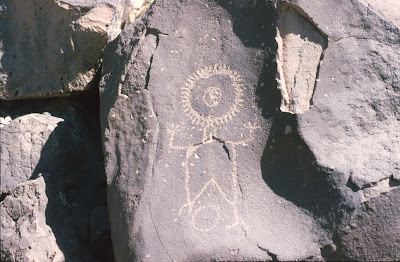
For many years I have been interested in portrayals of natural phenomena in rock art, particularly atmospheric and meteorological phenomena. On 30 September 2009, I published a column titled “Headdress or Halo? – Heiligenshein In Rock Art” (Faris 2009) in which I speculated about the possibility of the phenomenon known as Heiligenshein (or Holy Light) being the inspiration for some rock art anthropomorphs with arcs or halos around their heads. A related phenomenon, the Brocken Spectre, might also be the inspiration for such portrayals. Ineed, the Brocken Spectre, when viewed, is often accompanied by heiligenschein.

“Brockengespenst, also called
Brocken bow, mountain spectre, or spectre of the Brocken is the magnified (and
apparently enourmous) shadow of an observer cast in mid air upon any type of
cloud opposite a strong light source. Additionally if the cloud consists of
water droplets backscattered a bright area called heiligenschein and halo-like
rings of rainbow coloured light called a glory can be seen around the head of
aperture silhouette of the spectre. Typically the spectre appears in sunlight
opposite to the Sun’s direction at the antisolar point.” (Wikipedia)

“The phenomenon can appear on any
misty mountainside, cloud bank, or from an aeroplane, but the frequent fogs and
low-altitude accessibility of the Brocken, a peak in the Harz Mountains in
Germany, have created a local legend from which the phenomenon draws its name.
The Brocken spectre was observed and described by Johann Silberschlag in 1780,
and has since been recorded often in literature about the region.” (Wikipedia) Although it may be
relatively common in the Harz Mountains, the meteorological conditions to
produce this would be rare in most regions, and the less common the occurrence
the more remarkable it would seem when it does occur. I submit, this is exactly
the kind of experience that a person would wish to record on the rock.


“The ‘spectre’ appears when the sun
shines from behind the observer, who is looking down from a ridge or peak into
mist or fog. The light projects their shadow through the mist, often in a
triangular shape due to perspective. The apparent magnification of size of the
shadow is an optical illusion that occurs when the observer judges their shadow
on relatively nearby clouds to be at the same distance as faraway land objects
seen through gaps in the clouds, or when there are no reference points by which
to judge its size. The shadow also falls on water droplets of varying distances
from the eye, confusing depth perception. The ghost can appear to move
(sometimes suddenly) because of the movement of the cloud layer and variations
in density within the cloud.”
(Wikipedia)

Alex
Patterson in his Field Guide to Rock Art Symbols of the Greater Southwest
(1992), illustrated a group of Barrier Canyon Style figures in Utah under a
curved line that he identified as a rainbow (p. 166). I suggest that this may
be inaccurate for a couple of reasons. First, the rainbow is seen on the far
horizon. I cannot imagine a situation in which it would be seen in this close
proximity to a person. And second, the rainbow is a circular arc, it would
never be seen molding its contour to a group of figures in the manner
illustrated. Remembering that the Brocken Spectre is accompanied by
heiligenschein, I suggest, rather, that this might be a record of a small group
of people who experienced the Brocken Spectre phenomena together.
Obviously I cannot prove that any of these examples were actually inspired by the phenomenon known as the "Brocken Spectre." So this is an exercise in surmise, the presentation of possibilities instead of known truths. Yet I wish to point out that, as I and many other researchers have stated before, it is likely that some rock art was created to record a remarkable or out of the ordinary experience, and viewing this phenomenon would certainly qualify as that.
NOTE: Some images in this posting were retrieved from the internet with a search for public domain photographs. If any of these images are not intended to be public domain, I apologize, and will happily provide the picture credits if the owner will contact me with them.
REFERENCES:
Faris, Peter, 2009, Headdress or Halo? – Heiligenshein In Rock Art, 30 September 2009,
https://rockartblog.blogspot.com/search/label/heiligenschein
Patterson, Alex, 1992, A Field Guide To Rock Art Symbols Of The Greater Southwest, Johnson
Books, Boulder, Colorado
Wikipedia, Brocken Spectre, https://en.wikipedia.org/wiki/Brocken_spectre,
accessed on 4 October 2022.


 , 1980, Cambridge University Press, London, New York. Illustrated with many photos and with explanations of the optics behind them, it may have insights into some rock art imagery otherwise unexplained.

 Posts
Posts

