Bird Rattle's petroglyph record of his 1924
visit to Writing-On-Stone. Photograph
Peter Faris, 25 June 2016.
It is a
verity in our branch of Art History study that we rarely get to know who
created the art we study. In my March 3, 2018, posting I presented rock art (of
a sort) that had been created by Sir Isaac Newton. Now, in this posting, I am
visiting the author of a historic panel found in Writing-On-Stone, in Canada.
Close-up of the car on the right,
next to large "V"-necked figure
(the figure was not created
by Bird Rattle, it was already there).
Photograph Peter Faris, 25 June 2016.
This car contains 4 passengers.
A couple of
years ago I finally had the pleasure of visiting the famous rock art site of
Writing-On-Stone provincial park, in Alberta, Canada. There, along the cliffs
on the north side of the Milk River valley, a whole lot of world-class rock art
can be seen.
Close-up of the car on the left.
Bird Rattle's petroglyph record of his 1924
visit to Writing-On-Stone. Photograph
Peter Faris, 25 June 2016.
This car contains 2 passengers.
Among many
images in the Plains Biographic tradition to be found at Writing-On-Stone, one
panel shows a pair of automobiles with passengers clearly seen within. While
unmistakably of historic origin, the actual details of its creation were
debated until a photograph turned up which shows the creation of the images by
a Piegan elder named Bird Rattle in 1924.
Bird Rattle carving his petroglyph,1924,
Writing-on-Stone Provincial Park,
Alberta, Canada. Public Domain.
"Taken by Roland Willcomb, the
photograph clearly shows the South Piegan elder Bird Rattle carving a
petroglyph - one of two very similar, detailed automobiles - on a panel at the
main site in what is now Writing-On-Stone Provincial Park. The origin of these
automobile images has long been a source of debate. Several early researchers
assumed the vehicles were recent Euro-American images, while one of us in more
recent research had identified certain stylistic elements which suggested a
possible aboriginal source. The photograph conclusively ends the question as to
the origin of the automobile petroglyphs, but more importantly, its discovery
led the authors to additional photographs, correspondence, and documents
pertaining to Bird Rattle's and Willcomb's association with
Writing-on-Stone."
(Klassen et al 2000:189)
Bird Rattle, ca. 1910, Photograph
Edward S. Curtis. Public Domain.
"Born about 1863 near
Writing-On-Stone (Willcomb 1968a:3), Bird Rattle grew up during the last of the
buffalo days on the Northern Plains. He was intimately familiar with
Writing-On-Stone. As a boy in 1866, he and his famil were camped near the
locale at the time of the Retreats-Up-The-Hill battle - one of the last major
conflicts involving the Blackfoot Nation. Bird Rattle's name has long been
association with both Retreats-Up-The-Hill and Writing-On-Stone, as his version
of this battle directly links the rock art with this famous conflict. (Dempsey
1973) After the buffalo were gone, Bird Rattle settled in a cabin on Cut Bank
Creek, just north of Browning on the Blackfeet Reservation of Montana. By the
1920s, Bird Rattle was a prominent Piegan elder and the owner of a sacred
Beaver Bundle. (Willcomb 1970a:44)." (Klassen et al 2000:191)
Roland H.
Willcomb was born in Massachusetts and educated in engineering. He had first
come to Montana in 1908 (Willcomb 1970a). Willcomb worked around the American
West until 1923 when he returned to Montana to work for the Montana Highway
Commission. Between 1923 and 1925, he was the Project Engineer overseeing
construction of roads across the Blackfeet Reservation. Willcomb met Blackfeet
elders including Bird Rattle in Browning, Montana, and "a close friendship developed between Bird Rattle and Willcomb
which continued until Bird Rattle's death on October 31, 1937 (Willcomb 1979a)."
(Klassen et al 2000:191-2)
"Within a year of their
meeting, Willcomb had arranged to take Bird Rattle on a visit to
Writing-On-Stone. Apparently, Willcomb had been told stories of this
"place of mystery, 'where ghosts live'" (Willcomb 1968a:1) and he
wished to experience it himself. Their journey to Writing-On-Stone was
documented by Willcomb with a series of photographs, and he later recorded a
narrative of the journey (Willcomb 1968a), apparently based on his original
notes and letters."
(Klassen et al 2000:191-2)
”On the morning of September 13,
1924, Willcomb and Bird Rattle, accompanied by a second Piegan elder, Split
Ears, and Jack Wagner who acted as an interpreter, left Browning in Willcomb's
car. The party drove north to the Canadian border. There they were joined by
two of Willcomb's friends from Great Falls, John Stevenson and I. O. Deshon,
who arrived in a second car. From the border the two cards proceeded to
Writing-On-Stone, where the party set up camp near the cliffs. After briefly
inspecting the rock art on the cliffs, the party gathered around the campfire
where Bird Rattle and Split Ears described the rock art as messages from the
spirit world which could be read by Medicine Men (Willcomb 1968a:13). These
messages, which frequently changed overnight, warned of enemies in the area,
told them the location of buffalo herds or strayed horses, and foretold future
events. One of the stories told by Bird Rattle that evening was that of the
Retreats-Up-The-Hill battle, which Willcomb transcribed in great detail in his
later narrative. (Willcomb 1968a; Dempsey 1973)." (Klassen et al, 2000:193)
It was
during this visit that Bird Rattle decided to add a record of his trip to the
Biographic rock art at Writing-On-Stone. "According to Willcomb, at one
point during the day, "Bird Rattle
decided that he should record our trip. He selected a bare rock face some
distance from any of the ancient 'writings.' He tried his best with a hard
piece of quartz, but was barely able to scratch the surface of the
sandstone" (Willcomb 1968a:17). Bird rattle, in fact, selected a face
already containing rock art, and despite Willcomb's assertion to the contrary,
he was quite successful in carving his record of the trip, judging from the
resulting petroglyphs." (Klassen et al 2000:194)
"By recording this significant
event as rock art, Bird Rattle demonstrated the relationship between narrative
expression and the spirit powers of a sacred place. Bird Rattle's petroglyphs, and
Willcomb's narrative of this trip (together with the anonymous 1932 narrative),
provide new insights into the aboriginal significance of Writing-On-Stone, and
the meaning of its rock art."
(Klassen et
al 2000:195)
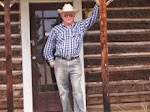
(I wonder whether Bird Rattle actually wore his feather headdress as he created his images, or whether the photo was posed later.)
For
students of this art form which is all too often presented to us anonymously on
the surface of the cliff, cave, or boulder, and incident like this where we
have factual knowledge of the time and place, as well as the thoughts of the
creator, can be of inestimable value in looking for meaning.
I am
personally very grateful to Klassen, Keyser, and Loendorf for their work in
winkling out the facts of this story, and then bringing it to us.
NOTE:
The images of Bird Rattle in this posting were retrieved from the internet with
a search for public domain photographs. If any of these images are not intended
to be public domain, I apologize, and will happily provide the picture credits
if the owner will contact me with them. For further information on these
reports you should read the originals at the sites listed below.
REFERENCES:
Dempsey,
Hugh A.,
1973 A History of Writing-On-Stone, Unpublished
manuscript on file with the Provincial Museum of Alberta, Edmonton, Alberta.
Klassen, Michael A., James D Keyser & Lawrence L.
Loendorf,
2000 Bird Rattle’s
Petroglyphs at Writing-On-Stone:Continuity in the Biographic Rock Art
Tradition, Plains Anthropologist,
45:172, 189-201.
Willcomb, Roland H.
1968a Ah-sin-efp:
Writing-On-Stone, Manuscript on file at
the Montana Historical Society Archives, Helena.
1970a Bird
Rattle and the Medicine Prayer, Montana
Magazine of Western History 20:42-49.



 Posts

