Showing posts with label earliest art.. Show all posts

Saturday, July 1, 2023

MIGHT THIS ACTUALLY BE HOMO NALEDI ROCK ART?

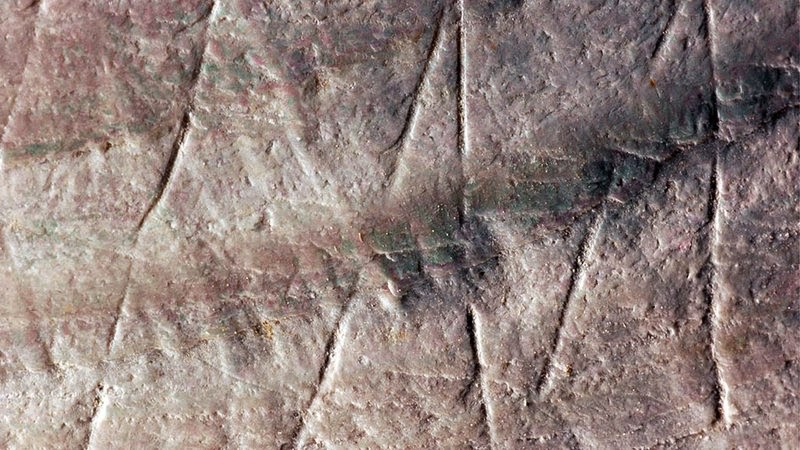
Possible Homo naledi rock art panel. Rising Star Cave, Cradle of Humankind, South Africa. Image by ABC News.

Pretty much anyone who is interested in archaeology has heard of the 2015 discovery of the new hominin species Homo naledi by Lee Berger. I am not going to take in the time and space here to go through the whole story of their discovery. For the few of you who do not know about Homo naledi there is a wealth of information online, or in my references below.

“Some 25 miles outside of Johannesburg, South Africa, there is a famous paleoanthropological site known as the Cradle of Humankind. So many hominin bones were found in the region that it was designated a UNESCO World Heritage site in 1999. Among the many limestone caves in the region is the Rising Star cave, where cavers discovered fossils representing a new hominin speciies, Homo naledi, in 2015. Only H. naledi remains were found in the cave, suggesting the possibility that the bodies had been placed there deliberately, although this hypothesis proved to be a bit controversial.” (Oullette 2023) The whole point of this is that H. naledi had a brain one-third the size of a human brain. It was roughly the size of a chimpanzee brain which suggests that  behavior such as deliberately placing the body of a deceased member in a chamber of the cave was unexpected to say the least.

Close-up of Panel A, possible Homo naledi rock art panel. Rising Star Cave, Cradle of Humankind, South Africa. Image by ABC News.

“Now the same expedition team has announced the discovery of H. naledi bodies deposited in fetal positions, indication intentional burials. This predates the earliest known burials by Homo sapiens by at least 100,000 years, suggesting that brain size might not be the definitive factor behind such complex behavior. The team also found crosshatched symbols engraved on the walls of the cave that could date as far back as 241,000 – 335,000 years, although testing is still ongoing.” (Oullette 2035) Now this is even more perplexing, this creature was scooping out a rough depression in the soil in the cave and placing the body in a fetal position. This is not just depositing the body in a cave, this suggests some sort of ceremonial or ritual behavior. And now, add to that the fact that purposely produced markings were made on the cave walls by this being at that early date and we have a remarkable discovery.

“We are facing a remarkable discovery here’ for a species with brains one-third the size of humans, said anthropologist Lee Berger, who led the research funded by the National Geographic Society, where he now works. Berger and colleagues describe their findings in studies posted online Monday. The research has not been peer-reviewed yet and some outside scientists think more evidence is needed to challenge what we know about how humans evolved their complex thinking.” (Burakoff 2035) Apparently that capacity existed in our evolutionary line far earlier than we realized.

“The interments predate the earliest known Homo sapiens burials by at least 100,000 years, making the Rising Star burials some of the most ancient in the hominin record and indicating that burials might not have been limited to H. sapiens or other hominins with larger brain sizes.” (National Geographic Blog 2023) The fact that some of the bodies were placed in a fetal position in a scooped out depression suggests ritual or ceremonial treatment.

“The oldest known H. sapiens grave dates to about 78,300 years ago in Africa. Contested Neandertal graves in Iraqi Kurdistan are roughly 70,000 to 60,000 years old. In South Africa’s Blombos Cave, a crosshatched design on a rock dates to around 73,000 years ago and geometric patterns incised on pigment pieces date to as early as about 100,000 years ago.” (Bower 2023)


Another possible Homo naledi rock art panel. Rising Star Cave, Cradle of Humankind, South Africa. Image by Nat. Geo.

Now, as to the rock art, the cross-hatching patterns are not in and of themselves very interesting, but, the fact that they may have been created by hominins 300,000 years ago certainly is. And, in the one view there are what appear to be some pretty interesting geometrics on the left side.

“There’s still a lot to uncover,’ said Rick Potts, director of the Smithsonian’s Human Origins Program who was not involved in the research. H. naledi is a pretty new addition to the family tree of hominins, which includes our direct ancestors and other extinct relatives who walked on two legs. Berger and his team announced the species in 2015, after a tip from local spelunkers led them to the Rising Star cave system near Johannesburg where they discovered fossils from at least 15 individuals who lived around 300,000 years ago. These creatures had some traits in common with modern humans, like legs made for walking upright and hands that could work with objects, said University of Wisconsin-Madison anthropologist John Hawks, a member of the research team. But other features looked more ancient, including their small brains.” (Burakoff 2035)


We know that chimpanzees (Pan troglodytes) and bonobos (Pan paniscus) are aware of death, and even seem to grieve for lost friends and family members, but as far as we know they would not be capable of the sort of ritual behavior that H. naledi has expressed in their treatment of their dead, as well as their marking the cave wall. As far as I know there have never been any reports of chimps or bonobos creating rock art. Can it be possible that there is a difference in the cognitive processes between the Hominid line and the Pan line that existed that far back in our prehistory. Do these markings in some way refer to their dead friends and relatives whom they ritually interred nearby? Is this, perhaps, the difference that would have once been referred to as our soul?

NOTE: Some images in this posting were retrieved from the internet with a search for public domain photographs. If any of these images are not intended to be public domain, I apologize, and will happily provide the picture credits if the owner will contact me with them. For further information on these reports you should read the original reports at the sites listed below.

REFERENCES:

Bower, Bruce, 2023, Homo naledi were burying their dead at least 100,000 years before humans, https://www.sciencenews.org. Accessed online 5 June 2023.

Burakoff, Maddie, 2023, Small-brained ancient human cousins may have buried their dead, according to a surprising study, 5 June 2023, https://news.yahoo.com. Accessed online 5 June 2023.

National Geographic Blog, 2023, New Evidence Suggests Intentional Burials and Use of Symbols by Other Hominins Hundreds of Thousands of Years Before Homo Sapiens, 5 June 2023, https://blog.nationalgeographic.org. Accessed online 5 June 2023.

Ouellette, Jennifer, 2023, Homo naledi were burying their dead at least 100,000 years before humans, 5 June 2023, https://arstechnica.com. Accessed online 5 June 2023.


Saturday, April 18, 2015

THE HOLLY OAK PENDANT - PALEOLITHIC ART, OR HOAX?


Negative image of the Holly Oak Pendant from the cover
of Science Magazine, 21 May, 1976. Note, the mammoth
image has been picked out from background details.
It is easy to see the lack of feet.

In this column I have periodically presented examples of what have been claimed to be very early examples of art in North America. These examples have included some rock art, but also other images in different media. So far, I fear, the extant examples have all proven to be hoaxes.

The Holly Oak Pendant is a fraudulent artifact created as a shell gorget bearing the image of a mammoth on the converse side. It was originally presented in 1889 as an authentic Paleolithic artifact from North America, given the image of the mammoth engraved on it.

 
 An engraving of the mammoth carving from La Madelaine,
France. Note this image is missing its feet.

Late in 1863, Edouard Lartet, the paleontologist, with Henry Christy, his friend and benefactor, had turned a few shovels of earth in the rock shelter of La Madeleine by the side of the Vezere River in France. They found remains of stone, bone and ivory tools so they returned in the Spring of 1864. That May, Lartet’s dig crew recovered five fragments of an ivory plate. When reassembled they displayed a wonderful engraved mammoth with almost all of the details of its appearance clearly defined. All this engraving lacked was the feet, which may have been on an un-recovered piece of the plaque or may have never existed because of lack of space on the surface.


Illustration of the Holly Oak pendant

In 1889, an archaeological assistant at Harvard's Peabody Museum named Hillborne T. Cresson, announced that he had discovered a prehistoric seashell pendant/gorget that bore the engraving of a woolly mammoth on one surface. He stated that he had discovered it near Holly Oak railroad station, in northern Delaware, in a layer of peat in the forest. This find was suspected of being fake by some establishment figures. One reason for suspicion was the unusual circumstance of its discovery. Cresson claimed he had discovered it in 1864, when he was a teenager, in the company of his music teacher, Mr. Saurault. He offered no explanation for why he had waited twenty-five years to share the discovery, even though its significance should have been obvious to him — especially since his music teacher was himself a student of archaeology. (http://www.museumofhoaxes.com/hoax/archive/permalink/holly_oak_pendant)
 
“The Holly Oak Pendant was accepted as authentic by many when it was discovered in the middle of the nineteenth century. The pendant, found in Delaware, appeared to be an incised drawing on shell of a prehistoric woolly mammoth. It reminded many of the Paleolithic cave paintings and carvings of the Europe of 20,000 years ago, convincing some of the existence of a similar – and similarly ancient – artistic tradition in North America.
The Holly Oak Pendant, if genuine, should have dated to more than 10,000 years ago, since that is about the time that woolly mammoths became extinct – obviously, people would not have been drawing mammoths long after they had disappeared. In fact, the shell turned out to be only about 1,000 years old. The artifact was a fake, though cleverly carved on an old piece of shell. “(Feder 2010:139)
 
 
Mammoth carving on mammoth ivory,
La Madelaine, France. Note in this ink
drawing the mammoth's feet are missing.

The 1864 Holly Oak Pendant/Gorget bears a very similar engraved mammoth to the one portrayed on the ivory plaque from La Madeleine – even down to the missing feet. That is the first detail that gave rise to suspicion that the image was fraudulent. The mammoth on the Holly Oak Pendant/Gorget had been copied from a published image of the ivory plaque from La Madeleine and the feet could not be included, even though there was sufficient room on the shell, because the forger did not know what they should have looked like.

“Thus something is terribly wrong with the context Cresson provided or created. Occam’s Razor slices right through this one – the Holly Oak Gorget, with its wonderful wooly mammoth, is not a genuine prehistoric artifact of any significant age. Indeed, the shell gorget itself, with no engraving on it, may well be from the very late Fort Ancient culture of Ohio. Cresson dug on one such site, and he was fired for stealing artifacts in Ohio. A radiocarbon date recently run on the shell gorget dates it to less than a thousand years ago. Even (Barry) Fell’s Epigraphic Society Occasional Publication volume branded it a fake based on the carbon 14 finding!” (Williams 1991:127)
This strongly suggests that the shell gorget in question was one of the artifacts stolen by Cresson, with the mammoth image later added to manufacture the evidence that would ensure his fame. The dating was carried out by Accelerator Mass Spectrometer C14 analysis, and resulted in a date of AD 885 within a range of AD 750 to AD 1000. (Meltzer 1990:55) The irony of this all is, of course, that we now know that not only were there also mammoths here in the New World, but there were people here hunting and eating them – only somewhat earlier than Cresson claimed, and just not carving their pictures on shells.

Note: Readers who find these subjects to be of interest will be well served to read the books referenced above, and listed below in my References list.
 

REFERENCES:
Feder, Kenneth L.
2010    Encyclopedia of Dubious Archaeology: From Atlantis to the Walam Olum, Greenwood, Santa Barbara, Denver, and Oxford.
 
Meltzer, David
1990    In Search of a Mammoth Fraud, New Scientist, July 14, 1990, Volume 127, No. 1725, p. 51-55.
 
Williams, Stephen
1991    Fantastic Archaeology, The Wild Side of North American Archaeology, University of Pennsylvania Press, Philadelphia.


Saturday, February 28, 2015

THE EARLIEST ART – HOMO ERECTUS ENGRAVED SHELL:


Mussel shell with scratch markings made by Homo erectus,
Trinil Site, Solo River, Java, Indonesia. Photograph Wim
Lustenhouwer, VU University Amsterdam. 

No matter what your particular interest is in the field of rock art you cannot avoid questions about the art produced by early cultures. Much has been published about the cave art of Cro Magnon peoples in Europe. Even before Cro Magnon there are items from Neanderthal contexts that show the beginnings of artistic sensibility. Now that horizon has apparently been pushed back almost a half millennia. On December 4, 2014, Nature published an article on a decorated shell recovered from Homo erectus material in Java, Indonesia, and this was mirrored by a publication on the same discovery in Smithsonian.com.

The shell is one that had been recovered along with fossil bones by the 19th-century Dutch physician Eugene Dubois, along the Solo River on the island of Java. Dubois named his discovery Java Man but it is now known as Homo erectus.

“Dubois collected 11 species of freshwater shells at the site, called Trinil. Most of them belong to the sub-species Pseudodon vondembuschianus trinilensis, a now extinct freshwater mussel he described in 1908.” (Thompson)  The excavated shells represented at least 166 individual Pseudodon mussels, but scientists initially were unsure that they had any connection to Homo erectus.

Now a new study of those shells at Naturalis Biodiversity Center, in Leiden, Netherlands, under the lead of Josephine Joordens from Leiden University has discovered that a number of the shells had been modified by Homo erectus.


Slash marks on mussel shell. Photograph Wim
Lustenhouwer, VU University Amsterdam.

Archaeologist Stephen Munro, working with Joordens, first noticed the lines engraved into the one shell. The lines appear as a series of slash marks with four of them assembled into a shape like the capital letter “M.” On this carved shell the lines had originally been deeply engraved into the calcium carbonate shell. This enabled the carving to survive for so long. “The shell with the engraving, was likely carved with a sharp object, such as a shark tooth. At the time of its carving, the shell likely had a dark covering, and the marks would have appeared as white lines, Joordens said.” (Geggel) Researchers hypothesizing that the engraving on the shell had also have been done by a Homo erectus wielding a shark’s tooth to scratch the lines, tested this with a modern mussel shell and used sharks teeth to make marks on it.

“The researchers used two dating techniques on preserved sediment in the shells to determine their age: between 540,000 and 430,000 years. They team also used x-rays to examine the Homo erectus bones and confirm that they came from the same rock layer as the shells. The results suggest that the Homo erectus fossils on Java aren’t quite as old as we thought they were.” (Thompson)


Mussel shell with sharpened and polished edge.
Photograph: Francesco d’Errico, Bordeaux University. 

One of the shells has a smooth and polished edge, suggesting it may have been used as a tool for cutting or scraping. “We found at least one that was very clearly and deliberately modified so that a sharp edge was produced that could be used like a knife,” Joordens said. ”There are other shells in the collection that have this tool-like appearance.” (Geggel) 

Pierced mussel shell, presumable by opening it
for food. Photograph Henk Caspers, Naturalis.

“Additionally, a large percentage of the shells were pierced in a certain location. “About one-third of the shells have a small hole that does not appear to be made by an animal, such as an otter, rat, bird, monkey, or snail. About 80 percent of the holes are made in the same location – near the shell’s hinges, and measure about 0.2 to 0.4 inches (0.5 to 1 centimeter) across.
It’s a clever way to get a snack, “without smashing the shell, so that you have all kinds of debris and breakage in the meat of the animal.” Joordens said. Perhaps Homo erectus pierced the shells with sharp points, such as the shark teeth that were found at Trinil, the archaeological site in Java, Joordens said.” (Geggel)  Modern experimentation has shown that once a mussel is pierced there the animal loses strength in it muscle and the shell can be easily opened. This also indicated to the researchers that the mussels were eaten raw as the shell of a cooked mussel opens naturally by itself, suggesting that the Trinil site on the Solo River on the island of Java served as sort of an oyster bar for Homo erectus. But whatever their actual activities and purposes there, one of them, on one occasion, used a hard, sharp point to engrave lines into a mussel shell. A shell that survived until excavated by Eugene Dubois in 1891 and 1892, and then sat on a shelf until recently examined by Stephen Munro. What an amazing day for Munro - and for us.

REFERENCES:
 
Geggel, Laura
2014    540,000-Year-Old Shell Carvings May Be Human Ancestor’s Oldest Art, on December 3, LiveScience.com

Thompson, Helen
2014    Zigzags on a Shell From Java Are the Oldest Human Engravings, on December 3, Smithsonian.com.