Showing posts with label Iconic Mode. Show all posts

Saturday, March 16, 2024

HORSE PETROGLYPHS AS INDICATORS OF CULTURAL TRANSFORMATION – PART 2:

The Cheyenne acquiring their first horse by trading. Ledger Book art by Howling Wolf (Southern Cheyenne). Online image, public domain.

In Part 1 of this series I presented the concept of the early Iconic Mode of horse portrayals illustrating them as somewhat otherworldly spiritual beings. At this stage the horse was shown separately and usually alone. The latter Iconic Mode shows the beginnings of integrating the horse into the Native American culture.

The Blackfoot name for the horse translates as “elk dog”. A name like “elk dog” expresses the results of fitting a new element into preconceived mental templates. When they saw their first horse it was an animal the size of an elk, but domesticated like the dogs around their own camp – thus “elk dog”. Predictably this was not unique to the Blackfoot. “Other tribes of the Great Plains also regarded the horse as strong medicine. Witness the Sioux name for this animal – Shonka Wakan, “Medicine Dog.” (Ewers 1997:207)

Equestrian figure, Shavano Canyon, Montrose County, Colorado. Photograph Peter Faris, 1981.

The Piegan name for the horse was "Missutuim - Big Dogs" (Secoy 1966:36). As the dog was the only domesticated animal that the inhabitants of the Great Plains knew, variations of Dog were natural for naming horses. As Michael Klassen (1998:67) stated: "An individual's first encounter with horses would have been a unique, astonishing, and totally unprecedented experience, which would not immediately fit within the explanatory cultural framework available. The uniqueness of this event, and its lack of cosmic or mythical precedence, may have on a certain level encouraged the recognition of its 'historicality.'"

Equestrian figure, Farrington Springs, Bent County, Colorado. Photograph Peter Faris, 2002.

In later stages of the Iconic Mode, horse portrayals are usually shown with a rider, but anonymously, without details or characteristics that identify the image as representing a specific occasion or individual. This implies an acceptance and appreciation of what the horse and rider together can represent, but shown as an abstract concept instead of an individual portrayal. These modes of representation are both classifiable as iconic. Klassen (1998:53) noted that mounted Horse motifs do not intrinsically display a greater degree of narrativity than that noted for the unmounted Horse motif.

Equestrian figure, Hayden, Routt County, Colorado. Photograph Peter Faris, 1986.

Images portrayed in the Iconic mode lack time sequence relationships (Maurer et al. 1992:23) so they do not represent a specific time, place, or event, but rather evoke the eternal present of the spirit world. Iconic images can be recognized as presentations of sacred subject matter and themes, such as the objects and beings associated with visions and medicine powers. Furthermore the thematic and formal repetition of Iconic motifs reflects the ritualized nature of sacred activities (Klassen 1998:45) 

The development of horse imagery through the Iconic Mode presents the early phases of Plains Biographic Style art.
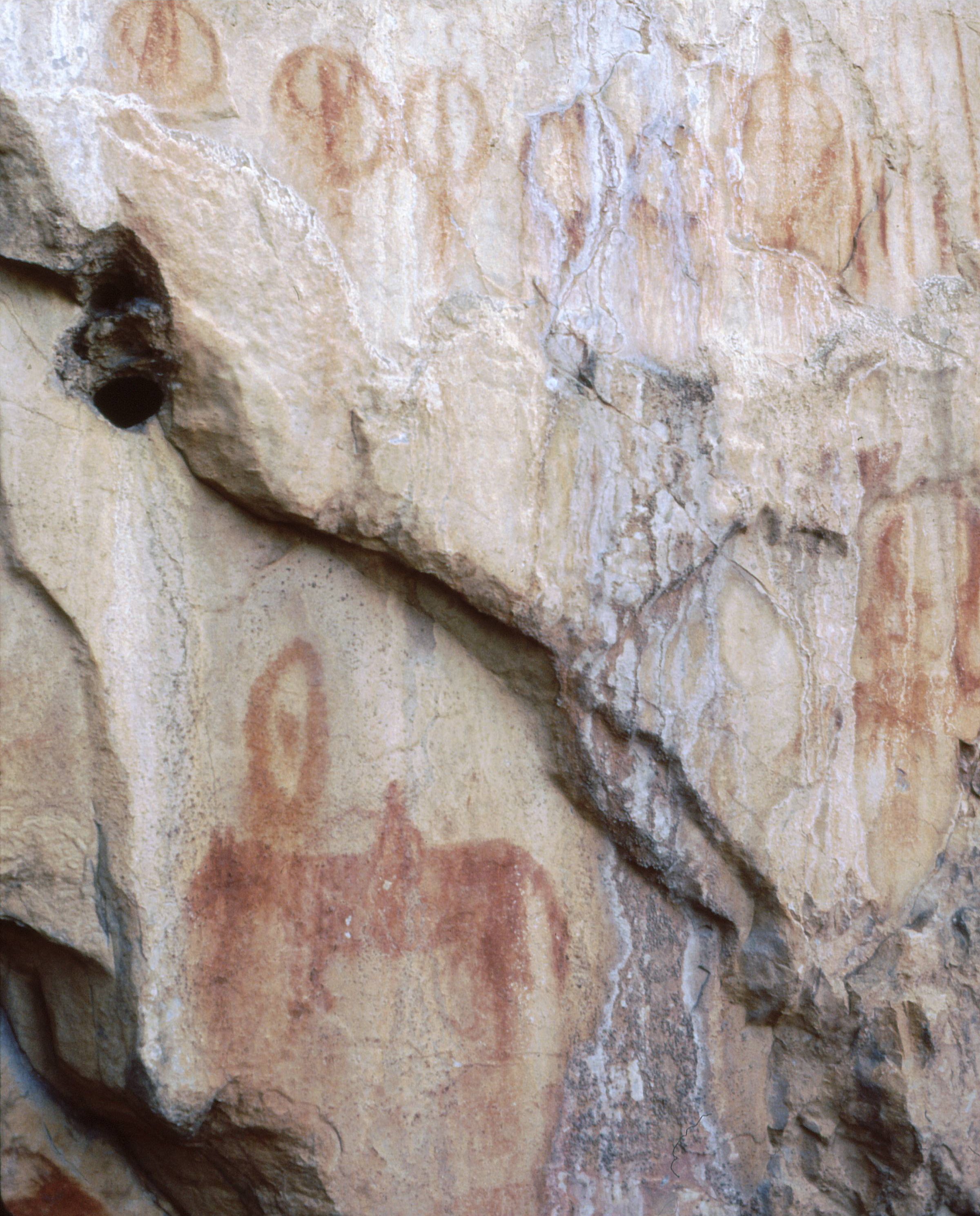
Equestrian figure, Shield Cave, Glenwood Canyon, Eagle County, Colorado. Photograph Peter Faris, 1991.

As the use of, and dependence upon, the horse became integrel to Indian societies Iconic portrayals continued to be produced in some instances (such as records of visions) but the bulk of these were supplanted by portrayals in the Narrative Mode (Faris 2001:5-6). The Narrative Mode represents the more familiar imagery that we are used to in Plains Biographic Art, in with the artist is recording a deed or event, or telling a story. This can also be seen in rock art produced in the Plains Biographic Style. I will go into this in the next part of the series.

NOTE: Some images in this posting were retrieved from the internet with a search for public domain photographs. If any of these images are not intended to be public domain, I apologize, and will happily provide the picture credits if the owner will contact me with them. For further information on these reports you should read the original reports at the sites listed below.

REFERENCES:

Ewers, John C., 1997, Plains Indian History and Culture: Essays in Continuity and Change, University of Oklahoma Press, Norman..

Faris, Peter K., 2001, Horse Petroglyphs as Indicators of Cultural Transformation, pages 1 - 13, in Southwestern Lore, Winter 2001, Vol. 67, No. 4, Colorado Archaeological Society, Denver.

Klassen, Michael A., 1998, Icon and Narrative in transition: contact-period rock art at Writing-On-Stone, Southern Alberta, Canada. In The Archaeology of Rock Art, edited by Christopher Chippindale, and Paul S. Taçon, pp. 42-72. Cambridge University Press, Cambridge.

Maurer, E. M., L. Lincoln, G. Horse Capture, D. W. Penney and Father P. J. Powell, 1992, Visions of the People: A Pictorial History of Plains Indian Life. The Minneapolis Institute of Arts.

Secoy, F. R., 1966, Changing Military Patterns on the Great Plains (17th Century through Early 19th Century), in Monographs of the American Ethnological Society No. 21. Edited by Esther S. Goldfrank, University of Washington Press, Seattle.


Saturday, March 9, 2024

HORSE PETROGLYPHS AS INDICATORS OF CULTURAL TRANSFORMATION – PART 1:

Horses at Little Bighorn (Custer) battlefield, Montana. Photograph Peter Faris.

Every once in a while, inexplicably, some of the columns disappear from RockArtBlog. Now I have no idea if this is done by blogger.com, by hackers, or poltergeists, but I have found it has happened again. A series of columns on horses in rock art that I posted years ago just isn't here anymore. Therefore I am rewriting this series of columns under the title Horse Petroglyphs as Indicators of Cultural Transformation.

Horse petroglyph, Purgatoire Canyon, Bent County, Colorado. Photograph Peter Faris.

The acquisition of horses by Native peoples led to a rapid transformation of Plains Indian life. Not only was the horse a powerful agent of change to the tribes of Plains and Plateau Indians who acquired it, it became a symbol of that change as well. The style of portrayals of horses in rock art changed over the years indicating the people’s attitude toward, and cultural assimilation of, the horse. This process is illustrated by examples of horses in rock art as well as other media used by Native American artists. (Faris 2001:1)

Horse petroglyph from Writing-on-stone Provincial Park, Canada. Photograph Peter Faris.

I first addressed this subject in my 2001 publication of Horse Petroglyphs as Indicators of Cultural Transformation, in Southwestern Lore, Winter 2001, Vol. 67, No. 4, the quarterly journal of the Colorado Archaeological Society, pages 1 - 13. It resulted from a period of research into various horse petroglyphs and pictographs with attention to the implications that details of the portrayals might carry. Starting with the fact that the presence of the horse at all allows us to make age estimates I wanted to look for other forms of information that the horse images might infer. Michael Klassen’s 1998 paper on Icon and Narrative in transition: contact-period rock art at Writing-On-Stone, Southern Alberta, Canada. In The Archaeology of Rock Art, edited by Christopher Chippindale, and Paul S. C. Taçon, pp. 42-72. Cambridge University Press, Cambridge, presented the concept of the varying Modes of Plains Biographic art and provided the framework that I had been looking for. The results, although now somewhat dated, may still prove of interest and provide some value in our thinking about contact period rock art.

Lakota Painted Shield cover, ca. 1850. Illustration from Norman Feder, American Indian Art.
Cheyenne sunshade, 1860s, collected at Fort C. F. Smith. Illustration from Feder, American Indian Art.

The acquisition of the horse by the societies of the Great Plains is reflected in the art that was produced by members of those societies. Those portrayals consisst of images painted on hides for shields, war shirts, robes, and tipis, as well as later in ledger books. Other examples may be found that were created in quillwork or beadwork on clothing and leather accessories. The most durable examples of their art are the petroglyphs and pictographs caved into cliffs and boulders, or painted in rock overhangs and caves. Horse images in rock art can be divided into two modes designated iconic and narrative (Klassen 1998:44) which represent the Plains Ceremonial and Plains Biographic traditions defined by Keyser (1977:49-55). The designation of Iconic Mode refers to images created for what appear to be spiritual purposes and Narrative Mode designates images that seem to record events and illustrate deeds. In this context mode refers to the qualities of the image that provide insight into the artist's attitude toward the subject. Mode is thus essentially independent of stylistic qualities. (Faris 2001:1) 

Horse petroglyph, Purgatoire Canyon, Bent County, Colorado. Photograph Peter Faris.

The importance of the horse can be inferred from their frequency of portrayal. Mayhall (1987:159) found that "the most frequently depicted figures were those of horsed, showing the concern of the Plains Indians with the horse, its capture, and its use", and Keyser (1987:52) states that "horses are second only to human figures as the primary components of Biographic art." Plains Indian artists reflected aesthetic concerns in their use of horse imagery, yet their representations also reflect the broader social contexts in which the images were produced. These broader contexts were also reflected in horse images produced in rock art.

Picture Canyon, Baca County, Colorado. Photograph Peter Faris.

Iconic Mode: Iconic portrayals present the subject as an essentially isolated figure, essentially as a record of the subject as a repository of spiritual power, not as part of a larger event or composition. Earlier portrayals of the horse tend to present it as an isolated figure, without accessories or specific details, and usually without a rider or other human accompaniment. This implies that the concept of the horse was seen as an "other", something with medicine power of its own that can be spiritually, if not physically, separate from the people in general and from the individual in particular. The horse is present because of that spiritual power, or the impact it separately has upon the life of the people. It was seen as a special contributor to the well-being of the society. (Faris 2001:4-5)

There were some stylistic changes in horse portrayal with the passage of time. Ewers (1939:33) noted that the hook-like hoof had a wide distribution in the early nineteenth century paintings of horses. It may be seen (painted) on hides from tribes as remote from one another as the Blackfoot and the Wichita. This wide distdribution, coupled with the fact that this feature is usually a part of a relatively crude representation of the horse, suggests that it is an old way of representing the hoof in Plains Indian painting which was later discarded in some localities where a more realistic form of hoof came into use along with a more realistic representation of the entire animal. (Faris 2001:5) This hook-like hoof can be found on early examples of horse imagery in rock art that represent the early Iconic Mode. 

I have presented this earliest form of Iconic Mode horse portrayal above. Subsequent postings will follow the development of horse portrayals in rock art imagery and will illustrate their transition from later stages of the Iconic Mode to the Narrative Mode as Plains Biographic art is elaborated and spread. The style of these portrayals suggests the stage of incorporation of the horse into the cultures of the Native Americans and gives us a basis for rough estimates of the date of the portrayal as well.


REFERENCES:

Ewers, John C., 1939, Plains Indian Painting, A Description of an Aboriginal American Art. Stanford University Press, Palo Alto.

Faris, Peter K., 2001, Horse Petroglyphs as Indicators of Cultural Transformation, pages 1 - 13, in Southwestern Lore, Winter 2001, Vol. 67, No. 4, Colorado Archaeological Society, Denver.

Keyser, James D., 1977,  Writing-On Stone: Rock Art on the Northwestern Plains. Canadian Journal of Archaeology, 1:15-80.

1987, A Lexicon for Historic Plains Indian Rock Art: Increasing Interpretive Potential. Plains Anthropologist, 32(115):43-71.

Klassen, Michael A., 1998, Icon and Narrative in Transition: contact-period rock art at Writing-On-Stone, Southern Alberta, Canada. In The Archaeology of Rock Art, edited by Christopher Chippindale, and Paul S. Taçon, pp. 42-72. Cambridge University Press, Cambridge.

Mayhall, M. P., 1987, The Kiowas. University of Oklahoma Press, Norman.