Saturday, April 18, 2020

INTERIOR FIGURE ANTHROPOMORPHS:


"The Great Gallery," Barrier Canyon
Style Anthropomorphs, Horseshoe
Canyon, Wayne County, Utah.
Photo Peter Faris, May 1992.

In early rock art of Utah, western Colorado, and to some extent southwestern Wyoming, we find the magnificent and fascinating imagery of the Barrier Canyon Style Archaic (roughly dated to at least 1500 to possibly 4000 years ago - Wikipedia) and the later Fremont people (from AD 1 to 1301 (2,000 - 700 years ago - Wikipedia). A common trait in their rock art is the one considered herein, the Interior Figure Anthropomorph. These consist of a pecked or painted figure containing within its torso one or more smaller figures of anthropomorphic or zoomorphic form. These might just represent the decoration on garments. Alternatively they may represent internalized spirits of ancestors or totem animals residing within a person - the source of their personal power. Or my favorite possibility, combining the two possibilities: it might represent spirits of ancestors or totem animals residing within a person, the source of their personal power, but painted on their garments for all to see.

There appear to be three different classes of Interior Figure images.
1. Animals within animals.
2. Animals within humans.
3. Humans within humans.
In the case of 1. animals within animals, the obvious explanation would seem to be a pregnancy or birthing motif. There are also a few examples of 3. human within human images that seem to suggest pregnancy or birthing.


Interior figure desert bighorn
sheep, Alex Patterson, 1992,
Coso Range, CA. p. 162.


Interior figure anthropomorph,
Alex Patterson, 1992, p. 162
Gobernador Basin, New Mexico.

In his 1992 Field Guide to Rock Art Symbols, Alex Patterson gave examples of petroglyphs that represent pregnancy to him. One example, from the California Coso Range, shows a bighorn sheep within a bighorn sheep, and the second example, from New Mexico's Gobernador Basin, shows a pair of anthropomorphs, apparently holding hands, one of whom has a smaller anthropomorph upside down inside its torso. He interpreted the bighorn sheep as a pregnant female, and the anthropomorph with the interior figure as a pregnant human female. (Patterson 1992: 162) I can see little reason to argue with Patterson's interpretation, although in the case of the bighorn sheep the interior figure seems to have half grown horns and I would think that the prehistoric artist would have to have known that baby sheep are born hornless (perhaps the horns are shown as clues to the identity, not meant as realism).

Having given these examples I now wish to move on to the more classic Interior Figure Anthropomorph, the aforementioned These consist of a pecked or painted human figure containing within the torso one or more smaller figures of anthropomorphic or zoomorphic form. 


"The Great Gallery," Barrier Canyon
Style Interior Figure Anthropomorph,
Horseshoe Canyon, Wayne County,UT.
Photo Don I. Campbell, 16 May 1984.


"The Great Gallery," Barrier Canyon
Style Interior Figure Anthropomorph,
Horseshoe Canyon, Wayne County,UT.
Photo Don I. Campbell, 16 May 1984.


Interior figure anthropomorph
indicated, combined Barrier
Canyon Style and Fremont panel,
Sego Canyon, UT.
Photo Peter Faris, October 8, 2016.


Close-up of interior figure
anthropomorph, combined Barrier
Canyon Style and Fremont panel,
Sego Canyon, UT.
Photo Peter Faris, October 8, 2016.

Although in some instances the occurrence of a figure within another figure may portray pregnancy, David Sucec of the Barrier Canyon Style Project is skeptical of that meaning for most occurrences with anthropomorphs. "I suspect that although animals within animals my suggest pregnancy, I don't think that is the case for figures. It is hard to say because gender is not often indicated, especially in Archaic imagery." (Sucec 2020)


Fremont Culture interior figure
anthropomorph lower center,
McConkey Ranch, Uintah County, UT.
Photo Peter Faris, September 1989.


Close-up of Fremont Culture
interior figure anthropomorph,
McConkey Ranch, Uintah County, UT.
Photo Peter Faris, September 1989.

As to the question of most of the Interior Figure anthropomorphs, I have to agree with David Sucec. I do not see any possibility that most of the images herein discussed are examples of pregnancy. The anthropomorphs with human and/or animal figures on them clearly represent something else. Sucec stated that "In any case, whatever the reading, I think that the interior figure is a significant (spirit, deity, etc.) form . . .in Archaic rock art, specific identities are mostly out of the question." (Sucec 2020)  The question I see here goes as follows; "is the interior figure actually an internalized spiritual presence (an ancestor or totemic animal of some sort) or is it decoration on an outer garment. In most examples I would argue that it is probably decoration on an outer garment. I have often written elsewhere that in a culture wherein everything is handmade, everything is unique and recognizable as belonging to a certain individual, and thus is a clue to personal identity. So, showing a unique garment in a portrayal is tantamount to producing a portrait of the individual.

Doll with painted shirt, Oglala.
Nat. Museum of the American
Indian, Internet photo.

In the Encyclopedia of American Indian Costume (1994) by Josephine Paterak we find that "Some Plateau and early Plains shirts had life forms painted on them, such as buffalo and otters." (Paterak 1994:210) And elsewhere Paterak tells us "When the Cheyenne adopted the war shirt, they wore it long (almost to the knees), painted with such symbols as thunderbirds, dragonflies, and celestial motifs." (Paterak 1994:100)

Painted war shirt with figures,
From Visions of the People,
Evan M. Maurer, Minneapolis
Institute of the Arts, 1992, p. 130.

"Shirts were often painted with important history lines or pictures. A vision or a noteworthy conquest might lead an eminent warrior to paint his shirt with  - - pictographs to provide a readable, billboard record of his war history - - . The Arapaho, Cheyenne, and Kiowas often painted celestial symbols on their war shirts." (Mails 1995:338)

Now these historic examples that I have cited certainly do not cast much direct light on Archaic practices, however I think that we can honestly look at two points of applicability. After all, even if there is not an observable material connection, the Barrier Canyon Style and Fremont Interior Figure Anthropomorphs we are considering are in the same general geographic area as the examples of painted shirts cited herein. The first point of applicability is that these historic practices may be holdovers influenced by long tradition handed down from Archaic practices. And second, that the examples cited indicate a possible philosophical openness to seeing value in this kind of garment decoration.

In addition to painted, or otherwise decorated shirts, we also know that Native Americans wore sometimes lavishly decorated robes of animal hide (buffalo, elk, deer, etc.) as garments and for warmth. Indeed, many Barrier Canyon Style anthropomorphs show complexly decorated torsos that could well represent such painted or porcupine quilled robes. In addition, a large proportion of the Fremont Culture anthropomorphs wear complex decorative accessories (pectorals, earrings, etc.) as well as having indications of specific items of clothing. 

I believe that we have to consider the possibility that Interior Figure Anthropomorphs might represent images of personages wearing their recognizable painted or porcupine quilled garments, decorated with totemic animals, illustrious ancestors, their visions, or their deeds. These will have been recognizable to other members of their band and/or clan, and thus, represent portraits of a sort. A recognizable image representing an important individual left painted or pecked into the cliff as a memorial record of a specific person.

NOTE: I wish to thank David Sucec of the BCS (Barrier Canyon Style) Project for his cooperation and sharing photographs and comments with me in the preparation of this column. His knowledge of Barrier Canyon Style rock art is unmatched. The BCS Project was formed by David Sucec (Director) and Craig Law (Photographer). Documentation has continued since 1991 and it has been a non-profit since 1992. The goal of the BCS Project is to photograph and record all Barrier Canyon Style rock art sites. For further information I recommend that you consult bcsproject.org.
Also: David Sucec does not agree with this possible interpretation of the Interior Figure Anthropomorphs. His statement to me on April 14, 2020 was "I have heard the interpretation that the formal motifs (patterns, designs) may represent clothing designs but, in Archaic, I question this interpretation (not to say that this is the case in latter imagery. I think they are symbolic (e.g., the parallel line motif as a water family symbol)." (Sucec April 14, personal communication)


Pilling figurines, nos. 1, 2 & 3
with paint traces, Wikipedia.
Internet photo, public domain.

I have not been able to locate any examples of Archaic clothing to compare with, except for sandals which do not seem to apply to this question. However, some of the famous Pilling figurines (Fremont culture) have painted decoration suggesting painted clothing, so  I submit that the question must at least remain open at this time.

REFERENCES:

Mails, Thomas E.
1995 Mystic Warriors of the Plains, Barnes and Noble Books, New York.

Paterak, Josephine
1994 Encyclopedia of American Indian Costume, W. W. Norton & Co., New York.

Patterson, Alex
1992 A Field Guide To Rock Art Symbols of the Greater Southwest, Johnson Books, Boulder.

Sucec, David
2018 I've Got You Under My Skin, The Figure in Figure Motif in Northern Colorado Plateau Rock Art, presentation to URARA, 2018, www.bcsproject.org

Sucec, David
2020 Personal Communication, April 9 and 14, 2020.

https://en.wikipedia.org/wiki/Barrier_Canyon_Style
https://en.wikipedia.org/wiki/Fremont_culture

Saturday, April 11, 2020

IMAGINARY CREATURES IN ROCK ART - THE INUIT MERCARIBOU:


Eskimo Monster Petroglyph,
the mercaribou.
Internet file.

In addition to the quasi-realistic zoomorphs found in rock art - the images of real animals found in nature - there are another category of animal petroglyphs and pictographs. These are imaginary creatures imagined from the mythology of the population or spiritual animals from their religious beliefs. Of course, one problem in studying this category of creatures is the challenge of deciding whether a particular zoomorph is an imaginary creature or just a particularly bad portrayal of a real one. One example of this is the image of the so-called "unicorn" in the cave of Lascaux in France.
On July 28, 2018, I published a column titled "The Paleolithic Unicorn - Found at Last?" in which I reported on the proposal that this image may have recorded an ice age relative of the rhinoceros, the elasmotherium. Based upon the morphology of the body of this image I personally see it as an aurochs with very poorly drawn horns, not an imaginary creature or an elasmotherium, thus my question mark in the July 28 title (see the picture).


The so-called Lascaux
unicorn, Internet picture,
Public Domain.

There are, however, a veritable zoo of actual imaginary creatures portrayed in rock art that have no equivalent in real life. But, before continuing, I need to clarify that these imaginary creatures are considered imaginary by us but were real to the believers.


Eskimo Monster Petroglyph,
the mercaribou.
Internet file.

Many years ago I ran across this image labeled Eskimo Monster Petroglyph. I know no more about it than that, not which particular people or where it came from (although I vaguely recall it was an online image from the Smithsonian Institution), but it appears to be a creature combining the front half of a caribou with the back half of a sea creature - a mercaribou. Perhaps a clue to the age of the record can be seen in the label "Eskimo" instead of the term "Inuit" suggesting that it is an old record, but source and details are lost to me.

As can be easily seen it is the body and forequarters of a caribou with the hindquarters replaced by the tail of a marine mammal such as a porpoise or small whale. Interpretations of the portrayal will probably interpret the lines over its back as representing a harpoon strike or the like.

Royal St. John's Regatta crest,
Internet file, public domain.

A modern version of this creature is found in the crest of the Royal St. John's Regatta, a boat race or racing shells first documented in 1816 (although likely held earlier, in the 18th century) on Quidi Vidi Lake at St. John's, Newfoundland. In their crest the central shield is flanked by two mercaribou supporters, shown with fish tails (brown trout) instead of marine mammal hindquarters as in the Eskimo image (this crest was developed in 1993 so it does not have nearly the antiquity of the Eskimo petroglyph). (Wikipedia)

The Eskimo mercaribou rather neatly portrays the two areas of concern of a hunting culture heavily dependent on both the caribou and sea mammals for food, and, as such perhaps represents a spiritual figure involved in food security for the population. In any case, it is a wonderfully inventive and imaginative creature.


REFERENCES:

Faris, Peter
2018 The Paleolithic Unicorn - Found at Last?, July 28, 2018, https://rockartblog.blogspot.com

Palacio-Perez, Eduardo, and Aitor Ruiz Redondo
2014 Imaginary Creatures in Palaeolithic Art: Prehistoric Dreams or Prehistorians Dreams?, pp. 259-66, Antiquity, http://antiquity.ac.uk/ant/088/ant0880259.htm

https://en.wikipedia.org/wiki/Royal_St._John%27s_Regatta

Sunday, April 5, 2020

SWEETWATER CAVE. COLORADO, A UTE INDIAN PICTOGRAPH SITE:


Sweetwater Lake, Colorado.
Photograph Jared Peltzman. 

I recently received a communication from Jared Peltzman including a number of photographs he took of rock art at Sweetwater Cave, northwest of the town of Dotsero here in Colorado.


Sweetwater Cave, Colorado.
Photograph Jared Peltzman.


Sweetwater Cave, Colorado.
Photograph Jared Peltzman.

According to Peltzman "A branch of the Dotsero Ute Trail starts on the eastern bank of the lake." (Peltzman 2020)

His photographs show predominately Ute Indian pictographs.


Ute pictograph.
Sweetwater Cave, Colorado.
Photograph Jared Peltzman.


Bighorn sheep, Ute.
Sweetwater Cave, Colorado.
Photograph Jared Peltzman.

"This was an obvious stop on the ancient Ute trail, during the seasonal rounds between the high and low country. Within this cave are protohistoric and historic era Ute pictographs, painted in charcoal, ochre, and other plant and mineral based pigments. It depicts hunters on horseback, animals such as bighorn sheep, bison, and deer, and a few abstract designs including a large yellow and red shield or "medicine wheel" symbol on one of the back walls, where light directly hits it through the entrance." (Peltzman 2020)


Ute pictograph.
Sweetwater Cave, Colorado.
Photograph Jared Peltzman.

According to Peltzman "it is about 7800-7900 feet above sea level, and is a very rich and diverse ecosystem. It is very pristine and beautiful, with tons of wildlife (including bald eagles) and old growth forests lining the limestone cliffs." (Peltzman 2020)

Back on December 16, 2011, I wrote a column titled Ochre Pigment in Pictographs in which I included photos of some Ute pictographs and also some ochre mined in a cave named Shield Cave. These illustrations from Sweetwater Cave fit closely, both in subject and in style, to some of the pictographs from Shield Cave. As the two caves are roughly 12 miles apart the pictographs could well have been made by members of the same band.

I am grateful to Jared Peltzman for sharing his photographs with us and giving me permission to reproduce them. Thank you Jared.

REFERENCE:

Peltzman, Jared
2020 Personal communication.

Wednesday, April 1, 2020

AN ANCIENT GREEK LAPTOP PICTURED IN A MARBLE RELIEF CARVING:


Carved Marble Naiskos,
Eastern Greek, circa. 100 BCE.
Internet photo, Public Domain.

It seem like almost every day we learn how some ancient civilization was surprisingly advanced. Now I have proof that the ancient Greeks had laptop computers.


Carved Marble Naiskos,
Eastern Greek, circa. 100 BCE.
Internet photo, Public Domain.

"Currently on display at the J. Paul Getty Museum in Malibu, Calif., the marble carving is titled "Grave naiskos of an enthroned woman with an attendant" and dates to about 100 B.C. The relief, which is a little over 37 inches tall, depicts a woman sitting on a cushioned throne while a servant girl holds an open box. According to the museum, the rectangular object held by the servant is "the lid of a shallow chest." (Rossela 2016)

I know that laptop computers in ancient Greece just doesn't seem possible, but, given the Antikethera Mechanism we just have to broaden our mental limits to fit the evidence.


Antikythera Mechanism, bronze,
Greek, circa 200 BCE,
Internet Photo, Public Domain.

The Antikythera Mechanism "is a complex clockwork mechanism composed of at least 30 meshing bronze gears. Detailed imaging of the mechanism suggests that it had 37 gear wheels enabling it to follow the movements of the Moon and Sun through the zodiac, to predict eclipses and even to model the irregular orbit of the Moon, where the Moon's velocity is higher in its perigee than in its apogee. This motion was studied in the 2nd century BC by astronomer Hipparchus of Rhodes, and it is speculated that he may have been consulted in the machine's construction." (Wikipedia)

It is nothing less than an analog astronomical computer, and, if the ancient Greeks could build such a machine, how hard is it to picture them experimenting with some form of laptop computer? Actually, it is really easy on April Fool's Day.

NOTE: Some images in this posting were retrieved from the internet with a search for public domain photographs. If any of these images are not intended to be public domain, I apologize, and will happily provide the picture credits if the owner will contact me with them. For further information on these reports you should read the original reports at the sites listed below.

REFERENCE:

Lorenzi, Rossela
2016 No, The Ancient Greeks Didn't Have Laptops, February 5, 2016, https://news.discovery.com/history/archaeology/no-the-ancient-greeks-didnt-have-laptops-160205.htm

https://en.wikipedia.org/wiki/antikythera_mechanism

Saturday, March 28, 2020

ANOTHER COUPLE OF BOGUS SKY MAP INTERPRETATIONS IN ROCK ART:


Rock Painting, Thompson
River indians, British Columbia,
James Teit's drawing, 1896.

I really appreciate examples of enthusiasm expressed about rock art, the problem is when enthusiasm for something is allowed to run rampant without critical oversight. In this case the example consists of two rock art panels that look totally different (one painted and the other pecked), from two totally different cultures, probably created centuries apart, and over 1,000 miles apart, yet being touted as identical sky charts. They were published in 2015 in ancientworldblog.blogspot.com, by Andis Kaulins, and while I appreciate Andis's enthusiasm I totally disagree with his conclusions and analysis.


Andis Kaulin's Sky Map
interpretation of James
Teit's drawing, 2015.

The first example was recorded by a James Teit, a pictograph panel from a boulder near Skaitok, near Spence's Bridge, British Columbia, in the territory of the Thompson River First Nation, in 1896. Teit's drawing of this panel has 28 numbered elements, each of which was explained for him by a tribal member named Waxtko, "an old woman at Spence's Bridge. In giving her explanations she stated that she had made paintings of the same character when undergoing the ceremonies of purification at the time when she reached maturity, and that she was perfectly familiar with the meanings of all the designs." (Teit 1896:227) Teit went on to get Waxtko to identify each element in the panel and published them (pages 228-30). In spite of this, Kaulins is able to overlook this first-hand account and propose his own analysis which completely contradicts Teit and Waxtko.


Anasazi Ridge panel,
near Ivins, Utah.
Internet photo, Public Domain.


Andis Kaulin's Sky Map
interpretation of Anasazi
Ridge panel, 2015.


The second example is from Southwestern Utah near Ivins. Listed as being in a location known as Anasazi Ridge, it appears to be a petroglyph panel done in a style resembling Great Basin Rock Art (Sucec 2020: personal communication). As you can see, there is absolutely no commonality between the two panels, yet Kaulins interprets them as identical sky maps (without giving any convincing motive I might add).

To me these panels represent confirmations of the old truism "to a hammer every problem looks like a nail." These might be seen as examples of the Availability Heuristic or perhaps the Representativeness Heuristic. Every interpretation being skewed toward your personal bias. If you truly believe that ancient peoples were busy littering the landscape with sky charts, then every rock art panel you see will seem to you to be interpretable as a sky chart. You will have to make your final decision for yourselves, but as for me, I see this whole thesis as bogus. We need to take every panel on its own, as an individual example influenced not only by the individual who created it, but the culture, and the age of its provenance. These so-called sky maps were shoehorned into identical interpretations by someone who wanted them to be exactly that, so that is what he saw. I do not.

NOTE: Some images in this posting were retrieved from the internet with a search for public domain photographs. If any of these images are not intended to be public domain, I apologize, and will happily provide the picture credits if the owner will contact me with them. For further information on these reports you should read the original reports at the sites listed below.

REFERENCES:

Kaulins, Andis
2015 From John J. Ensminger's Dog Law Reporter to the Skaitok Boulder, Spence's Bridge, British Columbia: Rock Art as a Sky Map of the Stars Similar to Pictographs of the Anasazi in Utah, August 27, 2015, https://ancientworldblog.blogspot.com

Sucec, David
2020 Personal Communication, http://www.bcsproject.org/

Teit, James Alexander
1896 A Rock Painting of the Thompson River Indians, British Columbia, edited from notes of the collector by Franz Boas, American Museum of Natural History, Vol. VIII, article XII, p. 227-229

Saturday, March 21, 2020

CAVE ART ACCURACY OF DETAIL IN ANIMAL DEPICTIONS IS BETTER THAN IN HISTORIC ART:


Aurochs, Lascaux Cave, France.
Internet photo, Public domain.

I have recently written about the question of identifying varieties of deer in cave paintings from their antler shapes, and also about cave artists learning to portray perspective in aurochs horns over time. Joseph Stromberg wrote a piece about cave pictures of animals in December 2012 with the title " Cavemen Were Much Better At Illustrating Animals Than Artists Today." His article was a synopsis of a much longer study by Horvath et. al. from Plosone, "Cavemen Were Better at Depicting Quadruped Walking than Modern Artists: Erroneous Walking Illustrations in the Fine Arts from Prehistory to Today," which focused on the portrayal of the gaits of the animals pictured on cave walls.


Diagram of gait of Lascaux aurochs,
From Horvath et. al. 
(I have no idea why they reversed it)

"The leg attitudes of walking quadrupeds, especially horses, are also frequently erroneously illustrated in the works of fine arts. These artistic representations of walking quadrupeds have not been systematically studied from a biomechanical point of view. To fill this gap, we have collected 1000 different fine art quadruped walking illustrations from the Internet and other sources. We analysed them to decide whether they are correct or not in respect to the relative limb positions with the assumption that the other aspects of statues, paintings, drawings and reliefs used to determine animal gait are depicted correctly. As a result we have determined the rate r of erroneous artistic quadruped walking depictions. We obtained the error rates of artistic quadruped walking illustrations for the prehistoric period, for the pre-Muybridge time (after prehistory but prior to 1887) and for the post-Muybridge period (after 1887). We have also calculated the error rate for three-dimensional (cavalry statues) and two-dimensional (paintings, graphic art, reliefs) artistic quadruped walking depictions." (Horvath et. al. 2012)


Photo study of horse gaits,
Edward Muybridge, public domain.

In this study the works of Paleolithic cave artists (particularly in Lascaux cave in France) were compared to animal portrayals by artists from the Renaissance until today. "The researchers evaluated the prehistoric artists on the basis of the landmark 1880s finding by British photographer Eadweard Maybridge that horses (and, it was later discovered, most four-legged animals) move their legs in a particular sequence as they walk. The "foot-fall formula," as it's called goes LH-LF-RH-RF, where H means 'hind,' F means 'fore,' and L and R mean 'left' and 'right,' respectively. At the time of Muybridge, this was thought to be an entirely novel discovery." (Stromberg 2012)


Horse drawings, Lascaux Cave, France.
Internet photos, Public domain.

But, as the researchers discovered, the Paleolithic artists apparently had learned it too. "Of the 39 ancient cave paintings depicting the motion of four-legged animals that were considered in the study, 21 nailed the sequence correctly, a success rate of 53.8%. Due to the number of combinations of how a four-legged animal's gait can be depicted, the researchers state that mere chance would lead to a 26.7% rate of getting it right. Cavemen artists knew what they were doing." (Stromberg 2012)


Cavallo della Sforza, designed by
Leonardo da Vinci. Statue by
Nina Akamu, 1999,
Internet photo, Public domain.

"When the researchers looked at 272 paintings and statues of four-legged animals made during modern times but before Muybridge's finding in the 1880s, such as a famous horse sketch by Leonardo da Vinci, it turned out that these more recent artists were much worse: They only got the sequence right 16.5% of the time. Remarkably, even the 686 paintings and statues studied that were made more recently than 1887, after scientists knew for sure how four-legged animals walked, still got it right just 42.1% of the time." (Stromberg 2012)


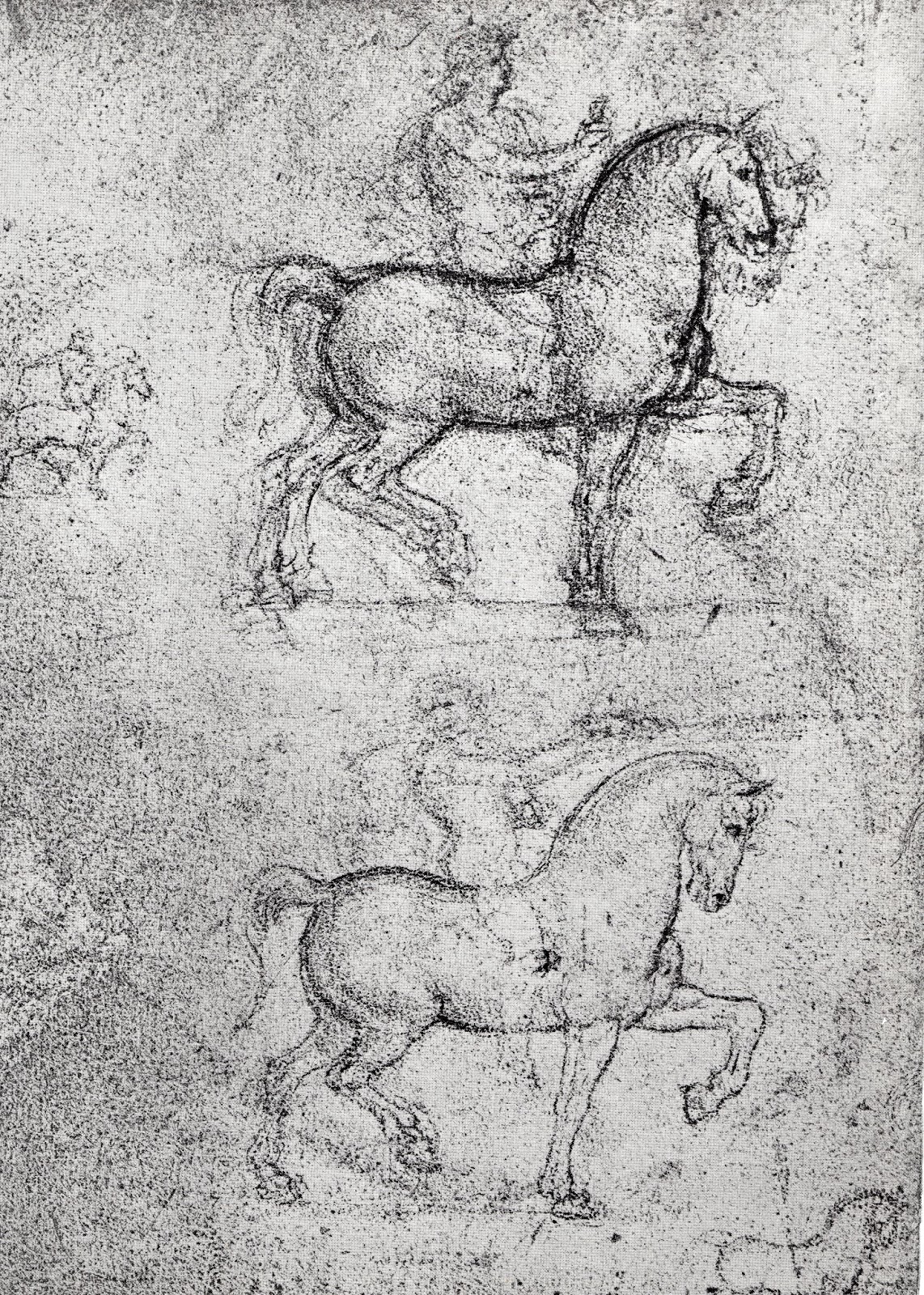
Design for Cavallo della Sforza,
Leonardo da Vinci, 1482.
Internet photo, Public domain.


Drawings of prancing horses,
Leonardo da Vinci, 1482.
Internet photo, Public domain.


Leonardo left many drawings of horses and designs for equestrian statues in his notebooks and if they were shown as walking they illustrated the horse's gait incorrectly. Since the cave paintings as well as Leonardo's sketches do not generally include a ground line, the researchers had to estimate that to complete their analysis, but, if more than one foot of the animal is raised there is no way to draw a ground line that contacts three feet. Cave artists - 53.8% to Post-Muybridge modern artists - 42.1%, and we call them "Primitive" artists.

Now it is important to again clarify that this only applies to walking gaits by these large quadrupeds. Other gaits; trot, gallop, run, leaping, etc., can have different characteristics including more than one foot off the ground at one time.

NOTE:  On August 25, 2019, I published "On Endless Motion - Depiction of Movement in Upper Coa Valley Rock Art" on RockArtBlog. This discussed a 2009 paper by L. Luis and A. P. B. Fernandes "On endless motion: depiction of movement in the Upper Palaeolithic Côa Valley rock art (Portugal)" in which they discussed animal portrayals in terms of implied animation. The walking gait that Horvath et. al. are examining was classified in this study as "Symmetrical animation."

Some images in this posting were retrieved from the internet with a search for public domain photographs. If any of these images are not intended to be public domain, I apologize, and will happily provide the picture credits if the owner will contact me with them. For further information on these reports you should read the original reports at the sites listed below.

REFERENCES:

Faris, Peter
2019 On Endless Motion - Depiction of Movement in Upper Côa Valley Rock Art, Portugal, August 25, 2019, https://rockartblog.blogspot.com/search/label/Coa%20Valley

Horvath, Gabor, Etelka Farkas, Ildiko Boncz, Miklos Blaho, and Gyorgy Kriska,
2012 Cavemen Were Better at Depicting Quadruped Walking than Modern Artists: Erroneous Walking Illustrations in the Fine Arts from Prehistory to Today, December 5, 2012, https://doi.org/10.1371/journal.pone.0049786

https://journals.plos.org/plosone/article/figure?id=10.1371/journal.pone.0049786.g003

Luis, L., & Fernandes, A. P. B.
2009 On endless motion: depiction of movement in the Upper Palaeolithic Côa Valley rock art (Portugal), In Congresso International da IFRAO 2009, Piauỉ, Brasil, IFRAO, p. 1304-1318

Stromberg, Joseph
2012 Cavemen Were Much Better At Illustrating Animals Than Artists Today, December 5, 2012, https://www.smithsonianmag.com