Saturday, January 25, 2025

CANARY ISLAND ROCK ART AND LITHOPHONES:

 
Map of the Canary Islands, by M. Hersher, Ancient World Mapping Center, University of North Carolina at Chapel Hill.

I have written about lithophones, as well as music and rock art, in previous columns (please check the cloud index at the bottom of the blog to see those articles). In this column I am going to discuss the relationship of lithophones to rock art panels on the Canary Islands.

Petroglyphs on El Hierro Island, Canary Islands, Spain. Internet image, public domain.

In a study of the rock art and lithophones of the Canary Islands, lead author Marco Merlini explained “Rock carvings are one of the most significant expressions of Guanches, the aboriginal stone age population that disembarked at the Canary archipelago during the first millennium BCE. It was formed by Paleo-Berbers with roots in the Mediterranean North African koine and with close links to the Libyan-Punic milieu.” (Merlini 2019:1) In linguistics, a koine or koine language or dialect is a standard or common dialect that has arisen as a result of the contact, mixing, and often simplification of two or more mutually intelligible varieties of the same language. (Wikipedia) Lithophones have been found all over the world and from a great many cultures, both ancient and modern. These musical rocks consist of many different minerals from limestone, lavas and granites to jade and stalactites.

Lithophones on de la Peña de Luis Cabrera. Image from Marco Merlini, 2019, Fig. 3. The white circles on a selection of handy sized rocks allow a person to play a tune.

In the Canary Islands “lithophones are located alongside petroglyphs, drawings and inscriptions incised into rocks of archaeological sites that are often astronomically significant. The sound rock sites and their use from prehistorical times until recent times are recalled by oral tradition too. In several instances, we know only the toponyms of the lithophonic sites, their location, and a generic oral memory emphasizing their special (and sometimes reputed magic) sonorous effects. The collective, although feeble, reminiscence maintained in the Canary Islands generation after generation represents the fundamental base of the investigation on the music of the stones. It includes: explication of toponyms; association of the lithophones with the ancestral meaning of rock carvings, channels, cup-marks, and other types of rock art in the surrounding areas; their relationship with engraved texts; connections of the ringing stones with legends and related traditions as places of worship, and/or of performing special rituals, and/or of supernatural interest and consecration.” (Merlini 2019:246) The authors included no actual factual evidence of astronomic significance of either petroglyphs or lithophones, but the possibility is not out of the question.

Canary Island petroglyph boulder. Image from 4-USERS.STICC.EDU.

“Canary Archipelago possesses an atout (asset) for our chances to understand the pre-historical exploitation of rock art sites for music-making. If we get to know that a natural “rock gong” produces sounds on a musical scale, then the subsequent question is to understand how it was used in the past, and even if it was actually in use. Association with musical instruments, petroglyphs, cave paintings and archaeological remains give only partial hints. The lithophones of the Canary Islands were alive in the troglodyte pre-Hispanic period and sometimes even after it. Part of the question concerning their exploitation is therefore solvable thanks to oral traditions or legends about their role in ceremonies or in creating an alert. The Canary Islanders, descendants from the Guanches, keep memory about certain stones and rock surfaces that were in use even in historical times to produce a peculiar metallic sound when being struck, and their peculiar association with rock art engravings.” (Merlini 2019)

Robert Bednarik (2010) wrote about lithophones being useful for long distance communication. “Judging from the few recorded instances it seems the utilitarian role of lithophones or rock gongs relates primarily to the communicating or carrying ability of the produced sound, and the metallic sound of effective lithophones can carry over distances of several kilometres. as mentioned above, in one report it serves to communicate with ancestors.” (Bednarik 2010:117)

Rocking lithophone, Image from tenerifeweekly.com.

The government has sponsored a study of Canary Island lithophones. “Through the work promoted by the General Directorage of Cultural Heritage in Tenerife, La Gomera and El Hierro, three types of lithophones have been documented: percussion, aerophones and rocking. The latter has only been found on the island of El Hierro and, as its name suggests, the sound is produced by rocking.” (Europa Press 2022) Someone standing on the top stone with one foot on each side can, by shifting weight, start a rocking motion on the top stone. The friction between the shifting top stone and the rock beneath causes the vibration that makes the sound. I wonder if the top stone would also ring if just struck like the other lithophones?

Canary Island petroglyph boulder. Image from 4-USERS.STICC.EDU.

“Sometimes Guanches shaped the acoustic space. In certain cases, they arranged the stone blocks to empower their sonority. For example, lithophones have been oriented to empower the sounding board effect of the surrounding space. In other cases, the natural sound of the rocks was accentuated by artificial layout and configuration of the place (Ulbrich 2003). Lithophones are located alongside petroglyphs, drawings and inscriptions incised into rocks of archaeological sites that are often astronomically significant. The sound rock sites and their use from prehistorical times until recent times are recalled by oral tradition too. In several instances, we know only the toponyms of the lithophonic sites, their location, and a generic oral memory emphasizing their special (and sometimes reputed magic) sonorous effects. The collective, although feeble, reminiscence maintained in the Canary Islands generation after generation represents the fundamental base of the investigation on the music of the stones. It includes: explication of toponyms; association of the lithophones with the ancestral meaning of rock carvings, channels, cup-marks, and other types of rock art in the surrounding areas; their relationship with engraved texts; connections of the ringing stones with legends and related traditions as places of worship, and/or of performing special rituals, and/or of supernatural interest and consecration. However, still nowadays the ancestral sonorous rocks are affected by suspicions that chains them to "pagan culture and spirituality". Lithophones have a diversity of forms, structures, geological frames and sounds, but they share a gloomy common denominator: most of them have been vandalized, plundered, but never Christianized, i.e. reformulated and taken under control by the Catholic Church and its liturgy. Contrariwise, the lithophones had a social and cultural solid place in the Canary native world.”  (Merlini 2019)

In the statement by Bednarik above (2010) he speculates that the primary utilization of lithophones is for communication. This generalization seems based on the fact that any form of sound produced and then heard is, in some sense, communication. “Most likely, their ancient function was multiple, taking advantage of their sonority and the exceptional loudness that benefit the sites in which they are embedded. Prehistoric and protohistoric manifestations firstly inserted the lithophones among the natural sites that anchored animism and attested the magic-ritual features of the sound of the volcanic stones. Music had not only a playful character, but also ceremonial in association with crops, cures, and offerings to divinities and deceased. Spanish conquerors and their chroniclers inform about rites of the ancient Canarians, mainly hinged on the request for rain. They included fasting of the entire village, processions with their livestock to certain elevated places or to the ocean, lamenting invocations by humans and even cattle and flocks (that Europeans misunderstood as yelling and barking), round dances, beating the ocean with sticks, sink palms and branches into the sea to make them weep, etc. Lithophones offered support for rhythmic or a-rhythmic sound production within the proscenium for the sacred acts aimed to gain the divinities’ pity (Ulbrich 2003).” (Merlini 2019) Again, the purpose is assumed to be communication, in this case with the divinities.

Canary Islands petroglyph boulders. Online image, public domain.

Of course tapping or pounding a boulder with another rock will eventually make marks, especially since reportedly many of the lithophonic boulders make different notes what struck in different locations. The question then should be are these marks also petroglyphs although they are a result of making a sound, not an image? Unfortunately, Merlini’s paper (2019) neglects to establish any relationship between the lithophones and certain petroglyphs, although a few may be discerned from illustrations.

NOTE: Some images in this posting were retrieved from the internet with a search for public domain photographs. If any of these images are not intended to be public domain, I apologize, and will happily provide the picture credits if the owner will contact me with them. For further information on these reports you should read the original reports at the sites listed below.

REFERENCES:

Bednarik, R. G., 2010. About lithophones. In R. Querejazu Lewis and R. G. Bednarik (eds), Mysterious cup marks: proceedings of the First International Cupule Conference, pp. 115-118, BAR International Series 2073, Archaeopress, Oxford. Accessed online 18 June 2024.

Europa Press, 2022, Documented a new typology of lithophones in El Hierro, 15 June 2022, Tenerife Weekly, https://tenerifeweekly.com. Accessed online 11 February 2024.

Merlini, Marco, 2019, The Sound of Rock Art: Canary Lithophones, https://www.academia.edu. Accessed online 17 June 2024.

Wikipedia, Koine language, en.wikipedia.org/wiki/koine_language. Accessed online 16 September 2024.

SECONDARY REFERENCE:

Ulbrich, H. J., 2003, Frequenzanalyse eines Lithophons auf Lanzarote (Kanarische Inseln), Almogaren XXXIV, Wien, p. 331-346.


Saturday, January 18, 2025

A NEWER CANDIDATE FOR THE OLDEST ROCK ART – 66,000+ YEAR-OLD HAND PRINT:


Maltravieso Cave entrance. Photograph from httpwww.turismoextremadura.com.

Every so often I get to write another column for RockArtBlog about a newly announced date breaking the record for the oldest rock art. You will find links to a number of them in the cloud index at the bottom of this blog. My column of 13 February 2021 concerned a pictographic image on the Indonesian island of Sulawesi that has been dated to at least 45,599 years ago. “Rock art researchers in Indonesia have announced the discovery of another candidate for the oldest representative rock art image, a picture of a Sulawesi Warty Pig found in a cave on the island of Sulawesi. The warty pig from Leang Tedongnge cave dates to at least 45,599 years ago, making it the earliest known representational work of art in the world (Sci-News 2021). Leang Tedongnge cave: the cave is located at the foot of a limestone karst hill. – (The) rock art panel is located on a ledge toward the rear of the cave and features at least three large figurative paintings of pigs.” (Faris 2021) Note that the researchers have limited their claim to “representative rock art” images, but not specifically defined what they intend that to mean. While we can all agree that a painting of a Warty Pig would be representative, one wonders what they would think of ancient hand prints. They cannot be called geometric or abstract so are they representative, or another special category?

Maltravieso Cave handprint (center of picture). Image from atlasobscura.com.

“Stencils and prints of the human hand are some of the earliest forms of deliberately created visual artwork preserved in the archaeological record. Maltravieso Cave houses more than 60 red hand stencils, but their precise ages have remained a mystery.” (Jackson 2024) This has now been corrected as a new paper describes the retrieval of Uranium-Thorium dates from carbonate crusts that have formed over a number of the handprints.

Photograph of Maltravieso Cave handprints above, and D-Stretch version below. Image from Standish et al., 2024, figure 6, page 6.

“U-Th dating of associated carbonate crusts has been applied to date parietal art in Maltravieso cave, Extremadura, Spain. Known for its large collection of red hand stencils (≥60), one example previously dated to >66.7 ka was taken to suggest Neandertal authorship. Here we present a more detailed U-series study of hand stencils within the cave, and place the results in the context of the chronology of these motifs worldwide. Twenty-two carbonate samples overlying pigment of hand stencils were dated from the cave’s Sala de las Pinturas and the Galería de la Serpiente. Minimum ages for the art range from the Holocene to the Middle Palaeolithic. Alongside published dating results from other sites, this demonstrates that Neandertals as well as modern humans could create these motifs.” (Standish et al. 2024:1)  These dates taken by Uranium-Thorium dating represent minimum ages because they are taken from material on top of the original hand print. This means that the actual hand prints must be even older. This minimum dating is pre-homo sapiens in this area so the hand prints must be Neanderthal.


Photograph of Maltravieso Cave handprints above, and D-Stretch version below. Image from Standish et al., 2024, figure 5, page 5.

Christopher Standish et al. (2024) re-stated this in their conclusions. “U-Th dating of carbonate crusts overlying painted rock art in Maltravieso cave indicates that the tradition of making hand stencils in Europe began prior to the Aurignacian; a conclusion that is consistent with wider chronological information for examples elsewhere. In Maltravieso, two samples from one stencil, including one sequence of four sub-samples that demonstrates closed-system behaviour of the carbonate and therefore reliability of the dates, gave minimum ages well within the range of the Middle Palaeolithic and long before the Initial Upper Palaeolithic; the oldest of these being 66.7 ka. Together with published dating evidence from sites elsewhere in the world, this suggests that Neandertals as well as modern humans created these enigmatic motifs.” (Standish et al. 2024:9) And as I said above “These dates taken by Uranium-Thorium dating represent minimum ages because they are taken from material on top of the original hand print. This means that the actual hand prints must be even older. This minimum dating is pre-homo sapiens in this area so the hand prints must be Neanderthal.”

In other words, the handprint was made considerably earlier than the arrival of modern humans in the area – thus, Neanderthal.

NOTE: Some images in this posting were retrieved from the internet with a search for public domain photographs. If any of these images are not intended to be public domain, I apologize, and will happily provide the picture credits if the owner will contact me with them. For further information on these reports you should read the original reports at the sites listed below.

REFERENCES:

Faris, Peter, 2021, A New Candidate for the Oldest Pictograph – The Sulawesi Pig, 13 February 2021. https://rockartblog.blogspot.com.

Jackson, Justin, 2024, Neanderthals were making hand stencil rock art more than 66,000 years ago, U-series dating suggests, 4 December 2024, Phys.org (online). Accessed online 4 December 2024.

Standish, Christopher D. et al., 2024, The age of hand stencils in Maltravieso cave (Extremadura, Spain) established by U-Th dating, and its implications for the early development of art, 19 November 2024, Journal of Archaeological Science: Reports 61, www.elsevier.com/locate/jasrep. Accessed online 3 December 2024.

Sunday, January 12, 2025

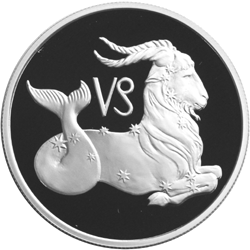
EGYPTIAN PETROGLYPH IDENTIFIED AS A CONSTELLATION – THE EL-HOSH CAPRICORN (GOAT-FISH):

The el-Hosh Capricorn petroglyph, Egypt. Image from msn.com.

A recent paper (2024) by Linda Evans and her team discuss a petroglyph with a combination of the apparent fore-quarters of a quadruped and the rear half being a fish tail, discovered at a rock art site in Upper Egypt. Their analysis led to conclusions that it represented the goat-fish symbol for the constellation Capricornus.

Close-up of the el-Hosh Capricorn petroglyph, Egypt. Image from phys.org.

“A new study by Dr. Linda Evans and her colleagues from Macquarie University, Australia, published in the Journal of Egyptian Archaeology, has recently identified what may be an Egyptian petroglyph depicting the zodiac sign Capricornus, a hybrid creature with the forequarters of a goat and the body of a fish. Zodiac symbols are completely unattested in Egyptian rock art, making this image the only known example. By studying the history of the zodiac sign, its introduction into Egypt, and its use, the researchers were able to determine the likely period of and possible reason for its creation.” (Oster 2024)

Enhanced image of the el-Hosh Capricorn petroglyph, Egypt. Image from phys.org.

Drawing of the petroglyph. Image from Evans et al., 2024.

At some point in prehistory hominins came up with a number of ideas concerning the night sky. One was that the stars made patterns that they believed that they could identify with beings, creatures, or implements. With this belief established it is not a long way to the assumption that these stellar creatures or beings influence life here on earth. “The ‘goat-fish’, a mythical creature incorporating the horned forequarters of a goat and the torso of a large fish, has long been known from the ancient Near East and Mediterranean regions. It first appeared in Mesopotamia, where it later represented the zodiac sign of Capricornus. There is also sporadic evidence of the sign in Egypt, beginning in the Graeco-Roman Period. Here we present an unusual petroglyph at the rock art site of el-Hosh in Upper Egypt (70 km north of Aswan, on the west bank of the Nile), which depicts a hybrid mammal and fish figure that we propose may also represent Capricornus.” (Evans et al. 2024) And, once we have accepted the proposition that what happens in the heavens influences life here on earth, then it is only natural to look for patterns or movements to try to analyze what they portend, and to develop rites and rituals to try to influence these portents.

The Sumerian god Enki. Illustration from mythology.net

Sandee Oster (2024) described the development of Capricornus as a symbol for a constellation. “The first occurrence of something resembling Capricornus occurred in Mesopotamia, where the Sumerian got Enki and the Akkadian equivalent Ea were usually depicted as bearded men with horned caps, wearing gowns. At the shoulders of these gowns, water streams filled with fish would spout. This later evolved into the first recognizable depiction of a goat-fish hybrid at the feet of the god on cylinder seals dating to ca. 2112-2004 BCE.” (Oster 2024) This cylinder seal was not illustrated.

Babylonian Capricorn on a boundary stone. (redrawn from Hinke 1907 fig. 36) Evans et al., 2024.

Greek Capricorn (sea goat). Illustration from Wikipedia.

According to Oster, the Greeks got the idea of the zodiac from the early Mesopotamian civilizations. “From Mesopotamia, the zodiacs and their associations eventually spread to Greece (5th century BCE) and from there to Rome (1st and 2nd century CE). By at least 300 BCE, zodiacs were known to Egypt and their earliest depictions could be found on zodiac ceilings in Egyptian Ptolemaic temples such as the temple Montu and Rattawy at Armant (c. 44-30 BCE). Later these zodiac symbols, including Capricornus, occurred in Roman-era temple ceilings, coffin lids, tombs, and even coins.” (Oster 2024)

Interestingly, I can find no mention of a capricornus or goat-fish hybrid therianthrope  anywhere online as being part of the Egyptian zodiac. Capricorn is one of the constellations in the Greek zodiac suggesting the possibility that this would have been introduced into Egypt by the Greeks or Romans

Later Egyptian (Greek period) Capricorn from the hypostyle hall, temple of Hathor, Dendera (traced from photograph), Evans et al. 2024.

Later Egyptian (Greek period) Capricorn from the Osiris chapel, temple of Hathor, Dendera (traced from photograph), Evans et al., 2024.

Linda Evans et al. (2024) came to the same conclusions when discussing the potential date of the petroglyph in question. “If a connection with Capricornus is accepted, a Graeco-Roman date for the petroglyph’s production may be possible. Furthermore, the creature’s outstretched tail possibly indicates a period earlier than the second century CE, when the Roman loop-tailed version of Capricornus became popular. It should be noted, however, that it has been proposed that Egyptian knowledge of the zodiac could have come directly from Mesopotamia, rather than via Hellenistic Greece.” (Evans et al. 2024)

Evans et al. discuss whether the possible origin of the symbol could be Mesopotamian or Graeco-Roman and note that if it was Mesopotamian the goat-fish could predate the Graeco-Roman Period. Their conclusion, however, is that it is more likely to have been created between the first century BCE and the end of the first century CE. One major clue that led them to this conclusion is the presence of Greek script carved on a nearby petroglyph panel.

NOTE: Some images in this posting were retrieved from the internet with a search for public domain photographs. If any of these images are not intended to be public domain, I apologize, and will happily provide the picture credits if the owner will contact me with them. For further information on these reports you should read the original reports at the sites listed below.

REFERENCES:

Evans, Linda, Fred Hardtke, and Wouter Claes, 2024, The Goat-Fish of El-Hosh: An Unusual Petroglyph Identified, The Journal of Egyptian Archaeology Online. Accessed online 20 November 2024.

Oster, Sandee, 2024, First ever goat-fish petroglyph reveals Egyptian  understanding of zodiac symbols, 19 November 2024, Phys.org. Accessed online 20 November 2024.

Saturday, January 4, 2025

2024 C.R.A.P. AWARD - PETROGLYPHS OF INDIAN TEMPLES AND STUPAS IDENTIFIED AS VIMANAS (PREHISTORIC FLYING MACHINES):

Hypothetical vertical section of a vimana. Drawing by T. K. Ellappa, Bangalore, India. 12 February 1923. Image from Wikipedia. Note - the little T-shapes in the blue cups at the top are the propellers which will provide the lift to make it fly.

It is time again for the RockArtBlog coveted annual C. R. A. P. (Certifiable Rock Art Prevarication) award, and do I have a really deserving recipient this year? Not to a particular person, but for an area of fringie writing using twisted and convoluted beliefs to turn petroglyphs of stone temples into flying machines. I am talking about the hokum surrounding modern “theorists” about Vimanas, the flying machines from the annals of ancient writings in India, and modern websites pushing these beliefs.

One characteristic of many of these websites is that they are anonymous, it is difficult to find an actual person’s name to associate with it. The writing is credited to “the editorial team,” although some sites originating in India have the author’s name on them.

Hypothetical illustration of a vimana. Illustration from theancientzen.com.

Another characteristic is exaggerated fringie hype about things like interstellar visitors, antigravity, and technologically advanced civilizations back during the Paleolithic or Neolithic ages. I want to reiterate that I am not attacking writings from India about vimanas any more than I would attack the bible because Ezekial saw the wheel. I am giving the C.R.A.P. award to the people who tell us that petroglyphs of stupas and Indian temples are actually the flying machines. You are entitled to believe whatever you want, but, as I have said before, RockArtBlog has a responsibility to call out outright lies when found.

I am going to pass on a number of the most egregious claims and statements to illustrate how ridiculous this can get, but I am not going to identify any particular internet site. If you want to find this garbage for yourself you can go online and do so, but I will not give them the publicity.

Indian warriors observing a vimana. Internet image, public domain.

“According to Ancient Indian history – one of the most extensive on the planet – their ancient sacred texts called the ‘Vedas’ speak of incredible flying ships that visited our planet over 6000 years ago. Throughout history, many common myths and legends mention incredible flying machines and how ancient people traveled great distances through the air: the flying carpets of ancient Arabia, Ezekiel’s wheel, Solomons’ ability to travel from one place to another and the magical chariots or ‘vimana’ mentioned in ancient Indian and Chinese texts.”

An Indian temple. Internet image, public domain.

According to another writer “The propulsion of vimanas is perhaps the most mysterious aspect, with some texts hinting at mercury vortex engines and other forms of advanced technology. For instance, references to a mercury-driven energy source can be found in the Sanskrit texts, which some interpret as evidence of sophisticated engineering concepts. The descriptions suggest a combination of mechanical and potentially non-mechanical propulsion methods that go beyond the simple combustion processes familiar to modern aircraft engineering.” This so-called mercury vortex engine is related to a plasma or ion drive sometimes used on modern satellites and spacecraft.

 “The Vaimānika Śāstra, an early 20th-century Sanskrit text on aerospace technology, makes a claim that the vimānas mentioned in ancient Sanskrit epics were advanced aerodynamic flying vehicles, similar to a rocket capable of interplanetary flight as backed up by the ancient alien theory. Revealed in 1952 by G. R. Josye, the texts contain 3000 shlokas in 8 chapters which Shastry claimed were psychically delivered to him by the ancient Hindu sage Bharadvaja. The propulsion of the Vimanas According to Kanjilal (1985) is by a “Mercury Vortex Engines”, a concept similar to electric propulsion. However, many people argue that a far greater, more accessible and ‘free’ power source was available to the ancient Vimana craft. It is noteworthy to mention that a couple of years ago, Chinese researchers discovered ancient Sanskrit documents in Lhasa, Tibet, dating back thousands of years. The ancient texts were sent to the University of Chandigarh for translation. The results were shocking. According to Dr. Ruth Reyna the translated texts, allegedly are ‘blueprints’ for the construction of interstellar spaceships.”

“According to the translated documents, the propulsion system designed for the spaceships was based on antigravitational technology, and based on a system analogous to that of ‘laghima,’ the unknown power of the ego that exists in man’s physiological makeup, ‘a centrifugal force strong enough to counteract all gravitational pull.Interestingly, according to Hindu Yogis, the mysterious ‘laghima’ force is what enables people to levitate. Dr. Reyna explained that ‘on board, these machines which were called ‘Astras,’ the builders of the crafts could have sent a detachment of men to any planet. The manuscripts, however, do not mention how interplanetary communication was achieved, but they do mention a trip from the Earth to the Moon, though it is unclear whether the trip was just planned or actually carried out.’”

Petroglyph of an Indian temple or shrine misidentified as a vimana. Internet image, public domain.

Wikipedia’s analysis gives some insight to the subject. “The Vaimānika Śāstra was first committed to writing between 1918 and 1923, and nobody is claiming that it came from some mysterious antique manuscript. The fact is, there are no manuscripts of this text before 1918, and nobody is claiming that there are. So on one level, this is not a hoax. You just have to buy into the assumption that 'channeling' works. ... there is no exposition of the theory of aviation (let alone antigravity). In plain terms, the VS. never directly explains how Vimanas get up in the air. The text is top-heavy with long lists of often bizarre ingredients used to construct various subsystems. ... There is nothing here which Jules Verne couldn't have dreamed up, no mention of exotic elements or advanced construction techniques. The 1923 technical illustration based on the text ... are absurdly un-aerodynamic. They look like brutalist wedding cakes, with minarets, huge ornithopter wings and dinky propellers”

Petroglyph of an Indian temples or shrines misidentified as vimanas. Internet image, public domain.

So, what we actually have, is real petroglyphs of temples or stupas of India and southeastern Asia being purposely misidentified as phony ancient steampunk antigravity flying machines, and for this reason RockArtBlog awards the 2025 C.R.A.P. (Certifiable Rock Art Prevarication) award to the unnamed purveyors of this garbage.

NOTE: Some images in this posting were retrieved from the internet with a search for public domain photographs. If any of these images are not intended to be public domain, I apologize, and will happily provide the picture credits if the owner will contact me with them. 


Saturday, December 21, 2024

HAPPY HOLIDAYS - 2024.


A VERY MERRY CHRISTMAS 2024

From RockArtBlog   

Image created by DALL-E-2.


 Have a very Merry Christmas,

A Happy New Year's Eve, 

and all the best in 2025.

Saturday, December 14, 2024

A NEW ROCK ART DISCOVERY IN THE NORTHERN SINAI – AND ANOTHER DONKEY:

Petroglyph cave at Wadi al-Zulma, North Sinai, Egypt. Image provided by Egyptian Ministry of Antiquities.

A recent discovery in the northern Sinai Peninsula of Egypt contains rock art of a style unknown throughout the rest of the Sinai. “An archaeological mission from the Tourism and Antiquities Ministry discovered an ancient cave featuring a unique and diverse collection of carvings at Wadi al-Zulma, North Sinai, the ministry announced on Saturday. The head of ministry’s Egyptian Antiquities Sector, Ayman Ashmawy, explained that the archaeological cave is located at the beginning of one of Wadi al-Zulma’s tributaries within a mountainous area of limestone that is difficult to reach – about 90 kilometers southeast of the city of al-Qantara Sharq, and 60 kilometers east of the Suez Canal.” (Al-Youm 2020) Although the team members are calling this a discovery, once again I have to point out that its location and rock art had been known by many other people.

Donkey petroglyph,
Wadi al-Zulma, North Sinai, Egypt. Image provided by Egyptian Ministry of Antiquities.
Donkey. Internet image, public domain.

This donkey image, at Wadi al Zulma in the northern Sinai desert of Egypt, is located roughly 450 miles from the donkey at Karahan Tepe in Turkey that I wrote about previously, and it is undated as of yet. This suggests that we need to be very careful about any implications of cultural similarities, although these themes are very similar.

“The age of the cave drawings is still unknown, but Aymen Ashmawi, head of the ancient Egyptian antiquities sector at the Ministry of Antiquities explained the scenes carved inside the cave are completely different from those found in South Sinai, having a special artistic style that resembles raised relief in execution.” (Bartek 2020)

Petroglyph at Wadi al-Zulma, North Sinai, Egypt. Image provided by Egyptian Ministry of Antiquities. This appears to be an older image of a quadruped, with a newer ostrich carved over it appropriating the front leg.

Superimposed petroglyphs at Wadi al-Zulma, North Sinai, Egypt. Image provided by Egyptian Ministry of Antiquities.

I will go farther than Ashmawi’s statement that they “resemble raised relief in execution.” I would classify many of these petroglyphs as low reliefs. The lines are fairly deeply carved, and then the inner edge of the line is rounded off to provide a more natural looking portrayal.

Ibex petroglyph at Wadi al-Zulma, North Sinai, Egypt. Image provided by Egyptian Ministry of Antiquities.

“The Director General of the North Sinai Antiquities and head of the archaeological mission working on the cave Hisham Hussein explained that most of the carvings are within the cave’s inner walls and depict animals such as donkeys, camels, deer, mule and mountain goats.” (Al-Youm 2020) The relatively deep carving, unlike simple scratching, suggests that the artists were there for relatively long periods of time. This allowed them to take more care in accuracy and appearance.

Quadruped petroglyph at Wadi al-Zulma, North Sinai, Egypt. Image provided by Egyptian Ministry of Antiquities.

“According to a Tourism and Antiquities Ministry statement, the cave is 15 meters deep and 20 meters high. The ceiling is made of limestone, and the cave is filled with large amounts of animal waste. Ashes found inside the cave indicate it’s continuous usage by locals as shelter, where they might have stayed with their flocks during rain or winter.” (Al-Youm 2020) Given ashes indicating continuous usage for shelter there must also be fragments of charcoal that may be radiocarbon dated, although the animal waste suggests that the stratigraphy of much of the deposit has probably been stirred up by the hoofs of livestock. Perhaps careful excavation next to a wall would yield better stratification of deposits.

Given that the team stated that the cave had been used by locals with their flocks, they certainly cannot claim credit as the first discoverers of the rock art.

NOTE: Some images in this posting were retrieved from the internet with a search for public domain photographs. If any of these images are not intended to be public domain, I apologize, and will happily provide the picture credits if the owner will contact me with them. For further information on these reports you should read the original reports at the sites listed below.

REFERENCES:

Al-Masry Al-Youm, 2020, Photos: Archaeologists uncover ancient cave in North Sinai, 26 April 2020, Egypt Independent, https:www.egyptindependent.com. Accessed online 27 November 2024.

Bartek, Jan, 2020, Remarkable Ancient Animal Engravings Discovered In Unknown Cave In Sinai, 1 May 2020, https://www.ancientpages.com. Accessed online 27 November 2024.


Saturday, December 7, 2024

A DONKEY IMAGE FOUND AT KARAHAN TEPE:

Excavation at Karahan Tepe, Turkey. Image from easternturkeytour.org.

A charming petroglyph of a running wild donkey has been discovered at the site of Karahan Tepe. "Karahan Tepe is an archaeological site in (the) Sanliurfa Province in Turkey. The site is close to Gobekli Tepe and archaeologists have also uncovered T-shaped stelae there and believe that the sites are related. According to Daily Sabah, 'The excavations have uncovered 250 obelisks featuring animal figurines' as of 2020. Additiionally, the site may be the earliest known human village, predating the construction of Gobekli Tepe, dating to between 9,000 - 11,000 BC." (Wikipedia) The "Daily Sabah" is a Turkish newspaper that is published in the English language. Other publications give the total number of obelisks as 266. Given the stylistic resemblances between Gobekli Tepe and Karahan Tepe this relationship would seem to be obvious.

Running wild donkey figure, Karahan Tepe, Turkey. Image from  anatolianarchaeologyy.net.

“The ongoing excavations at Karahan Tepe, led by Professor Dr. Necmi Karul, have revealed a remarkable new find: a depiction of a running wild donkey carved onto a stone laid on the floor of an ancient structure. This depiction, approximately 20 centimeters in length, is notable not only for its size but also for its dynamic portrayal, which reflects the artistic skills of Neolithic people. ‘The donkey figure found is a figure about 20 centimeters long, placed right next to the grinding stone,’ Dr. Karul told the correspondent. Rather than its dimensions, the fact that it is mobile and depicted in proportion to the stone on which it is carved is again an indication of the skill of the artists of this period.” (Radley 2024) I would not call a paving stone set in the floor mobile, but this is merely a detail.

Running wild donkey figure, Karahan Tepe, Turkey. Image from  anatolianarchaeologyy.net.

“The period of domestication and distribution of the donkey (Equus asinus) in Turkey occurred around 5000 to 7000 years ago. They are thought to have their origins from the Nubian (Equus africanus africanus) and Somalian (E. a. somaliensis) ass, both of which are subspecies of the African wild ass. The African wild ass lived in the deserts and other arid areas of the Horn of Africa, in Eritrea, Ethiopia and Somalia. However, it formerly had a wider range that extended into Egypt.” (Milligan 2024) This timeline does not seem to fit the estimated dates of occupation for Karahan Tepe (ca. 11,000 – 9,000 BCE) unless it was occupied for two thousand years or more, which is not backed up by estimations for the occupation dates there.

Running wild donkey figure, Karahan Tepe, Turkey. Image from  anatolianarchaeologyy.net.

 “According to Dr. Karul, the wild donkey motif is the first of its kind discovered at Karahan Tepe, adding a new dimension to our understanding of animal iconography and the relationship between humans and their environment during this perion. He explained that the animals depicted in the iconography of the era generally fall into two categories, those with an erie, imposing presence, often seen on obelisks, and more commonly consumed animals, such as birds, gazelles, and wild donkeys. The latter were animals that people lived with, consumed, and were surrounded by, compared to the more fearsome creatures. ‘The depiction of the wild donkey in motion, carved onto the base of a grinding stone is particularly notable as it is the first time we have encountered such a moving wild donkey motif.’” (Radley 2024)

Closeup of running wild donkey figure, Karahan Tepe, Turkey. Image from anatolianarchaeologyy.net.

Once again we seem to have discrepancy because pictures very clearly show the stone that the donkey is carved onto next to a grinding stone, not on its base. These discrepancies of date and location are mere details (errors of reporting) however, compared to the very early and wonderful depiction itself which we can confirm in the photographs.

NOTE: It is even possible that the small, factual discrepancies between reports could have resulted from differing interpretations during translation from an original report in Turkish.

REFERENCES:

Milligan, Mark, 2024, Donkey depiction discovered at Karahan Tepe, 22 August 2024, Heritage Daily online, https://www.heritagedaily.com. Accessed online 17 October 2024.

Radley, Dario, 2024, Running wild donkey figure discovered at Karahantepe, 31 August 2024, Archaeology magazine online, https://archaeologymag.com. Accessed online 17 October 2024.

Wikipedia, Karahan Tepe, https://en.wikipedia.org/wiki/Karahan_Tepe. Accessed online 23 October 2024.